Quantcast

President Trump Announces General Terms of Trade Deal with Vietnam

The details within the trade agreement are unique.  President Donald Trump has announced a trade agreement between the USA and Vietnam.  Interestingly Vietnam will face a 20% tariff rate (baseline) and a 40% tariff rate on transnational shipping.
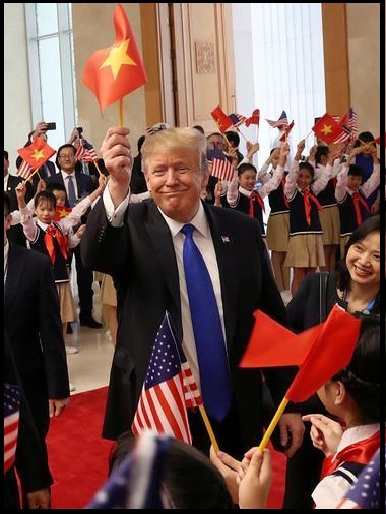
The 40% transnational shipping rate is an interesting approach toward the process of China shipping goods to ASEAN countries to avoid direct tariffs. A transnational shipping tariff is a practical, pragmatic and honest way for the USA and Vietnam to face each other economically without masks and pretenses.

PRESIDENT TRUMP“It is my Great Honor to announce that I have just made a Trade Deal with the Socialist Republic of Vietnam after speaking with To Lam, the Highly Respected General Secretary of the Communist Party of Vietnam. It will be a Great Deal of Cooperation between our two Countries. The Terms are that Vietnam will pay the United States a 20% Tariff on any and all goods sent into our Territory, and a 40% Tariff on any Transshipping. In return, Vietnam will do something that they have never done before, give the United States of America TOTAL ACCESS to their Markets for Trade. In other words, they will “OPEN THEIR MARKET TO THE UNITED STATES,” meaning that, we will be able to sell our product into Vietnam at ZERO Tariff. It is my opinion that the SUV or, as it is sometimes referred to, Large Engine Vehicle, which does so well in the United States, will be a wonderful addition to the various product lines within Vietnam. Dealing with General Secretary To Lam, which I did personally, was an absolute pleasure. Thank you for your attention to this matter!”

CTH was in the manufacturing base of Vietnam in January; their factories are loaded with component parts from China used to produce finished goods sent to the USA (and globally).  President Trump previously told Vietnam they need to reduce their reliance on Chinese imported component goods, but China has spent billions in advanced positioning and contracts, influencing Vietnam.

Vietnam is a very poor country, and their population cannot afford to purchase the products they manufacture.  They do not have a domestic consumption base. They are reliant on exports to more wealthy nations to keep their manufacturing base afloat.  Practically, it is easy to have sympathy for Vietnam due to their economic dependence on both China (for imported raw materials) and the USA (for exported finished goods).
(more…)

Watch Longshoremen Union – A Predictable Democrat Strategy to Weaponize Absent China Goods in Coming Months

[AUTHORS NOTE: Having attended the ASEAN conference to make contacts, after a brief respite at home I spent the past several weeks traveling Southeast Asia to research the likely impact from Trump’s tariff and global trade reset. Visits included manufacturing and distribution facilities in the Philippines, Malaysia, Thailand, Vietnam, Cambodia, Sri Lanka and South Korea. What I will share with you in the next few months is an overview from direct first-hand discussions, contrast against the MSM financial media outline.]

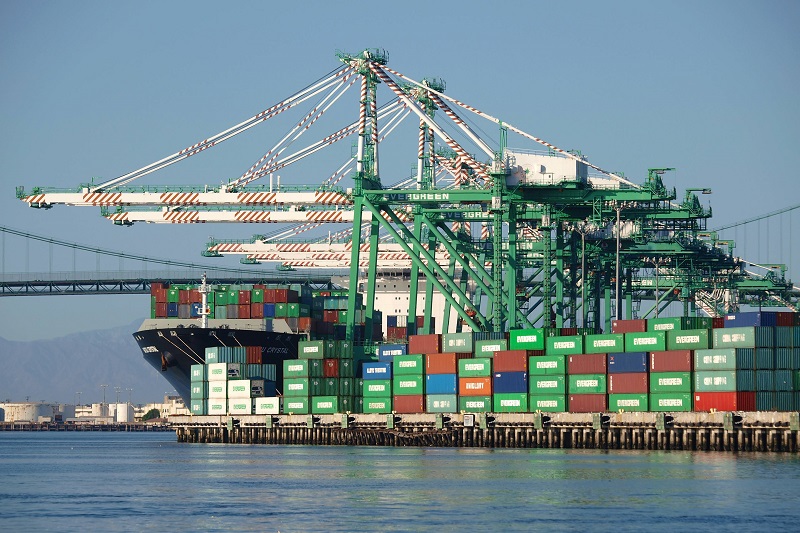
The predictable doomsday Wall Street Journal narrative includes a forecast for a massive drop in exports from China as shipping conglomerates begin to outline a drop in trans-pacific sea cargo and container carriers.

What I would say to concerned Americans is to filter out the political narrative and remind yourself of the expanded footprint throughout SE Asia that Beijing has already established.  Chinese companies, many of them subsidized by the CCP, are pre-positioned to begin transnational shipping. I have witnessed it first-hand.  However, here’s the WSJ narrative as it begins.

WSJ – The number of ships sailing from China to the U.S. laden with clothes, electronics, furniture and other goods is plunging, as an accelerating number of cargoes are canceled.

The scrapped sailings come after the Trump administration ratcheted up tariffs on China while giving a three-month reprieve on punitive levies for much of the rest of the world.

At the Port of Los Angeles, one of America’s biggest gateways for imports from China, executive director Gene Seroka told port officials Thursday that he expects a 35% drop in import volumes in two weeks “as essentially all shipments out of China for major retailers and manufacturers has ceased.”

(more…)

Chairman Xi Jinping Pressures Hedge Position in Vietnam with Increased Trade Agreements

Three months ago, I was in Vietnam reviewing just how expansive the positioning of Chinese investment was in the concurrent communist nation.  The short version is Beijing’s footprint in Vietnam was already huge.

As an outcome of the 2018 tariffs against China, which coincided with a President Trump visit to southeast Asia, multiple companies shifted manufacturing operations from China to Vietnam.

Beijing saw the move and slowly increased their own strategic footprint.

In the subsequent years as COVID-19 took attention from all other matters, and with Trump removed from the equation in 2020, China increased the scale of their investment and the outcomes in 2025 are very visible.

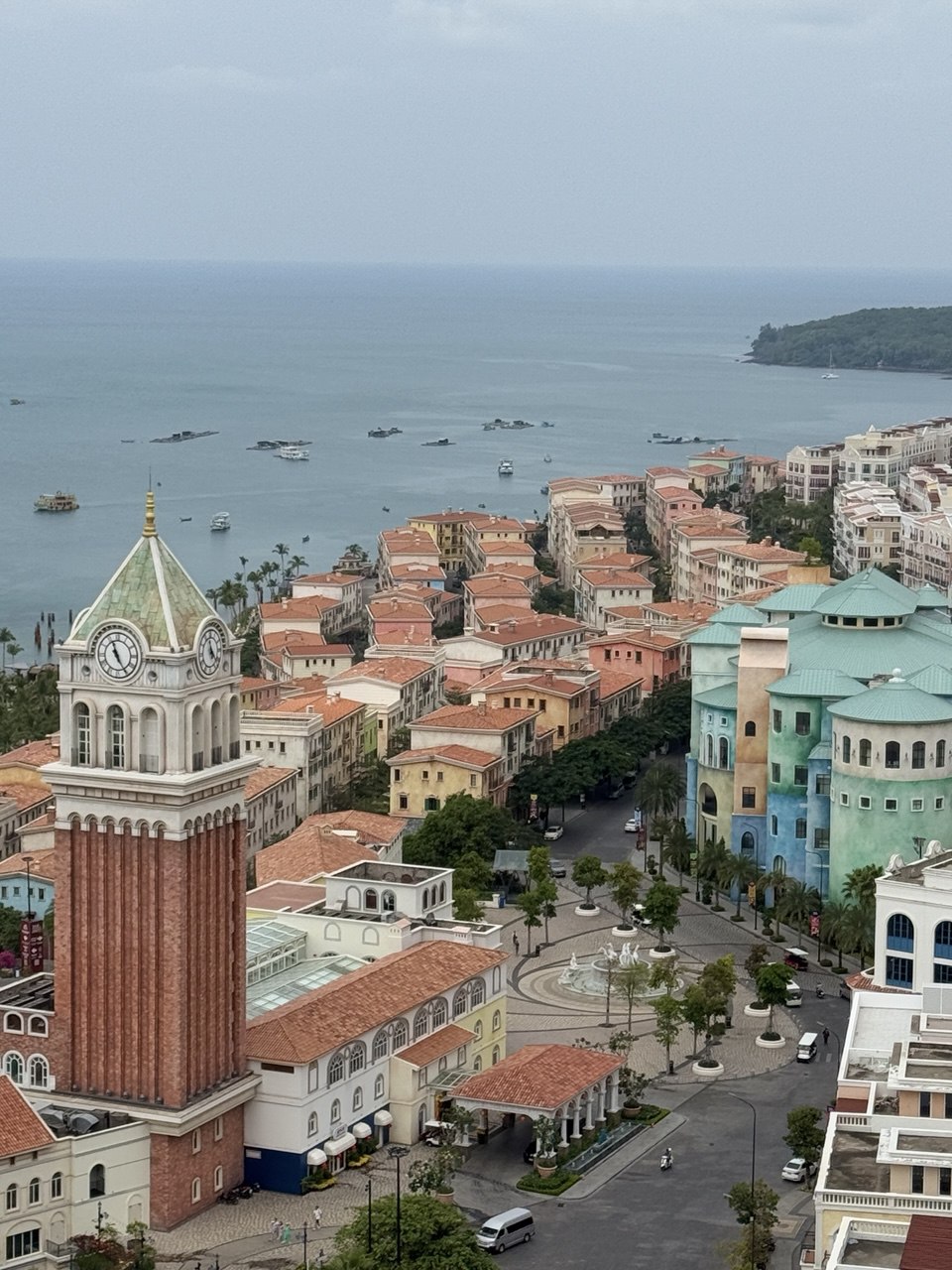
China even built this massive Disney type village in Phu Quõc (it’s nearly empty).

The people who live in Vietnam do not have money, they are a very poor nation.  The baseline poverty level, in combination with their communist regime politics, essentially eliminates their consumer power to purchase western goods and makes trade agreements between the U.S and Vietnam somewhat moot.  However, as a proxy manufacturing nation Vietnam is a valuable resource for China.

Essentially what can be seen in Vietnam is how Beijing spends money there for influence.  The U.S footprint is negligible in comparison to the visible influence of China.

Chinese Chairman Xi Jinping is in Vietnam right now making trade deals with the allied communist government.  At this point with so much Beijing influence money already in place, China can request very strategic terms.

(more…)

The First of Many – Vietnam Negotiates Zero Tariff Policy

On March 27th, CTH shared the following: “Wealthy nations will attempt to maintain exports against President Trump tariffs by subsidizing their industries. Corporations have deeper pockets, and the politicians are used to the bribes, we call it “lobbying.” Therefore, the government responds by subsidizing the corporations [ie. the WEF business model].

How does the politics of opposition surface?  …”Canada will subsidize their export industries, Germany will subsidize their auto industry, the EU will provide subsidies to their manufacturing powerhouses, and China will once again start subsidizing their manufacturing industry. Each of these nations will in turn, eventually, devalue their currency.

However, poorer nations will be faster to lower import tariffs on USA goods because they have lower lobbying (bribe) income from corporations to govt. That’s what we should expect to see.” [LINK]

With the tariffs now triggered, it begins exactly as anticipated:

[SOURCE]

The economics of the thing is now colliding with the politics and the ideology, of the thing.  Globalists are being confronted.  The proverbial West will cleave according to their financial self-interest.

The World Economic Forum (Build Back Better) model no longer views the USA as an ally.  The MAGAnomic “Big Ugly” is underway.  Countries will thrash and gnash their teeth; then surge in opposition, fail, then attempt to refoot and realign, then surge again and fail again.

And so it will go…

(more…)

Vietnam Proactively Responds to April 2nd “Independence Day” Tariffs, by Lowering Import Tariff Regime

Wealthy nations will attempt to maintain exports against President Trump tariffs by subsidizing their industries. Corporations have deeper pockets, and the politicians are used to the bribes, we call it “lobbying.” Therefore, the government responds by subsidizing the corporations [ie. the WEF business model].

Canada will subsidize their export industries, Germany will subsidize their auto industry, the EU will provide subsidies to their manufacturing powerhouses, and China will once again start subsidizing their manufacturing industry. Each of these nations will in turn devalue their currency.

However, poorer nations will be faster to lower import tariffs on USA goods because they have lower lobbying (bribe) income from corporations to govt. That’s what we should expect to see.

VIETNAM – Vietnam said it plans to cut import duties on a range of goods including cars, liquified natural gas and agricultural products.

[…] The announcement on the finance ministry’s website late Tuesday came less than two weeks after Prime Minister Pham Minh Chinh said the country was reviewing duties in order to encourage increased imports from the United States.

Vietnam represents the United States’s third-highest trade deficit, behind China and Mexico.

According to the finance ministry statement, import duties on some cars will be cut by half and the tax rate for liquified natural gas will drop from five percent to just two percent. Duties will also be cut for a number of other products including frozen chicken thighs, almonds, sweet cherries, raisins and wood. (more)

During President Trump’s first term, many companies proactively moved manufacturing operations from China to other nations in Southeast Asia.  Vietnam was a big benefactor of the manufacturing shift.  It is smart for them to respond to the reciprocal tariffs coming April 2nd by lowering their tariff rate.

(more…)

Gordon Chang on 2019 G20: "The Meeting of All Meetings"….

Author of ‘The Coming Collapse of China’, Gordon Chang, appears on Fox Business to discuss the mounting U.S. trade tensions with China, the fallout from the protests against Carrie Lam in Hong Kong, and the announced visit by Xi to North Korea.
Chang also sees the visit by China’s Chairman Xi Jinping to North Korea as a strategic and purposeful moment for Beijing; an attempt to find footing against the overwhelming economic punishment being delivered by U.S. President Donald Trump.


(more…)

More Tech Manufacturing Companies Exit China – Nintendo and Sharp Plan Exits…

Against the intense leverage being applied by President Trump, last week Beijing doubled-down and threatened punishment against any company that would leave China and begin manufacturing elsewhere.
The totalitarian response was predictable and expected.  However, also predictable was the corporate response to the threats.
As we shared:  “China is counting on prior western investment being so significant that a corporation will be reluctant to withdraw. However, in this outlook Beijing seriously underestimates the free market because communist controlled China doesn’t understand the action of a inherently free market.
The first loss is the best loss. If walking away from an investment provides more financial security and stability than attempting to retain a grip on a tenuous position – corporations will walk away.” (more)
Now today – “Nintendo Moves Some Switch Production Out of China”:

TOKYO— Nintendo Co. is shifting some production of its Switch videogame console to Southeast Asia from China to limit the impact of possible U.S. tariffs on Chinese-made electronics, said people who work on Nintendo’s supply chain.
It is another example of manufacturers adapting to the tariff threat. Taiwan’s Foxconn Technology Group said Tuesday that it was ready to move assembly of Apple Inc.’s iPhones out of China if necessary, and Japan’s Sharp Corp. , which is controlled by Foxconn, said last week that it planned to move production of personal computers to Taiwan or Vietnam.

(more…)

Investment Exodus / Shifting Supply Chains – China Walks into Trump's "Golden Ticket" Trap…

President Trump is executing one of the most brilliant geopolitical economic resets in the history of global trade. It really is stunningly remarkable how President Trump has controlled the entire landscape. The consequential phase now begins.
It is fascinating how the financial pundits didn’t see this coming. Perhaps one of the best indicators of where things are today comes from this quote within the South China Post:

“The Administration’s Section 301 tariffs and China’s retaliatory tariffs will now further disrupt – or even break – many thousands of supply chains in both countries.”
[Nelson Dong, a senior partner at Dorsey & Whitney]


The quote by Nelson Dong is stated *as if* shifting/breaking supply chains is a flaw in the approach. It’s not. Exactly the opposite is true; this is a feature of the strategic reset.  A specific and purposeful feature designed by President Trump.
What Dong is predicting is the deconstruction of “one-belt, one-road”.
(more…)

President Trump Surprises Troops During Stop at Elmendorf AFB, Alaska…

En route to the White House from Hanoi, Vietnam, Air-Force One stopped in Alaska for refueling.  During the stopover President Trump delivered remarks to U.S. troops stationed at Elmendorf AFB.
President Trump was greeted by Alaska Governor Mike Dunleavy who accompanied the president to a base hangar where U.S. troops were gathered.


(more…)

*UPDATE* Talks End With No Deal – Second Half / Day Two: Trump-Kim Summit, Hanoi Vietnam…

Update from the White House:
Statement from the Press Secretary Regarding the Hanoi Summit:

“President Donald J. Trump of the United States and Chairman Kim Jong Un of the State Affairs Commission of the Democratic People’s Republic of Korea had very good and constructive meetings in Hanoi, Vietnam, on February 27-28, 2019. The two leaders discussed various ways to advance denuclearization and economic driven concepts. No agreement was reached at this time, but their respective teams look forward to meeting in the future.”

As the Summit concludes with no agreement, President Trump will be holding a press conference shortly.
(more…)