Quantcast

Happening Quietly – Mexico Freezes Bank Accounts of Indicted Sinaloa Members and Collaborates with U.S. Intelligence Hub in Juarez

It is always a good idea to make note of things, put them into referenceable context, and then later tell the full story from background details that will surprise everyone else.

Two significant events have taken place within the last few days against the backdrop of Sinaloa government officials beginning to turn themselves in to U.S. federal authorities.

The first event is the Mexican government freezing the bank accounts and financial assets of those who have been named in the U.S. federal indictment.  Mexican President Claudia Sheinbaum says the seizures are out of her control, merely a process that takes place, yet the motives for her defensive protestations are more than a little transparent.

MEXICO – On May 18, President Claudia Sheinbaum confirmed that Mexico’s Financial Intelligence Unit froze the accounts of Sinaloa Governor Rubén Rocha Moya, his children, and senior aides. The action followed U.S. federal charges alleging they aided the Sinaloa Cartel through drug trafficking, weapons possession, and accepting multimillion-dollar bribes. Sheinbaum stressed the freeze was a technical, preventive step triggered by U.S. arrest warrants, not a domestic criminal finding.

The freezes come amid heightened U.S.-Mexico tensions over cartel corruption claims that have already strained security cooperation and political trust. Washington has broadened its anti-cartel strategy to target politicians accused of enabling organized crime, while Mexico remains sensitive to perceived foreign interference. Analysts warn the case could further erode institutional trust and complicate cross-border collaboration on security, trade, and migration.  (more)

The second event happened very quietly.

(more…)

U.S. Dept of War Suspends Permanent Joint Board on Defense with Canada

Remarkably, many news articles are citing confusion in trying to understand why U.S. Undersecretary of War, Elbridge Colby, announced the suspension of U.S. participation in the Permanent Joint Board on Defense with Canada. However, the announcement comes immediately after his meeting with U.S. ambassador to Canada, Pete Hoekstra, at the Pentagon and the comment,we’re working closely to ensure every NATO partner, including Canada, reaches the Hague Summit’s 3.5% GDP defense spending target, a vital investment for North American and Arctic defense.”

The issue, as outlined by Undersecretary Colby, centers around Prime Minister Mark Carney’s recent statements in antagonism toward the U.S., a public announcement that Canada would not be purchasing U.S. military equipment and the biggest issue of all, that Canada is not living up to the NATO defense spending agreements.

It was in December of 2024, immediately after the November election where Donald Trump won, when then Prime Minister Justin Trudeau flew to Mar-a-Lago for dinner with President Trump and told him there’s no way that Canada could meet their NATO obligations.  Canada had relied on the USA to provide all national defense and was 16th in defense spending at 1.1% of GDP. {CITATION}

The issue of NATO compliance was part of a larger discussion around trade imbalances, non-tariff barriers, intellectual property conflicts and legislative hurdles that Canada used as a crutch to retain economic benefit without reciprocity.

Trudeau was arguing that Canada could not change all the points of conflict, drop their non-tariff barriers, comply with NATO demands and simultaneously get into total alignment with the USMCA trade compact (CUSMA to Canada), because their climate policies did not support or match the heavy industrial processing capabilities of both the United States and Mexico.

This triggered President Trump to respond with the 51st state, notation.  Essentially, if you cannot be a partner with equal capabilities; and if you need to retain structural economic dependency; then Canada should just become a 51st state of the USA.

Since that time, things went downhill quickly.  Instead of trying to find ways to eliminate points of conflict, Prime Minister Mark Carney began a campaign of aggressive anti-Trump narrative distribution in order to maximize domestic political benefits.

President Trump then turned toward Mexico and began working with USTR Jamieson Greer to construct what is essentially a bilateral trade agreement between the U.S. and Mexico.

The administration began ignoring Canada, planning instead to announce the upcoming dissolution of the USMCA and then force Canada to negotiate a bilateral.  A jilted Canada then began doubling and tripling down on the anti-Trumpism, with Carney saying the era of trade between the USA and Canada is over.

Carney then reached out to Europe and China for trade replacement value and began making announcements about no longer purchasing U.S. manufactured fighter jets and military hardware.

U.S. Undersecretary of War, Elbridge Colby meets with U.S. Ambassador to Canada, Pete Hoekstra, and obviously the NATO stuff is just the straw that ended the U.S. participation in the Permanent Joint Board on Defense with Canada.  Not a complicated timeline to figure out.

(more…)

Did President Trump Say That in His Outside Voice…

During a White House event to celebrate Moms, President Trump introduced several prominent Moms in and out of government and celebrated their achievements.  As he often does, President Trump also delivered unscripted remarks to accompany the themed script of the event.

I’m highlighting one specific impromptu, off the cuff remark that deserves a little attention.  I’m certain somebody around Mexican President Claudia Sheinbaum will also bring it to her attention.  The moment happens at 35:51 of the video below. Watch (prompted):

…”drugs coming in by sea are down 97% and now we’ve started the land force, which is much easier.  And you’ll hear some complaints from some people in, like, representatives from Mexico and other places, but if they’re not going to do the job, we’re going to do the job and they understand that.”… 

Last week the DOJ indicted Mexican Governor Ruben Rocha Moya along with nine current and former Mexican officials for participating “in a corrupt and violent drug trafficking conspiracy with the Cartel to import massive amounts of fentanyl, heroin, cocaine, and methamphetamine from Mexico into the United States.” {GO DEEP}

Keep in mind, while the U.S. media are not reporting on the issue; however, every ground report indicates that indicted Sinaloa Cartel Governor Ruben Rocha is being protected in an undisclosed location by the Mexican National Guard.  Essentially, the Mexican military is protecting an indicted drug trafficker and politician in Mexico, while avoiding extradition to the U.S. That’s further context for President Trump’s remarks.

MEXICO CITY, May 6 (Reuters) – A U.S. indictment announced last week accusing several Mexican politicians, including the governor of Sinaloa, of having drug cartel ties is triggering a rift in the ruling Morena party as factions jostle ​over how to respond, posing a significant challenge for President Claudia Sheinbaum.

Publicly, Sheinbaum has denounced U.S. interference and said the evidence Mexico has seen so ‌far is not sufficient to arrest and extradite the 10 current and former Mexican officials accused by the U.S. Department of Justice of colluding with the Sinaloa Cartel to traffic drugs into the United States.

(more…)

Canadian Prime Minister is Playing a Very Dangerous Game

Anyone who has ever dealt with a toxic narcissist understands the psychology behind their manipulative language, words and intents.  What Canadian Prime Minister Mark Carney is doing here is very dangerous, particularly for the Canadian people.

After a year of increased provocative language intended to confront President Trump for U.S. nationalist policy changes on economics, trade and security, Prime Minister Carney travelled to Europe where he again delivered strong remarks saying that Europe is now the center of the “rules based international order,” the western government control mechanisms that have maintained economic and security relationships for the past one-hundred years.

Essentially, Carney, after saying the USA was no longer a reliable or obedient partner, emphasized the opposition to state nationalism must come from a collective decision to retain the old geopolitical structures.  President Trump must be opposed, and Europe -according to Carney- represents the assembly that will not permit state government nationalism (sovereignty) to replace their long-constructed globalist systems.

Today, Prime Minister Carney faced questions about those remarks. I don’t want to influence the audience, but with the context in mind, watch and listen closely to his response. [Prompted]

[NOTE: The question comes from the Toronto Star, the only ‘conservative’ media outlet permitted under the rules of the Canadian regime to ask questions.  All other outlets who might challenge the government viewpoints are strictly controlled and not permitted audience.]

Notice how Carney divides the world of opposition to President Trump, indicating the 5-Eyes nations of Canada, Great Britain, Australia, New Zealand are in opposition to Trump and in alignment with the old control mechanisms.  Adding to this grouping, Carney pulls in the entire European continent and boldly proclaims his position as lead diplomat and representative for their effort against the USA.

This is a very dangerous game that Prime Minister Carney is choosing to play here.  This is the behavior of a person who is toxically narcissistic and prepared to claim victim status as soon as his target hits back.  Carney has carefully and purposefully deceived his domestic audience, and things are about to get very ugly.

(more…)

Indicted Mexican Governor Ruben Rocha Moya Steps Aside During Investigation

Last week the DOJ indicted Mexican Governor Ruben Rocha Moya along with nine current and former Mexican officials for participating “in a corrupt and violent drug trafficking conspiracy with the Cartel to import massive amounts of fentanyl, heroin, cocaine, and methamphetamine from Mexico into the United States.” {GO DEEP} This has put Mexican Governor Claudia Sheinbaum in a precarious position.

Both President Sheinbaum and Governor Rocha Moya are from the Moreno political party in Mexico.  Following the indictment, Sheinbaum said she would not assist in any extradition effort of Governor Rocha and denounced the U.S. indictment; however, she said the federal government within Mexico would launch their own independent investigation.

Mexican President Claudia Sheinbaum denounced the U.S. prosecution of a sitting Mexican governor and other officials on drug trafficking charges as “political,” and said Thursday that Mexico would not comply with Washington’s demands that the accused be arrested and extradited to the United States.

“We are not permitting a foreign government to say what is the future of Mexico,” said a defiant Sheinbaum, who repeatedly assailed U.S. “meddling” in the incendiary case. (more)

There is considerable support within Mexico to eliminate the corrupt activity of the Cartels who many admit are in control of large sectors of their regional and federal government.  As a consequence, many Mexicans support the position of President Trump and the Dept of Justice in prosecuting Governor Rocha Moya if there is evidence to support it.

Today, Sinaloa Governor Rocha Moya said he would step down from his position as the federal investigation of the claims get underway.

(more…)

Canadian Prime Minister Claims All Nations Tell Him Privately They Regret Making Trade Deals with President Trump

Today is not a good day for the Canadian trade team.

It started with Quebec’s new Premier in Washington DC meeting with U.S. Trade Representative Jamieson Greer {citation} in order to talk trade {SEE TIMELINE} saying on Twitter, “Quebec wants a renewal of the [USMCA] to ensure a stable and predictable framework for our economic exchanges.” However, Mrs. Christine Fréchette (pictured left) then bragged about having strategic discussions with the U.S. Chamber of Commerce. {citation}

For those who might not know, the U.S. Chamber of Commerce is a parasitic Wall Street and K-Street lobbying organization that has been locked out of trade influence since President Trump took office in 2017.  It was the U.S. CoC who sold out our manufacturing base, paid-off prior administrations and wrote the actual trade language in almost every trade deal that destroyed U.S. manufacturing.

The U.S. Chamber of Commerce is a lobbying organization who focuses on the bottom-line profits of U.S. multinational corporations, and they don’t care what happens domestically to American jobs, American manufacturing and American wages.  The CoC is the organization who created the rust belt and destroyed our manufacturing base under the guise of promoting a “service driven economy.”

If Canada want’s a successful trade negotiation with the USA, the Chamber of Commerce is the last organization they should be strategizing with.

Then comes Prime Minister Mark Carney who not only steps on a rake, but he also publicly insults President Trump and the entire U.S. trade team by saying every country in the world privately tells him they regret making a trade agreement with President Trump. ¹{Citation at 28:10 of Video}

I’m going to post the entire video of Prime Minister Mark Carney discussing USMCA (Canada calls CUSMA) trade negotiations because the tone deafness of it is off the charts. That includes the Canadian Prime Minister saying that Section 232 national security reviews are a violation of the U.S-Canada trade agreement.  Carney believes any independent U.S. trade position that negates trade with any Canadian sector is a violation of trade rules, yet he is afraid to sue over Sec 232 because he doesn’t want to discover the flaw in his mindset.

(more…)

Canada Pushes Closer to the FAFO Threshold as Prime Minister Carney Says USA Will Not Dictate Terms of USMCA Renegotiations

Following direct remarks from both Commerce Secretary Howard Lutnick and U.S. Trade Representative Jamieson Greer, a triggered Canadian Prime Minister Mark Carney says the U.S. will not be permitted to dictate terms of the USMCA renegotiation, now scheduled for formal talks with Mexico only beginning May 25th.

According to the Canadian leadership they do not need the United States in order to maintain their economy.  The unfortunate people of Canada are very close to finding out exactly what that level of arrogance delivers.

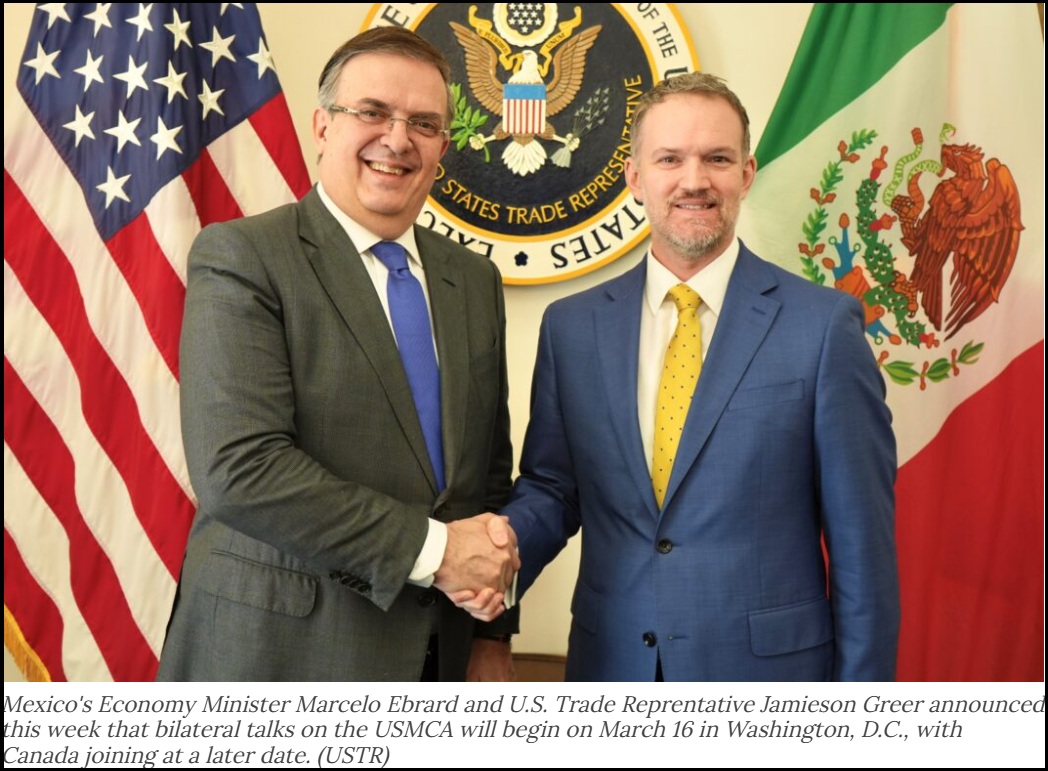
USTR Jamieson Greer was just in Mexico meeting with Mexican President Claudia Sheinbaum and the Mexican trade delegation. “Mexico’s economy minister Marcelo Ebrard ​said on Monday that ‌formal negotiations to review the U.S.-Mexico-Canada trade pact, known ​as the USMCA, ​are due to begin the ⁠week of May ​25.”

“Tomorrow and this afternoon we ​will hear the U.S. side’s views. Once that is done, ​we will move ​on to the next phase, which ‌is ⁠formal negotiations. We expect formal negotiations to begin the week of May ​25,” ​Ebrard ⁠said following a meeting with U.S. Trade ​Representative Jamieson Greer.” {source}

Meanwhile Canadian Prime Minister Mark Carney continues talking to his domestic audience about fighting Donald Trump and refusing to accept any terms that do not meet his current pontifications: “It’s not a case that the United States dictates the terms. We have a negotiation, we can come to a mutually successful outcome – it will take some time,” he continued.

In Washington, Trade Representative Jamieson Greer said unless Canada engaged in talks about broadening the so-called rules of origin that allow goods to enter the United States tariff-free, Washington might have to impose other border controls. {source}

As the rhetoric continues increasing, the possibility of a full block against the import of Canadian goods increases.

It is worth remembering, the recent Supreme Court decision that overturned the IEEPA tariffs also reinforced the unilateral power of the U.S. President to regulate any/all trade with any foreign country including a full block of trade if designated.  Canada is positioned to be the first nation to discover the expressed power of the U.S. President as affirmed by the United States Supreme Court.

One of the reasons why Canadians are oblivious to the potential collapse of their economy is because U.S. media reports are blocked from Canadian social media sites.  One of the infringements within the USMCA is the Canadian Law Bill [C-18, the Online News Act] that blocks information to Canadian citizens that is not supported by the Canadian government.

The people of Canada are stuck inside an Orwellian government constructed echo-chamber unable to hear opposing viewpoints.  They simply have no idea what is heading in their direction.  Which is incredibly ironic considering how much Mark Carney rails against Russian President Vladimir Putin, yet Canada has more restrictions on information than Russia.  Think about it. The need for control is a reaction to fear.

(more…)

Canada Does NOT Want to Open USMCA (CUSMA) for Renegotiations

Consider the amount of money involved in the trilateral USMCA trade agreement.  It’s not just about trade and commerce between the USA, Canada and Mexico; the totality of the equation is derived from all of the third-party nations who trade into the North American trade bloc.  There are tens-of-trillions at stake.

As we have outlined for several years the trilateral trade agreement has several material flaws.  With the U.S. economy as the primary consumption economy, both Mexico and Canada derive significant benefits within the USMCA.  Additionally, both Canada and Mexico leverage their unique positions to gain economic benefit from third parties who want to use either country as a backdoor into the U.S. market.

President Trump has long wanted to eliminate the trilateral trade deal in favor of two more controllable bilateral deals, one with Mexico and one with Canada.  In large measure this approach is specifically to end the exploitation by third parties.  President Trump also noted in his discussions with Canadian Prime Minister Mark Carney that the primary function of the USMCA was to eliminate NAFTA.

Keep this in mind.  The purpose of the USMCA was to eliminate NAFTA.

Now we enter the phase of the USMCA where President Trump can exit the agreement or modify the core foundation of the agreement.

For the past fourteen months Mexico has been modifying their trade and economic policy in anticipation of a USMCA change. However, for the past fourteen months Canada has been combative against President Trump, stoking anger toward Trump, and the government of Canada has been openly proclaiming their intention to economically and politically fight and defeat President Trump.

Again, remember the scale of the money involved here.  Additionally, Canada doesn’t have an organic economy if they cannot exploit their market access.  If Trump restricts third party exploitation, Canada loses massive amounts of money.  This is the baseline for Canada’s reluctance to open up the USMCA for renegotiation; they cannot lose their third-party loophole or else they are really in a bad place.

This sets the stage for trillion-dollar interests to frame opposition not only toward President Trump, but also toward any of his economic team who are in alignment with the renegotiation of the USMCA.  Commerce Secretary Howard Lutnick is chief among those targets along with U.S. Trade Representative Jamieson Greer.

Commerce Secretary Howard Lutnick outlines the issue in the first part of this recent discussion. WATCH:

(more…)

U.S. Trade Representative Jamieson Greer Discusses USMCA Review and Two Different “Protocols”

During an appearance at the Hudson Institute, U.S. Trade Representative Jamieson Greer is asked to summarize the administration’s approach to upcoming USMCA (CUSMA) renegotiations.

USTR Greer emphasized the focus is on outcomes in review of the USMCA, not focusing on the previous trade structure itself. The results carry more weight than reviewing what was intended.  On June 1st Greer anticipates telling congress that the U.S. intends withdrawal, pending unilateral negotiations with both Canada and Mexico to resolve conflict.

Greer describes two different protocols within any negotiation to deal with the structural differences between both Canada and Mexico.  Those differences include a completely different import/export profile with each country, different sectors of goods, difference in the wage rates within each country and a structural difference in the way each country is establishing their own, independent free trade agreements with other third-party countries.  These baselines form the reason to tell congress of the dissolution, and on July 1st inform both Canada and Mexico about it.

In the interim, the points of conflict are currently being negotiated with Mexico toward resolution.  The same negotiation is expected later between the U.S. and Canada; however, it sounds like that engagement will take place after congress is informed of the points of conflict.  WATCH (prompted):

.

(more…)

Chinese EV Manufacturers BYD and Gely Accelerate Plans for Canadian Dealerships

Put this in the USMCA (CUSMA) elimination/negotiation file.  Europe has already been the visible example of what happens when you open your market to low price Chinese EVs.

With the recent agreement by Canadian Prime Minister Mark Carney, Chinese auto manufacturers are now rushing to establish the dealerships, before the Beijing-Canada deal becomes an issue in the USMCA negotiation.

China is NOT going into Canada because they foresee a great market of Snow Mexicans purchasing their low price EVs.  They are going into Canada as a proactive measure to establish a North American footprint with an eye toward the USA.

(VIA MSM) – BYD and Chery are accelerating plans to establish a dealership network in Canada after the country introduced a quota allowing tens of thousands of Chinese-made EVs to enter at reduced tariffs. The rollout will begin in Toronto before expanding to other major cities, with BYD targeting about 20 dealerships in its first year. This marks a significant new front in North American EV competition, as Chinese automakers seek growth outside the U.S., where prohibitive tariffs keep them out.

(more…)