Quantcast

German Automaker Volkswagen Agrees to 100,000 Job Cuts and Streamlined Model Production

Volkswagen is a case study in self-destruction as a result of EU ‘climate’ politics and German auto company decision-making.  The decision to chase climate policy created European legislation that set quotas, limits and fines on automakers who did not shift to electric vehicles.  German automakers then chose to purchase carbon credits from China, who then use those sales to further discount exported EVs into the German market.

Simultaneously, Volkswagen opened up operation in China allowing their technology to be captured by Chinese auto makers who turned around and duplicated the technology at a much lower price.  Once the manufacturing was at full speed, China stopped purchasing Volkswagen autos.

The partly state-owned German automaker Volkswagen announced today [SEE HERE] their survival as a company now requires the elimination of 100,000 jobs in Germany with the closure of plants in Emden, Zwickau, Hanover and the Audi site in Neckarsulm.  Volkswagen will not be the last German company to suffer this fate as Mercedes is now 20% owned by Chinese EV company Geely.

The German auto workers do not have a choice. They no longer have a solid consumer base for their vehicles, and China continues to export low price EVs into the European market.  Every euro in tariffs against Beijing is offset by the euros the auto companies spend purchasing Chinese carbon credits to avoid European fines. They cannot get out of the spiral.

GERMANY – The car company Volkswagen has approved controversial plans to shed 100,000 jobs in a battle for survival as it faces fierce competition from Chinese rivals.

(more…)

Zelenskyy Heading to Canada

Sometimes you can get so far into the rabbit hole that you just need to transmit the signal and let others figure it out.  So, here’s some sketchy stuff that doesn’t make sense, but then again…

You might remember my mentioning that something was odd after Zelenskyy visited London in early June and then a series of unexplained events started happening.  Well, maybe what I am about to share connects to that, or maybe it’s just my imagination.

It all started when I took the announcement of De Nederlandsche Bank transferring gold from Canada and the USA, then overlaid their reported timeline with other stuff I have been tracking.  According to the announcement:Between March and August 2026, approximately 86 tonnes of gold were transferred from the combined total of approximately 313 tonnes held in the United States and Canada to London.” {source}

Now, mind you the official public notice just happened yesterday, Sept 2nd.

Between March and August 2026?  A very interesting set of dates, considering the Dutch claim their move was due to uncertainty with the USA and Canada economic and trade positions, yet those economic/trade positions were not tenuous until very late August.

Why move gold out of Canada in March?

Here’s the interesting timing.  Do you remember when Canada reported a 0.0% GDP growth in the first quarter, and technically that put them into a defined recession.  That narrative was not in the interests of Mark Carney who was -perhaps not coincidentally- repeatedly visiting the EU after taking up the leadership position for the “new, middle-power world order.”  In fact, the Canadian GDP result was widely reported and a sore spot for Carney’s govt.

(more…)

USMCA Termination Announcement Looming?

For those waiting patiently for the USMCA termination announcement, this is a potential indication and/or signal of pendency.

When President Trump and USTR Jamieson Greer send the official notification, a six-month countdown clock begins running.  As of right now there are no official statements that indicate the likely triggering, it’s a guess.  However, there are datapoints aligning in that direction.

[SOURCE]

No one outside our assembly has contemplated the termination of the USMCA (CUSMA) or what would occur in the aftermath; however, the Bank of Canada has gamed out the financial consequences, briefly in their forward guidance. The ramifications are significant, perhaps more significant than any other global trade announcement.

[…] “it more likely that a new shock or a combination of shocks could cause several vulnerabilities to crystalize at once. If this were to happen, these vulnerabilities could interact and reinforce each other

A cascading series of events could cause a sharp loss of investor confidence and lead to a spike in demand for liquidity or rapid asset sales. Funding markets could come under pressure, and stress could spread more broadly.” [SOURCE]

I suggest we keep a close eye on all U.S-Mexico discussions, as well as geopolitical leverage points that might surface in the U.S-Mexico relationship. My best guess is that once the U.S. and Mexico come to renewed terms on the ‘USMCA’ as a potential bilateral free trade agreement, that will be the moment when the planets are aligned for the termination notification.

(more…)

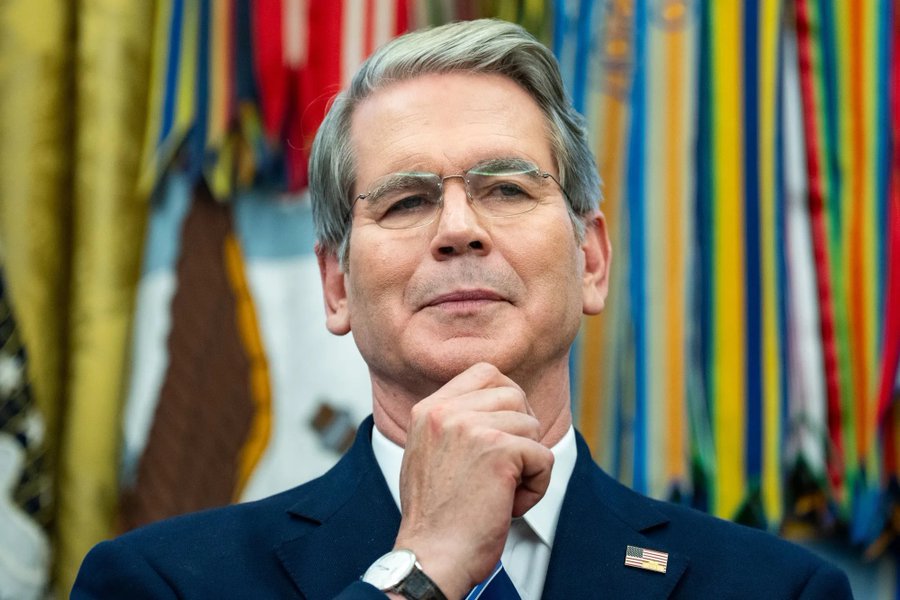
Treasury Secretary Scott Bessent Holds a Fireside Chat During G20 Finance Assembly

On the sidelines of the Asheville, North Carolina, G20 meeting of global finance ministers, U.S. Treasury Secretary Scott Bessent holds a fireside chat to discuss current geopolitical events and economic conditions.

.

(more…)

Barbara Boyd Discusses G20 Outlooks – Abundance Mindset ‘Build More Pies’ (Bessent) -vs- Scarcity Mindset ‘Divide Up Pie’ (Europe)

What Barbara Boyd describes in this video about the ideological differences in the G20 reminds me of the long battles around MAGAnomics.

One mindset is based on despair, the scarcity mentality, and says there is a limited amount of economic pie, and it must be divided by government to ensure equitable distribution (Europe/Obama).  The other mindset is based on faith, an abundance mentality, and says we should create, innovate, build and expand economic activity to create more pies (MAGA/Trump).

In this Wednesday update, Barbara Boyd previews the G20 meeting in Asheville, framing it as a clash between an agenda centered on physical economic growth—advanced by Treasury Secretary Scott Bessent—and what she calls the G20/EU’s long-running Malthusian, “green” framework that followed the 2008 financial collapse, bank bailouts, and a shift toward climate policies.

The episode contrasts Trump-era priorities—domestic manufacturing, supply-chain self-sufficiency, critical minerals, energy expansion, workforce upskilling, and new nuclear plans for shipping outlined by Energy Secretary Chris Wright—with European leaders’ efforts to build a “middle powers” bloc and “redirect” citizens’ savings into EU-directed investment. Boyd argues EU priorities include Ukraine war funding, the green transition, and open borders/free trade, and says the outcome of this fight will shape the future ahead of the midterms.

.

(more…)

Canadian Govt Gaslighting Is Off the Charts

CTH continues to get considerable questioning about how the U.S-Canada fracture will take place, what it means for the Canadian dollar (CAD) and when the issues can be expected to apex.  It appears that part of the reasoned disconnect people are struggling with is directly related to the messaging from the Canadian government in combination with the financial media.

In short, despite the increased trade friction, a decoupling of the U.S. economy from the Canadian economy just seems unfathomable to most observers. The main question we receive is ‘when will things happen‘?  Meaning when will financial markets react?  The most obvious answer to that question is, when the USA announces the termination of the USMCA (CUSMA) trilateral.

If you hold the opinion that all of these trade friction points will be resolved within the margins of the USMCA, then it is correct to predict that no significant material impact will be felt north of the border.  If, however, you hold the opinion that the USMCA will be terminated because the core of the issues between the two countries are irreconcilable, then the material impact will come as soon as that announcement is made.

Alberta Premier Danielle Smith, the only Canadian government official to attend President Trump’s inauguration, appears on Fox Business. Like all other Canadian officials, she cannot contemplate the elimination of CUSMA/NAFTA.  Such an outcome is simply beyond her comprehension. WATCH:

In previous interviews and broadcasts, Mrs Smith claimed if Canada was to introduce an export tax the USA would respond accordingly.  This is not accurate.  The U.S. has no mechanism to place a tax on exports.

Additionally, inside Canada the structure is provincial.  That means each province taxes each other province for goods and services.  In the USA we have state sales taxes, but those taxes are applied across all goods sold to/inside an individual state.  Ex. Florida does not tax Texas.  Florida has one sales tax for all goods regardless of their origin.

(more…)

Mike Steger Outlines Secretary Bessent Targeting the Dark Money Empire

A very interesting outline as Promethean Action’s Mike Steger notes the current lack of USA street protests is directly connected to Treasury Secretary Scott Bessent tracking, tracing and targeting the dark money non-profits.

From Arabella Advisors and the Sixteen Thirty Fund to the Tides Foundation, Open Society Foundations, CAIR, and the Southern Poverty Law Center, Mike explains how donations can move through interconnected charities and political organizations without revealing the original donors. These networks, he argues, allow billionaire-backed operations to influence elections, protests, political movements, and American culture while retaining their tax-exempt status.

Mike then examines the Trump administration’s response, including Treasury’s Form 990 Transparency Initiative, investigations into nonprofit financial networks, and efforts to hold tax-exempt organizations accountable for where their money goes. He also considers how Bessent’s campaign against Iran’s financial infrastructure offers a model for dismantling domestic networks accused of financing political violence.

But this system did not begin with a recent election. Mike traces its legal foundation to 1913, when the Rockefeller Foundation received a permanent charter and the Revenue Act created broad tax exemptions for charitable, religious, scientific, and educational organizations. WATCH:

Chapters:

(more…)

Promethean Action Outlines the Background of Mark Carney Working with DNC Officials and Operatives

This is a pretty good encapsulation of the relationship between Canadian Prime Minister Mark Carney and the DNC officials within the United States. Although Kokinda missed mentioning the meeting between Barack Obama and Mark Carney shortly before the G7 summit in France.

After Prime Minister Mark Carney abruptly pulled Canada out of U.S. trade talks and framed the dispute as a “war,” this episode argues the rupture isn’t really about tariffs but about political and financial strategy aimed at the U.S. midterm elections. Citing U.S. Trade Representative Jamieson Greer’s account of negotiations and Canada’s unique retaliation, the script claims Carney is pursuing “geo-industrialization” and a “donut strategy” to go around the White House and influence American public opinion, aided by U.S.-connected advisers and outreach to mostly Democrats.

Kokinda also highlights comments from Iran’s foreign minister about U.S. debt and links the broader conflict to competing economic systems. The episode concludes that Treasury Secretary Scott Bessent is fighting a parallel battle to manage risks from the yen carry trade using tools like FIMA to prevent destabilizing Treasury selloffs.

.

(more…)

MUST WATCH – U.S. Trade Representative Jamieson Greer Explains the Breakdown Triggers in U.S-Canada Trade Talks

In short, as Canadian conservatives suspected, Mark Carney lied about everything!

U.S. Trade Representative (USTR) Jamieson Greer appeared on CNBC this morning to discuss the trade agreement between the U.S. and Canada and what caused the final breakdown at the last minute.  Greer notes the Canadian team appeared to be negotiating at the end from the position of politics as the Canadian team were aligning themselves with a domestic effort.

Greer draws attention to the friction points being very small. The U.S. tariffs were on less than 5% of overall Canadian exports and less than .06% of U.S. imports.  The U.S. made several offers to present Canada with the best trade terms in the world; however, Canada wanted more.  Canada wanted to retain all their market barriers, retain all quotas, retain all tariffs and restrictions against U.S. goods and services, but remove all the tariffs against them.

This is a really solid interview to watch because USTR Greer doesn’t need to pretend anything.  The terms offered were direct and consistent with benefit to both America and Canada.  On the language issue, Greer completely refutes the claims by Mark Carney about the U.S. seeking to change the language of Quebec and starts laughing at the premise. The issue relates to Canada demanding that five percent of all tech income be given to Canadian tech companies they compete against. That demand is ridiculous.  WATCH:

.

(more…)

Prime Minister Mark Carney Pledges to Become a European Protectorate

Every time he has the opportunity, Canadian Prime Minister Mark Carney reminds the world he views Canada as a part of Europe.  As the trade conflict between the USA and Canada deepens, Mark Carney looks toward Europe for a financial and security lifeline.

During remarks earlier today Commonwealth Prime Minister Carney noted his intention to join with Europe this fall for increased economic and national security.  This is an alignment the former Bank of England head has been operating since his installation. [X Link]

From my perspective this is Commonwealth banker Carney’s financial hedge against the looming USMCA termination.

Carney will be counting on U.K and EU financial support when the Canadian dollar declines quickly.  You might remember the Bank of Canada warning about this.

May 2026: – […] A cascading series of events could cause a sharp loss of investor confidence and lead to a spike in demand for liquidity or rapid asset sales. Funding markets could come under pressure, and stress could spread more broadly.

To be clear, the FSR is not about what we expect will happen. It is an assessment of how existing vulnerabilities—or pockets of stress—could amplify shocks and ultimately spread across the financial system.” (more)

(more…)