President Trump used a pre-scheduled Hispanic Heritage event at the White House, to update on several initiatives and current policy events ongoing during the administration.
President Trump discusses the end to U.S. military force operations in Iraq and the drawdown directive given by his office for full and complete withdrawal. Additionally, President Trump discusses ongoing issues on the trade front, tariffs, the auto sector, Canada, AI/SI and much more. WATCH:
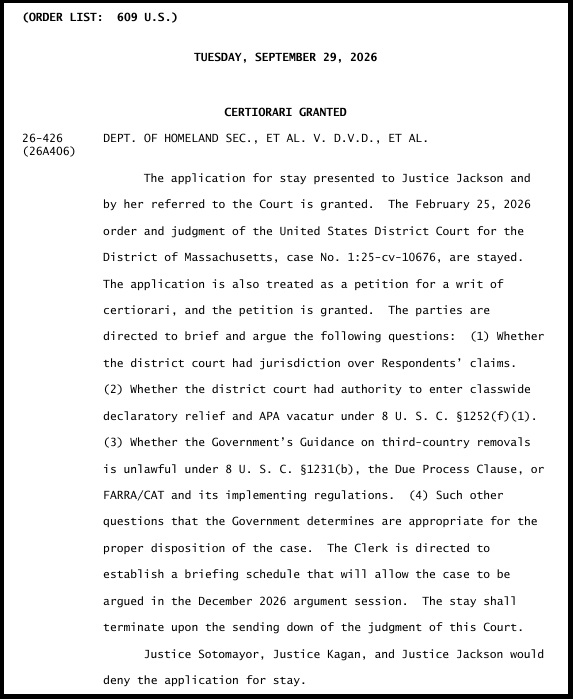
The Supreme Court majority (6-3) has granted the DOJ request to put on hold a Boston-based US District Judge ruling that DHS policy to remove illegal aliens to so-called third countries is unlawful. The process of rapid deportation will continue while the matter is called before the Supreme Court for oral arguments in December (ruling in ’27).
The three DEI Justices, Sotomayor, Jackson and Kagan did not support the ruling. They would have denied the ability to deport illegal aliens to third-party countries.
REUTERS – […] The Supreme Court previously sided with the administration in the legal challenge, suspending a preliminary order that Murphy issued earlier in the case halting the removals. In another win for the administration, the Supreme Court subsequently lifted limits the judge had imposed to protect a group of men from being sent to South Sudan.
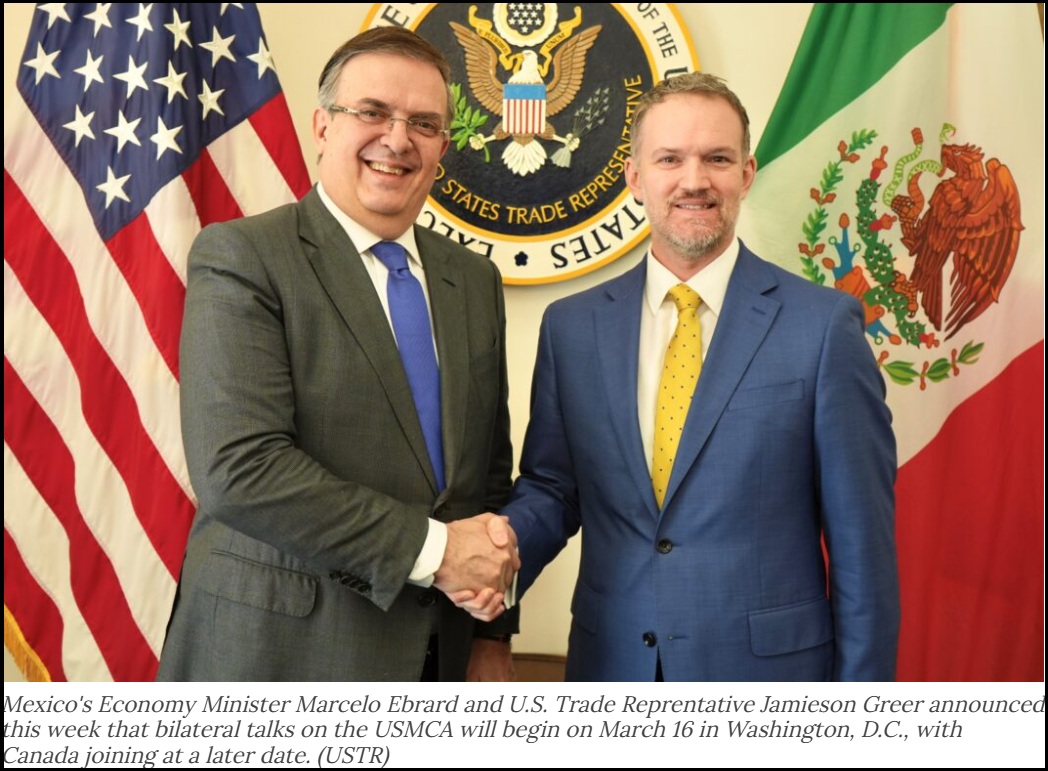
The state visit by Chinese Chairman Xi Jinping in combination with USTR Jamieson Greer’s responsibilities within the U.S-China trade program, meant that Greer had to defer a visit to Mexico to work on the USMCA replacement. However, bilateral trade agreement discussions at a technical level remained on track and progressing during Xi’s visit.
The U.S. and Mexico delegations have now expanded the bilateral topics from 54 sections to 90 sections. This indicates significant agreement on the major components of the framework and now the smaller overlapping topics that enmesh with the bigger topics are brought in.
Greer shifted focus toward the Chinese trade aspects due to the timing of the Xi-Trump summit. USTR Jamieson Greer is expected to be returning to the Mexico trade talks in about a week.
For the interests of the Mexican side, the main focus is seeking favorable reductions in the section 232 tariffs on steel, aluminum and automobiles. However, the digital platform section and intellectual property is also a priority being negotiated by team USA.
MEXICO CITY, Sept 23 (Reuters) – The fourth round of trade talks between Mexico and the United States will not take place next week and could instead be held in October, a senior Mexican official said on Wednesday, as the two countries juggle a shifting diplomatic calendar.
Luis Rosendo Gutierrez, Mexico’s deputy economy minister for foreign trade, said the delay was due to scheduling conflicts, including Chinese President Xi Jinping’s visit to the United States and the upcoming G20 summit. Despite the pause in formal rounds, Gutierrez said technical coordination with the US Trade Representative’s Office (USTR) remains a “daily” occurrence.
We can expect the pace of things to become increasingly fast in the next few weeks.
To our north, a small percentage of Canadians are just beginning to realize what the term “Associate Member” really means when it comes to a Canada joining with the European Union on strategic objectives.
Prime Minister Mark Carney has been selling a sovereignty argument to his constituents within his political package of antagonisms toward the U.S. trade team and President Trump. However, Europe has far greater restrictions and regulations on trade autonomy than the USA. If Canada is to be partnered to the EU, then suddenly Canada has to adhere to a higher level of trade restrictions. The EU makes the rules.
With Europe dictating trade standards, rules of production, manufacturing, access etc. Canada is no longer in alignment with the USMCA. This plays right into the hands of President Trump and U.S. Trade Representative Jamieson Greer, who would prefer two distinctly different bilateral trade agreements; one with Mexico and one with Canada.
The question then becomes, when do Trump and Greer announce the termination of the USMCA. The most reasonable answer is after the U.S. and Mexico finalize a bilateral trade agreement. With the U.S. and Mexico agreement confirmed, the Canadian leverage evaporates.
Carney had previously tried to pressure Mexican President Claudia Sheinbaum not to reach bilateral terms. However, again return to what Carney just did with Europe. Telling Mexico to sit on their hands while organizing a separate side deal with Europe is more than a little hypocritical; in fact, it is really, really insulting.
This opens the door for Trump and Greer to exploit Carney’s self-centered political duplicity, and when you understand that dynamic you have context for why there’s suddenly a warmer embrace of such an agreement by Sheinbaum. Any hope that Carney had to rely on Mexican favor toward them, was just eliminated by the gleeful backslapping in Strasbourg France witnessed by everyone.
Promethean Action’s Barbara Boyd recaps some of last week’s geopolitical events and activities of both President Trump and Secretary of State Marco Rubio. Good video for those catching up.
President Trump reacts to Mark Carney’s push to align Canada with the EU, calling it “laughable” and warning that if it’s hostile the U.S. could impose heavy tariffs or even halt trade with Europe. The episode argues the administration is securing the southern border through Marco Rubio’s Latin America trip and “Operation Shield of the Americas,” linking Peru’s participation and Keiko Fujimori’s election to an intensified campaign against cartels, drug production and trafficking, and Chinese influence.
Boyd’s recap frames Carney as a longtime opponent of U.S. interests, citing his Bank of England role, “green” credit agenda, and support for Ukraine, and claims Canada-EU plans target Arctic control and the U.S. northern defense line. It ends with Trump announcing a permanent U.S. presence in Greenland and warning Canada to curb fentanyl labs and criminal networks. WATCH:
The missing aspect in all USMCA/CUSMA trade discussions is the simple fact that President Trump and U.S. Trade Ambassador Jamieson Greer would prefer bilateral trade agreements. The reason is simple and is highlighted in all the problems with the three-party USMCA.
Two countries can negotiate based on their individual interests; multiple country assemblies get complicated. Canadian Prime Minister Mark Carney and his “middle power” strategy of multiple interests assembling to create larger influence simply doesn’t work in trade discussion. That’s the bottom line.
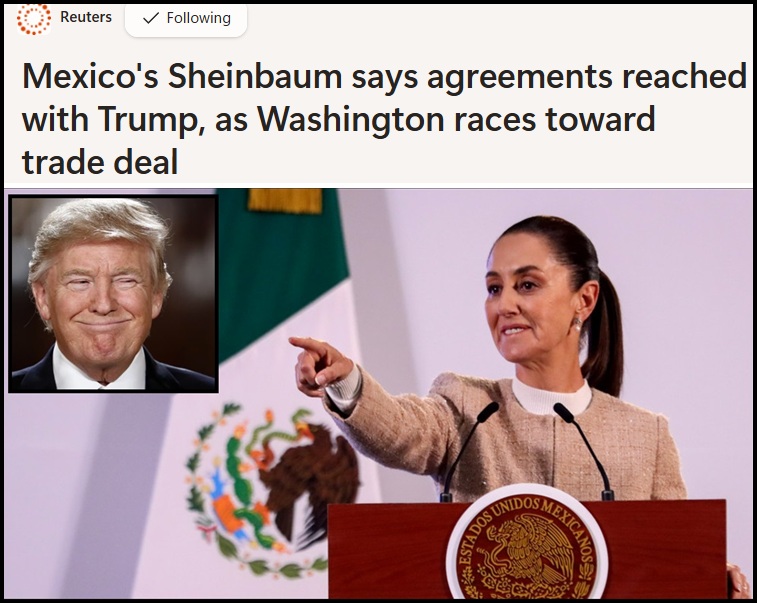
Reuters is reporting the obvious. Mexico and the United States are racing to reach a bilateral trade deal before the U.S. midterm elections in less than eight weeks, according to six sources in both countries familiar with the talks, an effort made more urgent by the collapse of Canadian negotiations with Washington. Both USTR Jamieson Greer and President Trump have previously said the deal with Mexico would likely come first.
Mexico has played this very well. Mexican President Claudia Sheinbaum has not participated in any antagonisms toward the U.S. position; they are simply negotiating for their best outcome. The Mexican government officials don’t try to hide their U.S. dependency under the misguided premise of patriotism. They understand the nature of the relationship.
If President Sheinbaum wants to keep a strong economy, she needs the USA. Both leaders want a trade agreement; it’s business beyond politics. Canada on the other hand is playing pure politics and trying to carve out a deal for themselves the rest of the world doesn’t have. Canada wants to be excluded from the baseline tariffs applied to everyone, that’s not going to happen.
There are a few that ankle bite about President Trump focusing on trade agreements as if it is foreign policy and not economic policy for America that is the #1 factor in our future. I do not see value in such nonsense. Economic security is national security – period.
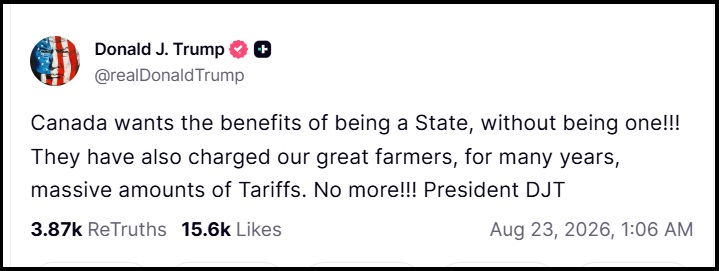
After a day of Canadian government officials pushing a twisted narrative about their position regarding U.S-Canada trade, President Trump puts forth a simple truthful statement:
Additionally, U.S. Trade Representative (USTR) Jamieson Greer talked to the New York Times about the current issues that created the fracture in negotiations. I will outline those aspects below.
CTH readers will note that in 2025 and again earlier this year, our prediction was the USMCA (CUSMA) would dissolve in/around early July, and the U.S. would ultimately end up withdrawing completely in/around August of 2026. I would be remiss if I did not note current events are following a very predictable path.
Trade issues with Canada are irreconcilable against the entitlement that underpins the Canadian economic mindset. You will note these “friction points” do not exist with Mexico; there is a cultural and brutally factual reason for this.
Canada feels entitled to maintain a trade relationship with the USA as if they are a state in our union. However, just like the abusive mentality in any toxic relationship, Canada refuses any reciprocity. Canada maintains protectionist tariffs, non-tariff barriers, quotas against U.S. goods and one-way restrictions on banking, finance, intellectual property and media. The latter part they call “cultural” protection.
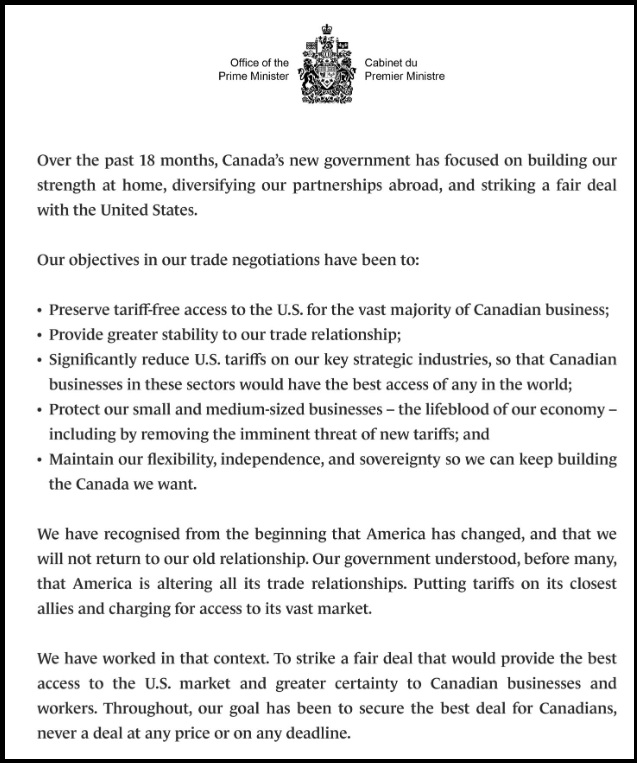
Moments ago, Canadian Prime Minister Mark Carney delivered the news via his X account. Discussions between the U.S and Canada have collapsed. All trade representatives are called back home. The 50% U.S. tariffs against Canada are now in effect. A trade war begins.
First, read the statement from Prime Minister Mark Carney, with the understanding that Carney is making the first statement because the news is exceptionally bad for Canada. Worse than bad.
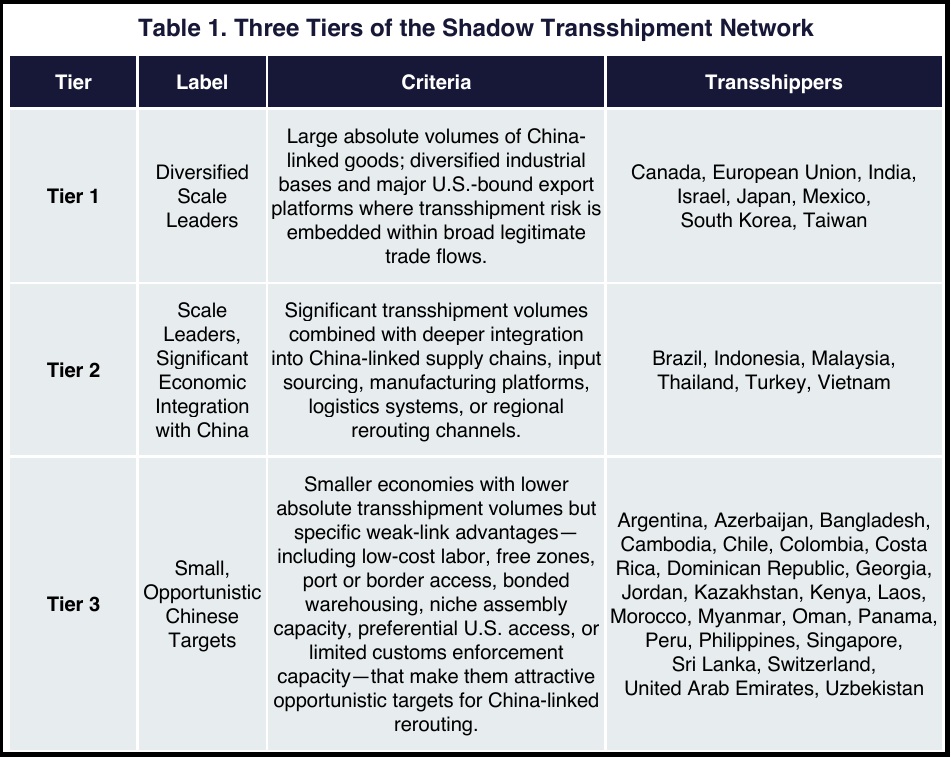
The White House Office of Trade and Manufacturing released an extensive report this week identifying the major nations who enable China to transship goods into the U.S market in an effort to avoid tariffs. [REPORT HERE]
Within the report several nations and regions are identified as being used by Chinese manufacturers to avoid U.S. customs and duty enforcement mechanisms. However, both Canada and Mexico are cited as primary enablers of the process.
The issue strikes at the heart of the problem identified long ago with the NAFTA agreement, and the problem only worsens when the USMCA provisions on country of origin are not enforced.
When you remove oil and lumber, the majority of Canada’s manufactured exports to the USA contain Chinese component parts and this has been the source of much friction in the current trade negotiations. The manufacturing supply chain within all free trade agreements only works when the source of component goods is accurately recorded.
Slowly she builds her performance outrage, methodically working through the talking points afore her. Full dramatic acting on display. Lips pursed, bladed eyebrows angled, contempt tone triggered and the intent obvious.
NIH Director Dr. Jay Bhattacharya appears on CBS Face the Nation to discuss Mexican poop lettuce, Mexico poop peppers, Illegal Alien measles spread and the weaponized information from health ‘administrators’ around the COVID-19 vaccine. Obviously, with Media Patron Saint Anthony Fauci facing scrutiny, Margaret Brennan defends Fauci as she would if the Lightbringer, Chicago Jesus was disrespected. Combative video and Transcript below:
[Transcript] – MARGARET BRENNAN: We’re joined now by the Director of the National Institutes of Health, Dr. Jay Bhattacharya. Good morning to you, doctor.
NIH DIRECTOR DR. JAY BHATTACHARYA: Good morning.
MARGARET BRENNAN: And we should mention you are also helping to run the CDC until the new director is sworn in as well.
DR. BHATTACHARYA: Until next Wednesday, yes.
MARGARET BRENNAN: Until next Wednesday. So let me ask you about a number of things that I think people at home are worried about, particularly around the food supply. The cyclospora outbreak linked to iceberg lettuce from Mexico is now in 15 states. There were two deaths this week due to it. Yesterday, USDA issued an alert for a range of products that may have salmonella, including meat and poultry. 27 states are affected by salmonella, possibly linked to jalapeños, but cilantro, red onion, avocado, also listed in the CDC notice. Albertsons, a grocery store, just recalled some items. There’s risk of salmonella in eggs in Texas, according to the CDC, and then you have the screwworm outbreak affecting beef. This is overwhelming for someone going into a grocery store right now. Why do they seem out of control?