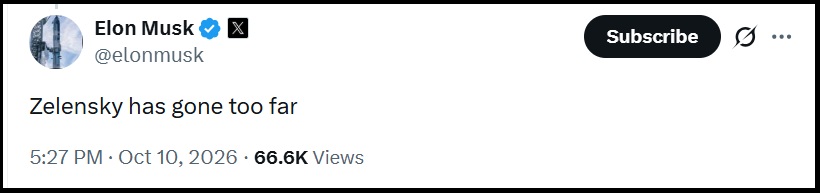
Again, there are multiple dynamics unfolding inside this story. However, as to the central component of Ukraine President Volodymyr Zelenskyy complaining about hampered access to Starlink and/or Starshield, Secretary of State Marco Rubio sets the record straight.
Ukraine has never had access to the U.S. military version of Starshield; providing that level of guidance access would be akin to the United States being in direct conflict with Russia using a proprietary U.S. military system. This is not our circus and not our war; there is no need for U.S. military conflict with Russia.
Because Ukraine does not have that access, it is now revealed that Zelenskyy has been using Starlink, a commercially available satellite system – but that system is not permitted by SpaceX to be used for military efforts. This is almost certainly where the relationship between Elon Musk and former Ukraine Defense Minister Michael Fedorov comes into play. Fedorov is no longer in the Ukraine govt. WATCH:
Rubio notes that Zelenskyy’s claims against the White House are nonsense. The White House has not interfered or instructed the military about the use of Starshield because Ukraine has never had Starshield to use. If Ukraine has been violating the terms of service by weaponizing Starlink (they have) then the commercial provider can act independently to block or stop that access. [Full Transcript Below]
In the background of this storyline, we should always remember that about a month ago Russia finalized their own upgraded satellite system that covers Russia and eastern Europe. It is widely suspected the increased accuracy of Russian targeting inside Ukraine is specifically because of their own enhanced capabilities, which now highlights the vulnerability of Ukraine if they do not have weaponize their Starlink access and the new desperation therein.
Bottom line, Secretary of State Marco Rubio continues to highlight his mastery of cutting through the nonsense and staying focused on the priorities of the administration with messaging that cuts through the media chafe. Rubio excels in this role far beyond prior expectations. Very impressive.
On the topic of his travel to the “stans”, watch carefully. This is connected to the overall Russia/Central Asia agenda.
Transcript Below: