Quantcast

Two More British Commonwealth Countries Considering ‘Associate Member’ EU Status – That’s Four of The Five Eyes

Readers here have significant knowledge of how the overall western intelligence apparatus works to control the activity of their respective governments. Factually, the intelligence apparatus never really changes with each election within each of the respective nations that makes up the “Five Eyes” assembly.

The U.K, Canada, New Zealand, Australia and the United States make up the intelligence control group.  Together with the U.K., four of the five eyes are British Commonwealth nations, so it doesn’t seem odd to see the intelligence assembly follow the geopolitical shift underway.

Great Britain has previously outlined how despite their Brexit the institutional intelligence remained connected to the European Union.  With Canada now taking on “Associate Member” status within the EU, Carney is just bringing them into alignment.  Now, reports are surfacing that Australia and New Zealand are also open to remaining attached to their British cousins.

(AUSTRALIA) – The Albanese government is open to considering associate member status with the European Union despite threats issued by US President Donald Trump.

EU Parliament President Roberta Metsola put the idea on the table following an address by Canadian Prime Minister Mark Carney where he welcomed the possibility of becoming an “associate member” of the Union.

Ms Metsola said Australia and New Zealand were among the countries “with which we want to deepen our relationship”. Assistant Minister for Foreign Affairs and Trade Matt Thistlethwaite told News24 the government would “consider” the proposal. (read more)

(more…)

British Military Intelligence Officer Killed in “Accident” in Ukraine

As the story is told, a 40-year-old British intelligence officer named Major Paul Wilks was killed in an “automobile accident” while traveling in Ukraine. The British media frame the incident as a car crash “away from the front lines” of the conflict.

One has to wonder how many British intelligence military officers are just innocuously traveling around Ukraine.  Who knows, maybe it’s just a great place for a holiday. However, common sense would seem to indicate that Major Wilks was probably not on vacation.

Sky News – […] Remembered as a “man of great intellect”, Major Wilks was deployed on multiple tours, including to Afghanistan, and was recognised with two Operational Service Medals. And he was awarded the Long Service and Good Conduct Medal in May.

He was commissioned from Sandhurst in 2012 and joined the Intelligence Corps, where he remained throughout his career. (source)

In related news:

WARSAW, Poland (AP) — Polish Prime Minister Donald Tusk warned on Thursday that Russia is planning hybrid strikes with drones or rockets on European countries supporting Ukraine, among them Poland.

Russia will pretend the attacks are “accidental” in order to “paralyze or at least weaken the motivation of NATO countries” to rush to the defense of the member state coming under attack, Tusk said in a speech to the Polish parliament.

(more…)

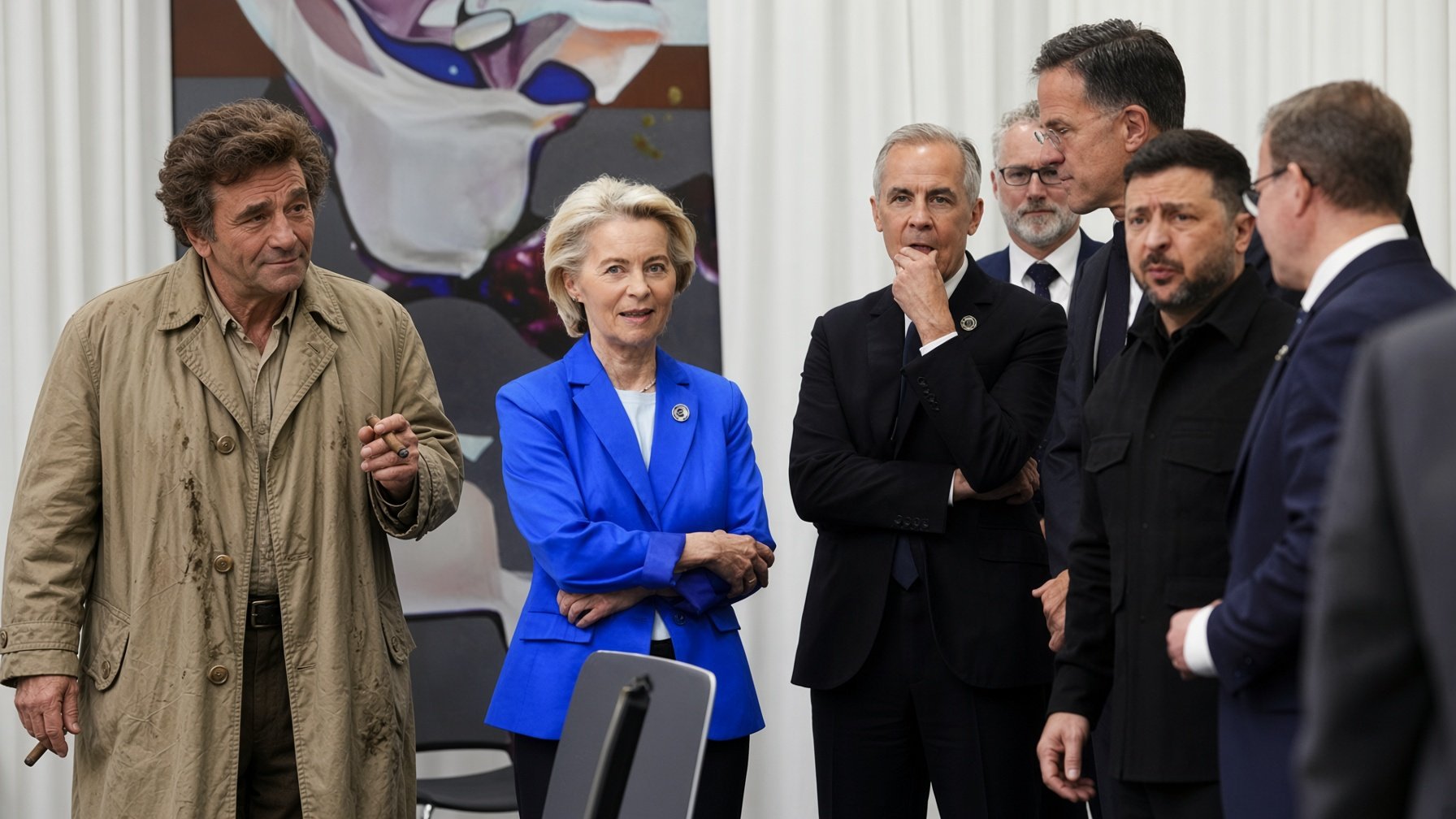
Ursula von der Leyen Announces Canada as First Associate Member of European Union

Pouring effusive and slobbering praise over the Canadian Prime Minister Mark Carney, the anointed “middle power” leader of a shrinking -and increasingly irrelevant- new world order, with grand pontifications EU Commissioner Ursula von der Leyen announced today that Canada is the first “Associate Member” of the European Union.

It’s a major award!  As noted by Reuters, “There is currently no such status as “associate member” set out in the European Union’s treaties — though various versions of an associate-type of membership have been floated in the bloc over the years. Germany suggested Ukraine be an associate member as an interim stage to full ​accession, though the proposal failed to gain traction as some EU capitals pushed back.”

von der Leyen gushed: “Dear Mark, I said we must urgently reimagine our partnerships. So, I would like to work with you on opening the door for Canada to be the first associate member of the EU. We share one ocean, one set of values, one way of seeing the world. And we will now build our shared future as well – thank you for being here.”  Mark Carney sat with a big smile, giddy with excitement and barely able to control his visible glee.  WATCH:

DAILY MAIL – […] But the attempt to flatter the former Governor of the Bank of England backfired, with diplomats saying they were never briefed about the proposal and that, in effect, ‘associate membership’ doesn’t even exist.

EU diplomats accused Brussels of ‘over-reach’, an accusation often levelled against Eurocrats by UK Brexiteers before Britain left the bloc. 

One EU diplomat told the Mail: ‘This bombastic announcement is just not right.

(more…)

Trump Says Zelenskyy No Longer Will Target Diesel Refineries – Zelenskyy Qualifies, Only if Russia Doesn’t Hit Food Routes

The Western intelligence operatives who control Volodymyr Zelenskyy and the Ukraine military effort, previously thought they could destroy the Russian economy by targeting online retail warehouses. That didn’t work out too well.  Russia then began destroying Kiev warehouses, and that created a major problem.

Ukraine-NATO then moved to targeting Russian diesel fuel refineries, and with a heavily exported output targeted that creates a global shortage. [There’s a lot of diesel refineries in Russia because the process is dirty industry, and EU-NATO doesn’t like those dirty carbon jobs.] That said, the disruption created a global price spike which led to President Trump asking Zelenskyy to avoid the diesel plants.

[SOURCE]

Sensing he has the upper hand, the vertically challenged unelected leader of Ukraine now says he will stop the targeting of diesel refineries if Russia stops destroying his electricity grid and food supply.  Somewhere in this hot mess there might be an opening for a ceasefire.

VOLODYMYR ZELENSKYYUkraine has proposed that its partners secure an agreement with Russia that would stop the destruction of critical infrastructure. Food, energy, and other basics that sustain life must be protected, and Russian strikes are directed primarily against them. Every day, Ukrainian energy facilities, port infrastructure, logistics, and even warehouses storing food and pharmaceuticals are targeted. Ukraine is not convinced that Russia is willing to abide by any agreement.

(more…)

Oil, Gas and Orange Juice

Western financial experts have a self-interest to never explain this issue. Instead, they frame the issue as BRICS seeking an alternate currency in the energy markets. However, the currency or petrodollar is not the issue. At least it’s not the core issue.

What Vladimir Putin, and by extension BRICS, do not want is corporatism -corporate financial control over govt systems- determining prices.

To give you an example of Vladimir Putin’s argument, consider orange juice.

Why should orange juice in California or Florida cost $7/gal, when the oranges are in CA or FL?

Shouldn’t the orange juice in FL or CA be cheaper than in, say, Minnesota? Logic would say, yes.

However, that would mean the corporations who have purchased the OJ production couldn’t maximize predatory profiting, through nonmarket forces, ie. “Commodity trading.”

The same organic supply/demand rule applies to strawberries, or [fill in the blank].

What is setting the price, what the west calls the “market price,” is actually the commodity trading issue. That means Minnesota, Florida and California consumers all pay the same price.  Within the energy sector Putin views this as unfair and unworkable.

To his credit, under normal supply/demand Putin would be selling oil/gas to Europe at much lower prices than “market prices” because the pipelines are in place, the proximity is near and the delivery is cheap.

However, for Europe that means the financial markets would not control energy prices. Europe wants financial control, not cheap energy.

The need for control is a reaction to fear. The financial system, the bankers and the multinational corporations, fears their loss of control.

So, war!

(more…)

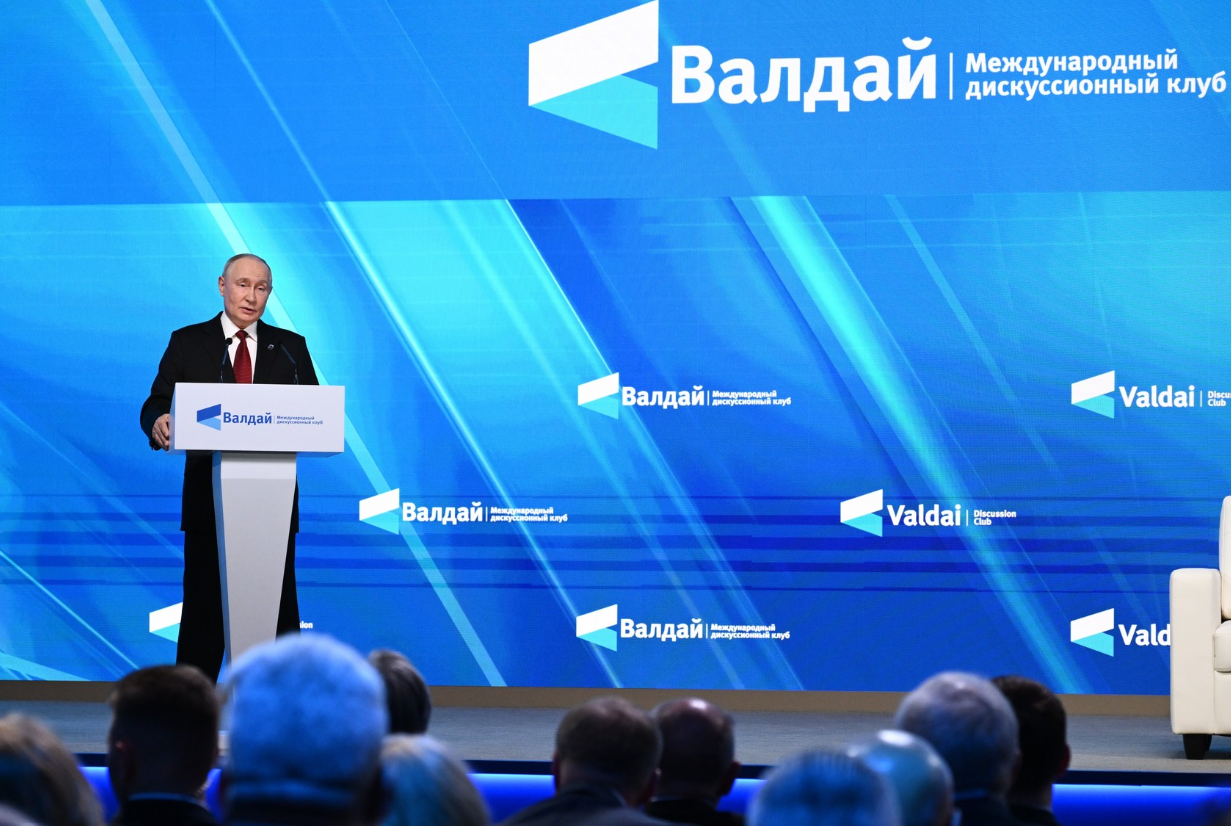
President Vladimir Putin Explains Why NATO Wants a War Against Russia

Sometimes Russian Federation President Vladimir Putin just nails the issue in a way that is difficult for western voices to deconstruct. This is one of those examples.

Using the reference of the EU recently raising interest rates in an effort to lower energy costs, a seemingly disconnected approach that attaches energy policy to monetary policy, Vladimir Putin outlines exactly why the EU Central Bank approach is used.  This is a really important dynamic to understand.

For a long time, Russia battled with the EU over the pricing process for oil and gas.  Russia, specifically Putin, wanted to sell oil/gas to the EU based on production prices and fair profits.

Europe wanted to buy Russian oil/gas based on “market prices” which are manipulated by speculation and traders.

Putin doesn’t like this pricing approach because it artificially inflates the price based on speculation, trading and inorganic influences.

Instead, Putin always said the “market approach” makes your energy prices go up, even when production capacitary prices go down (productivity).

Producers can provide increases in energy volume at lower per unit levels just by turning a dial on gas volume.  Why would Europe want to pay more, when the cost to deliver a higher volume lowers the per unit price.  The EU never had a good answer, other than that’s just the way the ‘western market’ works.

Concluding the first day of his working visit to India for the BRICS meeting, Vladimir Putin answered a media question about the EU and used this reference to outline why the financial system of the EU is actually the underlying reason for their need to have conflict with Russia.  This is really interesting.

Question: You have spoken at length today about the BRICS countries. I would like to raise a question concerning a nation which, though geographically more distant from here, is perhaps closer to you personally – Germany. As is known, elections have recently taken place in Saxony, where the Alternative for Germany secured a decisive victory. It appears a similar trend is emerging in Mecklenburg-Western Pomerania as well. How do you view these developments?

President of Russia Vladimir Putin: I do not wish to, nor will I, comment on matters of the internal political developments currently unfolding in the Federal Republic.

However, there are points which merit attention in this context – and I will explain why. In my view, all that is now happening across Europe as a whole is the consequence of systemic errors committed by the so‑called West, or, to be more precise, by the globalist circles of the West, in the political, security and economic spheres.

(more…)

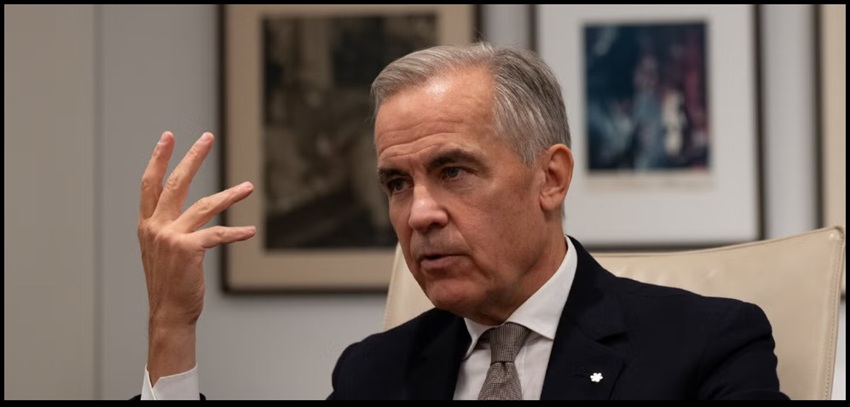
President Trump Discusses a “United Ireland” as Prime Minister Carney Seeks “Associate Member” EU Status

On one hand you have Canadian Prime Minister seeking to attain “associate member” status in the European Union {SOURCE}.  On the other hand, you have U.S. President Trump speaking about a “united Ireland.” {SOURCE} At first blush the stories seem disconnected, until you think about them.

Canada is a commonwealth country of the United Kingdom (UK) and seeking to achieve ‘associate membership’ status within the European Union is Carney’s way to counter the geopolitical reset currently underway by President Trump.  A reset that diminishes the influence of Great Britian’s, ie. London’s. historic economic influences.  One way to hit back against the scheme would be to leverage populist sentiment to take down London and Ottawa simultaneously.  That approach would support the breakup of the U.K commonwealth governing structure.  There’s the connection.

As we review the media reports, keep the U.S-Russia “strategic relationship” approach in mind.

CANADA – Canadian officials are negotiating with the European Union for closer ties with the economic bloc in response to the breakdown of trade negotiations with the United States earlier this summer, the Wall Street Journal reported on Saturday—including potentially becoming an “associate member” of the union.

Although the EU is historically not known for allowing flexible membership arrangements with individual countries, European officials are reportedly open to Canada joining as an “associate member,” anonymous officials from both Canada and the EU told the Journal.

This could mark the largest reorientation of the Canadian economy in decades—the U.S. has long been Canada’s largest trading partner, with about  going across the southern border in 2025.

(more…)

Barbara Boyd Looks at German Election Outcome and Ukraine-Russia Conflict Negotiations

Promethean Action’s Barbara Boyd presents her review of the election outcome in Germany, the alignment of Canada with the EU and the Ukraine negotiations headed by Steve Witkoff and Jared Kushner.

“A Saxony-Anhalt provincial election saw Germany’s nationalist AfD win 43.8% to the next party’s 17.2%, prompting alarm in the British press and among EU-linked elites because the AfD campaign pledged to end open borders and halt German funding for the Ukraine war. The script argues the surge reflects a broader European revolt driven largely by economics: China’s industrial strategy and competition are squeezing Germany’s Mittelstand, with the Wall Street Journal cited on job losses and a shift toward importing more advanced machinery from China, while green policies, nuclear shutdowns, and the ban on cheap Russian energy have pushed prices 40–50% higher and cut energy-intensive production by 15%.

It links Germany’s downturn to EU war-mobilization plans, casts doubt on Mark Carney’s planned EU-Canada alignment, and contrasts that with Trump-era peace efforts, including a Trump-Putin call, corruption probes in Ukraine, and U.S. officials downplaying inflation impacts from Canada’s tariffs.”

.

(more…)

EU Central Bank Raises Interest Rates on EU Citizens to Avoid Settling Ukraine-Russia Conflict

The European Central Bank raised interest rates a quarter of a percent claiming the effort will reduce energy prices.  However, the primary cause of higher energy costs is energy policy not monetary policy.

As you can see, Europe is blaming the Iran conflict, and by extension blaming President Trump for inflicting higher oil and gas prices.  Yet in reality, it was the European decision to cut themselves off of Russian oil and gas that led to their massive price increases.

In essence, if you ask yourself how far the EU collective is willing to go in order to combat the fictitious threat represented by Russia’s conflict with non-EU state Ukraine, it appears there is no upper limit.  Rather than assist in a resolution of the Ukraine-Russia conflict, they are willing to keep fueling the war and diminishing their own economy in the process.

From the perspective of the welfare of the average European, none of this makes sense.  This is bureaucratic ideology running amok.

FRANKFURT, Germany (AP) — The European Central Bank raised interest rates Thursday to cool inflation that is being fed by high oil prices from the Iran war. The decision was supported by a stronger-than-expected economy that suggests businesses can weather the higher borrowing costs.

The central bank for the 21 EU member countries that use the euro currency raised its benchmark rate by a quarter percentage point to 2.50% at a meeting held in Berlin, away from the bank’s Frankfurt headquarters.

(more…)

Canada and Ukraine Sign a 100-Year Partnership, with Canada Pledging $1 Billion to Ukraine Money Laundering Operation

It is obvious now why former Ukraine Defense Minister Mykhailo Fedorov, 35, has launched a weapons manufacturing business. On September 1, Fedorov together with Palantir CEO Alex Karp announced, “plans to directly develop combat robots, low-cost high-speed interception drones, and AI-based low-cost missiles through the new company.” {source}

Today, while signing a 100-year pact between Canada and Ukraine [SEE HERE], Prime Minister Mark Carney announced a $1 billion worth of investment and support for Ukraine, including the building of drones and weapons for Ukraine and Canadian defenses. [SEE HERE]

Canada will use the funds given to Ukraine and also used in collaboration for their own defense systems, in the accounting ledger to bring them into compliance with NATO military defense requirements.  However, beyond the accounting gimmicks and tricks, there are reconstruction funds obligated by Carney to Zelenskyy that will be handled by former Deputy Prime Minister Chrystia Freeland in her new position inside Ukraine.

Zelenskyy and Carney signed the 100-year pact during a ceremony earlier this afternoon.  Carney is also helping Zelenskyy establish a more westernized information control system aligning Ukraine media operations in the same format as Canadian government control of media.

  • Approximately $350 million to deliver critical air defence interceptors through the United States’ Joint Ukraine Multinational Program – Services, Training and Articles Rapid Timeline (JUMPSTART). This mechanism leverages financial donations from Allies to aid Ukraine in addressing its evolving defence needs, including procuring critical equipment.
  • Nearly $23 million in funding to bolster the capabilities of Ukraine’s security architecture – helping detect, prevent, and respond to hybrid threats to civilian safety. This includes both support for Ukraine’s police, national guard, military, and frontline communities affected by Russia’s aggression, as well as funding to combat threats and disinformation.
  • Providing nearly $435 million in new loan guarantees to the European Bank for Reconstruction and Development to support energy security, including winter gas purchases and secondary energy generators to produce electricity during shortages.
  • Allocating $200 million in concessional loans through Export Development Canada to support Ukraine’s reconstruction. It will help Ukraine repair critical infrastructure by enabling Canadian companies to support critical projects.
  • Providing an additional $10 million to the Ukraine Energy Support Fund, for a total of $100 million, to support Ukraine’s energy infrastructure, including the procurement and delivery of critical energy equipment to improve the resilience of Ukrainians to energy shocks.
  • Providing $2 million to the International Energy Agency (IEA) Joint Work Programme to support Ukraine’s Energy Resource Development. This funding will strengthen Ukraine’s energy resilience, provide regulatory support, and advance clean energy projects. {source}

(more…)