Quantcast

Volkswagen Will Eliminate Almost Half of Production Models After Losing Market Share to China

The European auto industry is a case study on how short-sighted trade policy goals, results in consequences.

Previously, German auto companies like Volkswagen entered into trade agreements with China and began manufacturing their vehicles with immediate financial success in the market.  However, it did not take long for Chinese auto companies to reverse the engineering and begin to deliver the same quality vehicles at much lower prices.

The Chinese then stop purchasing the Volkswagen vehicles and purchase the cheaper version, while simultaneously begin exporting those same vehicles into the home market from where the technology originated.

Today, with a double-digit decline in production, Volkswagen announces they will cut almost half of their models due to diminished sales.

BLOOMBERG – BERLIN — Volkswagen reported weak sales numbers on Friday, a day after the giant German automaker announced plans to slash the number of models by nearly half as sales plunged, particularly in China.

The Wolfsburg, Germany-based company said group sales fell 8.6 per cent in the second quarter to just under 2.1 million vehicles, with sales in China alone plummeted by more than one-third.

(more…)

Chancellor Friedrich Merz Delivers Statement of Immediately Mandated Government Reforms to German Workforce

This next storyline needs context to understand appropriately what just happened.

In February of this year, German Chancellor Friedrich Merz travelled for the first time in his business and life to China. Merz a lawyer by training, worked in business and corporate life doing mergers and acquisitions (Blackrock), but had never been to China.  Despite his upward climb in German politics, his worldview was always dominated by an internal acceptance that Germany was the industrial heart of the European Union.

Chancellor Merz believed that Germany was unrivaled within industrial manufacturing, particularly in aeronautics and mechanical engineering (auto sector).  So, when Merz went to China -while he held no trade capabilities as an outcome of the EU collective controlling everything- he also had no idea what Chinese industrial capacitary actually looked like.

To say Chancellor Merz was stunned by the advancements in robotics and industrial manufacturing within China would be an understatement.  Merz was shocked not only by the technological capability, but also by the Chinese industrial work ethic and capabilities of the workforce.

Merz returned to Germany and immediately began discussing how Chinese industrial capacity was far beyond anything he previously estimated.  Merz was shook.  His reaction was, essentially, the #1 industrial nation within the EU confronting a reality of years of industrial complacency.  Immediately he began talking about how things in Germany must change; how the German workforce must immediately start to get serious about productivity and production capacity.

That was late February and early March.

(more…)

Two Politically Pretentious Canadians Interview U.S. Ambassador Pete Hoekstra

I’ve said it before, U.S. Ambassador to Canada Pete Hoekstra is the most underpaid U.S. emissary sent to a hostile nation and constantly surrounded by threats, bitterness, anger and hatred.

It would be easier to be U.S. ambassador to North Korea.

There is so much nuance inside this interview, it is remarkable.

Ambassador Hoekstra tries in his best diplomatic form to tell the two Canadians Michael LeBlanc and Dr. Sylvain Charlebois about the underlying nature of the U.S-Canada trade conflicts.  However, in typical Canadian fashion both indoctrinated interviewers are curiously stumped by the points Hoekstra presents.  I am prompting this one because you also need to see the body/facial language. WATCH:

[SIDENOTE: The Canadians needed to turn off the comments on YouTube because Canadians are angry, bitter, abusive, vulgar and nasty in every comment section on the subject of U.S-Canada relations.]

Canada’s greatest strategic weakness is what Canadians call their greatest strength, pride.

There is a big difference between being proud and being prideful. The Canadian worldview is based on the latter.

(more…)

President Trump Axios Interview – The Elements of Power

President Donald Trump gives an extensive interview to Axios on current events, the comparison between Term 1 and Term 2, and the issues surrounding the ceasefire agreement with Iran.

The conversation centers on Iran, where Trump defends the military campaign, the deal that followed and his decision to stop short of further escalation. He also discusses the Strait of Hormuz, Israel and Benjamin Netanyahu, Cuba, Venezuela, artificial intelligence, Anthropic, China’s AI race and how he thinks about maintaining power in the final stretch of his presidency.

CHAPTERS:

0:00 – Welcome to The Axios Show
0:11 – The one big thing: power
1:37 – “I’m the boss” and the G7
3:36 – What Trump sees in world leaders
4:05 – Trump on Xi Jinping and China
6:11 – Venezuela, military power and oil
7:19 – Trump on Modi, Pakistan and global leadership

(more…)

Remembering Tiananmen – June 4, 1989

Today marks the anniversary of the Tiananmen Square massacre in China.

June 4, 1989 and the events leading up to that moment are forbidden discussion in China.  37-years later the Chinese Communist Party (CCP) will still target and seek the arrest of anyone who recognizes this monumental date in modern Chinese history.  As a few readers will remember, this date also personal to me.

[New Photographs Here]

Through the years CTH has remembered this date, noting the importance of that moment not only in China but also in the rest of the world who were watching events, trying to understand the student protest issues and also learning about the country that was beginning to break into a much larger modern world from the other side of the Pacific.

Part of the interest in communist China was driven by watching what was taking place in Eastern Europe, the collapse of communism.  Just five months after Tiananmen, in November 1989 the Berlin Wall came down, signaling the end to communism in Europe.  These months were fascinating for curious American Gen Xers who were witnessing an inflection point in history between two generations – and they could sense it.

For myself, June 4, 1989, also represented an awakening as I listened to several media broadcasts talk about the Chinese government response to Tiananmen as a “hard-right crackdown.”  No, that didn’t make sense.  On the left is bigger government, totalitarianism. On the political right is smaller government.  If the government was shutting down freedom and liberty protests, that’s bigger government – not smaller.

So, in reality, what I was witnessing was a “hard-left crackdown.”

…. But the media kept repeating, “hard right,” as if repeating it over and over was going to make reality bend in a different direction. They said it so much it was almost like they were trying to convince themselves.  I began thinking about things.  I kept my mouth shut and my ears open.  I began questioning things that were presented to me.  Suffice to say, I began waking up.

(more…)

USMCA Development – Canadian Prime Minister will Announce New Advisory Council for USMCA/CUSMA Negotiations

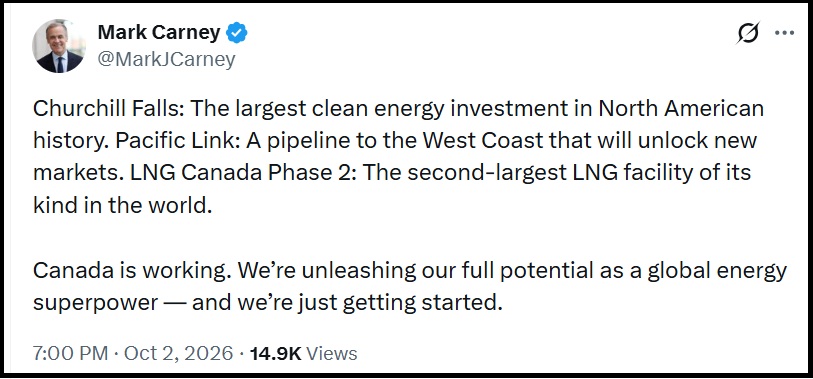
Somewhere along the path to the inevitable dissolution of the USMCA trilateral trade agreement, reality will set in for Canada.  Until then, denial is the preferred course of action from Prime Minister Mark Carney.  Not since COVID-19 have we witnessed an intellectual disassociation happening over such a large sector of a population.

According to the latest media reports, Prime Minister Mark Carney is set to announce a new Canadian Trade Advisory Council that will strategize the best moves within each sector of the Canadian economy to deal with the United States USMCA renegotiations.  Even at this latest date, the Canadian government is still under the belief they can negotiate themselves into a position where their status within the USMCA (CUSMA) will be retained.

Simultaneous to this announcement, the one best hope the Canadians have relied upon is also evaporating.  However, before discussing that aspect, let’s first look at the advisory council.

CANADA – Prime Minister Mark Carney is expected to unveil a new advisory council focused on Canada-US trade relations as Ottawa attempts to salvage Canadian-US trade amidst Donald Trump’s aggressive tariffs. According to reports, the council will bring together major business leaders, labour representatives and former politicians to advise the federal government ahead of the scheduled review of the Canada-United States-Mexico Agreement (CUSMA).

[…] While the entire list of figures present on the council has yet to be announced, the Government of Canada first announced the advisory committee in April 2026, and released a partial list of members. Members reportedly include Conservative leader Erin O’Toole, former Quebec premier Jean Charest, and other representatives from sectors such as energy, manufacturing and forestry. There are also multiple high-level Canadian executives present on the list released by the Prime Minister’s office on April 21. The committee will be chaired by Dominic LeBlanc, who currently serves as minister responsible for Canada-U.S. trade and intergovernmental affairs. According to the Prime Minister’s Office, the council’s role will be to provide strategic advice and industry expertise as Canada prepares for negotiations under the umbrella of Donald Trump’s renewed tariff threats.

(more…)

Russian Federation President Vladimir Putin Arrives in Beijing, China for Summit with Chairman Xi

Chinese Foreign Minister Wang Yi greeted Russian Federation President Vladimir Putin upon arrival in Beijing, China, for a summit with Chairman Xi Jinping just days after Xi and President Trump spent two days in personal conference.

There will be more details from this visit that will surface in the next several hours and few days; however, for those who walk the deep weeds the video of the arrival is very interesting.  Russia controls Russian interests in all things, including diplomatic missions.  Foreign Minister Wang Yi greets President Putin and there are customary celebratory festivities on the tarmac that most are familiar with.

Putin is walking briskly, very deliberately and giving warm waves to the assembled children. But Putin is all business, focused and walking fast.  Minister Yi slows his pace in an effort to slow Putin and emphasize the welcome. Putin keeps forward momentum. It’s subtle, but so typically Russian in approach. Nothing extraneous, nothing off script, nothing casual – straight, predictable and forward.

Notice the Russian control and immediate separation at the moment when they reach the end of the red carpet. Wang Yi and the Chinese welcome delegation as well as all security elements just disappear as in typical Russian fashion the Russian security service takes control from there.

It is a subtle difference between the merged casual formality of a U.S-China visit, and the hard lines of a Putin visit.  I find myself thinking about what a difference it would make in relations between our nations if Americans really understood Russians.  Russians are not cold per se’, they just don’t do casual very well.

There’s no “small talk” in Russian culture. There is talking that has a purpose and benefit – or there is silence. It is a facet of cultural distinction that many Americans just don’t understand.  There are no pretenses and everything is deliberate.

(more…)

Barbara Boyd Recaps Trump China Trip, Canada/EU Conflict and 2026 Midterm Positioning

Barbara Boyd from Promethean Action PAC gives her take on the current situation.

“Barbara Boyd argues the key outcome of Trump’s China visit was the personal trust between Trump and Xi, symbolized by Xi’s “secret garden” tour previously reserved for Putin, and framed as establishing guardrails for U.S.–China strategic and tech competition amid the Iran war and energy geopolitics. She says London and Democrats are “screaming” because Trump is reshaping global economic relationships while Treasury Secretary Bessent lifts U.S. sanctions on Russian exports. The episode targets Mark Carney and Keir Starmer as City of London figures who tried to capture China finance, advance BRICS as a dollar alternative, promote a synthetic reserve currency via CBDCs, and steer $130T through green finance—efforts Boyd says have failed as Trump reverses “Green New Deal” policies. She highlights DOJ election-rigging probes, renewed scrutiny of “Russiagate,” anti-fraud prosecutions, voter backlash, and insurgent politics in Los Angeles and London.”

.

(more…)

Treasury Secretary Bessent Extends Russian Oil/Gas Sanctions Waiver Another 30-Days

I’m not going to spend too much time on this as I suspect most readers are well aware of my predictions on the matter.  Suffice to say Treasury Secretary Scott Bessent and the Office of Foreign Assets Control (OFAC) has extended the sanctions waiver on Russian oil and gas for another 30-days. {citation}

[SOURCE]

The OFAC waiver targets Russian oil/gas that was loaded onto floating storage platforms as of April 17, 2026.  The destination of the oil/gas will primarily be China, India and Southeast Asia; westbound Arctic supply route. The general license means all of the ASEAN countries can purchase in dollars and provides Russia with an exchange for the same currency valuation.  Once again, Zelenskyy -and Europe- will not be happy.

There is a certain irony in Europe previously banning the import of Russian oil/gas (EU sanctions) and now, when they desperately need it, the supply is flowing in the opposite direction.  Both Russia’s Arctic I and Arctic II platforms are operating to produce the supply; however, as many readers here will note they coincidentally :::nudge, nudge – wink, wink::: started pumping supply to “on the water” storage for six months prior to the beginning of the Iran conflict.   This is the third U.S. waiver of sanctions.

Russian Federation President Vladimir Putin is scheduled to arrive in Beijing on Wednesday. {GO DEEP}

(more…)

Sunday Talks – U.S. Trade Representative Jamieson Greer Discusses U.S-China Trade Status

U.S. Trade Representative Jamieson Greer appears on CBS Face the Nation to discuss current U.S-China trade relations on the heels of the recent Beijing summit.  Brennan in her customary passive-aggressive mode as a professional narrative engineer.  Video and Transcript Below:

[Transcript] – MARGARET BRENNAN: We begin this morning with a top member of the president’s economic team, United States Trade Representative Jamieson Greer. Good morning to you, Ambassador.

JAMIESON GREER: Good morning. Good to be here.

MARGARET BRENNAN: It isn’t just a matter of sentiment. Gas is at an average of $4.51 a gallon. Americans have spent $45 billion more on fuel since the war began versus a year ago. The stock market is up, but lower-income Americans are pulling back on their spending. The New York Fed reports households earning less than $125,000 a year are fueling up their cars less often. How do you provide relief to the average American?

JAMIESON GREER: Well, we know that no one wants to see higher gas prices. At the same time, the president is balancing foreign policy considerations. We know that, in addition to wanting to have low gas prices, we don’t want our children or grandchildren to inherit a world where Iran has a nuclear weapon, so the president is focused on affordability in as many ways that he can- that he can. He’s bringing jobs back to America. We’re focused on getting wages up to offset any kind of increase in prices, and we’re seeing prices go down for staples like dairy, cheese, flour, etc. So we’re very focused on this. The president’s focused on it, and we look forward to seeing those prices come down soon as the operations wrap up in the Gulf.

(more…)