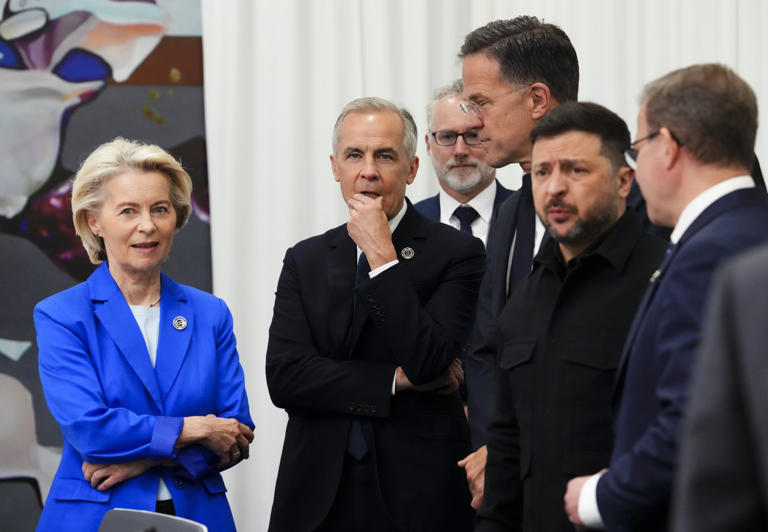
Ontario Premier Doug Ford went for a pizza with Canadian Prime Minister Mark Carney. Following the meeting Doug Ford appears on camera for a debrief to explain how he has reversed his opposition to Chinese EV imports. The presser looks like a hostage video (prompted):
“A Party intending to negotiate a free trade agreement with a non-market country shall inform the other Parties at least three months prior to commencing negotiations and, upon request, provide information regarding the objectives of those negotiations.
A Party that enters into a free trade agreement with a non-market country shall provide the other Parties with the full text of the agreement prior to signing.
If a Party enters into a free trade agreement with a non-market country, the other Parties may terminate this Agreement on six months’ notice and replace it with a bilateral agreement.” [SOURCE]
Canadian Ambassador to the U.S., Kirsten Hillman, appears on CBS Face The Nation to discuss ongoing political and trade relations between Canada and the United States – Video and Transcript below.
During one segment of the interview, Ambassador Hillman is asked about the dissolution of the USMCA (CUSMA) trade agreement, and immediately Hillman falls back upon the same Justin Trudeau position of the government. The U.S. politicians will not allow President Trump to dissolve the USMCA.
“I think that we have to believe that our political leaders are going to be listening to the people in the constituencies for whom that instrument was drawn up, and they’re saying, this is vital to us, do no harm.”
Canada is counting on American political opposition to defend the economic interests of Canada. This is exactly the same position that former Canadian Prime Minister Justin Trudeau espoused in 2017 and 2018.
[Transcript] – So a lot is going on in the relationship between our two countries. We are so deeply integrated here on trade, you buy more from the U.S. than any other country. We have the world’s longest land border. We have shared defense interests through NATO, shared air defense with NORAD. Are we like in the middle of a divorce? Like, how do you describe the relationship?
AMB HILLMAN I- I- we’re not in the middle of a divorce, but we are in the middle of a change. There’s no question about it. I think that we are finding ourselves, quite frankly, in- in a situation where some of the foundations that have governed our relationship for a long time, that you know, integrated supply chains are good, that working together on strategic issues is- are important, that looking out for each other in important ways is- is a number one priority. I think in some quarters, Canadians feel that those foundations are being tested. We will adapt. We will make it through, I have no doubt about that, but it’s yeah, it’s a complicated time.
Canada signing a trade agreement with China to permit the import of EVs is another escalation in the exploitation of the USMCA compact.
For the position of China, using Canada as a route to ship component goods into the United States is just a slight expansion of their current technique to avoid U.S. tariffs. However, President Trump is taking action immediately.
Noting on his Truth Social platform, President Trump announced that if Canada does effectively go through with allowing the import of Chinese electric vehicles, then the U.S. will impose a 100% countervailing duty against all Canadian imports.
“[…] As a part of the deal, Canada will ease the tariffs on Chinese electric vehicles that it imposed in tandem with the U.S. in 2024. In exchange, China will lower retaliatory tariffs on key Canadian agricultural products.” ~Politico
Canadian Prime Minister Mark Carney continues giving President Trump the ammunition to dissolve the USMCA trade agreement this year.
USTR Jamieson Greer and Commerce Secretary Howard Lutnick have both expressed anticipation of a new bilateral trade agreement to stop all this Canadian nonsense.
Hilarious Bloomberg interview with Commerce Secretary Howard Lutnick. The topics are European trade and politics combined with the overlay of Canadian trade and politics. The Bloomberg panelists question Lutnick about the similar “feelings” of the Europeans and Canadians, as it pertains to the outcome of trade discussions. It’s the feelings that make things difficult to negotiate.
Secretary Lutnick doesn’t dismiss the narrative but deconstructs the substance of the topic brilliantly. Lutnick notes the ridiculous nature of the Canadian trade position and their decision to go running to China because their feelings are hurt. Lutnick then affirms the USMCA is going to be dissolved mid-summer and fall of this year.
As we noted at the end of last year, splitting the USMCA into two bilateral trade deals, one for Mexico and one for Canada, will be one of the most interesting and long-term economically significant moves in U.S. trade history. It is going to be a lot of fun to watch these negotiations, and the pre-positioning gives us a preview of what is to come.
Mexico is doing everything almost perfectly in preparation for their bilateral deal. Canada is doing exactly the opposite and positioning themselves for the worst possible outcome of a deal with the USA. The disparity in approaches is so different, even now it is remarkable to watch. PROMPTED:
(VIA BLOOMBERG) – […] Canada has “the second-best deal in the world” with its access to the US market, Lutnick said, behind only Mexico. The Commerce chief also indicated that Canada’s tilt toward China could become an issue in talks over revamping the US-Mexico-Canada trade agreement known as USMCA.
If Ottawa opts to import Chinese electric vehicles and other trade-strengthening steps with Beijing, “do you think the president of the United States is going to say you should keep having the second-best deal in the world” during USMCA talks, Lutnick questioned.
President Trump gave an extensive interview to Maria Bartiromo just before he left Davos. The primary questions surrounded the announced deal between the Trump administration and NATO over the U.S. security request for Greenland.
President Trump said the NATO/Denmark security deal for Greenland gives the United States unlimited and exclusive use the country to build bases and systems for the North American defense dome. President Trump also talked about the U.S. trade relationship with Europe and the friction points that still have to be addressed. WATCH:
This is one of those conversations that hints around the edges of what the collapse of globalism actually entails. As noted in the beginning of the WEF panel discussion by Christine Legarde, the construct of global economics was built upon a foundation of interdependent trade dependencies. If nations are no longer reliant upon other nations for sourcing of goods and services, the global construct of banking and finance then begins to collapse.
Globalism in its economic construct is a series of dependencies. If those dependencies are severed, if each country has the ability to feed, produce and innovate independently, then the entire dependency model around globalism collapses.
Within the globalism model that was historically created there was a group of people, western nations, banks, finance and various government leaders, who controlled the organization and rules of the trade dependencies. The action being taken for self-sufficiency, in combination with the approach promoted by President Trump that each nation state should generate their own needs, then the rules-based order that has existed for global trade will collapse.
If nations are no longer dependent, they become sovereign – able to exist without the need for support from other nations and systems. If nations are indeed sovereign, then globalism is no longer needed and a threat of the unknown rises. How will nations engage with each other if there is no governing body of western elites to make the rules for engagement? The need for control is a reaction to fear, and it is the fear of self-reliance that permeates the elitist class within the control structures.
Global trade is now beyond goods and services and into the world of automated artificial intelligence. Legarde notes the tech sector wants/needs access to more global data in order to create the control systems of tomorrow. However, again the problem arises when sovereign nations refuse to dump their independent data into the bucket of data dependency.
If each nation of the world is operating according to its individual best interests, the position of Donald Trump, then what happens to the governing elite who set up the system of interdependencies. This is the core of their fear.
If each nation can suddenly grow tea, what happens to the East India Tea Company. Who then sets the price for the tea, and worse still an entire distribution system (ships, ports, exchanges, banks, etc.) becomes functionally obsolescent.
President Donald Trump participates in a bilateral discussion with President Guy Parmelin of Switzerland, the host nation of Davos and the World Economic Forum assembly.
President Parmelin said, “Davos is not the same without you,” to wit President Trump said, “I agree.” President Parmelin then said he was working to correct the trade imbalance and Howard Lutnick and Jamison Greer then informed the assembled press pool the pharmaceutical production coming to the USA will correct the issue. lol WATCH:
In a stunning and rapid strategy to keep the globalists from realizing what he is assembling, it is being reported that President Trump wants the Gaza Board of Peace constitution and remittance agreement signed in Davos. However, as the United Nations, European leaders and traditional globalists who comprise the WEF assembly begin to realize what Trump is putting together, they are getting triggered.
“Hey boss, they’re catching on. Better hurry up”
In essence, as people of self-appointed political importance are starting to realize, President Trump is assembling an entirely new structure for global partnerships that will likely end up with the functional obsolesce of the United Nations. Trump is selecting world leaders through the invite to a global board of peace; Gaza merely represents the initial venue.
One of the key aspects is the new global assembly will each pay their own way. No free riders this time. You want to sit at the big table, join the big club of sovereignty, assemble with a mutually respectful team of action, then pay the entrance fee to attend.
Surprise😁! [Remember the “Happy Trump” pin?]
(Bloomberg) — US President Donald Trump’s proposed Board of Peace has got off to a rough start: questioned by Europe, criticized by Israel and celebrated by friends of the Kremlin.
France’s Emmanuel Macron, for one, has come right out of the gate to decline an invitation that was also extended to strongmen such as Belarus’s autocratic leader Alexander Lukashenko. Several liberal democracies are squirming, uncertain how to respond and not wanting to offend Trump.
They don’t have long to decide.
Trump wants the full constitution and remit of the committee signed in Davos on Thursday, according to people familiar with the matter. But some elements of the small print have left invitees wondering whether to accept.
Last week President Donald Trump officially announced the members of the Gaza Board of Peace; an organization headed by President Trump and tasked to oversee the second phase of his plan to end the Israeli conflict in Gaza, specifically the reconstruction and disarmament of Gaza and Hamas respectively. [SEE HERE]
The members of the “Board of Peace,” chaired by Trump himself, includes Secretary of State Marco Rubio; Emissary Steve Witkoff; Jared Kushner; former British Prime Minister Tony Blair; an American-Jewish billionaire named Mark Rowan; World Bank President Ajay Banga; and Deputy National Security Advisor of the United States, Robert Gabriel. President/Chairman Donald Trump has also appointed Aryeh Lightstone and Josh Gruenbaum as senior advisors to the Board of Peace.
At the same time, President Trump announced another executive body that would operate under the Peace Council to assist with the facilitation of a new Palestinian government, the “Gaza Executive Board.” This structure is intended to manage day to day events on the ground instead of a Hamas loyalist govt. The appointees to the executive board have upset the Netanyahu government of Israel.
According to the White House announcement, the Gaza Executive Board will include: Witkoff; Kushner; Turkish Foreign Minister Hakan Fidan; senior Qatari official Ali al-Thawadi; Egyptian intelligence chief Hassan Rashad; Tony Blair; billionaire Mark Rowan; UAE Minister Reem Al Hashimi; former Bulgarian Foreign and Defense Minister Nickolay Mladenov, who also served as the UN envoy for the Middle East peace process; U.N Representative Sigrid Kagg, and Israeli-Cypriot businessman Yakir Gabbay, who specializes in real estate, technology and international investments.
Additionally, to establish security, preserve peace, and establish a durable terror-free environment, Major General Jasper Jeffers has been appointed Commander of the International Stabilization Force (ISF), where he will lead security operations, support comprehensive demilitarization, and enable the safe delivery of humanitarian aid and reconstruction materials. [link]
According to Israeli media Netanyahu is not happy, and planning to protest the Turkish, Qatari and UAE appointments to Marco Rubio (not Trump):
President Trump’s impromptu remarks from inside the Ford F150 plant will probably not make headline news because, well, quite frankly, what President Trump says below is something the financial media just don’t want to discuss.
This is really an important point. In the era where information is skewed based on the interests of the organization sharing the information, government or private sector media, it is extremely valuable to just listen to what President Trump says directly. In comments such as this brief segment below, you can see exactly where he is going with manufacturing and trade policy.
Specifically pay attention to how President Trump emphasizes, then reemphasizes the irrelevance of the USMCA from his perspective. As we have noted all along, the Trump administration (USTR Greer) will abandon the trilateral USMCA this year and instead begin a formal process for two bilateral free trade agreements.
Now, the entire financial media system is pretending this is not going to happen, especially in the statements by every stakeholder north of the border. However, listen to how President Trump himself describes the USMCA or CUSMA as the Snow Mexicans like to call it. Trump is completely nonplussed about what is going to happen. WATCH: