Quantcast

China Leverages Pressure on Iran to Stop Strikes on Saudi Oil Fields

Ahead of Chariman Xi’s visit to Washington DC for a state visit on September 24th and 25th, Reuters is reporting that China has asked Iran to halt all strikes on Saudi Arabia oil fields.
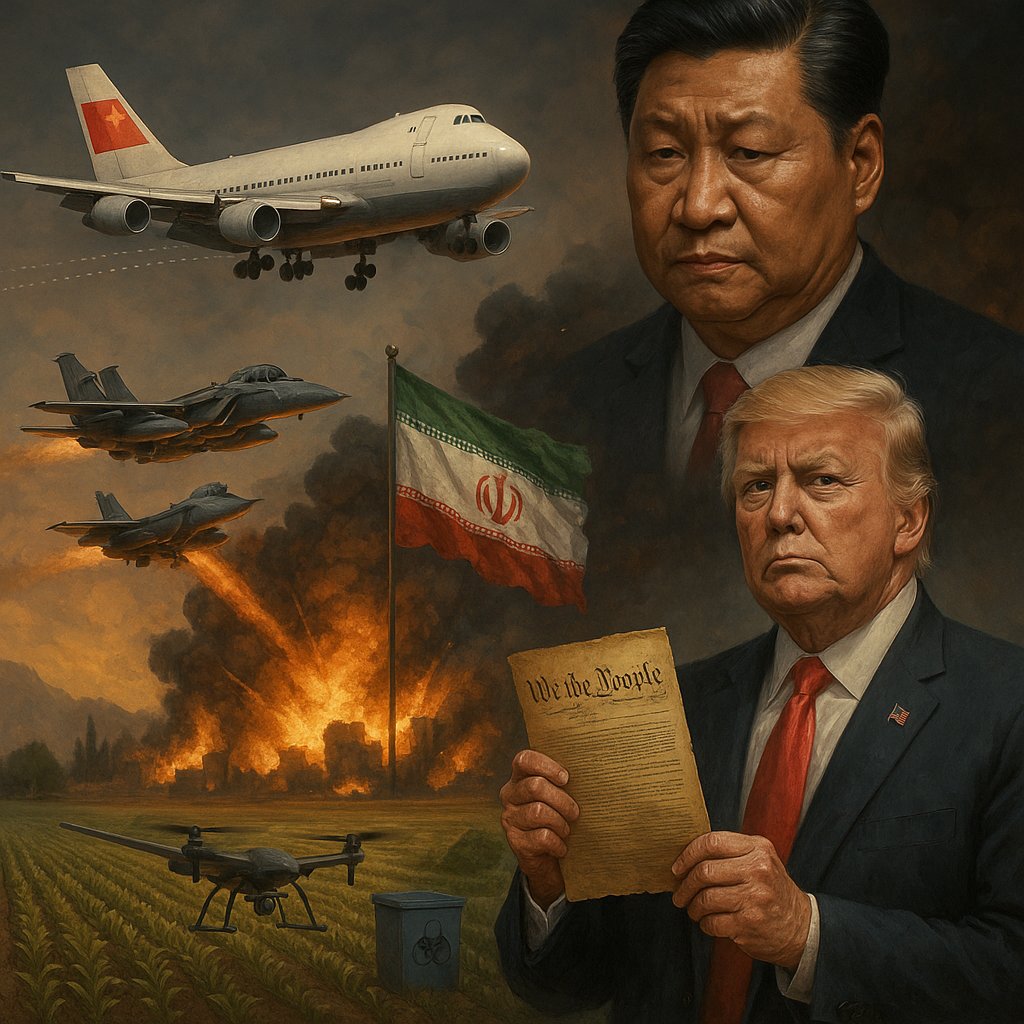
The request from China carries a self-interest as China’s oil dependencies have become problematic since the Strait of Hormuz became a point of economic friction between Iran and U.S. military forces. The Saudi East/West pipeline was also hit by Iranian backed Houthi rebels from Yemen, creating even more energy turmoil.

Additionally, Beijing is the most exposed to the recent congressional sanctions applied toward countries that retain trade relations with Russia.

Both President Trump and Chairman Xi have a vested interest in seeing an end to the conflict between Russia and Ukraine. However, with EU-NATO still provoking expanded conflict the dynamic has become one of middle-powers (Canada, U.K, EU) against significant energy powers China, USA and Saudi Arabia.

Another way to look at it is the coalition of Green Energy nations -vs- Low Cost energy nations.

The U.K, Canada and Europe have been supporting attacks against gasoline and diesel fuel refineries in Russia. This approach appears to contain a political motivation to drive up gas/diesel prices in the USA as part of an anti-Trump election strategy. The state visit by Chairman Xi comes at a critical time in the global energy dynamic.

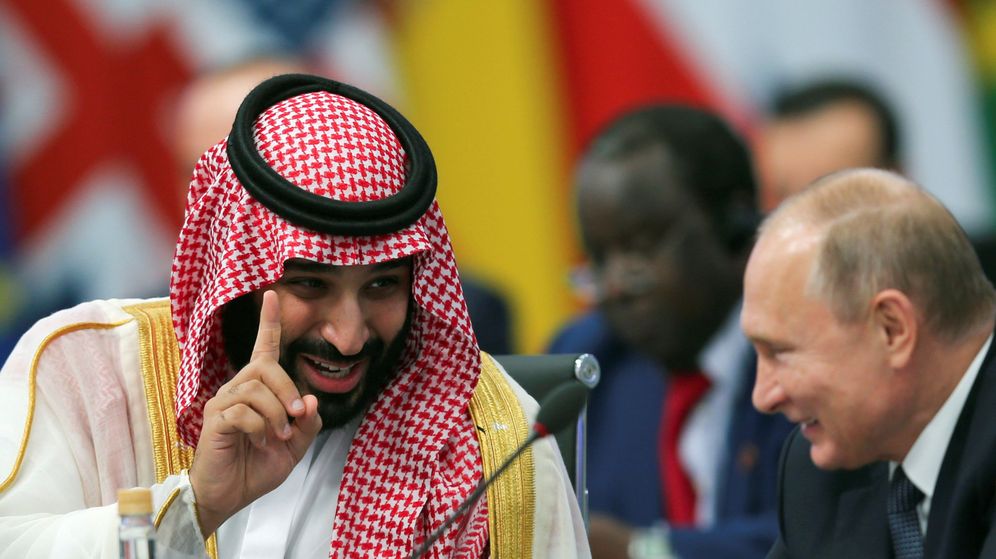
HOUSTON, Sept 18 (Reuters) – Oil prices fell on Friday after China, acting on a request from Saudi Arabia, asked Iran to limit attacks by Houthi rebels on Saudi oil infrastructure that have threatened a second oil export route in the Middle East.
(more…)

Very Interesting – Saudi Arabia Cancels Oil Shipments to Europe

The Iran-backed Houthi rebels in Yemen reportedly hit Saudi Arabia’s east/west pipeline with drones. President Trump did not strike the Houthi’s.  Despite knowing oil prices would jump, President Trump told Saudi Crown Prince Mohammed bin Salmon to approach the issue carefully.

Reuters, citing an Axios report based on two US officials, said Crown Prince Mohammed bin Salman called Trump twice on Thursday and pressed for military action. Trump rejected the request, according to the report.

Why would President Trump ‘not’ strike back against the Iran-backed Houthi rebels, knowing the drone attack on the Saudi pipeline would only worsen the oil issue?  Well, you won’t read this anywhere else…. However, if Saudi Arabia shut down the east/west pipeline for a while (they just did), then the oil flowing to the Red Sea that ends up in Europe would be halted (it just was).

Think about it.  All of a sudden Europe cannot get oil from Mohammed bin Salmon. So, how does that change the dynamic of President Trump’s desired leverage toward Europe in his approach to bringing Russian oil back into the market.

I hope everyone can see the dynamic.  All of a sudden that Russian oil Europe hates so much, turns into dependency leverage against EU antagonisms against solving the Ukraine-Russia conflict.   This is not happening accidentally.

Oil Price News – Saudi Aramco has canceled or delayed crude deliveries to European refiners after the shutdown of the kingdom’s East-West pipeline cut into one of its remaining routes around the Strait of Hormuz.

At least three European refiners have had late-September cargoes canceled or pushed as far out as November, according to market sources cited by Argus. Two more expect notices covering September supplies.

(more…)

“One Ping Only, Vasily”

♦President Trump’s foreign policy approach brought North and South Korea together away from the table of conflict.  ♦President Trump’s foreign policy approach brought Serbia and Kosovo together away from the table of conflict.  ♦President Trump’s foreign policy rallied the Gulf Cooperation Council to stop Qatar’s support for Islamic extremists via the Muslim Brotherhood. ♦President Trump’s foreign policy brought Turkey and the Kurdish forces together away from war and conflict.  ♦President Trump’s foreign policy created a ceasefire to stop the bloodshed in Syria.  President Trump mediated a cessation of hostilities between India & Pakistan in the Kashmir region. ♦President Trump’s foreign policy brought Israel and the UAE together… and then Bahrain… and then Sudan in the Abraham Accords.

President Trump executes a clear foreign policy, a unique doctrine of sorts, where national security is achieved by leveraging U.S. economic power. It has been a fundamental shift in approaching both allies and adversaries; summarized within the oft repeated phrase: “economic security is national security.”

The Trump Doctrine of using economics to achieve national security objectives is a paradigm shift in American politics.  Modern U.S. history provides no easy reference strategy, because until now no American president has ever leveraged this approach.

U.S. B-2 bombers struck Iran on June 22, 2025, as part of Operation Midnight Hammer, targeting key nuclear facilities.

Immediately following the August 2025, Alaska summit between Russian President Vladimir Putin and President Trump, Russia restarted Arctic-2 LNG terminals and began increasing natural gas (LNG) production for storage on ‘floating platforms.’

President Trump met with President Putin on August 15, 2025, and the curious increase in Russian production began on August 18, 2025.

It absolutely did not make sense that Russia would start producing even more LNG considering the previously imposed western sanctions against them, and the fact that Russia was already overproducing LNG. As noted by analysts at the time. Russia had no market for this LNG, yet Russia began increasing LNG supply anyway.  For six months Vladimir Putin extracted and stored LNG.

Two months later, on October 25, 2025, President Trump did something odd.  President Trump had attended the ASEAN summit in Asia before; however, this time instead of flying West over the Pacific, he flew east to Malaysia.  This put a refueling stop in Qatar, which everyone just ignored as a routine part of the travel plan.

However, upon arrival in Qatar, the Amir of Qatar came to the airport to pay a courtesy visit to President Trump.  They spoke aboard Airforce One during the refueling stop.

(more…)

One Major Shift Can Solve the Iran Problem and So Much More

**BUMPED by Request** History has a tendency to rhyme.

There is one move on the geopolitical chessboard that can put all of the U.S. and President Trump’s problems into an immediate checkmate.  However, the forces against the alignment are significant. If President Trump can end the Ukraine-Russia conflict and end the sanctions regime against Russia, everything changes.

Bringing Russian oil, gas and natural resources back into the global economy not only removes all leverage held by Iran, but it also wipes out intransigent resistance against the geopolitical reset and upends over a hundred years of EU and Commonwealth financial manipulation.

Not only does the Iran problem immediately shift, but so too does any/all leverage carried by Canada on behalf of London and the broader commonwealth structure.  With a U.S-Russia strategic economic alliance, something factually stated at the end of every message from Moscow, the dynamics of global structures is entirely different.  However, all the oppositional interests are well aware of the consequence and their actions reflect it.

The United States and Russia ended World War II.  A U.S-Russia alliance would change everything.

Who would benefit from such a strategic partnership?  The USA, Russia, India, China, Saudi Arabia, the Gulf States (GCC), ASEAN countries and even Japan and the Caribbean, including Cuba.

Who would oppose such a seismic shift?  The U.K, specifically the financial constructs within the City of London, Canada, the EU-NATO states, all the Commonwealth countries and the Five-Eyes group (Australia, New Zealand, Canada, the U.K and the U.S. Intelligence Community).

Now we have appropriate context for the dynamic of the issue, along with context for exactly why all oppositional elements are conducting current activity.  A strategic partnership between the U.S. and Russia represents an existential threat to all the old systems – everything.

The first step would be solving the Ukraine-Russia conflict. So, let’s look at that problem specifically and how a transactional approach might frame the four corners of an end to it.

(more…)

U.S. Central Command Destroys Three Iranian Tankers After IRGC Fires Upon U.S. Navy Vessels

The U.S. Central Command has released video showing their elimination of three Iranian oil tankers following an attack on two U.S. navy vessels in the Strait of Hormuz.

TAMPA, Fla. — U.S. Central Command (CENTCOM) forces struck three Iranian crude oil carriers, Sept. 5, after the Islamic Revolutionary Guard Corps (IRGC) launched ballistic missiles toward two U.S. Navy warships patrolling regional waters.

A U.S. aircraft carrier and guided-missile destroyer successfully evaded multiple unprovoked Iranian attacks. No American personnel were harmed.

Following Iran’s failed attacks, CENTCOM permanently disabled the IRGC crude oil carriers M/T Downy off the coast of Kharg Island and M/T Stark 1 near Jask. American forces also completely destroyed the unladen crude oil carrier M/T Kylo (also known as the “Noxen”) in the Gulf of Oman, striking the vessel in multiple critical locations to render it inoperable after the crew was directed to abandon ship.

(more…)

Treasury Secretary Scott Bessent Holds a Fireside Chat During G20 Finance Assembly

On the sidelines of the Asheville, North Carolina, G20 meeting of global finance ministers, U.S. Treasury Secretary Scott Bessent holds a fireside chat to discuss current geopolitical events and economic conditions.

.

(more…)

Treasury Secretary Scott Bessent Announces, “Operation Economic Outcast” Against Iran – Video and Transcript

Secretary Bessent notes in his prepared remarks that President Trump has called the nations who are engaged with Iran to request them to cease and desist.  That means Trump likely called Chairman Xi (China), President Putin (Russia), President Erdogan (Turkey) and President Asif Ali Zardari of Pakistan.

The video and transcript of Secretary Bessent’s remarks are below. Media questions begin at 7:50 of video. WATCH:

[TRANSCRIPT] – Good afternoon.

Today, at President Trump’s direction, the United States Treasury has begun Operation Economic Outcast – an unprecedented campaign against the Islamic Republic of Iran and its enablers.

In the Second World War, D-Day marked the historic beginning of a campaign with our allies to target and drive the enemy from its positions, including those in third countries.

Today, in that same spirit, we are launching an economic onslaught against Iran’s financial connections around the globe. Our objective is to sever every economic lifeline that sustains this tyrannical regime until Tehran stands alone.

(more…)

Promethean Action Reviews Current State of the Middle East as it Evolves

Within this video from Promethean Action, they look at the latest developments in the Middle East.

Treasury Secretary Scott Bessent says the U.S. is escalating economic isolation measures against Iran and forecasts the Strait of Hormuz will become “irrelevant” within two years, while Energy Secretary Chris Wright argues shipping continues under escorts and rerouting, citing 8–9 million barrels/day still moving through the strait plus 6 million diverted via expanding pipelines.

The episode frames this as part of a broader strategy since March 2025 targeting Iran’s financial networks while expanding alternative energy supplies, including increased U.S. production, changes in Venezuela, UAE production outside old OPEC quotas, and Iraq pipeline deals to bypass Hormuz, alongside a nuclear power “renaissance.” It highlights remarks at Chatham House by Lebanese adviser Jean Aziz blaming Henry Kissinger’s 1976 actions for decades of conflict and IRGC entanglement, and Qatar’s Majed Al-Ansari describing a regional Gaza “20-point plan” leading to a Washington-based Board of Peace meeting on Feb. 19, 2026.

.

(more…)

WaPo: President Trump Took Secret Flight Out of Turkey Following NATO Summit

Keep in mind the Washington Post receives all of their exclusives from the CIA leak network.

For some insufferable reason, the Washington Post (CIA) is publishing a story about President Trump’s security protocols following the NATO summit in Ankara, Turkey last month.

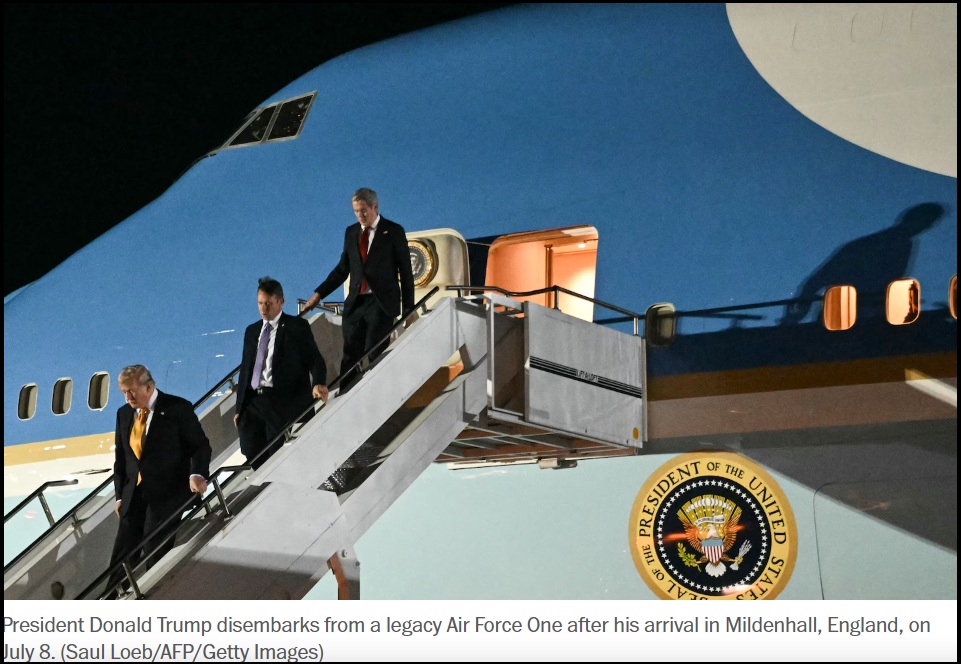
As the story is told, President Trump went into the legacy Airforce One, however, he quietly exited the plane via a catering truck set up on the opposite side of the plane and then he boarded an Air Force C-32 support plane for the flight out of Turkey destined to Britain’s Mildenhall air base.

At the time of the travel there was a credible threat from Iran toward the President.  Apparently, extra precautions were taken, and the Washington Post (CIA) needs to tell people about them.

[…] In Ankara, Trump boarded the old Air Force One jumbo jet in view of television cameras. He was secretly shuttled minutes later to a smaller plane — an Air Force C-32A — via an airport catering truck typically used to load meals and other supplies preflight, according to the U.S. official and corroborating material reviewed by The Post. That made Air Force One a “decoy” with media and some White House staff aboard, the official said.

(more…)

Secretary Bessent Outlines Reality of Capital Markets Making the Strait of Hormuz Irrelevant

Treasury Secretary Scott Bessent gets it.  When asked about the Strait of Hormuz, Bessent notes that yes, things will likely never return to the way they were before; however, there is a distinction that must be applied.

Even if Iran completely acquiesced to all of the most stringent terms and conditions requested by President Trump, they will never again recapture the position they held with the Strait of Hormuz as a chokepoint.

Capital markets respond to risk in the medium and long term; risks are always mitigated.  With the Strait now identified as a strategic risk, the emphasis will be on forever neutralizing that risk and avoiding the issue in the future.  As a consequence, Iran’s strongest point of leverage is disappearing now and will continue to disappear.  WATCH (prompted):

As further explained by James Thorne on X:By repeatedly signaling its willingness to disrupt the Strait of Hormuz, Tehran hasn’t strengthened its hand, it has accelerated the market’s exit. Capital does not tolerate chokepoints; it routes around them.

Saudi Arabia is expanding its East-West pipeline. The UAE has already built out Fujairah as a bypass. Iraq is revisiting overland export corridors. Every marginal dollar now flows toward redundancy, not reliance. What was once a geopolitical lever is being engineered into irrelevance. Bessent gets it: markets don’t absorb coercion; they arbitrage it away.

(more…)