Commerce Secretary Howard Lutnick is at the operational center of the MAGAnomic policy hub. Secretary Lutnick is the pivot point to the technical systems that will pay down the deficit and balance the USA budget. {Direct Rumble Link Here}
In this lengthy interview with Bret Baier, Secretary Lutnick talks about some of the policy proposals, direct actions of the government and economic systems that he and President Trump are putting into place that will grow Main Street and fuel the golden era in American economic growth. Well worth watching:
.
April 2nd, 2025, begins the reciprocal tariff program for all nations.
Moments ago, Commerce Secretary Howard Lutnick took the oath of office in the Oval Office as delivered by Vice-President JD Vance.
Secretary Lutnick is going to be a very key component in the MAGAnomic agenda, likely second only to President Trump. Just as Wilbur Ross was key to unlocking the economy in President Trump’s first term, so too is Secretary Lutnick going to play a pivotal role.
Long before President Trump won the election, Howard Lutnick was one of the few people who really understood the construct of MAGAnomics, how economic nationalism was crucial, and how the strategic use of tariffs creates massive GDP growth. The swearing-in ceremony is very uplifting, and both President Trump and Secretary Lutnick are very positive about the future.
At 11:38 of the video below, President Trump holds an impromptu press conference. WATCH:
Shortly, Vice-President JD Vance is scheduled to meet with Ukrainian President Volodymyr Zelenskyy in Germany, at the Munich Security Conference.
The meeting was originally scheduled to take place this morning, however, a member of the Ukrainian delegation confirmed that their meeting will now take place after 5 p.m. local time in Munich (approximately 11 a.m. ET). Vice-President Vance delivered remarks earlier to the Munich conference.
If you do nothing else today …. WATCH THIS SPEECH!
It is very interesting that JD Vance brought up the recent Romanian election and the nullification of the result by European courts. Vance shot an arrow directly into the heart of the hypocrisy of ‘democracy’ as defined by the European control agents (essentially EU intel). Within the remarks, Vance alludes to missing elections in Ukraine and other various anti-democratic activities that have been recently visible in the EU.
“There is no security if you are afraid of the voices of your own people,” Vance said. Continuing, “if you are running in fear of your own voters, there is nothing the American people can do to assist you.” WATCH:
You can hear a pin drop as Vice President Vance, tells the EU bureaucrats exactly how their activity is undemocratic, totalitarian and against the will of the majority of the people they are supposed to represent.
This is a seismic confrontation between JD Vance, President Trump representing the true cause of liberty, and the EU elites who believe they know better than the proles underneath them with their pesky demands for freedom. Congratulations to JD Vance and President Trump for pulling no punches. This is awesome.
[Transcript] “One of the things that I wanted to talk about today is, of course, our shared values. And, you know, it’s great to be back in Germany. As you heard earlier, I was here last year as United States senator. I saw Foreign Secretary David Lammy and joked that both of us last year had different jobs than we have now. But now it’s time for all of our countries, for all of us who have been fortunate enough to be given political power by our respective peoples, to use it wisely to improve their lives.”
Today, President Donald J Trump signed an executive order triggering the first ever system of “reciprocal trade tariffs,” a seismic change in U.S. trade policy that will also consider the respective nation’s VAT (Value Added Tax) tariff.
Within the executive order [as outlined], the Secretary of Commerce and the United States Trade Representative will consider foreign industry subsidies, and non-monetary tariff barriers as part of the determination of the tariff levied. This is a stunning shift in U.S trade agreements that will cut through all the angles being deployed to avoid U.S. tariffs and block U.S exports into their country.
The policy will pressure foreign nations to lower their trade barriers to U.S. goods and eliminate disparity in foreign trade agreements. One big example will be the impact on the EU through the continuing Marshall Plan. The EU will now face reciprocal tariffs and no longer benefit from one-way tariff acceptance. There are obviously no tariffs on products made inside the USA.
With “reciprocal tariffs” the Commerce Dept and USTR will now determine the trade imbalances with each individual country and will evaluate each FTA (Free Trade Agreement), one-by-one to deconflict the trade imbalance. Direct tariffs, subsidies, regulatory hurdles, non-monetary trade barriers and hidden export subsidies will be addressed as part of the reciprocity evaluation. This is a completely new dynamic in the era of modern global trade and economics.
During the executive order signing event, President Trump took questions from the media. WATCH:
Between now and April 1st, each individual trade agreement will be evaluated with consideration for all facets of the cost for American companies to export to the evaluated nation. Direct tariffs, Value Added Taxes (VAT), state subsidies and non-monetary regulatory tariff barriers, will be determined for each nation. That nation will then be made aware of the tariff against each sector within their export system to the United States.
Effective April 2, 2025, President Trump will then have the tariff data provided by the USTR and Secretary of Commerce. President Trump will determine when the reciprocal tariff will be triggered and will likely engage in discussions with the leaders of the foreign nations.
These fireside chat-style impromptu pressers during executive order signings are awesome. The revolutionary change in government transparency and communication is, well, quite literally historic and stunning. The media can ask questions in real-time as the specific policy is implemented and explained, while simultaneously the ability of the media to shape an anti-Trump policy narrative is removed.
If you have followed the arc of Tech, Peter Thiel recruiting JD Vance, the creation of Palantir, the funding of Vance’s senatorial run, and eventually the roadmap to connect Vance to Trump, this is a video speech you absolutely must not miss. JD Vance was sent to the AI Summit for a reason.
JD Vance talks at the AI summit in Paris, France, about his core mission, his core purpose inside current political influence. This is the very origin of his legacy, unfolding in real time. Vice-President JD Vance talks about Artificial Intelligence, the future and the Trump administration position.
Vice President JD Vance warned European leaders against heavily regulating U.S. tech companies and said excessive efforts by the European Union to regulate artificial intelligence could stymie its growth, during an AI summit in Paris Tuesday that marks his first foreign trip since taking office. WATCH:
.
Do you feel more or less confident about the future, having watched these remarks?
Japanese Prime Minister Shigeru Ishiba was asked for his first impression of President Donald Trump at the conclusion of their first meeting. You could hear a pin drop as the White House press pool listens to the respect delivered. WATCH:
.
Regarding the politics of the Japanese military aspect to the reply. It is the legacy of assassinated Prime Minister Shinzo Abe, who was a close and dear friend of President Trump, that set Japan on the path to rebuilding their military and independent national security. PM Abe was crossing the country to talk about the need for a newly built military that would provide American defense forces the ability to draw down. PM Ishiba is continuing that legacy initiative.
President Donald Trump and Japanese Prime Minister Shigeru Ishiba hold a press conference in the White House at the conclusion of their bilateral meeting. Livestream Links Below:
Big Panda has a problem, and his name is President Donald Trump.
CTH went (proactively) directly into the heart of the Chinese Potemkin Village, much like my trip to Russia, to specifically see what the reality is on the ground in the region of all Beijing influence. Where the East meets the West you will find a hot mess of propaganda, kept in place by widespread geopolitical pretending.
Never was that reality clearer, than in the example of the retaliatory tariffs announced in response to President Trump’s trade tariffs.
(Via AP) – China said it would implement a 15% tariff on coal and liquefied natural gas products as well as a 10% tariff on crude oil, agricultural machinery and large-engine cars imported from the U.S. The tariffs would take effect next Monday. {link}
First, tariffs on energy products are pure propaganda. Coal, LNG and crude oil are fungible. In the case of China the energy products arrive from a global market, there is no identifiable way to tariff American energy products. This is not like Canada where the Candian energy products are entirely dependent on pipelines into the USA, and therefore unavoidably easy to tariff by Trump.
Chairman Xi gets most of the Chinese imported energy resources from Russia, specifically Coal, LNG and Crude Oil. So, this subset of tariffs against American energy products is pure propaganda, essentially moot.
You know who buys USA-made “large-engine cars” (Chevy Tahoe, GMC Yukon and Ford Raptors) in China? People well connected to the Chinese Communist Party, that’s who. If you are not a member of the elite ruling class in China, you do not buy large-engine cars. So, what exactly is the intent on this one? The target is a domestic internal political apparatus, in combination with narrative creation that Beijing believes will create the biggest splash headlines in the West. That’s it. Again, pure political propaganda.
Earlier today, President Trump signed several executive orders recognizing and structuring ongoing efforts including the creation of a USA “Sovereign Wealth Fund.” Full Video below:
.
WASHINGTON DC – […] The new wealth fund, which Treasury Secretary Scott Bessent told reporters could be formed in the next 12 months, could be used to finance major government projects and fund strategic investments in critical areas like supply chains. Sovereign wealth funds in the Middle East and Europe are among the largest institutional investors in the world, providing massive pools of capital for Wall Street firms and the U.S. tech industry.
Knowing the severe ramifications likely and taking a proactive approach toward root-cause analysis, CTH attended the ASEAN summit to gauge how Asia was likely to respond to Trump term-2 and the looming possibility of a severe nationalist approach toward a renewal of USA manufacturing. The untangling of the Beijing Belt & Road initiative was a key topic of interest noted. [Watch Vietnam, Thailand and the Philippines.]
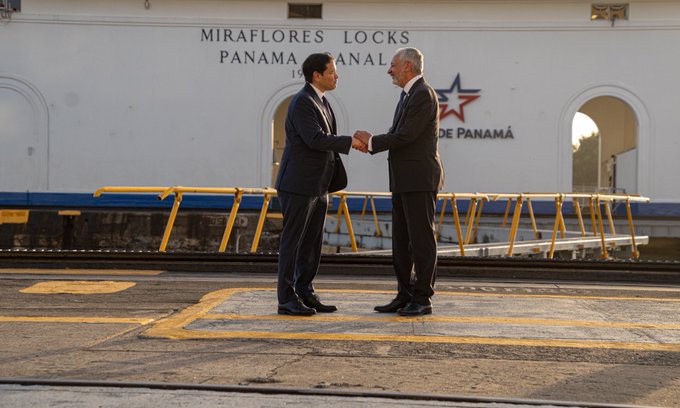
Secretary of State Marco Rubio traveled to Panama this weekend to express the position of President Donald Trump as it pertains to Chinese influence over the maritime transit gateway known as the Panama Canal. Following the meeting with President José Raúl Mulino, the government of Panama has announced they will no longer support China’s Belt & Road initiative.
STATE DEPT – Secretary of State Marco Rubio met with Panamanian President José Raúl Mulino and Foreign Minister Javier Martínez-Acha today in Panama City to address critical regional and global challenges. Secretary Rubio informed President Mulino and Minister Martínez-Acha that President Trump has made a preliminary determination that the current position of influence and control of the Chinese Communist Party over the Panama Canal area is a threat to the canal and represents a violation of the Treaty Concerning the Permanent Neutrality and Operation of the Panama Canal. Secretary Rubio made clear that this status quo is unacceptable and that absent immediate changes, it would require the United States to take measures necessary to protect its rights under the Treaty.