A win tomorrow would be the three nuclear power leaders agreeing to meet again for further discussions. Taking on the global ‘middle powers’ who control finance and banking structures would be a big bonus.
President Trump, Xi Jinping and Vladimir Putin are meeting in Shenzhen, the first summit ever of the leaders of the United States, China and Russia. The establishment press calls it “Yalta 2.0.” Susan Kokinda argues that what London really fears is a Bretton Woods 2.0. She starts with the reactions of Richard Haass and the Atlantic Council’s Frederick Kempe, then checks them against physical reality: together the three nations produce 60% of the world’s crude steel, 67% of its aluminum, 83% of its rare earths and 88% of its orbital launches.
From there Kokinda follows the gas price paper trail after the midterms back to August 15, 1971, when Nixon ended Bretton Woods and the City of London’s speculation machine took over, and to the billionaires who profit from it and finance the Democrats’ “affordability” campaign. Finally, Marco Rubio and JD Vance on an economy that serves people: the American System of Hamilton and Lincoln. And Judy Shelton, now Counselor at Treasury, has some advice: buckle up.
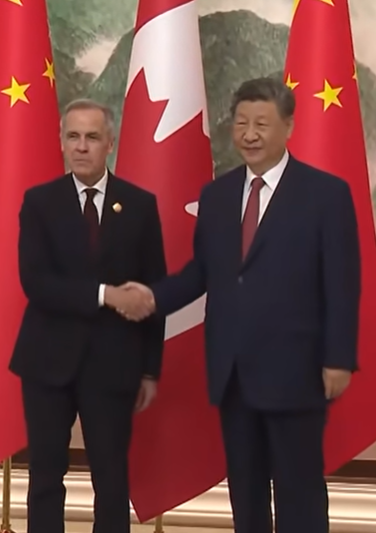
During a press conference for his domestic audience and traveling press pool, Canadian Prime Minister Mark Carney outlined his specific points of focus for an enhanced and collaborative Canada-China relationship. {FACT SHEET HERE}
China’s growing influence, what some may call forming a beachhead in Canada, has been a concern to many Americans. However, as noted in the response to the general question about President Trump’s statements toward Carney, the Canadian PM noted that as a general matter President Trump is not concerned about Canada-China trade and the subsequent influence therein.
From a U.S. perspective Trump’s pragmatic outlook makes a lot of sense. First, at the moment you start to worry about the influence of China in Canada, it’s too late. China operates a long-game approach, and factually China already has the most effective influence operation inside Canadian politics. Quite simply, that horse is out of the proverbial barn and will never get put back; the only option for the U.S. now is to mitigate how the China influence bleeds into the U.S.
Secondly, Canada is sending fish, beans, seed oil and non-rare minerals to China, that part is irrelevant. The imports from China into Canada are where the U.S. interests exist. Due to pre-existing leverage and financial ties inside Canada, Carney is open to Chinese steel, aluminum and autos. However, Chinese autos will never come into the USA and will, predictably, destroy the Canadian auto industry. Canada’s continued import of Chinese steel and aluminum is a core issue behind the U.S. tariffs. Carney has just made those “non-melt and pour” tariffs permanent.
Operating on behalf of the British Commonwealth, Mark Carney is trying to leverage China as a threat; but again, the Chinese industrial infection will not come south. Carney doesn’t have leverage on this issue and President Trump is seemingly just flipping him off. WATCH (prompted):
Canada is simply not in alignment with the interests of North America. Canada carries a European outlook in the approach toward China. Slowly, China is dominating Canada economically, as they are Europe, and trying -from the outside- to save a dying economy whose political interests exist as an outcome of their need to pretend they are not being dominated is a futile effort.
Carney has lots of prose but very little substance. He is selling off Canadian assets to prop up his own existence. Chairman Xi is a willing buyer, and President Trump understands the negotiations toward Canada are best directed at the new ownership of Canada, not the transitional tenants.
Lastly, what Carney says in response to that question is a little funny and entirely lost on the Canadian people who likely listen to it. Remember, the #1 complaint Carney had (falsely) was that the U.S. was interfering in Canadian “sovereignty.” That’s the entire “elbow’s up” movement. Yet what Carney outlines is an ambivalent U.S. President who, quite frankly, doesn’t give a darn about what Canada does. Think about it.
During the arrival ceremony and group picture at the APEC summit, President Trump was the final dignitary to present with Chairman Xi during the arrival. Following that moment, the group assembly begins, and it was interesting the first person to enter for the lineup was Russian Federation President Vladimir Putin.
This is the first moment the three leaders have assembled in the 2026 APEC summit. There is significant buzz about it.
You can tell Chairman Xi is very focused on President Trump almost to the exclusion of all other participants in this 2-minutes of video. In addition to formal diplomatic protocols Trump and Xi have spent considerable private time together during each of their last exchanged state visits. You can see the personal relationship dynamic as Xi is careful to guide President Trump throughout. Very interesting. WATCH:
The official ASEAN Summit ended yesterday; however, the leaders of the southeast Asian nations awaited the arrival of President Trump to hold a special ASEAN-USA Summit, focused on geopolitical relationships and trade specifically with the United States of America.
The ASEAN special U.S. summit included a dinner with ASEAN leaders in honor of President Trump, hosted by Philippines President Ferdinand Marcos, Jr. Both President Marcos and President Trump delivered remarks at a dinner to celebrate the occasion. WATCH:
After approximately 18-hours of travel time, President Donald Trump arrives in the Philippines and is greeted by Philippine President Ferdinand Marcos, Jr.
President Trump arrives as the Association for Southeast Asian Nations (ASEAN) summit is wrapping up, and several leaders were awaiting his arrival to participate in official trade signing deals that were assembled prior to the ASEAN summit beginning. A Quad meeting (Australia, Japan, India and USA), and a bilateral trade announcement with Thailand are on the schedule. President Trump’s schedule is packed with rapid fire meetings and discussions.
The arrival ceremony is below. WATCH:
President Trump then quickly headed to a Quad Meeting between the leaders of Japan, Australia, India and himself.
Hopefully this does not come as a surprise to readers here. CTH has been outlining the most predictable outcome within the auto-sector if the U.S-Canada trade talks fracture. Today, speaking from Phnom Penh, Cambodia, Prime Minister Mark Carney said if the U.S-Canada trade talks don’t end up with support for the Canadian auto-sector, then he will shift focus to having the auto plants building Chinese EVs.
This is exactly what we predicted when Carney first agreed to import 49,000 Chinese EVs in January of 2026. Since then, both BYD and Geely are currently shipping cars into Canada. However, it was obvious that both companies would be willing to expand their assembly operations into unused Canadian auto plants.
First, here’s Carney outlining how China is his fallback position if things don’t work out with the USA. (Prompted):
Canadian media immediately picked up on the issue {see here}, because Mark Carney is going to the APEC summit in China and this is likely to be part of the trade/economic dynamic.
PHNOM PENH, Cambodia — Prime Minister Mark Carney said Monday that Canada could turn to Chinese automakers if trade negotiations with U.S. President Donald Trump fail to preserve an integrated North American auto industry.
Carney’s comments in Cambodia came ahead of a planned meeting with Chinese President Xi Jinping this week in Shenzhen, China, where Chinese auto manufacturing is expected to be discussed. The two leaders reached an agreement in January allowing tens of thousands of Chinese electric vehicles into Canada at reduced tariffs.
“We have the best auto workers in the world, and we want them fully deployed, full opportunity, in an integrated North American market,” Carney told reporters in Cambodia. “That market has become less integrated because of U.S. trade actions.”
The movement to recruit Secretary of State Marco Rubio as the 2028 GOP Presidential Nominee officially began this weekend with the production created around this speech at the Federalist Society National Lawyers Convention in Washington DC.
Right now, Secretary Rubio has no substantive reason to run for office in 2028. However, there are exceptionally well-funded organizations and interests that are strongly positioning to change that. The speech was followed by a question-and-answer session that is as substantive as the speech itself.
Rubio was introduced by his daughter, and it is well worth watching the introduction first – so there are two videos, starting with the introduction. WATCH:
The full speech video and Q/A with Secretary Rubio is below.
As long as the Iran conflict continues, energy speculators have the justification for higher oil, gas, fuel and energy prices. Even if global oil and gas flows return to their pre-conflict levels, so long as the conflict itself is in place the market traders, speculators and manipulators have a justification for higher prices. The center for this global financial matter is London.
If you are an EU minded ‘climate change’ ideologue having constructed decades of fabricated net-zero objectives, the Iran conflict now serves your interests. The Iran conflict does not assist the interests of the people of Europe, but rather the interests of the political and powerful elite in finance control who benefit from higher prices of traditional energy.
The blame for higher EU energy costs now shifts from EU climate advocates to Trump.
Here’s where it takes a Machiavellian twist. One way to keep the Iran situation in place is to place ancillary pressure on the key to the solution, Russia.
So long as the EU keeps threatening Russia with expanded conflict, there is no motive for Russia to assist President Trump in the solution within Iran. Solving the crisis within Iran is against Putin’s security interests, as long as the EU threat holds some reasonable possibility, because Iran -a Russian ally- can strike Europe with their remaining ballistic missile inventory.
What we see is the creation of a Gordian Knot. You cannot resolve the Iran conflict so long as Russian security interests are threatened, and you cannot resolve the Russian security interests as long as the Ukraine-Russia conflict continues.
President Trump wants the Iran conflict resolved. Russia is the key; which is why President Trump has redirected diplomatic resources to resolve the Ukraine-Russia war. However, that war underpins the justification for expanded conflict espoused by Europe toward Russia. The EU take a hostile position toward Russia knowing a peaceful resolution is against their ‘climate change’ agenda. There are trillions of pre-positioned interests at stake.
Ukraine President Vladimir Zelensky (correct name) tells his western supporters that President Trump is too favorable toward the position of Russian Federation President Vladimir Putin. {SOURCE} This is not fully accurate, nor is it entirely false. The missing element is ‘why’.
The remarks by Zelensky, Kushner and Witkoff are below in the first 6 minutes of the video.
The main thrust from Ireland is for Europe to be actively involved in negotiating any agreement between Ukraine and Russia. Considering the puppet status of Zelensky in this dynamic, the demands from the EU gnats makes sense, although it is annoying.
Kushner affirms he conveyed this request to Vladimir Putin in Moscow, and posits that Putin was open to talking about the larger security ramifications with Europe and Ukraine. This should please the Europeans; however we should remind ourselves of the upcoming APEC summit which will bring Putin, Trump and Xi together. That table is much more consequential than the net-zero gnats that puff their tailfeathers around Dublin.
Stephen A. Smith sits down inside the White House Roosevelt Room with President Donald Trump for a wide-ranging interview on the post-midterm landscape.
Topics include the GOP’s electoral losses, the ongoing conflict with Iran, rising gas and grocery prices, and the economic impact of sweeping tariffs. The conversation also dives deep into Trump’s record with Black voters, HBCU funding, criminal justice reform, border security under Chief of Staff Stephen Miller and Jensen Huang’s resignation from Nvidia.
Chapters:
0:00 Intro: Inside the White House Roosevelt Room
1:11 Analyzing the 2026 Midterm Election Losses
5:45 Ken Paxton, John Cornyn & GOP Primary Endorsements
8:47 The War with Iran, Nuclear Threats & Gas Prices
16:16 How Tariffs Are Bringing Back U.S. Manufacturing