Treasury Secretary Scott Bessent gives his perspective on the Xi, Putin, Trump trilateral meeting in Shenzhen, China.
Bessent also discusses the Ukraine-Russia conflict, the issues with Nvidia and Jensen Huang, the status of the war against Iran and the personal threats against his life. WATCH:
This one was easily predictable as we noted the day after the election. Democrats are going to target Elon Musk, SpaceX and Starlink over the Ukraine issue.
The incoming Chairman of the House Permanent Select Committee on Intelligence (HPSCI) Jim Himes, has sent a demand and threat letter to Director of National Intelligence Jay Clayton, demanding answers over how Ukraine has been impeded in their use of Starlink to conduct offensive military action against Russia.
(VIA CNN) – A top Congressional Democrat is warning that lawmakers will withhold government funding for systems developed by Elon Musk’s SpaceX if the Trump administration and tech billionaire refuse to disclose who is responsible for ordering the slowdown of Ukraine’s military-grade Starlink satellite service, CNN has learned.
In a classified communication sent to Director of National Intelligence Jay Clayton, Democratic Rep. Jim Himes — who will become chairman of the House Intelligence Committee in January — demanded clarity on what led to the slowdown of Ukraine’s Starshield connection speed on multiple occasions in recent months, according to an excerpt of the communication obtained by CNN.
“Simply, our committee cannot authorize funds for the development of government systems that the government will not fully control,” Himes wrote to Clayton. “I appreciate your assistance in obtaining transparency in this instance so we can have confidence going forward in authorizing funding for the development of systems using SpaceX as the primary vendor.”
There is a shift in the U.S-Canada trade negotiations that is now beginning to surface. In preparation for what comes next Canadian trade negotiator Dominic LeBlanc is informing Canadian media to prepare for tariff permanence.
This outline may be lengthy because there’s a lot to update. First, we need to remember what the difference is between Section 232 tariffs and Sec.338 tariffs.
♦ Section 232 tariffs are the national security tariffs on steel, aluminum, autos and lumber. Those sectors of the U.S. manufacturing base are considered critical industries vital to the national security interests of America. The steel and aluminum tariffs are based on the “melt and pour” rule. All steel and aluminum products not melted and poured in North America are subject to an import tariff. Canada doesn’t melt and pour much; instead, they import from China.
Section 232 tariffs are permitted within the USMCA trade agreement because they apply to national security interests. Additionally, Canada holds tariffs and quotas against U.S. steel, aluminum, lumber and cars. The United States finally put our foot down. The 232 tariffs were U.S. national security matters and issues of trade reciprocity.
The Sec.232 tariffs against Canadian steel, aluminum, autos and lumber are the issue that triggered tariff retaliation from Canada. Remember, the 232 tariffs are the ones that matter most. These are the tariffs that form the cornerstone of a renewed American manufacturing system.
♦ When Canada retaliated against the Sec.232 tariffs with a set of punitive tariffs against U.S. products intended to target political areas of the USA that support President Trump, the Trump administration responded with retaliation of our own. Those U.S. retaliatory tariffs are the Sec.338 tariffs.
The Sec.338 tariffs are U.S. tariffs in response to retaliatory trade actions taken by Canada, which included banning U.S. alcohol imports and similar retaliatory measures. This is critical to remember. The U.S. Sec.338 tariffs are not a priority to the USA; they were simply tariffs punching back at retaliatory Canadian trade action. At the core matter, the U.S. trade position really doesn’t care much about the Sec.338 tariffs, they represent hitting back at Canada against a sector of trade that represents 0.03% of total U.S. trade.
Summary: From a strategic USA position – Section 232 tariffs are important to MAGAnomics. Section 338 tariffs are simply not important; they are basically political gloves slapping political faces.
It’s quite a remarkable story in the arc of history. After WWII American industrial production expert W. Edwards Deming went to Japan and helped them establish some of the world’s best quality manufacturing standards. Eighty years later and the offspring of those Japanese industrial beneficiaries have returned to America to help us rebuild the rust belt.
The story of a renewed Japan-USA partnership, spearheaded by a trade policy of President Donald Trump, is turning into a very special relationship between our two economies.
The New York Times has a lengthy article outlining how the Pennsylvania steel sector is revitalized and enthusiastic about the new partnership {SEE HERE}.
NYT – […] Following a fraught $14.9 billion takeover of U.S. Steel by Japan’s Nippon Steel, a squad of translation app-wielding Japanese engineers has descended on the plant, armed with a multibillion-dollar mandate to drag the aging facility into the 21st century.
In the Mon Valley, an industrial region winding along the Monongahela River in southwestern Pennsylvania, land at the Edgar Thomson site is being cleared for a new steel rolling mill the length of five football fields. Inside the existing facilities, equipment is being upgraded, while engineers dispatched by Nippon Steel are introducing new and more efficient Japanese steel-making techniques.
In Mon Valley, “the excitement level is the highest I’ve seen it here in my 27 years,” said Ron Ferchak, a director at U.S. Steel’s Mon Valley Works. The hope, he added, is “that this will be an operation that will carry on for decades.”
[…] Nippon Steel is busy making preparations for the new $3 billion mill that is expected to prolong the site’s life for decades. In total, the work is expected to generate thousands of jobs and more than $1.7 billion in economic activity for Pennsylvania.
U.S. Trade Representative Jamieson Greer gives an interview following his attendance at the APEC summit in Shenzhen, China. Within the interview USTR Greer outlines the current discussions with Chinese trade negotiators around microchip sales, rare earth minerals and ongoing agricultural products.
Russian Federation President Vladimir Putin holds a press conference at the conclusion of the U.S-China-Russia meeting in Shenzhen, China, on the sidelines of the APEC summit.
There is a considerable shift in outlook and position within President Putin as he responds to questions from Russian media. Perhaps, this shift is also what lies behind Jared Kushner’s statements to the Europeans in Berlin, where Kushner emphasized to the EU that Russia was “comfortable” with NATO-like security guarantees for Ukraine {source}.
Kushner’s remarks followed a conversation with President Donald Trump about the trilateral discussion in Shenzhen.
In alignment with the tone shift, the Kremlin quickly uploaded the hour-long press conference to their YouTube channel, with English overlay. Something has definitely shifted. WATCH:
The transcript is a work in progress, but is partially provided below:
[Transcript] – President of Russia Vladimir Putin: Good evening.
I suggest we skip opening remarks and go straight to your questions. Please.
Question: Good evening, Mr President.
Nikita Korzun, NTV.
Your trilateral meeting with Xi Jinping and Donald Trump looks absolutely historic. But do you think it was historic in essence? What did you discuss, and what will happen next?
Thank you.
Vladimir Putin: Nobody knows what will happen next. Only God knows that.
However, I would really want it to have a continuation, at least because in terms of comparing notes, in a number of key areas, we have reached if not an agreement, then a mutual understanding.
This primarily concerns its historical significance and the like. There have never been such meetings before. We have held the first meeting, which has opened a new page in the history of diplomacy.
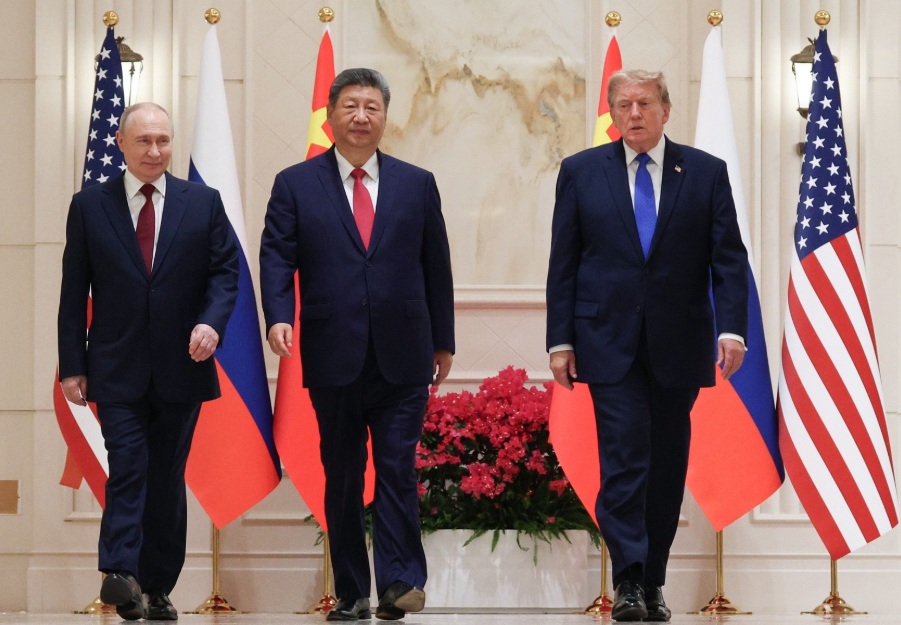
A trilateral meeting between President of Russia Vladimir Putin, President of China Xi Jinping and US President Donald Trump took place on the sidelines of the APEC Summit in Shenzhen.
Taking part in the meeting on the American side were Secretary of State, National Security Adviser to the US President Marco Rubio, Secretary of the Treasury Scott Bessent, Secretary of Commerce Howard Lutnick, White House Chief of Staff Stephen Miller, and US Ambassador to the People’s Republic of China David Perdue.
Taking part in the meeting on the Russian side were Foreign Minister Sergei Lavrov, Deputy Prime Minister – Finance Minister Anton Siluanov, Deputy Chief of Staff of the Presidential Executive Office Maxim Oreshkin, Presidential Aide Yury Ushakov, and Defense Minister Andrei Belousov.
The Chinese side was represented by Member of the Standing Committee of the Political Bureau of the CPC Central Committee, Head of the General Office of the CPC Central Committee Cai Qi, Member of the Political Bureau, Director of the Office of the CPC Central Commission for Foreign Affairs, Foreign Minister Wang Yi, Executive Vice Minister of Foreign Affairs Ma Zhaoxu, Ambassador of the People’s Republic of China to the United States of America Xie Feng, and Ambassador of the People’s Republic of China to the Russian Federation Zhang Hanhui.
[TRANSCRIPT] – President of the People’s Republic of China Xi Jinping: “I very much welcome a trilateral meeting between the leaders of China, Russia and the United States.
The first trilateral summit in this format is truly a landmark event. The main topic of our discussion today is maintaining world peace and promoting strategic stability in relations between major powers. Peace is an eternal aspiration of humanity.
Our planet has seen over 10,000 wars, and the two largest wars brought unprecedented suffering to humanity. There are more than 60 smouldering local conflicts throughout the world. History teaches us that good relations between major powers make the world a safer place, while confrontation between them plunges it into chaos.
There is finally some factual information that has surfaced as a result of Palmer Luckey (Andril, weapons tech) and Elon Musk (SpaceX) that sheds light on the Ukraine issues surrounding Starlink and Starshield.
Zelenskyy is Lying! [23:00]
It started with Palmer Luckey giving a simple explanation about how Musk was put in an untenable position by Volodymyr Zelenskyy and his duplicitous European advocates. Essentially, the U.S. Military and NATO do not want their military satellite constellation known as Starshield to be destroyed by Russia as legitimate military targets. Instead, the advocates for Ukraine want Elon Musk to provide Ukraine with access to the commercial product Starlink so they can hide behind an obfuscation that NATO is not assisting Ukraine directly.
When questioned about it, Musk confirms that Zelenskyy is lying, NATO leaders in Europe are lying and U.S. advocates for Zelenskyy are lying. Starlink is not permitted to be used for offensive military purposes, it is a commercial network, and Musk has no interest in seeing his commercial product destroyed if Russia labels it as a military target. Ukraine has never been given permission to use Starlink for military operations. Zelenskyy is lying. WATCH (prompted):
The United States and EU-NATO have never authorized Ukraine to use Starshield, a completely separate satellite system.
The reasoning is simple, if the U.S/EU-NATO authorize Zelenskyy to use Starshield, Russia may, quite understandably, destroy it because it represents a legitimate military target. It is a risk NATO is unwilling to make.
President Trump, Chairman Xi Jinping and President Vladimir Putin held a historic meeting today on the sidelines of the APEC summit. This is the first time the leaders of China, Russia and the United States have sat down together for formal discussions of world events. The USA, China and Russia are the major nuclear weapon powers.
This is the meeting the international community has been discussing at length, and this is the meeting that has all the ‘middle power’ European leaders in a state of concern. Additionally, this is a meeting of the major world producers of goods, manufacturing materials and products that drive global commerce. These are, quite simply, the ‘hard powers.’
As noted by President Trump in these public remarks, there were background discussions that already took place before the three leaders came to the cameras. Additionally, following these public remarks the three leaders held another round of private discussion. There are multiple videos of the events surfacing; however, the video below gives the best encapsulation of the public moments along with audio translation in real time. WATCH:
The leaders of the APEC nations appear for an official group photograph in Shenzhen, China. Interestingly, Chairman Xi and the Chinese delegation recognize the international attention is toward the upcoming three-way discussion between Chairman Xi, President Trump and President Putin and they position the group photograph accordingly.
After handshakes the group stand for the customary picture with Xi, Trump and Putin at the center. WATCH:
We note that after the picture Canadian Prime Minister Mark Carney attempted to engage with President Trump, but only briefly does Trump give Carney attention; he then quickly dispatches Carney. Watch the body language.