The high court has indicated it will be releasing opinions on one or more of the previously argued cases on Friday February 20, Tuesday Feb 24, or Wednesday Feb 25. The decision over tariffs triggered by President Trump using the International Emergency Economic Powers Act (IEEPA) is one of the decisions now considered highly likely to surface.
If the decision doesn’t come this Friday, a rather interesting situation unfolds. The following week falls into the Tuesday Feb 24 State of the Union address.
Typically, several Supreme Court justices sit in front row of the House floor during the speech. The decision could be released on the morning of the speech, or justices could actually sit in the audience – knowing the outcome and the morning after the State of the Union address, the ruling could be released.
Now, there is a possibility the ruling will not come out in this cycle, but that is diminishing possibility considering the length of time the Supreme Court has sat on this opinion.
The court knows the importance of this decision, and they obviously know the State of the Union speech is scheduled to be delivered on Tuesday the 24th. This will be an interesting dynamic to watch unfold.
While the government of Canadian Prime Minister Mark Carney has inked a trade agreement with China to accept cheap imported vehicles in exchange for Beijing purchasing some agricultural products, President Trump has promised those cheap Chinese EVs will never cross the border into the USA.
The Canadian polling on the issue has done a remarkable chang in the past few years. Now, the majority of Canadians are willing to purchase cheap Chinese EVs. As outlined by Bloomberg, “More than half of Canadians, or 53%, say that knowing an EV was made in China would have no effect on their purchasing decision, according to a new poll by Nanos Research Group for Bloomberg News.”
Approximately 50,000 Chinese electric vehicles will enter the Canadian market in the first year. “The pact with China includes a provision that part of the quota will be reserved for electric vehicles priced at C$35,000 ($25,700) or less, the government has said.” {SOURCE}
The Canadian government wants a Chinese auto manufacturer, any Chinese auto manufacturer, to build factories in Canada to produce these electric vehicles. Canada wants the jobs and economic activity because Canada is currently bleeding jobs and economic activity due to the trade conflict with the U.S.
Building cheap Chinese EVs in Canada might help offset a few thousand job losses, but building Chinese EVs in Canada only further ensures there will not be a substantive trade agreement between the USA and Canada once the USMCA (CUSMA) is dissolved. [More on that coming]
Overnight in the USA time zones, Secretary of State Marco Rubio delivered a very important speech at the Munich Security Conference [3:00am ET]. The video is below [prompted] and a FULL transcription will soon follow Added Below:.
This is a critically worded speech that is very important to listen to with great deliberation. Within his remarks Rubio is telling Europe that we want to remain allied in our interests, but we are no longer going to allow the system of “globalism” to destroy our uniquely American life.
The United States is separating from the madness; this is not up for debate. The only question is whether Europe is too far gone, or whether they will join us.
The euphoria that followed the collapse of the Berlin Wall, “led us to a dangerous delusion. That we had entered quote the end of history. That every nation would now be a liberal democracy; that the ties formed by trade and by commerce alone would now replace nationhood. That the rules-based global order, an overused term, would now replace the national interest, and that we would now live in a world without borders where everyone became a citizen of the world. This was a foolish idea that ignored both human nature and it ignored the lessons of over 5,000 years of recorded human history, and it has cost us dearly.”
[Transcript] SECRETARY RUBIO: “Thank you very much. We gather here today as members of a historic alliance, an alliance that saved and changed the world. When this conference began in 1963, it was in a nation – actually, it was on a continent – that was divided against itself. The line between communism and freedom ran through the heart of Germany. The first barbed fences of the Berlin Wall had gone up just two years prior.
And just months before that first conference, before our predecessors first met here, here in Munich, the Cuban Missile Crisis had brought the world to the brink of nuclear destruction. Even as World War II still burned fresh in the memory of Americans and Europeans alike, we found ourselves staring down the barrel of a new global catastrophe – one with the potential for a new kind of destruction, more apocalyptic and final than anything before in the history of mankind.
At the time of that first gathering, Soviet communism was on the march. Thousands of years of Western civilization hung in the balance. At that time, victory was far from certain. But we were driven by a common purpose. We were unified not just by what we were fighting against; we were unified by what we were fighting for. And together, Europe and America prevailed and a continent was rebuilt. Our people prospered. In time, the East and West blocs were reunited. A civilization was once again made whole. ”
The pundits, economists and financial media are shocked, perplexed, befuddled and flummoxed. The Bureau of Labor and Statistics has released the January inflation data [SEE HERE] and the results are much better than they expected.
Overall inflation is 2.4% year-over-year, and there are zero indications that tariffs are having any impact on consumer prices [See Apparel].
CORE inflation, which removes food and energy, comes in at 2.5% year-over-year, the lowest number since March 2021. This is like reliving 2018 all over again, when the pundits proclaimed with absolute certainty that Trump’s tariff approach was going to cause inflation; it never happened.
VIA ABC – Inflation cooled in January, dropping price increases to their lowest level in nine months, new data from the Bureau of Labor Statistics showed. The lower-than-expected reading defied fears of a tariff-induced hike in overall costs.
Prices rose 2.4% in January compared to a year earlier, according to the Consumer Price Index.
Writing on a Truth Social post earlier this evening, President Trump is threatening to block the U.S. side of a new bridge that links Detroit, Michigan to Ontario, Canada:
(Truth Social) – “As everyone knows, the Country of Canada has treated the United States very unfairly for decades. Now, things are turning around for the U.S.A., and FAST! But imagine, Canada is building a massive bridge between Ontario and Michigan. They own both the Canada and the United States side and, of course, built it with virtually no U.S. content. President Barack Hussein Obama stupidly gave them a waiver so they could get around the BUY AMERICAN Act, and not use any American products, including our Steel.
Now, the Canadian Government expects me, as President of the United States, to PERMIT them to just “take advantage of America!” What does the United States of America get — Absolutely NOTHING! Ontario won’t even put U.S. spirits, beverages, and other alcoholic products, on their shelves, they are absolutely prohibited from doing so and now, on top of everything else, Prime Minister Carney wants to make a deal with China — which will eat Canada alive. We’ll just get the leftovers! I don’t think so.
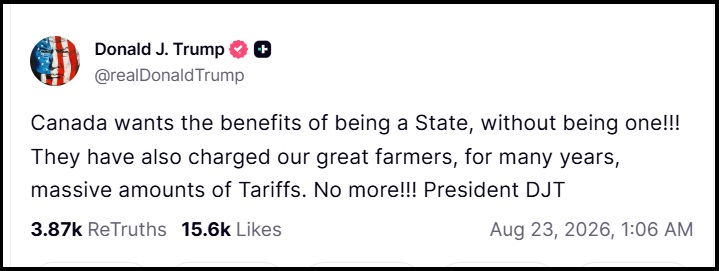
The first thing China will do is terminate ALL Ice Hockey being played in Canada and permanently eliminate The Stanley Cup. The Tariffs Canada charges us for our Dairy products have, for many years, been unacceptable, putting our Farmers at great financial risk. I will not allow this bridge to open until the United States is fully compensated for everything we have given them, and also, importantly, Canada treats the United States with the Fairness and Respect that we deserve. We will start negotiations, IMMEDIATELY. With all that we have given them, we should own, perhaps, at least one half of this asset. The revenues generated because of the U.S. Market will be astronomical. Thank you for your attention to this matter!” ~PRESIDENT DONALD J. TRUMP
The USMCA renegotiation plan likely plays a big part in this announcement. Don’t react, just watch.
Japanese Prime Minister Sanae Takaichi took a calculated risk only three months after her October 2025 election victory when she dissolved the Japanese Parliament and called for a snap election. The high-stakes gamble paid off, with Japanese voters handing her ruling Liberal Democratic Party (LDP) a big super-majority Sunday.
Takaichi said in a January press conference, calling for the snap election was a “profoundly weighty decision,” adding that “by doing so, I am also putting my position as prime minister on the line.”
The voters responded with great enthusiasm for her leadership. Sanae Takaichi was also a protege’ of former Japanese Prime Minister Shinzo Abe, a close personal friend of President Donald Trump.
President Trump who heartedly endorsed Takaichi also celebrated the outcome on Truth Social: “Congratulations to Prime Minister Sanae Takaichi and her Coalition on a LANDSLIDE Victory in today’s very important Vote. She is a highly respected and very popular Leader. Sanae’s bold and wise decision to call for an Election paid off big time. Her Party now runs the Legislature, holding a HISTORIC TWO THIRDS SUPERMAJORITY — The first time since World War Il. Sanae: It was my Honor to Endorse you and your Coalition. I wish you Great Success in passing your Conservative, Peace Through Strength Agenda. The wonderful people of Japan, who voted with such enthusiasm, will always have my strong support.”
Treasury Secretary Scott Bessent appears on Fox News to discuss the current state of the U.S. economy as contrast against current growth plans and economic policy. As noted by Bessent, the future of the Main Street economy generally lags behind the forecast of the Wall Street economy. All of the domestic investment is currently building out the capacities of the underlying economy to expand.
Additionally, Bessent notes the importance of the cumulative effect of strategic energy policy, the assembly of a critical mineral reserve and the mounting growth in the industrial manufacturing center. MAGAnomics is creating expanded domestic growth by reshoring many of the industrial jobs due to tariff policy. Overall, the interview gives a big picture perspective on the short- and long-term economic program. WATCH:
White House Manufacturing Policy Advisor, Peter Navarro, has written an op-ed warning about a new bill under construction in congress [BILL HERE] that seeks to stop President Trump from blocking the ‘de minimis loophole’ on imported goods.
Previously, various shippers and transport companies like UPS and Fed-X had lobbied congress to retain a loophole on customs and duties allowing items valued less than $800 to enter the USA without tariffs. They were joined by ecommerce outlets like Amazon, Alibaba, Temu and Shein to keep cheap foreign goods flowing into the U.S. without passing through customs declarations.
President Trump stopped the de minimis loophole on China and Hong Kong and then globally.
As noted by Navarro, “the threshold for the exemption hit a staggering $800 per package — by far the highest in the world. Europe’s is closer to $150. Japan’s is under $70. China’s general threshold is in the single digits. The U.S. wasn’t “aligned with global norms.” We were the outlier, and a very expensive one.”
Now, Navarro is warning that congress is seeking to subvert the Trump position on imports and go back to allowing cheap foreign goods flood the U.S. market at a level that creates chaos in customs enforcement and facilitates the flow of illegal drugs and narcotics back through the system.
(The Hill) – […] Their bill is simultaneously a poster child for big money politics and a breathtaking insult to the public’s intelligence. It assumes voters won’t read past the title, won’t remember why de minimis was killed in the first place, and won’t connect the dots between lobbying disclosures, campaign checks, and a legislative resurrection of a loophole that nearly destroyed U.S. trade enforcement.
President Trump speaks to President Sheinbaum about upcoming USMCA renegotiation, while Mexican Economy Minister Marcelo Ebrard meets simultaneously in Washington with US Commerce Secretary Howard Lutnick and U.S. Trade Representative Jamieson Greer to discuss the upcoming trade review.
(VIA BLOOMBERG) Mexican President Claudia Sheinbaum said she had a “cordial” conversation with Donald Trump on Thursday, discussing trade and security issues ahead of the review of the North American free trade deal.
Sheinbaum said the review of the United States-Mexico-Canada Agreement will continue as planned and that she and the president discussed tariffs and non-tariff barriers in their latest call.
Mexico’s leader added that Trump invited her to the US but that no date has been set for what would be their second in-person meeting.
On security, Sheinbaum offered that both leaders are pleased with the level of cooperation so far between their two countries. Trump agrees “that we are making progress in the general understanding we have,” she told reporters at her regular daily media briefing, without offering more details.
We all know what is likely to happen, these small articles are like aperitifs while we await the main performance. Meanwhile, the overwhelming majority of Canadians -sans possibly Alberta residents- are clueless.
Here we go. If you’ve been under the Treehouse branches for more than a few months, it is now officially time to pull up a rock take a front row seat and enjoy the show. Don’t draw attention to yourself; however, please do bring your favorite beverage, relax and watch what no one else will admit is happening. The 2026 operation to exit the USMCA is officially underway.
While the Snow Mexicans are gnashing their teeth talking about feelings and various shiny things, United States Trade Representative Jamieson Greer is meeting today with Mexican Secretary of Economy Marcelo Ebrard to strategize the best approach for a U.S-Mexican bilateral free trade agreement.
Please remember, in order to fully appreciate the moment, we must allow all negotiation pretenses to remain in place, giving the illusion of something that will no longer be present when the end goal is reached.
Jan 28 (Reuters) – U.S. Trade Representative Jamieson Greer and Mexican Secretary of Economy Marcelo Ebrard agreed during a meeting on Wednesday to begin formal discussions on possible reforms to the United States-Mexico-Canada trade agreement, Greer’s office said.
Possible reforms include stronger rules of origin for key industrial goods, more collaboration on critical minerals, increasing efforts to defend workers and producers, and efforts to combat dumping of manufactured goods, the USTR’s office said in a statement. (LINK)