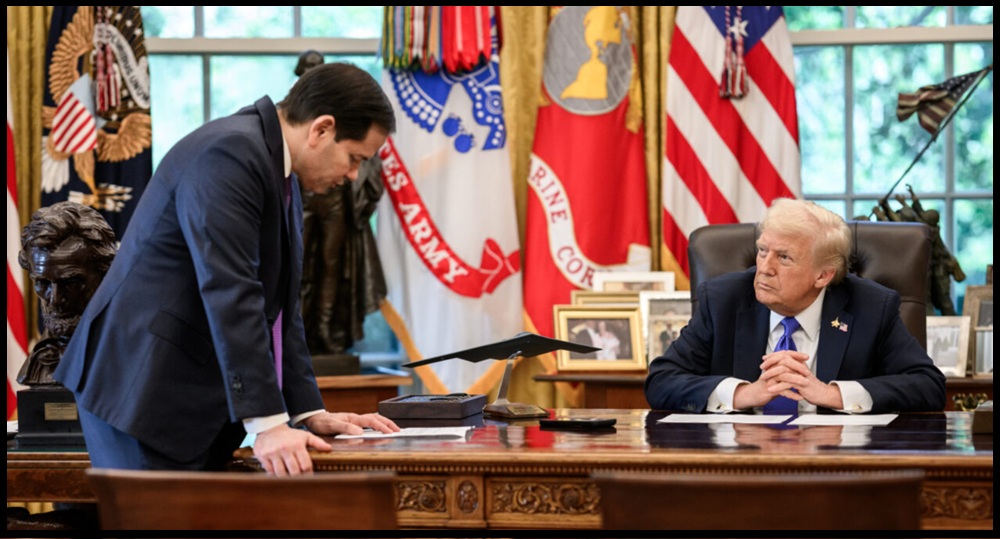
U.S. Secretary of State Marco Rubio used the background of the Acropolis in Athens, Greece, to highlight how western civilized history created the cornerstone of western democratic ideals….. Then government became complacent.
As nations of the western world struggle with retention of civil order, Rubio notes the fundamental ideas and ethical laws that originated from Greece still exist today, and we can choose to reestablish the essential code of ideals and honor.
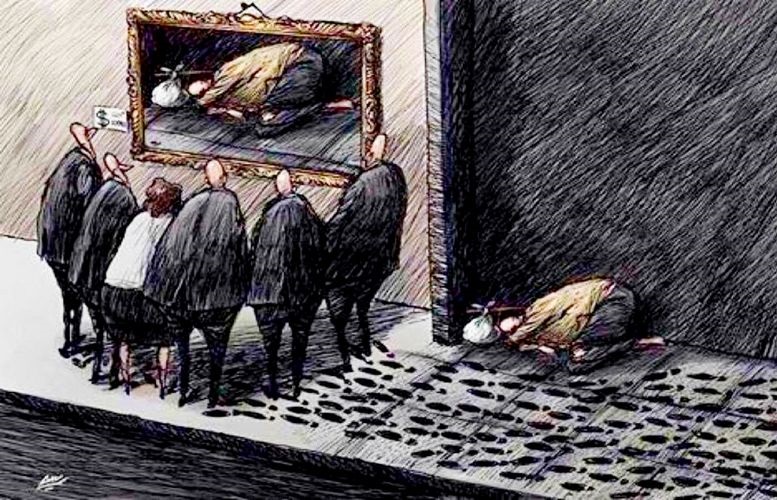
…”Over time, we in the West came to feel ashamed of the very things that made us exceptional. We felt embarrassed that our achievements set us apart from the rest of the world. Our prosperity somehow became a source of guilt. We no longer believed we deserved and had earned our greatness.
The word “nationalism” became a dirty word. And so we tore down our monuments; we condemned our own history. And in too many places, we taught our children to be ashamed of the countries they would inherit. In the process, we opened our borders and outsourced our industry, and allowed our militaries to wither and to decay.
And with every passing year, we seemed to outsource more of our sovereignty, transferring our decisions to global bureaucracies far beyond the reach of our control.”… WATCH:
[Transcript] – SECRETARY RUBIO: “There are great ruins all across the world. In many cases, they are places where history seems to have exhausted itself: remnants of distant cultures that have long passed beyond living memory.
But the Acropolis is different.
For thousands of years, the civilization that built what stands behind me has captivated the imagination of the Western world. Generations of our statesmen, artists, and philosophers have looked to it – they’ve looked to it with wonder and they’ve looked to it with awe.
Now time has a tendency to dull the senses: great victories and catastrophic defeats, they seem to shrink to becoming like a footnote in a textbook, another fact for our schoolchildren to memorize and forget. But the Greeks of antiquity, they seem to have an almost mystical hold on our memory. They call us back to them, again and again.
480 years before Christ, the armies of Xerxes arrived in this city and they put its sanctuaries to the torch. Most Athenians had by then evacuated by ship to a nearby island. But there was a handful of them that refused to leave their home. So instead, they barricaded themselves in the rocky fortress of the Acropolis to fight an extraordinary last stand, heaving massive stones down the cliffs onto the Persian invaders and holding the greatest empire of the age at bay for days. They were eventually overwhelmed. The Persians plundered the temples, burned the shrines, and razed the Acropolis to the ground but when the Athenians returned, they gathered the broken remains of the old Acropolis and buried them in the hill where it had stood. And decades later, under Pericles, they raised the Parthenon.
For 25 centuries since, the Parthenon has stood. Empires have risen and fallen beneath its shadow. And the progeny of the men who built it – the sons of Athens and Rome – have carried their civilization with them to the ends of the Earth.”