Quantcast

Neil Oliver Contemplates Western Leaders Squeezing Jello in a Closed Fist, While BRICS Leaders Smile

Comrade rebels, for his weekly monologue UK pundit Neil Oliver reviews the ever-controlling, increasingly totalitarian, western political landscape, and then gives his perspective on how the BRICS formation seems to be benefiting from it.  It is an interesting contrast worth review.  WATCH:

.

(more…)

BRICS Economic Bloc Expands Adding Iran, Argentina, UAE, Saudi Arabia, Egypt and Ethiopia During Summit

The original BRICS economic alliance between Brazil, Russia, India, China and South Africa has expanded today.  During the summit held in South Africa, the group which is home to about 40% of the world’s population and a quarter of global gross domestic product, voted to accept the applications of Iran, Argentina, Saudi Arabia, United Arab Emirates, Egypt and Ethiopia.

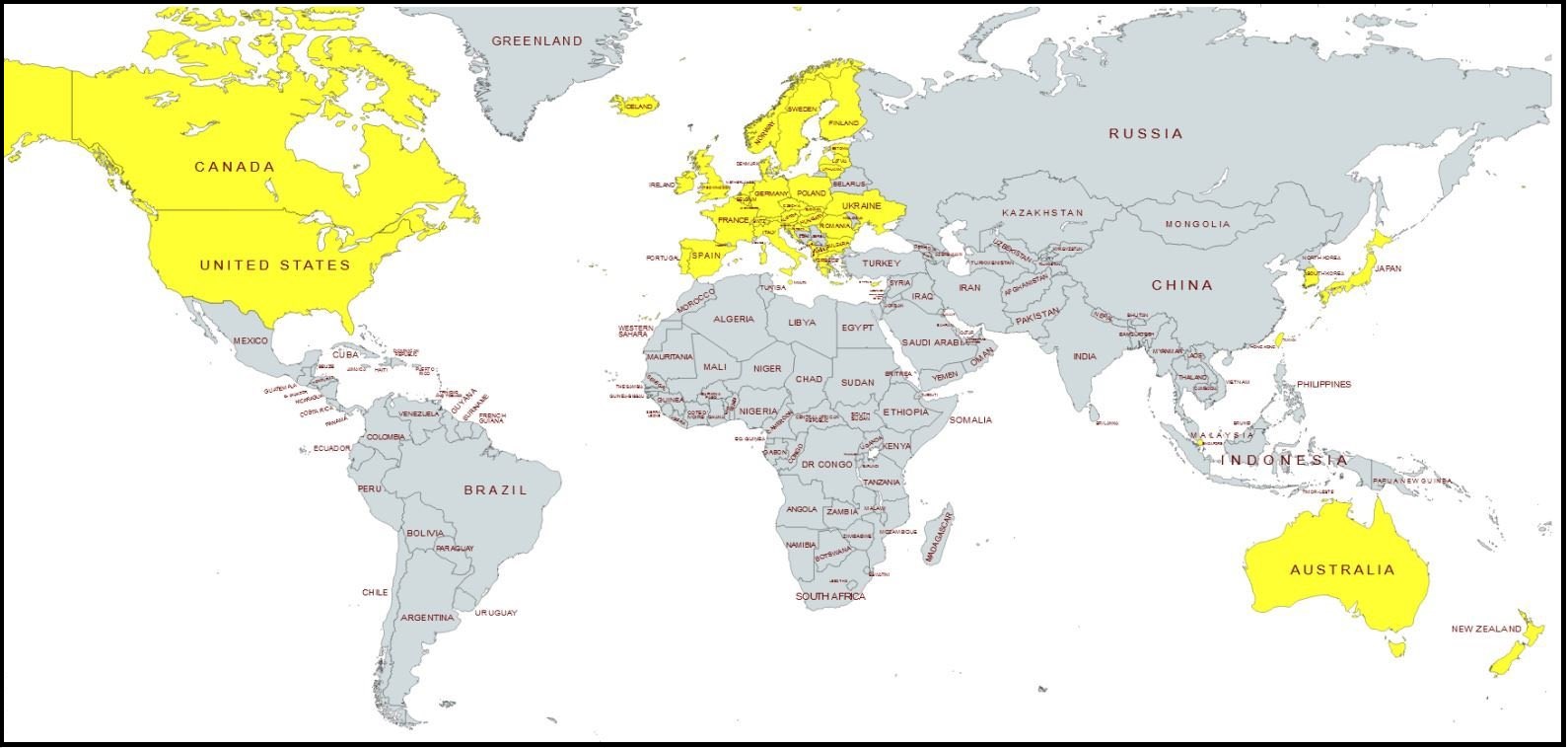
What we see forming now is further evidence of the great energy cleaving.  As most western nations chase the World Economic Forum’s priority around ‘climate change’, the BRICS alliance hedges for more traditional energy sources (oil, natural gas, coal).  China will benefit the most as the Western industrial economies will not be able to compete in a global market using windmills and solar panels.

The western alliance (yellow) will be chasing climate change energy policy to power their economies.  The rest of the world (grey) will be using traditional and more efficient energy development.  The global cleaving around energy use would be complete.

This is not some grand conspiracy, ‘out there‘ deep geopolitical possibility, or foreboding likelihood as an outcome of short-sighted western emotion.  No, this is just a predictable outcome from western created events that pushed specific countries to a natural conclusion based on their best interests.

(New York Times) […] On Thursday, the bloc revealed its decision, adding six new countries, including the staunchly anti-Western Iran, in an apparent victory for Beijing.

(more…)

PREVIEW: Tucker Carlson Travel to Budapest Hungary and Interviews President of Serbia

I swear this guy has people looking over my research shoulder.  Tucker Carlson travels to Hungary, home of PM Viktor Orban, for an interview with the President of Serbia Aleksandar Vučić.  Carlson then shares a preview of the upcoming conversation {Direct Rumble Link}.

We have discussed Hungary quite a bit, because Viktor Orban has been a very public thorn in the side of Joe Biden, the CIA and USAID (same/same), along with the US State Dept. It makes sense that Orban, via Budapest, would be a safe host for a discussion between Tucker Carlson and Aleksandar Vucic. WATCH:

.

(more…)

Republican Chris Christie Advocates for More War, More Conflict, More Turmoil, More Weapons, More U.S Intervention

Big Picture: Democrats want power, Republicans want money – and when it comes to foreign policy, they are in complete UniParty alignment.  This is the baseline to understand why only Donald J. Trump represents an alternative to the foreign policy worldview of the corrupt DC system.  This is also why they hate him and us.

There is no genuine alternative, no distinction between the foreign policy of professional Democrats and the foreign policy of professional Republicans.  The nature of each wing of the UniParty vulture flows in complete sync on the issues of U.S. global interests and the multinational beneficiaries who pay for the policies of intervention.

At the absolute core of the issue for Republicans is the money. The financial mechanisms which create a need for outcomes in various nations.  The ultimate and biggest pay-to-play scheme, where the policy of the United States is sold to the highest bidder and becomes an outcome of the interests of the multinational corporations.  It is maddening to watch this dynamic continue to play out and yet feel incapable of stopping it. This is part of the value in Donald Trump.

(Politico) – Speaking to Erick Erickson at an Atlanta-area conference on Saturday morning, Christie went deep on his foreign policy vision, saying the U.S. must push back against authoritarian leaders and uphold democratic rights and norms in a broad preview of what foreign policy in his administration would look like (more).

Uphold “democratic rights and norms” while we still have the memories of the COVID-19 regime in our memory banks.  How exactly was democracy evident in forced vaccinations, mandated medical rules by fiat, shutdowns, lockdowns, violations of just about every right these presumed democrat leaders claim to advocate?  Who exactly are the totalitarians in this equation?

It wasn’t Russia or Vladimir who forced the U.S. government to mandate medical procedures.  It wasn’t China or Xi Jinping who denied people the ability to comfort their sick, infirmed and dying loved ones.  It wasn’t North Korea or Chairman Kim who arrested parents on playgrounds, chased people from the beach or set about rules saying if you were seated in a restaurant you were safe, but if you stood up the rona would kill you.  These were the insufferable fiats of hypocritical politicians right here in the USA.

But seeing as it is Chris Christie making this argument, let me go bigger.

(more…)

Stunningly Low Prices – A Visit to an Average Russian Supermarket

I wouldn’t normally write a post like this, but WE ARE NOT going to find this level of ground reporting anywhere in U.S. media.   As you might be aware, I have been doing extensive research on the Russian economy specifically with the outcome of western sanctions.

In his video a Youtuber I follow visited a local supermarket, similar to a WalMart Super Center to share information for his USA followers.

Dima Dear, a remarkably nice young man, lives in St Petersburg, Russia (formerly Leningrad), and he shares various experiences with his audience at their request.  There is a lot of U.S interest as people following his story are starting to realize life in Russia is not what western media portray.

If you are familiar with USA grocery prices, what Dima shares in this ground report is stunning from a U.S. perspective.  If you watch this livestream, keep in mind that 100 rubles equals $1.00.  350 rubles is $3.50.  Additionally for weighted products 1kg equals 2.2 lbs.   So generally speaking, if something is 100 rubles/kg it is $1 for two pounds.

Example from the video:

•Lean ground beef at 329 rubles/kg is less than $1.65/lb.
•Bacon at 250 rubles/kg is less than $1.25/lb.
•20 eggs are 139 rubles or $1.39.
•Boneless skinless chicken breast $4 for 4lbs.
•Typical Bagged salad mixes .79¢ each. etc.

The wild part is that in Russia they are getting worried these prices are too high.  👀

The average rent for a nicely furnished 2-bedroom modern apartment in St Pete Russia is around $500/month.  Something akin to downtown Manhattan. Including rent, utilities, food, transportation, personal items and purchases, a Russian citizen can live very comfortably, remarkably comfortably, on an income of around $1,200 to $1,500/month.  In downtown St Pete which is considered a more expensive place to live.

Put that into a USA middle-class perspective and evaluate the impact of western sanctions against the average Russian cost of living.

(more…)

Japan Exports Fall in July, Driven by 14.3% Decline in Shipments to China

Some economic data released by the land of the rising sun points to a larger global weakness in manufacturing demand.   Within the data year-over-year exports from Japan fell in July by 0.3%, which is the first time since 2021 the contraction was noted.

Digging a little deeper, the weakness in Japanese exports is driven primarily by a decline in exports to China of 14.3% in July, which follows a 10.9% decline in June.  Japan is a component supplier to China, which would indicate the demand for Chinese products globally is substantially less than Beijing has previously admitted.

That said, Japan’s direct export of finished goods to the U.S. actually increased 13.5%, mostly driven by the export of electric vehicles.

However, 13.5% is identical to the overall decrease in Japanese imports.

Essentially, component parts to China are down, but completed finished goods to the U.S. are up.  Overall, the results from Japan point to a soft overall global economic status, the result of continued contraction of Western economic activity.

TOKYO, Aug 17 (Reuters) – Japan’s exports fell in July for the first time in nearly 2-1/2 years, dragged down by faltering demand for light oil and chip-making equipment, underlining concerns about a global recession as demand in key markets such as China weaken.

(more…)

Bidenomics – Multiple Key Performance Indicators Spell Trouble Ahead

Several people have made queries about the current state of our national economic condition against the backdrop of disconnected data points that seemingly conflict. Here’s my review.

July and August are key months to gauge the prior six months of U.S consumer positioning.

Why?

Because all advance purchase orders for the U.S. holiday season are made in May, June and July for inventory builds and delivery schedules for September.  The decisions made by purchasing officers in late spring and early summer, reflect their predictive analysis for the holiday season.

Inventories are evaluated, critical financial discussions are held, and orders are placed for September arrival and distribution.  This predictive activity is what we see in the July and August data that flows from the global, multinational and shipping corporations who facilitate the transfer of the goods.  Check what is happening in distribution, and you can see what eventually creates the boxcar effect in the supply chain that ultimately leads to shuttered manufacturing.

Those who are involved in the business of shipping goods are signaling the flares around the state of the consumer economy and what will happen.  At the same time, the wording is almost hilarious in this era of great pretending.  Instead of saying ordinary words like “poor sales results for durable goods,” the parseltongue calls sales, “destocking.”  Example:  “CEO Vincent Clerc said he saw no sign that the destocking which has curbed global trade activity would end this year.”

Global shipping company Maersk is warning that shipping volume is low because warehouse inventories are high.  The goods are unsold.

(more…)

Western Sanctions Not Impacting Russian Economy as Much as Expected

I have been researching the MACRO economic dynamic in Russia quite deeply for the past six months.  Essentially looking to discover not only what impact the western imposed sanctions might be having, but more broadly looking to see what happens to self-sustainability when essentially locked out from the world of commercial imports.

The research is fascinating, not simply because it is a unique opportunity, but also because national economic issues play a big role in the overall social dynamic.  That said, I can say the social aspect is stunningly more interesting than the data driven outcomes.  When you really dig deep into actual life of the ordinary people in Russia, far away from the geopolitical contexts, you get an entirely different perspective.  My worldview of the average Russian person/family has completely changed.

There is a really good thread on how the western sanctions against Russia are having a much lesser impact than initially thought [SEE HERE].  On the economic side, one thing I would point to is how the economy is essentially an outcome of two facets: (1) the internal production strength, and (2) the service side of the ledger.

[READ HERE]

The author makes the accurate point that from a production side perspective, Russia actually has a larger economy now than Germany, the largest EU nation.  The cause for this is “autarchy” or self-sufficiency.  Indeed, as the timeline of the sanctions closes in on the second year completing, the Russian production economy is even stronger than when the sanctions began.  Quite simply, they are making even more of their own goods now.

The sanctions hit what would typically fall into the service side of the economy, as well as financial and economic roadblocks.  However, that aspect of the Russian economy was much smaller than most suspected and there were sanctions going back to 2014 which made the outcome of the 2022 western imposed restrictions less impactful.

I will be finishing my review of the economic data once Q3 is over, that will give me an entire year of data to share.  However, the social stuff is even more fascinating.

I have a new understanding of why former NSA contractor Edward Snowden was so comfortable using Russia as the place to hide after his release of classified intelligence showing how the U.S. government was spying on Americans via social media and metadata collection.

(more…)

A Message From Rush Limbaugh

Wow, does this message from Rush Limbaugh ring true today. {Direct Rumble Link} WATCH:

God Bless Him – We all miss Rush Limbaugh.

Before Donald Trump entered politics there was no home for people voting on the issues of a national economic agenda. Both Democrat and Republican candidates had essentially the same worldview on national economic policy because they are all getting money from the same multinational corporate trough.  However, President Trump changed that dynamic by presenting an alternative national economic policy called America-First.

For decades middle America was begging the McConnell’s, Ryans, Boehners, Romney’s, McCain’s, Bushes, et al, to make America-Fist economic policies their priority.  All of our shouts for help fell upon deaf political ears plugged by corporate donations and influence.  Our communities were literally collapsing around us (see rust belt), and yet no national politician would do anything of consequence.

(more…)

They See It Coming – Fitch Joins S&P to Downgrade USA Credit Rating

Collapse is never a sudden occurrence; it is an outcome of gradual erosion over time. A weakening that takes place almost invisible to those who pass through the construct, until eventually, at an uneventful time in the mechanics of history, the process gives way.

Fitch has joined with the prior position of Standard & Poors to downgrade the USA credit rating. The weight of debt, in combination with reverberations from the continued hammering deep inside the political fundamental change operation, has triggered another flare.

In the bigger picture, this is a self-fulfilling prophecy driven by the latest focus on unsustainable economic policy, aka The Green New Deal. The efforts of the fiscal, monetary and economic policy are all aligned to shrink the U.S. economy, thereby creating the era of “sustainable energy” a possibility. Unfortunately, this is akin to a household intentionally shrinking their income while at the same time taking on credit card debt. The process itself is not sustainable.

(Reuters) – Rating agency Fitch on Tuesday downgraded the U.S. government’s top credit rating, a move that drew an angry response from the White House and surprised investors, coming despite the resolution of the debt ceiling crisis two months ago.

Traders’ immediate response was to embark on a safe-haven push out of stocks and into government bonds and the dollar.

Fitch downgraded the United States to AA+ from AAA, citing fiscal deterioration over the next three years and repeated down-the-wire debt ceiling negotiations that threaten the government’s ability to pay its bills.

(more…)