It is always a good idea to make note of things, put them into referenceable context, and then later tell the full story from background details that will surprise everyone else.
Two significant events have taken place within the last few days against the backdrop of Sinaloa government officials beginning to turn themselves in to U.S. federal authorities.

The first event is the Mexican government freezing the bank accounts and financial assets of those who have been named in the U.S. federal indictment. Mexican President Claudia Sheinbaum says the seizures are out of her control, merely a process that takes place, yet the motives for her defensive protestations are more than a little transparent.
MEXICO – On May 18, President Claudia Sheinbaum confirmed that Mexico’s Financial Intelligence Unit froze the accounts of Sinaloa Governor Rubén Rocha Moya, his children, and senior aides. The action followed U.S. federal charges alleging they aided the Sinaloa Cartel through drug trafficking, weapons possession, and accepting multimillion-dollar bribes. Sheinbaum stressed the freeze was a technical, preventive step triggered by U.S. arrest warrants, not a domestic criminal finding.
The freezes come amid heightened U.S.-Mexico tensions over cartel corruption claims that have already strained security cooperation and political trust. Washington has broadened its anti-cartel strategy to target politicians accused of enabling organized crime, while Mexico remains sensitive to perceived foreign interference. Analysts warn the case could further erode institutional trust and complicate cross-border collaboration on security, trade, and migration. (more)
The second event happened very quietly.
Mexico – Mexico’s federal government quietly approved a new intelligence-sharing arrangement that will allow multiple U.S. agencies to operate inside a major surveillance complex in Ciudad Juárez, according to a report by Drop Site News, even as President Claudia Sheinbaum’s administration has publicly pushed back against unauthorized CIA-linked activity in the country following the deaths of two U.S. officials in April.
The report states that representatives from the FBI, DEA, ATF, Homeland Security Investigations and Customs and Border Protection are expected to work from the 18th floor of Chihuahua’s new Centinela Tower in Juárez, a sprawling surveillance and intelligence hub operated by the state’s Secretariat of Public Security.
According to four senior Chihuahua security officials cited by Drop Site, the agencies will focus on intelligence-sharing tied to drug trafficking, weapons smuggling, organized crime and migration enforcement. (more)
Last weekend, following the Tucson, Arizona, capture of Gerardo Mérida, a retired Mexican army general who served as public-security secretary in northwestern Sinaloa state, Sinaloa Senator Enrique Inzunza Cazárez, who is also facing drug trafficking and weapon charges, was taken into custody in San Diego by the DEA.
Both Merida and Cazarez were named in the lengthy indictment that included current Sinaloa Governor Rocha Moya, who, if ground reports are accurate, appears to be hiding while protected by the Mexican national guard.
According to the New York Post reporting, businessman Enrique Diaz Vega – another name from the indictment – also turned himself into U.S. authorities in Arizona last Friday. That means four of the ten men named are currently in custody, with Governor Rocha Moya hiding out in Mexico.
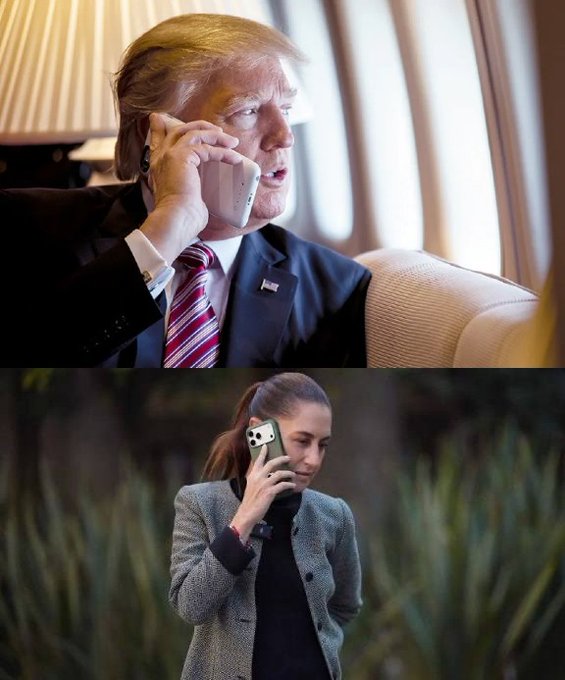
Sheinbaum in between the hardest rock and hard place that ever existed.
Just where she needs to be.
No doubt, Sheinbaum’s been dwelling in this space during her entire political career, her disadvantage being that she became Mexico’s president during the reign of the magnificent 47th President of the U. S.; now the squeeze “is on” w/ no relent.
If she sought and accepted the office of President of Mexico with the sincerest intentions of making Mexico a better, more prosperous, and safer nation, then now is her time to come shining through. Cooperate with Trump and her job becomes exponentially easier. More dangerous for her, but easier to fulfill her obligations to the citizens of Mexico.
Good description.
Hope I’m wrong, but I don’t believe she is the one to maneuver in this situation. What Mexico really needs is a Mexican Trump, someone who both truly loves Mexico and has the talent to take on centuries of corruption.
She is playing it perfectly. They would assassinate a strong man.
I sincerely hope you are correct.
Trump is bad/cop, protecting her. She is good/cop.
Bet she’s strengthened her bodyguards numbers.
They wouldn’t hesitate to assassinate a woman.
They’ve killed plenty.
They would, and have murdered every judge who has come against them.
The only way to stamp them out is literally stamp them out militarily. No survivors!
And the brass ball*
Yes, the brass ball too.
I tend to agree. I’m guessing the US has her in a vice grip and this is her only move, with prejudice.
She is not a wolf, and this is the land of wolves.
Alejandro…Sicario…very nice…
They seem to be following the script… Who is Alejandro in real life… and when will he strike?
Oh, it is highly probable to presume the CIA and DEA are operating inside Mexico right now
Have been, even before authorization…
The cartels are in a tough spot too. If they remove President Sheinbaum, her successor may very well allow U.S. air strikes and other ops on Mexican soil. A number of their confederates are selling out and copping plea deals. This adds another layer of stress.
Had not thought of this situation in the matter you described – you could be correct.
FAFO
Steinbaum probably has a larger bullseye on her back from the cartels than PDJT does from Euro banking elites IOW Rothchilds!
The poster girl for the expression “you dance with the devil…..”
Unless that Rock is not shaped by hands, hmm
Do you imagine she ran for office without knowing what she was getting into? How does a nation filled with Hernández, García, Martínez, López, and González ELECT a Sheinbaum in the first place? Common thought says she was INSTALLED THERE as a trusted operative.
What use are the other six now to the cartel? Should’a high tailed it to the US and surrendered.
froze the accounts of Sinaloa Governor Rubén Rocha Moya, his children, ……… Imagine his children dancing at some disco going up to the bar to pay their tab and it’s declined.💋
Take the money and run.
Where to?
They can run but they can’t hide.
Ha! that’s quite a scenario to imagine.
I’d like to be a fly on the wall for that one.
Imagine the grifters of those children, expecting all their goodies to be covered, and now NOT.
The Gravy Train has reached the end of the line.
I doubt that even the majority cartel leaders’ money is in banks. Most of it is probably in numbered Swiss accounts of any of the Caribbean islands that deal with money laundering and concealment.
This ^^^. Whatever money is frozen was probably left in place for the eventuality/show of being frozen. The money for ‘local ops’ and influence peddling… support of the friends/family. No idea obviously, just a thought. Or, perhaps just hubris “they won’t dare freeze the accounts!”… well, guess what sparky.
Also, not saying “don’t freeze it”, just that this is a first step, not an end.
Please allow me to suggest an alternative view…
Watch American Made (w Tom Cruise) and notice just how much cash he had to manage.
(official trailer ^^^)
All of the indicted have huge stashes in every barn, chicken coop, car trunk, mattress, etc.
However, their “friends” might not, and their loyalty might wane.
That’s true, but unless they want to get facial surgery for their extended family and find a nice quiet mobile home in another country, how long can those piles of cash last?
Protection costs money. Silence costs money. Their “friends” know they have cash lying about.
They can’t sell their big assets without a visible money trail.
They gave out a rather precise location if anyone wanted to find the feds. Also freezing funds keeps them in Mexico
I would think that any cartel member with more than two brain cells maintains a offshore stash of money and a fresh ID in a country that won’t extradite.
I would think that rule would also apply to most of our members of congress.
In reality there are few countries that won’t extradite, treaty or no treaty.
Hence false IDs.
Agree. In this day and age of AI there is really no place to hide. I’m guessing in their line of business there is no dark alley in the world that they will not need to be looking over their shoulders.
Were it me, I’d take the better odds of protective custody as opposed to wondering which of your friends or family might like to collect cash from someone wishing to settle old scores.
Correct. You would have to live off of the grid in a small and remote location. No cell phone or internet. 99.99% of folks could not handle that. Kazinsky the unabomber managed that for some years but made two big mistakes. (1) He continued to communicate to others by mailing package bombs and (2) He wrote a very detailed manifesto that was published and recognized by his brother.
My advice to any cartel member on how to get away: Give up all of your material possessions (this includes money, cars, guns, cell phones, and coke); move to a remote village in another country where you have no relatives (Paraguay, Namibia, Cambodia, etc.); and devote your life to prayer and hard work.
Could be semantics. Operating inside the complex may also mean access to information (computers, servers) and not necessarily being physically present.
That disclosure seemed a bit out of the ordinary. Why telegraph your location?
Could simply be the building and floor the good guys want the bad guys to target.
Dangling a little bait, or setting up some actual bad guys on the 18th floor for a fireworks show.
Could be any number of scenarios.
I noticed that too.
As did I
I thought that was a bit odd, but it could be intentional.
First thought I had. The cartels are armed to the teeth, could blow it up.
Maybe there really is a CIA.
I have no doubt that there are some in the CEYEA and FBLIE who are good folks. But they are probalby few and keeping their heads down, hoping to hang onto their pensions.
More likely, hoping to hang on to their lives.
Those boys play rough.
Just ask JFK…
War on drug cartels needs to be in coherence with war on drug use. As long as there is a demand there will be supply.
Singapore uses the death penalty to address the supply side. Drug use is very low.
So does Saudi
China uses fentanyl to kill hundreds of thousands of mostly white males 24-40 years old and it doesn’t stop drug use here.
The problem is most regular street drugs are now laced with fentanyl and prescription drugs from Mexico sold on the streets are heavily lace with it as well
Agreed. Dangerous drug USERS need to be taken down hard! Start with Hollywood, West Hollywood, Brentwood (L.A. County) and that general area, then work out to similar locales around the country.
The Medical Industrial Complex needs to ger serious about inpatient addictions treatment.
They don’t want to pay for inpatient care. The ACA lets a lot of stuff not me treated or even managed properly.
Why r mexican cartel guys allowed to be in san diego?
Why was a Beliezian rapper who was deported from the US after doing prison time for shooting up a nightclub in NYC back in the US last week putting on a sold out show?
The truth is that “mexican cartel guys” are operating all over California.
Have seen some of them at Costco- with their silicone chicas and all their flashy crap,
alligator skin boots, and expensive vehicles. Huge carts full of stuff.
They could not be more obvious if they tried.
She’s a dead woman walking…..
people Make CHOICES in Life…
It’s not difficult to get stupid people to do stupid things, if you promise them money and power.
Just ask any congress critter. They’ll step up every time.
It’s No Country for Old Women.
‘The seizures are out of my control…”
TRANSLATION:
”I like the way my head is attached to my body and I’d like to keep it like that.”
Why in the Hell would any part of the “Intelligence” in our government share anything with a failed Narco State of Cartel members of Mexico ?
One of the most if not the most complicit in the deaths of over 100.000 + Americans yearly from fentanyl and that doesn’t include the illegal criminals let loose in the U.S.
My grandson lost his daddy to a fentanyl laced overdose…
My sympathies to you and your family.
It has always amazed me how many Americans are directly killed by China and foreign governments and our politicians do absolutely nothing.
It’s very telling with their inaction.
American family members who have lost loved ones don’t pay off politicians nearly as well as China and the cartels do.
Local Mayors and their DA’s are the problem.
We see this in OKC (of all places!).
Our DA has a lovely statement about helping the helpless, on her DA webpage.
She thinks that her statement perfectly reflects her (stated) Christian beliefs.
What about those who overdose?
What about the businesses w vagrants, drug addicts, prostitutes, etc., crowded
around them?
Tough love seems to elude her.
I’m sorry for your loss. Same thing got my oldest son’s father a few months ago. Divorced decades ago, but it was a shock to most who knew him.
Clearly he made a foolish decision while at a ski resort, but he wasn’t expecting it to be laced with… or to die b/c of.
Reality is it’s everywhere, & there are no barriers on those it impacts.
My son thought he was buying bootleg Xanax.
Drugs touch so many families in terrible ways.
I lost my son.
I’m sorry for your loss. May you find peace comfort and strength knowing others care.
Without President Trump she would probably just be another Mexican President turning a blind eye to everything in order to keep from being assassinated by the cartels, and in the process making enough extra on the side to afford a retirement villa in Spain just in case. Now, this is just an assumption, but maybe, just maybe, she has come around to seeing this as an opportunity to eliminate the cartels and get back control of her country?
If the Mexican national guard protects cartel members you can bet we are not seeing the true Hag in Mexico.
It’s probably more likely that her only choice is to be killed by the U.S. or be killed by the cartels. Certainly, more “nuanced” than that. Possibly she was promised protection to her and her family in exchange for cooperation.
“Without President Trump she would probably just be another Mexican President turning a blind eye to everything in order to keep from being assassinated by the cartels”
Just like every other Mexican president. Whether she has come around or not, President Trump has left her no choice. She is being forced to choose. She can obfuscate all she wants, but she can’t stand in the way of President Trump.
Sssssssh Don’t tell anyone. Its a secret.
They have enough cash they don’t need those bank accounts.
The Hobbs/Maye’s Drug Cartel government of Arizona is as corrupt (or more so) than any Mafia Syndicate from decades ago.
These people are gangsters. Gangsters on steroids.
The DOJ and FBI and IRS (the non-corrupt elements in each) need to do a full court press on Arizona, with emphasis on Phoenix and Tucson.
FOLLOW THE MONEY.
Lot’s of this corruption, especially on the Republican side) stems from that dirtbag McCain.
Any of his friends still in power are worth a closer look.
Team 47 has a very sharp team. No doubt that Treasury has been sifting through data. DOGE software tools are probably being employed. I think that this is why things are moving so fast.
Don’t forget Fontes, current Secretary of State & previously cartel lawyer
McCain had a side kick. He’s still around, but awfully quite lately. Remember those Ukraine’s highest non citizen awards?
Not being flip when I say that having CTH and a source designated SUNDANCE is like having a PDB as part of my daily web route.
Personal data base for those in for those of us that struggle w acronyms. Had to look it up. Unashamed. PDQ, I know. Ha.
The Mexican government now admits that they have allowed cartels to use Mexican banks to launder their money.
Maybe we might get a peek into wire transfers and to whom they went to.
I haven’t been to Mexico in years, But Juarez was a cesspool.
“The freezes come amid heightened U.S.-Mexico tensions over cartel corruption claims that have already strained security cooperation and political trust. Washington has broadened its anti-cartel strategy to target politicians accused of enabling organized crime, while Mexico remains sensitive to perceived foreign interference. Analysts warn the case could further erode institutional trust and complicate cross-border collaboration on security, trade, and migration.”
Well, there’s your Corrupt Corporate Media “interpretation” of the events.
President Trump is guilty of “foreign interference.” His interference is “complicating collaboration” and “eroding institutional trust.”
Corrupt Media gobbledegook. We don’t hate the media enough.
From Gateway Pundit’s Hispanic Bureau:
Indigenous Women in Guerrero Beg Donald Trump for Help as Los Ardillos Cartel Attacks Intensify and Claudia Sheinbaum’s Government Faces Accusations of Abandonment – Gateway Hispanic
Yes, I know GP gets a lot of things wrong, but their Hispanic reporting on Mexico is one of the few outlets talking about the violence.
“Both Merida and Cazarez were named in the lengthy indictment that included current Sinaloa Governor Rocha Moya, who, if ground reports are accurate, appears to be hiding while protected by the Mexican national guard.”
If the Mexican National Guard is hiding him, then they are protecting him. Is he safer in Mexico or in US custody? Maybe all he has to do is cooperate with US officials, and learn how to spell and sign his new name; “Patrick O’Mally.” If he’s worth hiding, than it’s worth extracting everything he knows and who he knows about, be they Mexican of US citizens or government officials.
The CIA is involved to try to stamp out the competition.
a drunk south american tried to de-sober the world.
A SOBER, AMERICAN PATRIOT changed everything.
point? don’t be stupid. Dope will make you stupid
God Bless America
“Mexico’s federal government quietly approved a new intelligence-sharing arrangement that will allow multiple U.S. agencies to operate inside a major surveillance complex in Ciudad Juárez…”
There better be some ironclad security for our people. The cartels are facing a serious threat to their existence.. It’s likely they will respond violently in various locations within Mexico and possibly the US.
One of those four men in custody needs to rat out the AZ pols both Dimm and Rino that are on the take and have all of them go down too.
The lady president not well advised or simply not up
To her position. Trump is in correct path and as Mexican can help
Out nation
I would expect gunplay shortly.
Corruption in Latin America. The thing you’re not allowed to talk about. The thing that is literally in their DNA. Can you arrest 25% of an entire nation? It’s why they have so many poor people, no middle class and huddled masses of humanity trying to escape it. Can anyone blame them? It’s an extremely daunting problem.
the number of countries in the world where corruption is NOT in the DNA is a short list.
I think Sheinbaum is a wheeler-dealer like Trump. My best guess is privately she/Mexico are sharing intel to capture the indicted fugitives, de-fang the cartels and root out the corrupt actors in Govt/military.
While privately she works with Trump/US, publicly she puts up a fight in the papers, defending their Mexican sovereignty, etc,
In exchange…..she doesn’t get prosecuted. Her party becomes ‘the party that took down the cartels’, and Mexico gets better terms when Trump ends the USMCA.
Intelligent comment!
Oh yes, bring them into the US for a little American justice. They will be home for Christmas.
Let’s not be fooled. Sheinbaum is a creature of expediency. To get elected, she threw in with the cartels; now a bigger dog has entered the picture (Trump) and she follows his lead. If she were a Mexican patriot, Trump wouldn’t need to deal with the cartels, because it’s her job first and foremost.
It’s worth Trillions!
How wise was it to publish the location of where our joint security forces will be working together?! Foolish in my opinion!!!
She had the chance to do the right thing in public. She didn’t. Maybe good reasons for it but didn’t. Trump sent in paramilitary CIA forces to act directly on Mexican criminals in Mexico. She has nothing to say about it. She certainly can’t defend those criminals without being seen as a criminal herself. Same goes for these cartel politicians. They will all plea “we had to play ball because they would have killed our children and make us watch and hear their screams.”
Who is a victim and who is simply a criminal is really hard to determine and we can’t really know until we see intelligence recordings showing the cartel politicians ordered criminal actions to happen… and even then… today… can we really trust digital-electronic productions? Let’s start by agreeing there are LOTS of things we can have opinions about, but most of those are things we “can’t know for certain.”
“Best I can do is look for the crap to be ended and if victims are harmed in the process, it’s still for the greater good.”
Border Hawk News
State Department Reviewing Operations at All 53 Mexican Consulates in US
By Allan Wall
https://borderhawk.news/state-department-reviewing-operations-at-all-53-mexican-consulates-in-us/
Frozen banking is good, but it doesn’t account for the shipping containers loaded to the gills with seal-wrapped packages of American $100 bills.
Bessent’s “No Excuses” Bombshell: Trump’s Treasury Just Cornered LONDON, Not Iran
Interesting to see how Tel Aviv handles her, I mean this..