Quantcast

Sunday Talks – Treasury Secretary Scott Bessent Discusses Trade Conflict with Canada and Greenland

Treasury Secretary Scott Bessent appears on ABC News with narrative engineer Jonathan Karl to discuss the outcomes of the Davos assembly, the Canadian trade conflict and the U.S-NATO deal over Greenland.  Video and Transcript Below:

[Transcript] – KARL: I’m joined now exclusively by Treasury Secretary Scott Bessent, who is just back from Davos and joins us here in the studio.

Thank you for being here, Mr. Secretary. Let me start with the threat that the president made just yesterday to Canada. He said, if Canada makes a deal with China, it will immediately be hit with a one hundred percent tariffs against all Canadian goods. Why is Donald Trump threatening Canada again with another trade war?

SCOTT BESSENT, (R) UNITED STATES TREASURY SECRETARY: Well, Jonathan, good to be with you. And look, Prime Minister Carney went to — went to China, came back, dropped some industry specific tariffs on Chinese goods, and we have a highly integrated market with Canada, sometimes in autos, which he dropped the E.V. tariff, I believe, from a hundred percent to six percent.

The goods can cross across the border during the manufacturing process six times. And we can’t let Canada become an opening that the Chinese pour their cheap goods into the U.S. We have a USMCA agreement, but based on — based on that, which is going to be renegotiated this summer, and I’m not sure what Prime Minister Carney is doing here, other than trying to virtue-signal to his globalist friends at Davos.

I don’t think he’s doing the best job for the Canadian people.

(more…)

Canadian Ambassador Hillman Says Canada Is Relying Upon Democrats and Republicans in Congress to Protect them from Trump’s Bilateral Trade Approach with Canada

Canadian Ambassador to the U.S., Kirsten Hillman, appears on CBS Face The Nation to discuss ongoing political and trade relations between Canada and the United States – Video and Transcript below.

During one segment of the interview, Ambassador Hillman is asked about the dissolution of the USMCA (CUSMA) trade agreement, and immediately Hillman falls back upon the same Justin Trudeau position of the government. The U.S. politicians will not allow President Trump to dissolve the USMCA.

“I think that we have to believe that our political leaders are going to be listening to the people in the constituencies for whom that instrument was drawn up, and they’re saying, this is vital to us, do no harm.”

Canada is counting on American political opposition to defend the economic interests of Canada. This is exactly the same position that former Canadian Prime Minister Justin Trudeau espoused in 2017 and 2018.

[Transcript] – So a lot is going on in the relationship between our two countries. We are so deeply integrated here on trade, you buy more from the U.S. than any other country. We have the world’s longest land border. We have shared defense interests through NATO, shared air defense with NORAD. Are we like in the middle of a divorce? Like, how do you describe the relationship?

AMB HILLMAN I- I- we’re not in the middle of a divorce, but we are in the middle of a change. There’s no question about it. I think that we are finding ourselves, quite frankly, in- in a situation where some of the foundations that have governed our relationship for a long time, that you know, integrated supply chains are good, that working together on strategic issues is- are important, that looking out for each other in important ways is- is a number one priority. I think in some quarters, Canadians feel that those foundations are being tested. We will adapt. We will make it through, I have no doubt about that, but it’s yeah, it’s a complicated time.

(more…)

President Trump Threatens to Hit Canada with 100% Tariff if they Become a Transshipping Hub for Chinese Imports

Canada signing a trade agreement with China to permit the import of EVs is another escalation in the exploitation of the USMCA compact.

For the position of China, using Canada as a route to ship component goods into the United States is just a slight expansion of their current technique to avoid U.S. tariffs.  However, President Trump is taking action immediately.

Noting on his Truth Social platform, President Trump announced that if Canada does effectively go through with allowing the import of Chinese electric vehicles, then the U.S. will impose a 100% countervailing duty against all Canadian imports.

[SOURCE]

“[…] As a part of the deal, Canada will ease the tariffs on Chinese electric vehicles that it imposed in tandem with the U.S. in 2024. In exchange, China will lower retaliatory tariffs on key Canadian agricultural products.” ~Politico

Canadian Prime Minister Mark Carney continues giving President Trump the ammunition to dissolve the USMCA trade agreement this year.

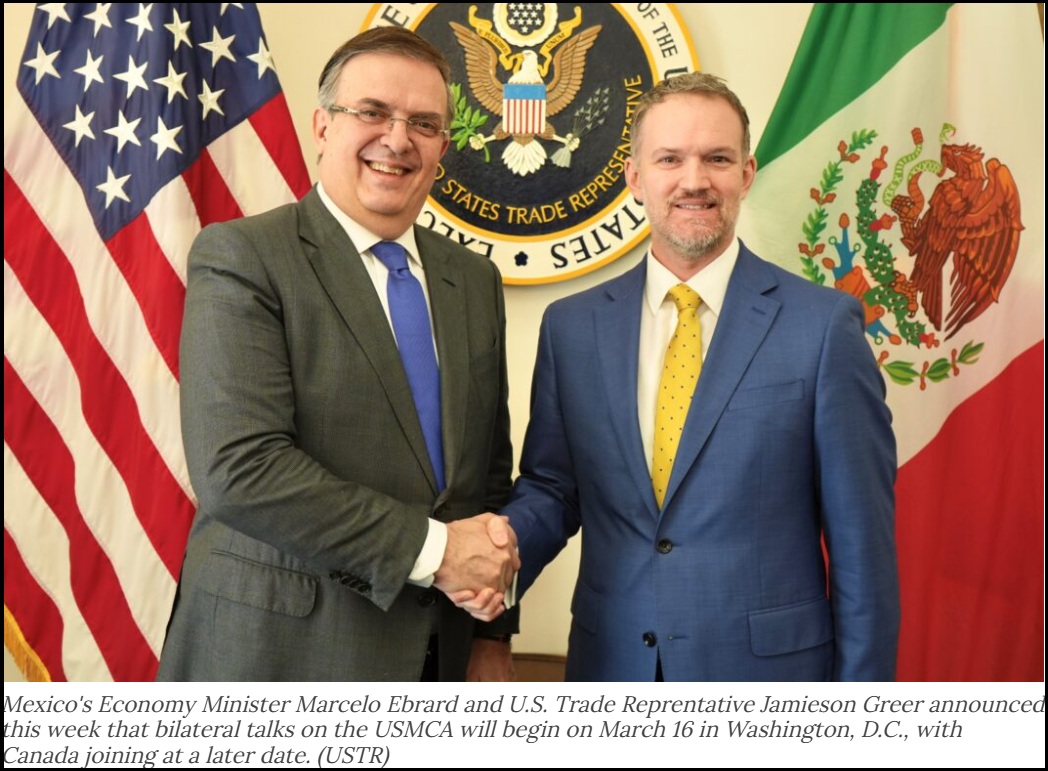
USTR Jamieson Greer and Commerce Secretary Howard Lutnick have both expressed anticipation of a new bilateral trade agreement to stop all this Canadian nonsense.

(more…)

Secretary Lutnick Gently Dispatches the Feelings of Canada and the EU, and Focuses on Pragmatic Economic Growth

Hilarious Bloomberg interview with Commerce Secretary Howard Lutnick.  The topics are European trade and politics combined with the overlay of Canadian trade and politics.  The Bloomberg panelists question Lutnick about the similar “feelings” of the Europeans and Canadians, as it pertains to the outcome of trade discussions.  It’s the feelings that make things difficult to negotiate.

Secretary Lutnick doesn’t dismiss the narrative but deconstructs the substance of the topic brilliantly.  Lutnick notes the ridiculous nature of the Canadian trade position and their decision to go running to China because their feelings are hurt.  Lutnick then affirms the USMCA is going to be dissolved mid-summer and fall of this year.

As we noted at the end of last year, splitting the USMCA into two bilateral trade deals, one for Mexico and one for Canada, will be one of the most interesting and long-term economically significant moves in U.S. trade history.  It is going to be a lot of fun to watch these negotiations, and the pre-positioning gives us a preview of what is to come.

Mexico is doing everything almost perfectly in preparation for their bilateral deal.  Canada is doing exactly the opposite and positioning themselves for the worst possible outcome of a deal with the USA.  The disparity in approaches is so different, even now it is remarkable to watch. PROMPTED:

(VIA BLOOMBERG) – […] Canada has “the second-best deal in the world” with its access to the US market, Lutnick said, behind only Mexico. The Commerce chief also indicated that Canada’s tilt toward China could become an issue in talks over revamping the US-Mexico-Canada trade agreement known as USMCA.

If Ottawa opts to import Chinese electric vehicles and other trade-strengthening steps with Beijing, “do you think the president of the United States is going to say you should keep having the second-best deal in the world” during USMCA talks, Lutnick questioned.

(more…)

Israel Not Happy with Trump Appointed Turkey and Qatar Roles in Assisting Gaza Stabilization and Executive Board

Last week President Donald Trump officially announced the members of the Gaza Board of Peace; an organization headed by President Trump and tasked to oversee the second phase of his plan to end the Israeli conflict in Gaza, specifically the reconstruction and disarmament of Gaza and Hamas respectively. [SEE HERE]

The members of the “Board of Peace,” chaired by Trump himself, includes Secretary of State Marco Rubio; Emissary Steve Witkoff; Jared Kushner; former British Prime Minister Tony Blair; an American-Jewish billionaire named Mark Rowan; World Bank President Ajay Banga; and Deputy National Security Advisor of the United States, Robert Gabriel. President/Chairman Donald Trump has also appointed Aryeh Lightstone and Josh Gruenbaum as senior advisors to the Board of Peace.

At the same time, President Trump announced another executive body that would operate under the Peace Council to assist with the facilitation of a new Palestinian government, the “Gaza Executive Board.” This structure is intended to manage day to day events on the ground instead of a Hamas loyalist govt.  The appointees to the executive board have upset the Netanyahu government of Israel.

According to the White House announcement, the Gaza Executive Board will include: Witkoff; Kushner; Turkish Foreign Minister Hakan Fidan; senior Qatari official Ali al-Thawadi; Egyptian intelligence chief Hassan Rashad; Tony Blair; billionaire Mark Rowan; UAE Minister Reem Al Hashimi; former Bulgarian Foreign and Defense Minister Nickolay Mladenov, who also served as the UN envoy for the Middle East peace process; U.N Representative Sigrid Kagg, and Israeli-Cypriot businessman Yakir Gabbay, who specializes in real estate, technology and international investments.

Additionally, to establish security, preserve peace, and establish a durable terror-free environment, Major General Jasper Jeffers has been appointed Commander of the International Stabilization Force (ISF), where he will lead security operations, support comprehensive demilitarization, and enable the safe delivery of humanitarian aid and reconstruction materials. [link]

According to Israeli media Netanyahu is not happy, and planning to protest the Turkish, Qatari and UAE appointments to Marco Rubio (not Trump):

(more…)

President Trump: “The Cartels are Running Mexico”

Once again giving context to the immediate reaction from Mexican President Claudia Sheinbaum following the operation to exfiltrate Venezuelan dictator Nicolas Maduro, during the return flight to Washington DC President Trump spoke about how President Sheinbaum is “a little afraid” of the cartels in Mexico.

When asked about his previous offer to have the U.S. military intervene in the drug and human trafficking operations within Mexico, President Trump said, “I would say every single time I’ve talked to her I’ve offered to send troops.” Following up with, “she’s concerned, she’s a little afraid, the cartels are running Mexico. Whether you like it or not, the cartels are running Mexico.”  WATCH:

This is not just an ordinary off-the-cuff statement when you consider the ramifications. There is no closer geographic nation to the mainland United States other than Mexico, and President Trump is being brutally honest in his statement that Mexican President Sheinbaum is afraid of the cartels.  The cartels run the Mexican government.

Mexican residents living in the United States and sending money back to Mexico are a major economic driver of Mexico’s GDP.  Currently the best estimate of GDP is that personal remittances make up around 4% of their domestic economy.  The United States sent $62.5 billion dollars in remittances to Mexico in 2024, 96.6% of the total received by the country. 47% of remittances from the United States to Mexico are sent from California and Texas [source].

The remittances essentially subsidize the average Mexican family, while the illegal cartel income is estimated around $12 billion annually [source].   The total Mexican GDP is around $1.7 trillion [source], Canada is roughly $2.4 trillion, the United States is around $30 trillion.

(more…)

USTR Jamieson Greer Outlines U.S. Trade Strategy, Free Trade Agreements and Trade Policy

U.S. Trade Representative Jamieson Greer is questioned about the Trump administration strategy or lack thereof. “Yes, there’s a strategy,” Greer says in this new interview. “First of all, you don’t change 70 years of trade policy overnight. And second of all, when some people say, ‘Oh, well, this is chaos. What’s your strategy?’, what they really want to know is can we go back to how it was before? And that’s not going to happen.”

The interview is in an audio file presented by Politico and shared below. This is some really good information on the various free trade agreements and the regions represented by some of our largest trade partners. Well worth listening to as you go about your day and travels today. Embed below:

USTR Greer notes how the tariffs are being used, the upcoming Supreme Court decision, the need for congress to codify the tariff regime in legislation and the various regional strategies for the deployment of countervailing duties.

(more…)

Canadian Media Catch On, U.S Trade Rep Jamieson Greer Says Trump Likely to Exit the USMCA (CUSMA)

In the world of Trumpian geopolitical trade stuff, three issues are very interesting to watch. (1) The strategic reset with Russia which could break the official western construct of financial control. (2) The proactive and defensive positioning of Mexico (desperate attempt to retain economic attachment), and (3) the certain dissolution of the USMCA what Canadians call CUSMA.

Canadian media are starting to realize something we have talked about on these pages for years; President Trump intends to end the USMCA because the USMCA was used as a fracture point to eliminate NAFTA.

Wall Street, the U.S. Congress, the massive K-Street lobbying network around the U.S. Chamber of Commerce and the entire political apparatus of business and industry would never permit the end to NAFTA; too many trillions at stake. So, President Trump replaced NAFTA with the interim USMCA, which was better but factually more useful in elimination of the original.

Now, as we have discussed by highlighting President Trump’s no-so-subtle words on the issue, the Canadian media is realizing the USMCA will be dissolved in favor of two independently negotiated bilateral trade agreements; one with Canada and one with Mexico.

(CTV) – U.S. President Donald Trump could decide next year to withdraw from the Canada-United States-Mexico trade agreement (CUSMA), Politico reported on Thursday, citing U.S. Trade Representative Jamieson Greer.

“The president’s view is he only wants deals that are a good deal. The reason why we built a review period into CUSMA was in case we needed to revise it, review it or exit it,” Greer told Politico’s White House bureau chief Dasha Burns in a podcast episode that airs Friday.

Greer also raised the idea of negotiating separately with Canada and Mexico and dividing the agreement into two parts in the podcast, adding that he spoke with Trump about that possibility just this week.

(more…)

Canadian Prime Minister Mark Carney Confirms He Apologized to President Trump for Reagan Ad Effort

On Friday President Trump noted (off-the-cuff) he was ambivalent to the trade interests of Canada and had no intention to restart discussions. However, Trump also said he holds no personal animosity toward Canadian Prime Minister Mark Carney for the stupid and antagonistic move they made in purchasing a manipulative television ad intended to undermine the Trump trade position.

On Saturday, Prime Minister Mark Carney confirmed he did apologize to President Trump for the Canadian effort.


GYEONGJU, South Korea, Nov 1 (Reuters) – Canadian Prime Minister Mark Carney said on Saturday he had apologised to U.S. President Donald Trump over an anti-tariff political advertisement and had told Ontario Premier Doug Ford not to run it.

Carney, speaking to reporters after attending an Asia-Pacific summit in South Korea, said he had made the apology privately to Trump when they both attended a dinner hosted by South Korea’s president on Wednesday.

“I did apologise to the president,” Carney said, confirming comments by Trump made on Friday.

(more…)

U.S. Ambassador to Canada Informs Govt and Business Leaders No Trade Deals Possible

For those who have followed along with the U.S-Canada trade positioning, the current status of conflict between the Trump administration and the government of Canada is not surprising.  {GO DEEP} Going all the way back to the replacement of NAFTA, with the USMCA, President Trump always said he did not favor multilateral trade deals with multiple countries; instead, he preferred bilateral free trade agreements.

Some people have construed the bilateral preference of President Trump to be the elimination of globalism in favor of nationalism in trade agreements.

While the outcome of the Trump approach indeed aligns with that theme, it is not specifically the objective of President Trump to eliminate global trade, but rather to focus on specific interests in trade that benefit the unique nature of each party involved.

As a result, the USMCA -or CUSMA as said in Canada- is not in alignment with a bilateral free trade agreement, and the conflicted differences between trade with Mexico and trade with Canada are an outcome of this dynamic.  The solution is simply to eliminate the multilateral in favor of the bilateral approach.  This is the objective of President Trump as expressed.

That said, the USMCA covers approximately 60% of U.S-Canada trade, and the remaining 40% is being debated and argued.  President Trump would prefer to just deal with 100% of the trade sectors in one free trade agreement; hence, his ambivalence until the USMCA is dissolved.

Canada, on the other hand, continues to demand that all trade conflicts be resolved without opening up the entire USMCA. Again, another conflict. Canada is like the dependent spouse in a divorce arguing for child support payments when the “children” are in their twenties.

The current status is President Trump pulling back completely from discussions with Canada, while the various provincial Premiers and Prime Minister Mark Carney antagonize over the issue.

At a certain point, when the entire national economic plan of Canada is based on “Donald Trump bad”, and all political messaging internally is to proclaim they have no alternative policy positions, the Canadians might not realize it, but they are confirming complete and total dependency on the nation Donald Trump represents.

(more…)