Quantcast

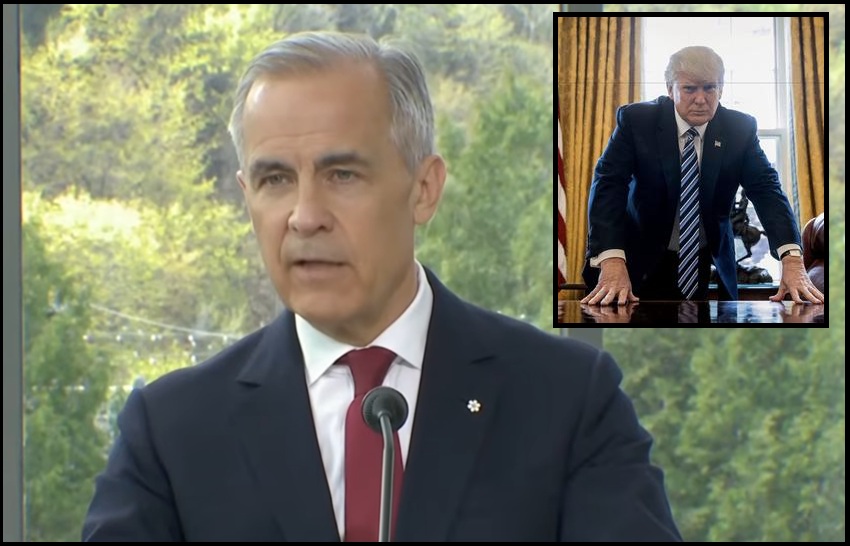
Canadian Prime Minister Mark Carney Confirms He Apologized to President Trump for Reagan Ad Effort

On Friday President Trump noted (off-the-cuff) he was ambivalent to the trade interests of Canada and had no intention to restart discussions. However, Trump also said he holds no personal animosity toward Canadian Prime Minister Mark Carney for the stupid and antagonistic move they made in purchasing a manipulative television ad intended to undermine the Trump trade position.

On Saturday, Prime Minister Mark Carney confirmed he did apologize to President Trump for the Canadian effort.


GYEONGJU, South Korea, Nov 1 (Reuters) – Canadian Prime Minister Mark Carney said on Saturday he had apologised to U.S. President Donald Trump over an anti-tariff political advertisement and had told Ontario Premier Doug Ford not to run it.

Carney, speaking to reporters after attending an Asia-Pacific summit in South Korea, said he had made the apology privately to Trump when they both attended a dinner hosted by South Korea’s president on Wednesday.

“I did apologise to the president,” Carney said, confirming comments by Trump made on Friday.

(more…)

U.S. Ambassador to Canada Informs Govt and Business Leaders No Trade Deals Possible

For those who have followed along with the U.S-Canada trade positioning, the current status of conflict between the Trump administration and the government of Canada is not surprising.  {GO DEEP} Going all the way back to the replacement of NAFTA, with the USMCA, President Trump always said he did not favor multilateral trade deals with multiple countries; instead, he preferred bilateral free trade agreements.

Some people have construed the bilateral preference of President Trump to be the elimination of globalism in favor of nationalism in trade agreements.

While the outcome of the Trump approach indeed aligns with that theme, it is not specifically the objective of President Trump to eliminate global trade, but rather to focus on specific interests in trade that benefit the unique nature of each party involved.

As a result, the USMCA -or CUSMA as said in Canada- is not in alignment with a bilateral free trade agreement, and the conflicted differences between trade with Mexico and trade with Canada are an outcome of this dynamic.  The solution is simply to eliminate the multilateral in favor of the bilateral approach.  This is the objective of President Trump as expressed.

That said, the USMCA covers approximately 60% of U.S-Canada trade, and the remaining 40% is being debated and argued.  President Trump would prefer to just deal with 100% of the trade sectors in one free trade agreement; hence, his ambivalence until the USMCA is dissolved.

Canada, on the other hand, continues to demand that all trade conflicts be resolved without opening up the entire USMCA. Again, another conflict. Canada is like the dependent spouse in a divorce arguing for child support payments when the “children” are in their twenties.

The current status is President Trump pulling back completely from discussions with Canada, while the various provincial Premiers and Prime Minister Mark Carney antagonize over the issue.

At a certain point, when the entire national economic plan of Canada is based on “Donald Trump bad”, and all political messaging internally is to proclaim they have no alternative policy positions, the Canadians might not realize it, but they are confirming complete and total dependency on the nation Donald Trump represents.

(more…)

There It Is – White House NEC Director Kevin Hassett Notes Something VERY Important

White House Chair of the National Economic Council (NEC), Kevin Hassett, walked out to the press pool to discuss the latest excellent inflation figures from the Bureau of Labor Statistics today {BLS REPORT HERE}.  However, the insufferable press pool wanted to talk about other things.

I’ll get to the BLS data below – with a gold nugget just for you, don’t share it.  But first, NEC Director Hassett also let something slip in his responsive comments that most will miss.

When asked about Trump’s decision to terminate all trade negotiations with Canada, Hasset noted the discussions were frustrating, and “The Canadians were very difficult to negotiate with.” Then comes the key point (03:28), “The fact that we are now negotiating with Mexico, separately, reveals that it’s not just one add, there’s frustration that has built up.”

What Hassett just confirmed again, as if we needed more evidence, is that the trilateral trade agreement -the USMCA- is not going to exist once Trump opens it up for renegotiation.  The USA team is already working on a separate bilateral trade agreement between the USA and Mexico, proactively.  The USMCA is dead – we just have not made it official yet.  WATCH (prompted):

.

On the inflation data, the September inflation rate was 0.3 percent, much lower than all economists and pundits predicted.  The tariffs are having no impact on the rise of consumer prices.  In fact, the sectors with the most imported goods are the sectors with the lowest inflation.

(more…)

Former Canadian NAFTA Trade Negotiator Starts Noticing Trump Doesn’t Intend to Keep USMCA

In Canada they call the USMCA trade agreement “CUSMA” putting Canada first.  President Trump calls it the USMCA because that’s the order of sequence when the trade negotiations took place, the USA then came Mexico and much later, Canada.  However, Trudeau used his typical Alinsky gaslighting to pretend Canada was always participating; they were not, they came in at the end.

That said, the former NAFTA trade negotiator for Canada, John Weekes, has finally realized President Trump does not intend to renew or renegotiate the USMCA, he intends to dissolve it in favor of two bilateral free trade agreements; one with Mexico and one with Canada.

I’m not sure what finally, and I do mean FINALLY, triggered a Canadian to realize this, but perhaps they finally listened to President Trump telling Canadian Prime Minister Mark Carney [IN MAY] he intends to end it. DUH!  WATCH:

The reality of the U.S-Canada economic relationship and the position of President Donald Trump is not that difficult to understand if you take all the disparate datapoints and quotes from Trump and put them into context.

During a White House meeting with Mark Carney, President Trump essentially told the Canadian Prime Minister why he was in no hurry to get to a deal with Canada.  The 35% tariffs on non-USMCA goods triggered August 1st because the main priority of Trump -looking toward Canada- is to dissolve the USMCA.

(more…)

Mexico Is Doing What Canada Is Ignoring – Preparing for 2026 USMCA Renegotiation

There are going to be two major stories in 2026 that we will have full context to understand.  Yes, the 2026 midterm politics are going to lead the headlines, but two other issues will have considerable impact.

The first, is the FISA (702) reauthorization, and there is a lot that will surface in the next several months likely to upend the best laid plans of the administrative UniParty [Tulsi Factor].  The second, is the USMCA reauthorization – the end of the trilateral trade agreement, and the structural shift into two separate free trade agreements.

As to the latter issue, while Mexico and Canada are currently in a state of economic flux, only Mexico is preparing to deal with the seismic shift that is about to unfold.  Canada is going to be caught completely off guard.

While Canadian Prime Minister Mark Carney is trotting around Europe trying to establish his relevance amid the pro-Ukraine coalition,  Mexican President Claudia Sheinbaum is spending time focused on her domestic economy.

Mexico is preparing to drop significant tariffs on Chinese imports, a proactive move to position Mexico in advance of the upcoming bilateral discussion.

Sheinbaum knows that right now for every deportation ICE executes, her economy is hit as remittances recede. Simultaneously, for every mile of border wall that is completed, the financial dependency model increases.  President Trump’s leverage in the upcoming bilateral trade negotiation against Mexico increases each day, week and month.

Claudia Sheinbaum is smartly focused on trying to get ahead of the issues, while Mark Carney ignores his vulnerability and is about to make Canada naked to the economic weaknesses created by Justin Trudeau.

(more…)

Canada Surrenders – PM Carney Announces End to All Retaliatory Tariffs – Trump Gives Nothing, U.S. Tariffs Remain

The Canadian govt led by Prime Minister Mark Carney has completely capitulated to the power and influence of President Trump.

While explaining how the United States has fundamentally changed the entire landscape of global trade, the leader of the Snow Mexicans announces he is dropping all countervailing and retaliatory tariffs against the USA and getting nothing in return.  Total and complete surrender by Canada; there is ZERO upside for Canada – NADA, Zippo, Zilch.

Prime Minister Mark Carney made the announcement, then faced the ire of the assembled media who were furious about the details within the statement.  The Canadian people had been promised an “elbows up” fight to the end. Instead, today they got down on their knees and begged Trump to retain the USMCA.

Complete and utter capitulation by Canada. No digital services taxes. No countervailing duty tariffs. No reciprocity tariffs on Steel and Aluminum. No retaliatory tariffs (reciprocal/baseline). Meanwhile, the USA keeps 50% tariffs on steel and aluminum against Canada, and Canada only gets 25% tariffs against U.S. steel/aluminum.

In addition, Canada has pledged to continue gaslighting their citizens, while wasting time, effort and resources on a hope to retain the USMCA, while refusing to admit to themselves that President Trump intends to dissolve it. WATCH:

.

If that recap sounds bad for Canada, trust me – it’s way worse.  Really bad, horrible – terrible even.  So far beyond bad, the light from where horrible starts could not reach the Canadian terrible place for a year.  Not good.  😊

(more…)

Sunday Talks – U.S. Trade Rep Jamieson Greer Outlines Tariff Status

U.S. Trade Representative Jamieson Greer appears on Face the Nation with the ever-dramatic Margaret Brennan. Video and Transcript Below:

The part about Canada is very interesting.

[Transcript] – MARGARET BRENNAN: And we’re joined now by United States Trade Representative, Jamieson Greer. Ambassador, good to have you here.

JAMIESON GREER: Great to be here. Thank you.

MARGARET BRENNAN: So the President signed this executive order on Thursday, raises tariff rates on about 70 countries. Should we expect those to be negotiated down in the coming days?

JAMIESON GREER: I don’t, I don’t think they will be in the coming days. I think a lot of these, well I know a lot of these, are set rates pursuant to deals. Some of these deals are announced, some are not, others depend on the level of the trade deficit or surplus we may have with the country. So, so these, these tariff rates are pretty much set. I expect I do have my phone blowing up. There are trade ministers who, who want to talk more and see how they can work in a different way with the United States, but I think that we have, we’re seeing truly the contours of the President’s tariff plan right now with these rates.

(more…)

Canadian Officials Continue Wondering Why Trump Administration Projects Ambivalence Toward U.S-Canada Trade Deal

The reality of the U.S-Canada economic relationship and the position of President Donald Trump is not that difficult to understand if you take all the disparate datapoints and quotes from Trump and put them into context.

During a White House meeting with Mark Carney, President Trump essentially told the Canadian Prime Minister why he was in no hurry to get to a deal with Canada.

The 35% tariffs on non-USMCA goods are going to trigger on August 1st, because the main priority of Trump -looking toward Canada- is to dissolve the USMCA.

During the May 6th oval office meeting with Carney, President Trump was discussing the USMCA and said:  “As you know it terminates fairly shortly. It gets renegotiated fairly shortly.” … “This was a transitional deal, and we’ll see what happens, we’re going to start renegotiating that” … “I don’t know if it serves a purpose anymore.”  …. “And the biggest purpose it served was, we got rid of NAFTA.”

To understand why President Trump wants to dissolve the USMCA {SEE HERE}.  To understand the technical value of dissolving the USMCA {SEE HERE}.  It’s not a complicated economic analysis; it’s common sense.

Currently, approximately 60% of the traded goods and services between the U.S. and Canada are covered by the USMCA; the remaining 40% will be hit by tariffs on August 1st at a 35% rate.

When the USMCA is renegotiated, predictably dissolved in favor of two bilateral trade agreements – one for Mexico and one for Canada, all of the U.S-Canada trade sectors will be part of the enlarged free trade negotiation.  As a result, there is absolutely no motive to engage in trade discussions now.

(more…)

The Marshall Plan is Over – EU Commission President Ursula von der Leyen Announces Details of U.S-EU Trade Agreement

The Marshall Plan is OVER!

Okay, this is a very big win.  EU Commission President Ursula von der Leyen outlines some more details of the U.S-EU trade agreement.  The parameters fall similar to the Japanese deal, without the banking aspect.

The EU will face (and accept) a 15% tariff rate for most exports to the USA including autos, that’s huge, even with some zero-for-zero tariff sectors outlined.  The primary motivating factor was to avoid the 35% tariff rate scheduled for August 1st and provide the EU corporations with certainty in their tariff rate as applied by the USA (15%).  WATCH:

.

This is almost full acquiescence to President Trump.  WATCH THE VIDEO

Ursula has the sads.

(more…)

Trudeau Redux – Canadian Prime Minister Mark Carney Huddles with U.S. Senators

In 2018, Canadian Prime Minister Justin Trudeau relied heavily on House Speaker Nancy Pelosi for assistance when the U.S. and Mexico constructed the majority of the USMCA trade pact.  Today, Canadian Prime Minister Mark Carney takes the same approach.

[SOURCE]

PRESS RELEASE – “Today, the Prime Minister, Mark Carney, met with a bipartisan delegation of United States senators in Ottawa. The Senator for Oregon, Ron Wyden, the Senator for Alaska, Lisa Murkowski, the Senator for New Hampshire, Maggie Hassan, and the Senator for Nevada, Catherine Cortez Masto, were present.” (more)

The 35% tariffs against Canada are scheduled to go into effect on August 1st.

(more…)