Quantcast

Reports of Finland and Sweden Likely to Join NATO Highlight Global Financial Cleaving Underway

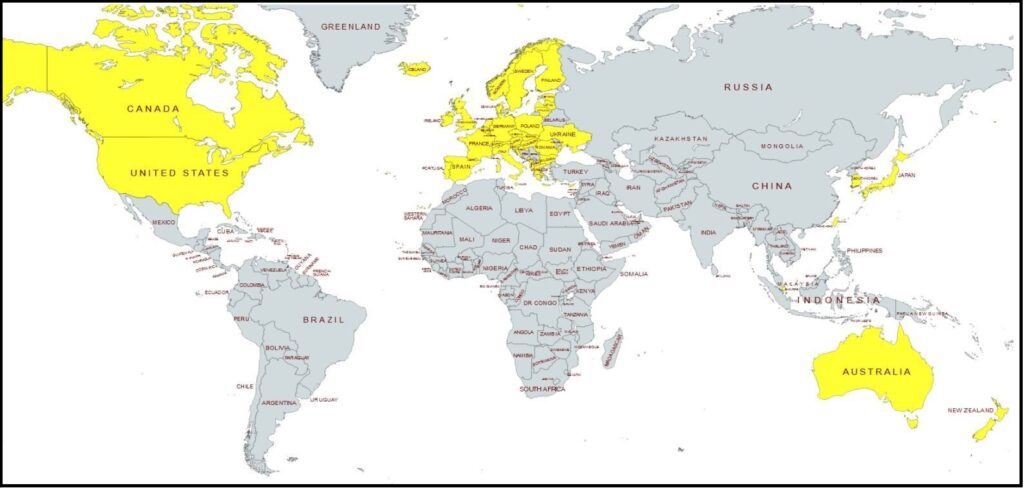
The Financial Times is reporting {link here, paywall} that Finland and Sweden are likely to join the NATO alliance.  According to the reporting {also in Reuters} the application from Finland is expected in June and Sweden shortly thereafter.

Adding Sweden and Finland would be a major escalation in both the western conflict and provocations against Russia, obviously, justified by western leaders as a consequence of the Russian invasion of Ukraine.  However, in the big analysis, the global financial system appears to be the larger issue.

From the outset of the Russian military operation into Ukraine, it was obvious the western alliance was intent on an almost ‘all or nothing‘ confrontation with Russia. The only limits to what the alliance was willing to do was trigger a nuclear showdown through direct military action against Russia to protect the non-NATO country of Ukraine.

The NATO and western government response was a fast system of financial sanctions intended to cripple the Russian economy.  However, Russia responded to those actions with countermoves on the trade front, beginning to establish the first ever non-Euro and non-dollar-based trade system.  In essence, a financial trading system created by the BRICS group (Brazil, Russia, India, China and South Africa).

Therefore, if we think about the current status of geopolitics and international finance, the NATO response now involves a priority of controlling and protecting the previously established financial structures of global trade.  A NATO effort to avoid the cleaving is now underway as an outcome of the sanctions against Russia.

As one person put it, “This is a fight for the dollar as reserve currency. Imagine trying to maintain our debt when nobody wants treasury notes. If BRICS succeed, US collapses as an economic power. On the other hand, if we win, Klaus Schwab’s nutty world wins.”  I tend to agree with this outlook because it parallels something we see domestically in the U.S.

(more…)

Latest CBS Poll Reflects No Hope for Anyone, Including Joe Biden and Democrats

CBS has released their latest YouGov Poll [DATA HERE], again showing the top priorities of the American people are not even on the radar of the American government.  The DC beltway disconnect is stark.

Interestingly, the recent survey of Pennsylvania voters done by Reuters, turned up this almost identical priority list, only Rusia/Ukraine did not even appear in the top five.  The economy, inflation, gas prices, crime and immigration are the top five issues across the board, in almost every poll.

Russia/Ukraine is a non-existent issue. Yet, that is the actionable priority -with questionable importance for U.S. security interests- for a totally out of touch government and media to focus on.  Sending $14 billion to help Ukraine’s border fight, while our borders are crushed with illegal aliens, is a sharp stick in the eye for every American.

Unfortunately, our opinion doesn’t matter, and frustratingly, the people using Biden as a tool to achieve their goals do not have any concern whatsoever about political fallout.  Biden is a disposable tool for a program of rapid single-term advancement of the democrat-communist agenda.

(more…)

As Expected, Le Pen and Macron Head to a Runoff in French Election – Polling Shows Them Even After Primary

As expected, in the France election no candidate achieved 50% of the vote.  That sets up a runoff election fifteen days from now to determine who will be the next president.  Reuters Article Here – Guardian/MSM Article Here

In the primary race the final results are not yet announced; however, current President Emmanuel Macron has approximately 28% of the vote, and challenger Marine Le Pen has around 24% of the vote.  No other candidate was close enough to change the top two outcome.

In the head-to-head matchup, the race is essentially tied, well within the margin of polling error (as above).  Interestingly, Le Pen has flipped the 18-to-34-year age bracket and now holds majority support in the younger voting bloc.  Perhaps, due to young French citizens feeling the outcomes of the professional political left thirsting for unilateral power during COVID.

There was around a 65% voter turnout according to most early analysts.  The general election is essentially a coin toss based on the current polling.  The final vote to determine the winner will take place April 24th.  It will be a very closely watched event by leaders around the world.  A Le Pen victory would be seismic in the world of politics, akin to Trump’s victory in 2016, and that outcome is a strong possibility.

The professional political left are apoplectic.

(more…)

Cleveland Fed Chair Outlines Reasons Monetary Policy Cannot Lower Inflation When Energy Policy Is in Control

Loretta Mester, the president and CEO of the Federal Reserve Bank of Cleveland, appears on CBS Face the Nation to discuss inflation, the economy and monetary policy.  Ms Mester is in a tough place, because she cannot admit the influence of federal monetary policy is far outmatched in the era where Joe Biden energy policy is limiting oil and gas development and creating massive inflation.

Mester does admit the supply chain crisis will extend well into 2023, but blows hopeful unicorn wishes by projecting that price inflation will temper by the end of this year.  From the perspective that 20 to 50% price increases on critical goods (housing, food, fuel, energy) are unsustainable in repeated cycles, she is correct; the rate of inflation will lower. However, that’s only because the baseline prices will have increased so high the rate of increase measure falls.  WATCH:

A $4 item that gains a $2 increase holds a 50% rate of inflation.  The next year that $6 item again has a $2 increase, but the rate of inflation drops to 33%.  The price increase is the same, but the rate of inflation drops.  That’s what is going to happen in the second half of this year.  FUBAR

The White House is doing this on purpose in order to chase their ideological dreams of sustainable energy and climate change.  Energy prices underline the entire economy, because oil and gas prices touch everything.  Insofar as they continue the war against coal, oil and gasoline, there’s nothing monetary policy can do to combat inflation.  The Fed must however, pretend not to know things.

(more…)

Neil Oliver, the COVID Schemes Cost Billions, but the Aftermath Costs Are Worse Than Money

Neil Oliver takes a look at the economics of COVID and how government intervention and spending has crushed the working class.  However, it is not the financial aspects that carry the worst debt in the aftermath, there is a human cost that can never be repaid or recreated.  WATCH:

{TRANSCRIPT} –  “There are debts that can be repaid and debts that can’t. During the time of Covid, vast piles of money were conjured into being by the government, borrowed as if by magic from the distant future. Unimaginable quantities of that funny money were wasted – spent on PPE that didn’t work or that wasn’t needed and is now yet more plastic heaped into landfills or otherwise littering the landscape and seascape. Millions went on the Nightingale hospitals that were never used. Around 37 billion pounds – ten percent of a total of 370 billion pounds set aside for Bounce Back Loans and the Eat Out to Help Out scheme – were lost to fraudsters. £37 billion pounds.”

(more…)

BRICS Ministers of Finance Hold a Meeting – It Is Time to Replace Western Financial Trade Mechanisms and Remove The Dollar

This is not some grand conspiracy, ‘out there‘ deep geopolitical possibility, or foreboding likelihood as an outcome of short-sighted western emotion.  No, this is just a predictable outcome from western created events that pushed specific countries to a natural conclusion based on their best interests.

You can debate the motives of the western leaders who structured the sanctions against Russia, and whether they knew the outcome would happen as a consequence of their effort, but the outcome was never really in doubt.  Personally, I believe this outcome is what the west intended. The people inside the World Economic Forum are not stupid – ideological, yes, but not stupid. They knew this would happen.

[Left to Right] Xi Jinping (China), Vladimir Putin (Russia), Jair Bolsonaro (Brazil), Narendra Modi (India) and Cyril Ramaphosa (South Africa), the BRICS group.
The finance ministers of the BRICS alliance (Brazil, Russia, India, China and South Africa) have decided to create their own financial mechanisms to continue trade between nations of similar disposition.  Once the internal issues inside the BRICS alliance are resolved, and once the mechanisms are created, then other nations will be able to decide to join or not.  The great global cleaving will commence.

(Reuters) – Russia, hit by Western sanctions, has called on the BRICS group of emerging economies to extend the use of national currencies and integrate payment systems, the finance ministry said on Saturday.

[…] On Friday, Finance Minister Anton Siluanov told a ministerial meeting with BRICS, which consists of Brazil, Russia, India, China and South Africa, that the global economic situation had worsened substantially due to the sanctions, the ministry’s statement said.

(more…)

Globalism v Nationalism – Last Weekend Hungary, Tomorrow France Round One

Last weekend, it was the Hungarian election that surfaced as the first contest between globalism -vs- nationalism in the “post-COVID” era.  This weekend, it is the election in France that will indicate how the French people feel about similar issues of the totalitarian, fascist or corporate state, i.e. “globalism.”

There are a multitude of parties and coalitions in France represented by multiple candidates.  However, if no candidate wins 50% of the total vote tomorrow, only the top two candidates will advance to the second round national election on April 24th.  Those top two candidates are likely to be current French President Emmanuel Macron (globalist wing) and Marine Le Pen (nationalist wing).

Currently Macron holds around 25% and Le Pen around 23% (individually) for the first round, with multiple candidates holding smaller percentages of the remaining vote.  Therefore, it is almost certain that Macron and Le Pen will advance to a head-to-head matchup on April 24th.  That’s when things will really become important for the larger battle of globalism v nationalism.

The two candidates have faced off before, however, this time the pandemic response by Emmanuel Macron could likely tilt the election in favor of Le Pen.

SIDEBAR – I predict we will see Barack Obama enter the French presidential election again, as an influence agent, between Monday of next week and April 24th, just as he did the last time in order to try and convince the French people to stick with Macron.  Foreign interference in national elections (think Russia interfering in U.S. elections) is a horrible thing, a terrible threat to democracy, except when the U.S. globalists need it.

When the U.S. leftists, Democrats, need to influence the Canadian election, suddenly election interference is a good thing.  When the Democrats need to influence the Mexico election, no big deal. When the U.S. leftists need to influence the French election, or Egyptian election, or Israeli election, or U.K. election, no biggie, no biggie, no biggie.  Their hypocrisy is boundless when they know the media will let them pretend not to know things.  Watch for it, I’ll bet one donut the U.S. will pull out all the stops to support Macron. I digress…back to the point of current France.

(more…)

Worsening Food Price Increases Gain Global Attention – UN Food and Agriculture Organization Tracks Highest Prices Ever Recorded

The UN Food and Agriculture Organization reported on Friday they are recording the highest Food Price Index since they started recording thirty years ago. With record highs in prices for cereals, vegetable oils, dairy and meats

This issue has been a slow burning fuse toward the biggest powder keg in modern history, and it is about to get very serious.  We have been warning about it since last fall {Go Deep}.  In the most deliberate and painstaking ways possible, we have been urging everyone to take this issue seriously.

The background cause is complex and started with the 2020 government response to the pandemic.  U.S. and international government intervention in the food supply process has been FUBAR from the beginning. Every action taken since early 2020 has been one bad policy after another; building failure upon failure, crisis upon crisis, bad decision upon bad decision, bringing us to a precipice summed up by saying “the absence of food will change things.”

Some will say the food prices we are about to experience –and the crisis it will create– was deliberate.  Others will say this was the cumulative outcome of major failures on the part of the government.  At this point the former makes more sense, and the latter looks like a justification and excuse, because if government entities were really serious about food prices and shortages, they would be taking pragmatic steps to mitigate the problem; they are not.

There are simple things government could do, such as helping farmers offset targeted fertilizer costs, providing relief for diesel fuel and energy costs, and taking other simple steps that would help the agricultural industry.

Instead of responding with the urgency this would demand, the collective government action has been to ignore the problem (talk soundbites), and give speeches about using subsidies to offset the end result (consumers) – without ever addressing the root cause.  All this while fueling conflict in Ukraine and chasing radical energy policies under the guise of global climate change.

The UN Food and Agriculture Organization (UNFAO) keeps track of food prices and projections using a global index [SEE HERE].  What they are calculating, and what they are projecting based on the current calculations, is a major increase in food prices combined with a major increase in food scarcity due to the unaffordability of food products.

(more…)

There It Is, The Canadian 2022 Budget Authorizes a Central Bank Digital Currency

CTH noted earlier, in the aftermath of the COVID-19 control mechanisms, things were being done legislatively to follow a ‘new world order’ for western democracies {Go Deep}.  One of the nations we noted following this new direction, was Canada.  Today, a review of the proposed Canadian 2022 budget finds something to align with the new version of democracy – the establishment of funding to create a central bank digital currency.

That should not necessarily come as a surprise.  After all, despite a massive amount of denial from the Canadian Finance Minister and Canadian Prime Minister toward the context of CTH research {Go DEEP}, the direct evidence we were looking for is now discovered.

Buried deep, very deep, in Chapter 9.2 of the Canadian Budget you will find this:  …”In the last several months, for example, there have been a number of high-profile examples—both around the world and here in Canada—where digital assets and cryptocurrencies have been used to avoid global sanctions and fund illegal activities.”

(Chapter 9.2) […] Budget 2022 includes measures that will help maintain the integrity of the financial system, promote fair competition, and protect both the finances of Canadians and our national security.

    • Budget 2022 announces the government’s intention to launch a financial sector legislative review focused on the digitalization of money and maintaining financial sector stability and security. The first phase of the review will be directed at digital currencies, including cryptocurrencies and stablecoins.
    • Budget 2022 also proposes $17.7 million over five years, starting in 2022-23, to the Department of Finance to lead the review.

The review will examine, among other factors: how to adapt the financial sector regulatory framework and toolbox to manage new digitalization risks; how to maintain the security and stability of the financial system in light of these evolving business models and technological capabilities; and the potential need for a central bank digital currency in Canada. (LINK)

Huh. Imagine that.  What was called a “conspiracy theory” just a few weeks/days ago, is now the expressed intent of the same government who denied it was ever being considered.

(more…)

There Is Something Very Troublesome About the Western Govt, Post-COVID, Rules-Based Order

While the western media quickly jumped from the COVID crisis to the Ukraine crisis, in the background of current events there is a lot of activity amid western government that does not look very democratic.

The word ‘autocracy‘, with all its variants, has been used a lot frequently by western government politicians as they attack the ideology of Russia, China and essentially every national leader who does not join their “rules-based order” club.  There is so much linguistic repetition from the same western leadership, it’s impossible not to see this autocracy narrative as some form of talking point that stemmed from some G7 or NATO collaboration meeting.

It does not seem coincidental the new catch phrases of “autocracy” vs “rules-based order” surfaced at the tail end of the COVID crisis, when Build Back Better shifted from a talking point into an actual set of western legislative constructs  perhaps intended to codify the emergency powers those same officials deployed.

What kind of democracy, or rules-based order mindset, was the European Commission carrying when they decried the overwhelming national election in Hungary?  Surely if the EU wanted to celebrate democracy, they would cheer for the high voter turnout that reelected Prime Minister Viktor Orban, yet they did exactly the opposite.  Apparently, some democracies are more valued than others.

At the same time the EU is clutching pearls over the results in Hungary, another western ally, Canada, is codifying the government’s emergency act power to seize property without due process.  As we are directed to be distracted by everything Zelenskyy, it might be worth noting that Ontario Bill 100 is about to permanently change the rules of permitted political protest. You can read about Bill 100 here and watch the economic debate here.

(more…)