Quantcast

Florida Republican Legislature Unify in Support for DeSantis Redistricting Map

Late last month Florida Governor Ron DeSantis vetoed a legislative redistricting proposal for the state’s new expanded districts.  Florida is gaining a congressional seat as an outcome of the last census and a rapid growth in population.

The concern DeSantis expressed last month was not with the state house or state senate districts, but rather with the new congressional district mapping. {Background} Attorneys for the governor’s office and state saw a conflict between the legislative map and the constitutional provisions for district assignment.  The Governor’s office wrote a new map eliminating the gerrymandering which ultimately, based on the 2020 election outcome, would appear to give 20 districts to Republican areas and 8 districts to Democrat areas

Of course, the professional activists within the Democrat apparatus are apoplectic. “If this map is enacted, Florida will be sued.,” tweeted Marc Elias, a Democratic Party elections lawyer.  However, the Republican state legislature has indicated their full support in advance of a special session to affirm the new redistricting map.

FLORIDA – A Republican-favorable congressional redistricting plan that Gov. Ron DeSantis’ office released Wednesday landed quick support from the leader of the Senate’s reapportionment efforts.

Democrats, meanwhile, said the once-a-decade redistricting process has gone “extreme partisan” and threatened legal challenges.

(more…)

March Retail Sales Report Shows Contraction in Non-Essential Consumer Spending

The U.S. Census Bureau {LINK} reports the March retail sales data {pdf LINK} showing a contraction in sales overall (excluding gasoline) and a massive contraction in on-line sales.  As we expected, we are seeing the continued demand side contraction for non-essential purchases.

First, when you review the data, keep in mind all of the statistics are based on dollars.  Currently the BLS calculates the rate of inflation at 8.5 percent year over year. So, when we look at retail sales figures, we must remember the items being sold cost more.  Any reported sales figures in a sector that do not exceed the inflation in that sector, indicates decline in units sold.

The top-line for March retail sales is 0.5% growth; however, the rate of inflation is 8.5%, so the amount of goods sold is substantially less than the 0.5% dollar increase would indicate.  Subtract the sales of gasoline (w/ massive price increases), and retail sales are negative (-0.3%) in March.  SEE TABLE-2

A good category to note the contraction in non-essential purchases is electronics and appliances.  Again, CORE inflation in that segment is around 6%, and yet total sales were only 3.3% higher, meaning less actual units sold.  Compared to 2021, electronics and appliance sales dropped 9.7%.

Showing how much people are pinched, gasoline prices are around 60% higher than this time last year, yet gas station sales only increased by 8.9%.  This means people are buying a lot less fuel at much higher prices.  People have shifted their transportation habits because gas costs so much.

Two more very interesting notes:

(more…)

CNBC Forced to Tell the Horrible, Terrible, Bad, Bad Results of Their Biden Performance Poll

CNBC commissioned a poll by Hart research and associates, a friendly outfit for the left.  Unfortunately, that means CNBC then needed to tell everyone what the results were [Full Poll pdf Here].  That task fell to CNBC’s Steve Liesman; an appropriate name given the task at hand.

The irony doubles when you remember this was the same CNBC pundit who refused to accept the horrible economic data that began surfacing last fall.  There was even a public broadcast where Liesman said the BLS statistics had to be wrong, because the results were so horrible.  A few months later, and here he is explaining how the country now feels about Joe Biden.   WATCH:

(CNBC) – […] The pessimism is clearly dragging on Americans’ opinions of President Joe Biden. In fact, nothing looks to be working in the Biden presidency from the public’s viewpoint.

The president’s approval rating sank to a new low of just 38%, with 53% disapproving. Biden’s -15% net approval rating is measurably worse than his -9% approval in the CNBC December survey. What’s more, his approval rating on the economy dropped for a fourth straight survey to just 35%, with 60% disapproving, putting the president a deep 25 points underwater. (article link)

(more…)

Fed Governor Christopher Waller Predicts We Have Reached Peak Inflation, Here Is What they Will Not Say

Fed Governor Christopher Waller appeared on CNBC to announce we have reached peak inflation, and things will moderate from here.  All of these fed moves are political moves, not monetary policy-based moves. Here’s the thing they will never admit to the non-institutional investor.

The fed has been painfully slow to raise interest rates on purpose.  They did not make a mistake.  The reason for their delay is they needed to wait for the beginning of the first 2021 inflation wave to cycle through before they raised interest rates.  It’s a game of mirrors that almost no one sees.  WATCH:

The rate of inflation will drop once the statistical year-over-year comparisons reach the same moment in the prior year.  The fed will raise interest rates in May and then use the June inflation rate decline as a false talking point to highlight how their policy is working.  They wait for May, because they need to wait for the calendar, nothing else.  Inflation is measured as the percentage of change from the prior year.  By waiting until the inflation is measured against the first wave of rising prices, it will give the illusion of a decline in inflation.

So that’s why they waited.  But here’s the worse part….

(more…)

Producer Price Index Sets New Record at 11.2 Percent Wholesale Inflation, Highest Rate Ever Recorded

The “Producer Price Index” (PPI) is essentially the tracking of wholesale prices at three stages: Origination (commodity), Intermediate (processing), and then Final (to wholesale). Today, the Bureau of Labor and Statistics (BLS) released March price data [Available Here] showing a dramatic 11.2% increase year-over-year in Final Demand products at the wholesale level.  This is the fifth consecutive month with the highest rate of inflation the PPI ever recorded.

The single month increase in wholesale prices of 2.3% was driven by inflation built into the supply chain at every level that shows up in the final wholesale price.  Those price increases then get passed along to consumers along with the additional costs for warehousing, transportation and delivery.  I modified Table-A (FINAL DEMAND) to take out some of the noise.

Wholesale prices of goods jumped 2.3 percent in March, and the wholesale price of food products jumped 2.4 percent.  The total demand inflation compared to last year is 11.2 percent, the highest rate ever recorded since the PPI tracking was first started.

The total final demand monthly calculation (1.4%) is lower than the final demand goods (2.3%), because final demand services are offsetting.  You may remember the discussion/analysis about prices beginning to stabilize after this month due to a contraction in demand for goods and services.  I see support for that thesis within this data.

The three phases of wholesale product creation: (1) origination, (2) intermediate, and (3) final, cycle through the economic analysis in reverse chronological order.  Roughly speaking, the flow of goods quantified is done in 30-day sequences.  Final demand this month is comparing to final demand in March 2021.  The intermediate demand goods this month will become final demand goods next month (April).

The rate of inflation behind this set of final demand goods is beginning to soften.  See Table B, Intermediate goods.  Again, modified to take out the noise:

(more…)

Treasury Secretary Janet Yellen Delivers Remarks Outlining “The future of Our International Order,” and Need to “Decarbonize Our Economies”

Treasury Secretary Janet Yellen delivered a remarkable speech today outlining “the future of the international order,” in the aftermath of the global pandemic and the current conflict in Ukraine.  Within the speech, Yellen outlines the priorities of the United States according to the current administration and the international financial mechanisms that she controls.

The speech is quite jaw-dropping when you consider the nature of her position, and the fact that she is an unelected bureaucrat within government.

As you read the speech {Transcript Here}, keep in mind she is not the President of the United States, or the commissioner of the New World Order, yet she presents herself as authorized to control the geopolitical constructs of the Biden administration.  The hubris is astounding.

Secretary Yellen: outlines the goals and objectives of the international order, predicts a concerning global famine, warns against the cleaving of financial mechanisms for international trade as an outcome of the Ukraine conflict, threatens any nation who does not support the western political alliance and outlines the need for decarbonization of the global economy.

Yellen expresses all of these powers from the position of a U.S. Treasury Secretary – the equivalent of a government financial minister.  Speech highlights with emphasis mine:

(Transcript) – […] “Russia’s horrific conduct has violated international law, including core tenets of the UN Charter—challenging countries to demonstrate where they stand with respect to the international order that has been built since World War II.  Therefore, when I speak about a changed global outlook, I’m not just talking about growth forecasts.  I’m also referring to our conception of international cooperation going forward.  

I will focus my remarks today on the significance of international cooperation in this current environment and for our future.

(more…)

Multiple Simultaneous Food Production Impacts Create Global Concern

I want to be very careful here, because multiple people have sent me a version of this outline asking for opinion. Basically, is David Friedberg correct?

The discussion in this video surrounds farming as a construct of global caloric creation.  Meaning, with all that is taking place in the farming system on a global scale, will there be dramatic food shortages?  It is a complex issue.  In the larger picture what Friedberg, a former scientist within the Monsanto organization, explains is accurate; however, I would inject some nuanced dissension as it relates to U.S. farm production specifically.

The first four and a half minutes of the video are an accurate representation of the global state of farming, albeit with a little too much weight on the Ukraine-Russia aspect.  There was a preexisting issue long before Russia entered the picture. The price of fertilizer was already skyrocketing, Russia-Ukraine has made that already looming issue, worse.  WATCH First 04:30 minutes:

https://youtu.be/1xtGTVWrw-M

The problem described, about farmers deciding not to plant, is weighted more heavily in less developed countries where access to the financing for a future crop is not stable {AP Article Here}.  For most of the developed world farming will continue; it is the end product where prices will reflect the additional costs of bringing a harvest to market.  Bottom line, as the futures market is showing, crops will be more expensive.

There is going to be a problem in the same areas of the world where food stability and dependency is already an issue.  Yes, the convergence of current farm challenges will make those areas more vulnerable.  We do not know, to what extent.

(more…)

During Speech to Blame Vladimir Putin for Massive Inflation, Bird Poops on Joe Biden

Joe Biden was in Iowa today attempting to justify the massive Bidenflation his economic policies have created.  As a result of Biden energy, fiscal and monetary policy, rising oil and gasoline prices are contributing to pre-existing inflation and crushing the U.S. economy.

As part of the White House plan to blame anyone and everyone except the Joe Biden policy agenda, Biden took to the microphones to blame Russian President Vladimir Putin.  However, reflecting the synergy of human and avian opinion, a bird flew overhead and pooped on him.  WATCH:

(more…)

Inflation Rate Jumps to 8.5 Percent as Energy, Food and Gasoline Prices Skyrocket

This is not going to be news to CTH readers and intellectually honest analysts.  The Bureau of Labor and Statistics has released the March consumer pricing data [DATA HERE] showing the recent surge in energy, gasoline and food costs that we have all felt.

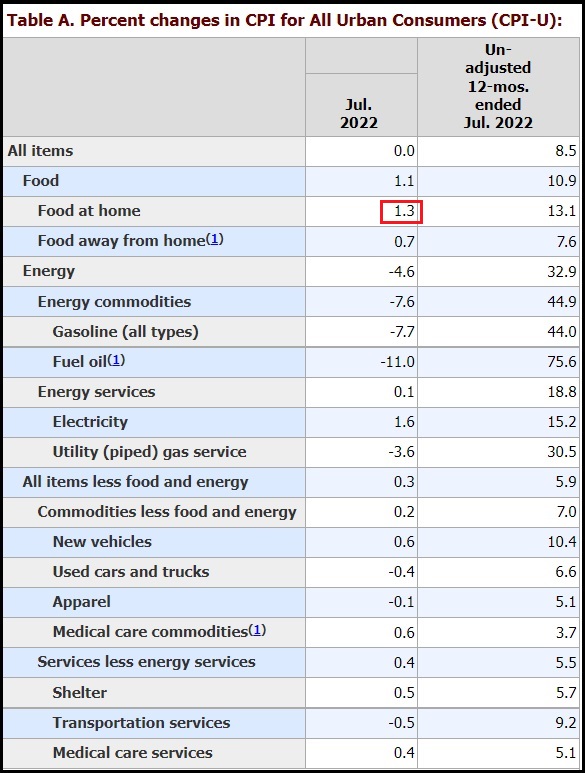
The monthly increase of 1.3% brings the annual rate of inflation to 8.5 percent year-over-year.  However, the details tell the exact story we have been outlining for well over six months.   This is the second wave of inflation being recorded.  Grocery store prices (food at home), energy prices, and gasoline prices are all driving the inflation rate. [BLS Table 1]

Again, I modified Table-1 to take out the noise.  The data shows what we have felt for the past two months.  Working class families are feeling the pinch as their wages cannot keep pace with the increase in prices on products that are a priority.  Food, housing, gasoline, energy.

If we were using the old CPI method for analysis, current inflation would be well above 20%.

That said, there are issues also inherent and visible in the data for the non-food and energy segments, what I would call the durable goods side.  First, we are seeing the beginning of the durable good contraction getting quantified as we have previously discussed.   The prices for used vehicles, electronics, appliances and other non-critical durable goods are now flatlining, or even dropping in price.

Every indication within the economy indicates this is being caused by a demand contraction.  People are not purchasing durable goods because their disposable income is gone.  This lack of demand also shows up in wage rate suppression.  Despite high employment, wages are not rising – in part because there is excess productivity in the durable good economy.

(more…)

Here We Go, White House Warns of Extraordinarily Elevated Inflation Data to Be Released Tomorrow

She did it again. Just like in February, when Psaki (seemingly out of the blue) gave a weird proactive statement about bad economic data that was going to be released the following day {LINK}. Earlier this afternoon White House spokesperson Jen Psaki gives another proactive justification for even worse inflation data that is about to be released from the Bureau of Labor and Statistics tomorrow.

In this brief soundbite, Psaki says the March inflation data that is going to be released tomorrow is going to show “Putin’s price hikes” on U.S. consumers.  However, even within the framework of her false justification, she attempts to blame Putin for gas price increases in January, when the Russian military operations did not start until February 24th.  The inflation news is going to be really bad tomorrow. How bad?  WATCH:

https://youtu.be/tNBvUq8e2Ko

None of this will come as a surprise to CTH readers.  We noted in the February inflation data (released in March), that things were going to be much worse in the April release.  The reason was simple, the massive gas price increases were not yet matriculated in the February data, and the massive food inflation was not yet captured by the USDA component. All of that preceded Russia’s invasion of Ukraine.  None of it has anything to do with Vladimir Putin.

The inflation data that will be released tomorrow is the first visible data assembly of the second inflation wave now upon us.  Remember, inflation data lags behind the reality of the price increases. What the BLS will show tomorrow is the price results from the last half of Feb through the half of the month of March.  It will likely show the largest single month inflation increase in modern history.

(more…)