Quantcast

China Leverages Pressure on Iran to Stop Strikes on Saudi Oil Fields

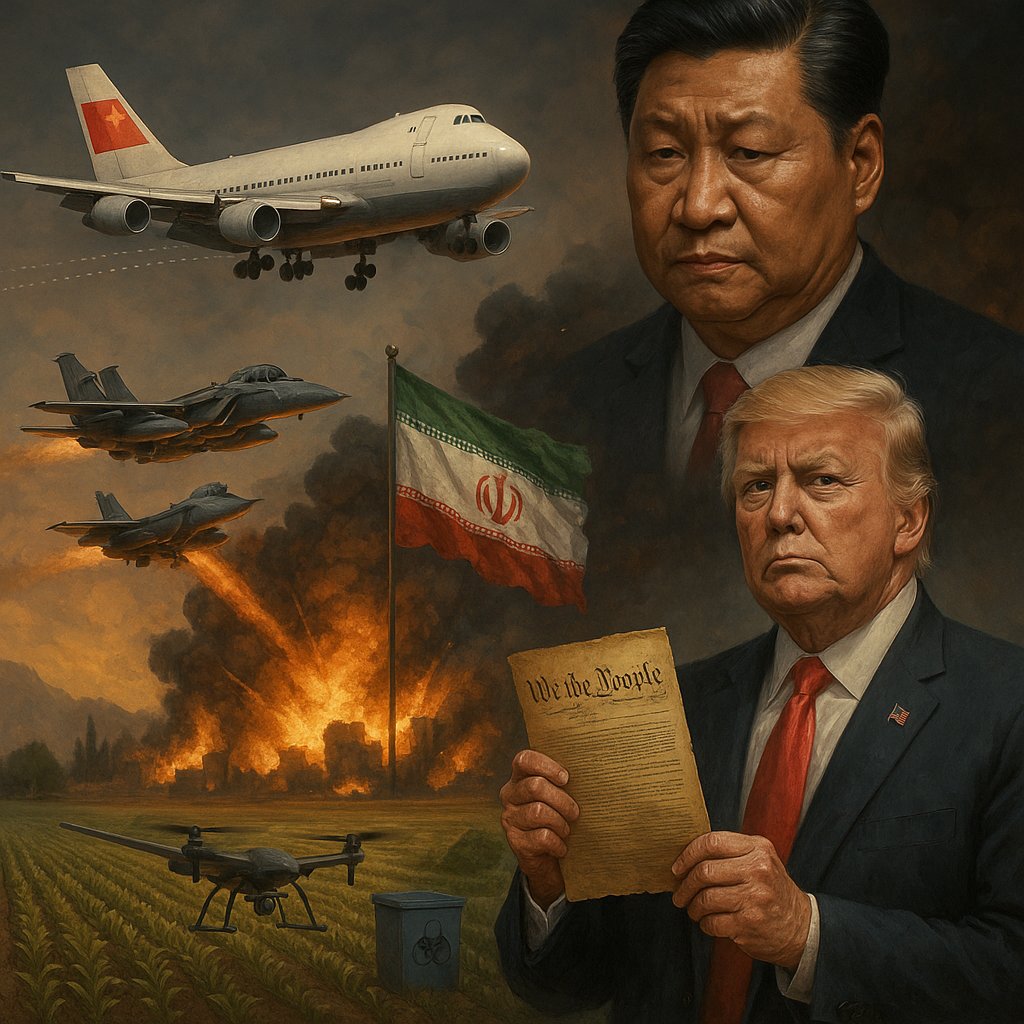
Ahead of Chariman Xi’s visit to Washington DC for a state visit on September 24th and 25th, Reuters is reporting that China has asked Iran to halt all strikes on Saudi Arabia oil fields.

The request from China carries a self-interest as China’s oil dependencies have become problematic since the Strait of Hormuz became a point of economic friction between Iran and U.S. military forces. The Saudi East/West pipeline was also hit by Iranian backed Houthi rebels from Yemen, creating even more energy turmoil.

Additionally, Beijing is the most exposed to the recent congressional sanctions applied toward countries that retain trade relations with Russia.

Both President Trump and Chairman Xi have a vested interest in seeing an end to the conflict between Russia and Ukraine. However, with EU-NATO still provoking expanded conflict the dynamic has become one of middle-powers (Canada, U.K, EU) against significant energy powers China, USA and Saudi Arabia.

Another way to look at it is the coalition of Green Energy nations -vs- Low Cost energy nations.

The U.K, Canada and Europe have been supporting attacks against gasoline and diesel fuel refineries in Russia. This approach appears to contain a political motivation to drive up gas/diesel prices in the USA as part of an anti-Trump election strategy. The state visit by Chairman Xi comes at a critical time in the global energy dynamic.

HOUSTON, Sept 18 (Reuters) – Oil prices fell on Friday after China, acting on a request from Saudi Arabia, asked Iran to limit attacks by Houthi rebels on Saudi oil infrastructure that have threatened a second oil export route in the Middle East.

(more…)

Very Interesting – Saudi Arabia Cancels Oil Shipments to Europe

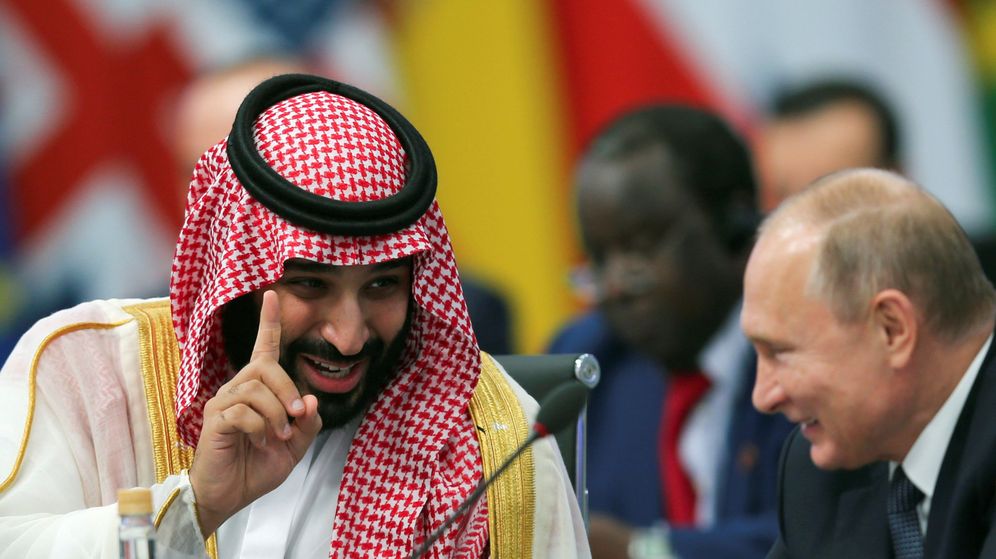
The Iran-backed Houthi rebels in Yemen reportedly hit Saudi Arabia’s east/west pipeline with drones. President Trump did not strike the Houthi’s.  Despite knowing oil prices would jump, President Trump told Saudi Crown Prince Mohammed bin Salmon to approach the issue carefully.

Reuters, citing an Axios report based on two US officials, said Crown Prince Mohammed bin Salman called Trump twice on Thursday and pressed for military action. Trump rejected the request, according to the report.

Why would President Trump ‘not’ strike back against the Iran-backed Houthi rebels, knowing the drone attack on the Saudi pipeline would only worsen the oil issue?  Well, you won’t read this anywhere else…. However, if Saudi Arabia shut down the east/west pipeline for a while (they just did), then the oil flowing to the Red Sea that ends up in Europe would be halted (it just was).

Think about it.  All of a sudden Europe cannot get oil from Mohammed bin Salmon. So, how does that change the dynamic of President Trump’s desired leverage toward Europe in his approach to bringing Russian oil back into the market.

I hope everyone can see the dynamic.  All of a sudden that Russian oil Europe hates so much, turns into dependency leverage against EU antagonisms against solving the Ukraine-Russia conflict.   This is not happening accidentally.

Oil Price News – Saudi Aramco has canceled or delayed crude deliveries to European refiners after the shutdown of the kingdom’s East-West pipeline cut into one of its remaining routes around the Strait of Hormuz.

At least three European refiners have had late-September cargoes canceled or pushed as far out as November, according to market sources cited by Argus. Two more expect notices covering September supplies.

(more…)

CIA Director John Ratcliffe Releases 71 Presidential Daily Briefs (PDBs) Outlining Intelligence Discussions Before and After 9/11

Today the CIA released an unprecedented 71 Presidential Daily Briefs given to the Executive Branch before and after the 9/11 terrorist attacks.  You can review the material [HERE – CIA LINK]

I would remind readers, in 2010 George W Bush’s campaign manager, aide and senior staff, Karl Rove, revealed [“Courage and Consequence“] that then CIA Director George Tenet had been trying for several weeks to get a personal meeting with President Bush to outline an intelligence concern about an international terror threat.

According to Rove, White House National Security Advisor, Condoleezza Rice, had been blocking Tenet from meeting with President Bush.  Director Tenet sent several requests using alternate channels to reach Bush.  Eventually, in the late spring or early summer 2001, Tenet overcame the Rice block and was given time to brief President Bush.

CIA Director George Tenet then told President Bush the CIA had intercepted telephone “chatter” pointing to an al-Qaeda terrorist threat that somehow involved airlines.  However, the details and the specifics of the threat were unknown.  The only thing Tenet knew with certainty was that some type of plot was underway and airlines were involved.

George W Bush responded to Tenet by saying it appeared the CIA director was just trying to “cover his ass” in case something happened.  Bush was angered at the vagueness of the warning and told Tenet to consider his ass covered, but essentially the information was useless without specifics.

The rest, as they say, is history.  The matter did not surface again until after the 9/11/01 plot was carried out.

(more…)

Canada and Europe to Formalize Strategic Partnership on Sept 16th, with Canada Becoming a de facto European Protectorate

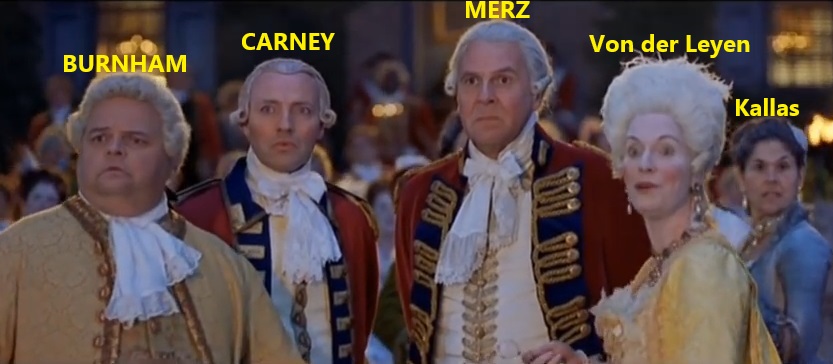
Bloomberg is reporting that EU Commissioner Ursula von der Leyen and Prime Minister Mark Carney are scheduled to formalize a strategic partnership with details to be delivered during remarks on September 16th.

In the big picture this does not come as a surprise as Prime Minister Mark Carney has called Canada the most European of non-European states. The ideology of the EU bureaucracy in Brussels and the Carney government in Ottawa is in full alignment. Canada yearns to be European in part to help defend the British Commonwealth from the global reset underway by U.S. President Donald Trump.

President Trump is assembling a sovereign global structure where the tentacles of the British commonwealth system are removed. A sovereign USA, China, India, Russia and Saudi Arabia acting independently, albeit with each nation organizing their interests by forming bilateral trade and economic attachments with each other nation.

In essence President Trump is emphasizing ‘Nationalism’ over ‘Globalism’, where the influences of the old, mostly British or colonial systems are removed. In order to combat this strategic reset the U.K commonwealth countries Australia, New Zealand, the British Caribbean states and Canada are organizing themselves into a cluster with the European nations as “middle powers.”

According to the expressed defensive plan outlined by Prime Minister Mark Carney, the totality of the “middle powers” assembly would then be large enough to block the influences of the USA, China, Russia, India or Saudi Arabia.

This new alignment will be interesting against the geopolitical backdrop of the economically aligned G7 or G20 construct. However, there is a big upside. Given the nature of the expressed intent for collective defense and security, there is an immediate opportunity created by the assembly for the United States to exit NATO.

(more…)

One Major Shift Can Solve the Iran Problem and So Much More

**BUMPED by Request** History has a tendency to rhyme.

There is one move on the geopolitical chessboard that can put all of the U.S. and President Trump’s problems into an immediate checkmate.  However, the forces against the alignment are significant. If President Trump can end the Ukraine-Russia conflict and end the sanctions regime against Russia, everything changes.

Bringing Russian oil, gas and natural resources back into the global economy not only removes all leverage held by Iran, but it also wipes out intransigent resistance against the geopolitical reset and upends over a hundred years of EU and Commonwealth financial manipulation.

Not only does the Iran problem immediately shift, but so too does any/all leverage carried by Canada on behalf of London and the broader commonwealth structure.  With a U.S-Russia strategic economic alliance, something factually stated at the end of every message from Moscow, the dynamics of global structures is entirely different.  However, all the oppositional interests are well aware of the consequence and their actions reflect it.

The United States and Russia ended World War II.  A U.S-Russia alliance would change everything.

Who would benefit from such a strategic partnership?  The USA, Russia, India, China, Saudi Arabia, the Gulf States (GCC), ASEAN countries and even Japan and the Caribbean, including Cuba.

Who would oppose such a seismic shift?  The U.K, specifically the financial constructs within the City of London, Canada, the EU-NATO states, all the Commonwealth countries and the Five-Eyes group (Australia, New Zealand, Canada, the U.K and the U.S. Intelligence Community).

Now we have appropriate context for the dynamic of the issue, along with context for exactly why all oppositional elements are conducting current activity.  A strategic partnership between the U.S. and Russia represents an existential threat to all the old systems – everything.

The first step would be solving the Ukraine-Russia conflict. So, let’s look at that problem specifically and how a transactional approach might frame the four corners of an end to it.

(more…)

Secretary Bessent Outlines Reality of Capital Markets Making the Strait of Hormuz Irrelevant

Treasury Secretary Scott Bessent gets it.  When asked about the Strait of Hormuz, Bessent notes that yes, things will likely never return to the way they were before; however, there is a distinction that must be applied.

Even if Iran completely acquiesced to all of the most stringent terms and conditions requested by President Trump, they will never again recapture the position they held with the Strait of Hormuz as a chokepoint.

Capital markets respond to risk in the medium and long term; risks are always mitigated.  With the Strait now identified as a strategic risk, the emphasis will be on forever neutralizing that risk and avoiding the issue in the future.  As a consequence, Iran’s strongest point of leverage is disappearing now and will continue to disappear.  WATCH (prompted):

As further explained by James Thorne on X: “By repeatedly signaling its willingness to disrupt the Strait of Hormuz, Tehran hasn’t strengthened its hand, it has accelerated the market’s exit. Capital does not tolerate chokepoints; it routes around them.

Saudi Arabia is expanding its East-West pipeline. The UAE has already built out Fujairah as a bypass. Iraq is revisiting overland export corridors. Every marginal dollar now flows toward redundancy, not reliance. What was once a geopolitical lever is being engineered into irrelevance. Bessent gets it: markets don’t absorb coercion; they arbitrage it away.

(more…)

President Trump Gives Lengthy Interview about Lindsey Graham and Iran Duplicity

President Trump calls-in to Fox Morning to discuss the passing of his friend Senator Lindsey Graham and other events of importance.    The discussion about Graham is the first 8 minutes.

The interview is prompted to [8:04] the segment where President Trump is discussing the current status of insufferable negotiations with a duplicitous Iranian negotiating team.  Obviously, President Trump is done with the word games and efforts of the Iran regime to “tap along” the negotiations while never intending to uphold their word or promises.

Previously the Gulf Cooperation Council (Saudi Arabia, UAE, Qatar, Kuwait, Bahrain) urged President Trump to ignore the statements and promises from Iran as they could not be trusted.  However, the GCC -which is ironic considering Qatar intermediaries- then tried to directly negotiate with Iran using Pakistan.

Collectively the GCC, Trump and now NATO are all in the same frame of thinking that Iran is simply just playing games.  As a consequence, U.S. and allied military action is now taking place against Iran on multiple fronts.  WATCH:

.

(more…)

President Trump Holds a Bilateral Meeting with Egyptian President Abdel Fattah al-Sisi

Perhaps one of the most consequential voices in all of the Middle-East is Egyptian President Abdel Fattah al-Sisi.  Egypt is the intellectual hub of modern Islam, and a very pragmatic President Sisi has been the major opposition to radical Islam for the past decade.

President Sisi walks a careful position balancing his opposition to the Muslim Brotherhood with pragmatic perspective toward Israel and the friction therein.  Egypt has been stable under the leadership of Sisi, but extremist elements have continued to use the Siani region to create instability.  President Trump and President Sisi are in alignment on the cause for peace and stability.  WATCH:

.

(more…)

President Trump Announces Iran Deal is Complete – Strait of Hormuz Open for Transit

President Trump announces the deal with Iran is completed:

[SOURCE]

(more…)

Following Phone Call with Arab Allies, Turkey and Pakistan, President Trump Notes Memorandum of Understanding with Iran to Be Announced Shortly

The Gulf Arab allies had been negotiating through Pakistan with Iran.

Egypt, Jordan, Bahrain, Saudi Arabia and Qatar are now joined by Turkey in the construction of the agreement, which is important because Turkey now represents the figurative center of the Muslim Brotherhood.

The GCC and President Trump are not going to end Iranian Islamic extremism without the umbrella political organization of the Brotherhood accepting terms.

[VIA TRUTH SOCIAL] – “I am in the Oval Office at the White House where we just had a very good call with President Mohammed bin Salman Al Saud, of Saudi Arabia, Mohammed bin Zayed Al Nahyan, of The United Arab Emirates, Emir Tamim bin Hamad bin Khalifa Al Thani, Prime Minister Mohammed bin Abdulrahman bin Jassim bin Jaber Al Thani, and Minister Ali al-Thawadi, of Qatar, Field Marshal Syed Asim Munir Ahmed Shah, of Pakistan, President Recep Tayyip Erdoğan, of Türkiye, President Abdel Fattah El-Sisi, of Egypt, King Abdullah II, of Jordan, and King Hamad bin Isa Al Khalifa, of Bahrain, concerning the Islamic Republic of Iran, and all things related to a Memorandum of Understanding pertaining to PEACE. An Agreement has been largely negotiated, subject to finalization between the United States of America, the Islamic Republic of Iran, and the various other Countries, as listed. Separately, I had a call with Prime Minister Bibi Netanyahu, of Israel, which, likewise, went very well. Final aspects and details of the Deal are currently being discussed, and will be announced shortly. In addition to many other elements of the Agreement, the Strait of Hormuz will be opened. Thank you for your attention to this matter!

~ President DONALD J. TRUMP

(more…)