Quantcast

A Pragmatic Perspective on the Iran Conflict

Many people have requested that I outline some context on the Iran conflict; so, here it is.

What follows is my own researched perspective on the challenge that President Trump is facing.  I anticipate the non-interventionists will not be happy with it, and also the Israel First crowd will not like the brutal pragmatism of it. Alas, having spent a great deal of time watching things unfold, here’s my take.

Start with this question: Considering all the years the debate over Iran’s nuclear ambitions has persisted, why haven’t its strongest allies, China and Russia, ever provided Iran with a nuclear weapon?

Now, before anyone jumps into the nuclear non-proliferation perspective, let me remind you we are not going to pretend things here. You can pretend that Beijing didn’t give the DPRK nuclear weapons by pretending that North Korea isn’t a proxy province of China. Or you can stop pretending. The choice is yours!

So, what’s different?  Well, in the DPRK example, Beijing holds the control mechanism.  For Iran, giving religious fanatics a nuclear weapon would be tantamount to giving the Muslim Brotherhood the ability to start World War III.

As recently noted, Saudi Arabia’s Crown Prince Mohammed Bin Salman urged President Trump not to back down from this moment of consequence and to eliminate the Iranian threat once and for all. MbS is about as close to a Middle East pragmatist as you can find.  In response, a desperate British Prime Minister Keir Starmer rushed to Saudi Arabia hoping to change the position of MbS.  Great Britain is almost out of fuel.

That’s a good place to start looking at the regional perspectives.

(more…)

Susan Kokinda Outlines the Shift in Strategic Alliances

The rebranded Lyndon LaRouche PAC has another good outline on the new strategic alliances assembled by President Trump as the ongoing conflict with Iran continues.

Susan Kokinda reviews how the United Kingdom and Europe have been sidelined as President Trump directly negotiates with key stakeholders in the middle east and Asia.  Kokinda correctly notes the messaging from Russia indicates a strategic awareness that old systems are fracturing and the potential for new strategic alliances is rising.

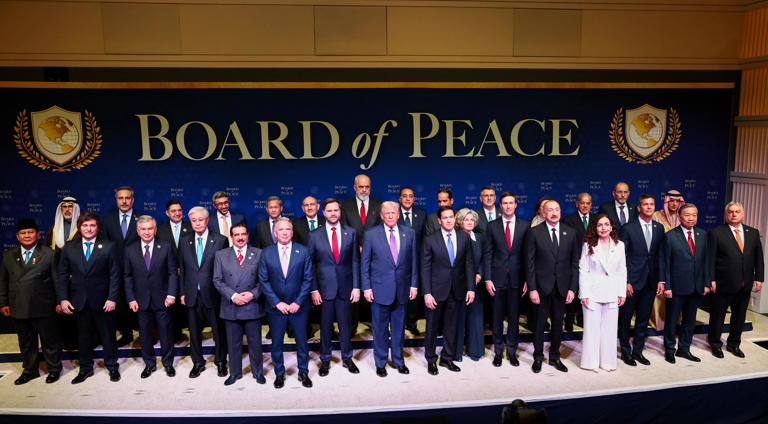
Susan Kokinda argues President Trump has opened a new diplomatic space to de-escalate the Iran conflict by working through a regional roster—Saudi Arabia, Egypt, Turkey, Pakistan, Gulf States, and back channels into Iran—while the U.K., EU, and NATO are absent and increasingly irrelevant. Citing reporting that ministers met in Riyadh and that Egypt, Turkey, and Oman carried messages, she says this “Board of Peace” architecture is isolating Iran and weakening its proxies, pointing to Lebanon’s move against Hezbollah, the Palestinian Authority’s condemnation of Iran, and Hamas considering disarmament. Kokinda links Europe’s exclusion to self-inflicted energy weakness from Green and anti-Russia policies, noting rushed LNG moves and a delayed Russian oil ban vote. She concludes Ukraine’s outlook darkens as Europe and Britain lack leverage, highlighting Zelenskyy’s scramble for support in London and Washington.WATCH:

.

(more…)

Joint Statement from U.S Negotiators, Arab Partners, Turkey and Gaza Officials on Next Steps in Peace Plan

President Trump Special Emissary Steve Witkoff relays this official statement following meetings with U.S. Negotiators, Arab state partners, Turkey and Gaza officials about the next phase in the Israel-Gaza peace plan.

STEVE WITKOFF – “We, the representatives of the United States of America, the Arab Republic of Egypt, the State of Qatar, and the Republic of Türkiye, met yesterday in Miami to review the implementation of the first phase of the Gaza ceasefire and to advance preparations for the second phase.

The first phase has yielded progress, including expanded humanitarian assistance, the return of hostage bodies, partial force withdrawals, and a reduction in hostilities.

In our discussions regarding phase two, we emphasized enabling a governing body in Gaza under a unified Gazan authority to protect civilians and maintain public order.

We also discussed regional integration measures, including trade facilitation, infrastructure development, and cooperation on energy, water, and other shared resources, as essential to Gaza’s recovery, regional stability, and long-term prosperity.

In this context, we expressed our support for the near-term establishment and operationalization of the Board of Peace as a transitional administration for the civilian, security, and reconstruction tracks of the reconstruction. We reviewed next steps in the phased implementation of the Comprehensive Peace Plan for Gaza, underscoring the importance of sequencing, coordination, and effective monitoring in partnership with local Gazan institutions and international partners.

(more…)

Fascinating Background – The CIA Was Misleading Witkoff and Kushner on Key Intelligence About Hamas During Critical Phase of Peace Negotiations

A fascinating hour-long interview with Steve Witkoff and Jared Kushner as they outline the backstory to the Israel-Hamas peace agreement in Gaza.

During a segment (prompted below) Witkoff and Kushner are outlining the step-by-step process as they engaged the leaders of Qatar, Turkey and Egypt.  Witkoff reveals how the CIA was briefing them both, multiple times a day, and the briefing itself was exactly the opposite of what Emir of Qatar and Presidents of Turkey and Egypt were telling them.  The CIA intelligence was the exact opposite of reality.  WATCH:

.

What they are describing is EXACTLY why we outlined how ‘outside govt’ emissaries were/are vitally necessary to work around the control agenda of the U.S. Intelligence Community.  This small example is stunning in magnitude when considered around the importance of the moment.

On a positive note, with Witkoff making this stunning public statement, we can now add a major datapoint to President Trump’s reference of NOT TRUSTING the CIA.  Combined with the previous assertions of Marco Rubio and Tulsi Gabbard on essentially the same level of outlook, this example of the CIA getting it wrong (misleading the administration) has long-range ramifications beyond the Hamas example.

With this backdrop for reference, surely now we can have an optimistic sense that President Trump doesn’t trust the CIA intelligence on the Russia-Ukraine conflict.

(more…)

President Trump Sending 200 U.S. Experts in Transportation, Planning, Security, Logistics and Engineering to Establish Gaza Coordination Center

As noted by President Trump during his remarks about the regional state leaders requesting that he personally head the “Gaza Board of Peace,” it is only USA President Trump the regional stakeholder’s trust.

Together with the USA and Israel, Egypt, Saudi Arabia, Turkey, the UAE and Qatar have tentatively constructed a ceasefire and peace plan that is contingent upon President Trump as the fulcrum to balance all interests.  This puts President Trump in an exceptionally important position.  This balance is also why only Donald Trump can pull this off.

As the difficult challenge begins, the preliminary objectives – the ‘how to do this‘ – aspect starts to surface.  As noted by the Associated Press, President Trump is sending 200 experts in transportation, planning, security, logistics and engineering from the U.S. military to frame out a “civil-military coordination center” in Israel.

The coordination center will include partner nations, nongovernmental organizations and private-sector experts.  The regional states will supplement and support the center as the transitional hub for immediate reconstruction and humanitarian aid.  It is likely President Trump will need to select and appoint members to the Gaza Board of Peace as this coordination center gets up and running.

As this process unfolds, Israeli President Benjamin Netanyahu is likely to get angered by a predictable stiff-arm from President Trump.  The regional stakeholders will be watching this dynamic closely.  Domestically, this will be very interesting to watch play out.

(more…)

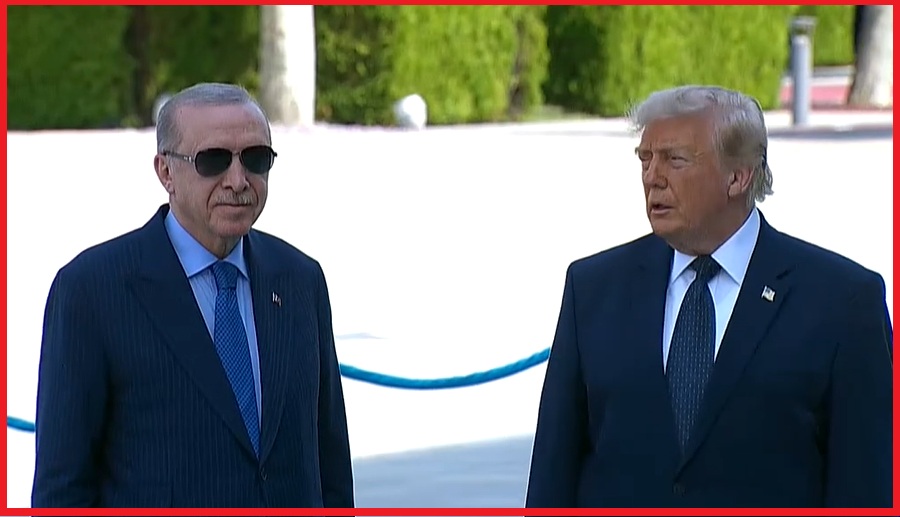
President Trump Holds a Bilateral Meeting with Turkish President Recep Erdogan

Turkish President Recep Erdogan is the figurative head of the Muslim Brotherhood. As the gatekeeper between the Middle East and Europe, Turkey sits at the center of multiple issues, and Recep Erdogan uses his position as gate guard to his favor. If Europe tries to pressure him, he opens the gates.  Europe has stopped trying to pressure Erdogan.

A rather curious NATO membership underpins the strategic influence of Erdogan and Turkey. While simultaneously Turkey maintains positive relationships with Russia and is not a member of the sanction regime against Vladimir Putin. The careful strategy has resulted in massive economic gains for Turkey, and Istanbul now stands as the gateway hub between East and West.

President Erdogan is a strong and ruthless leader openly supporting the political arm of Islam known as the Muslim Brotherhood. Erdogan also maintains close ties with Qatar. Turkey knows how to play all sides to their best interest. Erdogan also reads and speaks fluent English, though you’d never know it when the cameras turn on.  WATCH:

.

(more…)

Israeli Report – Trump, Netanyahu and Arab Partners Close to Peace Solution for Gaza

Last night on CNBC Presidential Envoy Steve Witkoff hinted that some stunning revelations around expansion of the Abraham Peace Accords would likely surface in the next week.   Immediately thereafter, President Trump sent a message of support for Israeli Prime Minister Benjamin Netanyahu, against a judicial effort targeting the Prime Minister.

Today, we start to hear of some rather stunning developments in the region that might explain multiple background stories, including the above and the severity of response from President Trump when he felt that Israel was overreacting to the Iran missile fired during the early hours of the ceasefire.

In a stunning development, Israel Hayom is reporting on the outlines of a peace agreement and long-term solution for the Israel-Gaza conflict.  The report might explain why President Trump made bold moves in Syria recently, including the removal of all U.S./western sanctions and the close relationship between Saudi Crown Prince Mohammed Bin Salman (MbS).

According to Israel Hayom, there was a 4-way call (Trump, Netanyahu, Rubio, Dermer) after the Iran strikes. President Trump and Benjamin Netanyahu agreed to “fundamental principles in general terms” including:

♦ “Gaza hostilities will conclude within two weeks.” ♦ “Four Arab nations (including Egypt and the UAE) will administer the Gaza Strip, replacing the murderous Hamas terrorist organization.” ♦ “The remaining Hamas leadership will face exile to other countries (possibly Qatar and Turkey), while the hostages gain freedom.” ♦ “Multiple nations globally will accept numerous Gaza inhabitants seeking emigration.” ♦ “Abraham Accords expansion will bring Syria, Saudi Arabia, and additional Arab and Muslim countries to recognize Israel and establish official relationships.” ♦ “Israel will declare its willingness for future Palestinian conflict resolution under the ‘two states’ concept, contingent upon the Palestinian Authority reforms.” ♦ “The United States will acknowledge limited Israeli sovereignty implementation in Judea and Samaria.”

President Trump was reportedly angered by Israeli strikes after his Iran ceasefire announcement, because he feared further hostilities would derail this complicated deal.

(more…)

Ukraine Presents Draft Proposal, a “Term Sheet” for Ceasefire Discussions

Eventually both sides have to get past the talking points and start putting demands to paper.

According to President Trump’s envoy to Ukraine, Keith Kellogg, Ukraine has put forth a draft proposal outlining their general terms for a ceasefire between Ukraine and Russia.  Now the Trump administration is awaiting a similar draft from the Kremlin.

Once both drafts, what they are calling “term sheets”, are received and reviewed it appears that President Trump will reengage the process and seek to bring both parties to the negotiation table.  At least that looks like the general outline.

Retired Lt. Gen. Keith Kellogg, notably an anti-Russia leaning participant in the construct (worked for Mike Pence), appeared on Fox and Friends earlier this morning to discuss the current status of the issues, against the backdrop of President Trump’s frustration.  WATCH:

(Via MSM) – […] “We have received everything we need. The facts are sufficient for action. We do not need any more evidence,” Kellogg said he said on Fox News, speaking about recent developments in Russia’s war against Ukraine.

Following the first direct meeting between Ukraine and Russia since the war started in Istanbul on May 16, Russian Foreign Minister Sergei Lavrov said the Kremlin would draw up a draft proposal listing its conditions for a lasting peace, which is due to be released this week.

(more…)

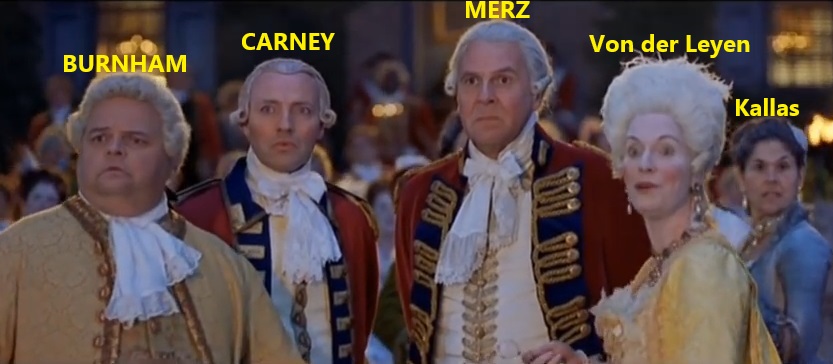
Zelenskyy and EU Allies Macron, Starmer, Merz and Tusk Unite Against President Trump Effort

The agenda behind Zelenskyy and his handlers is very clear, the EU need to keep distance between U.S. President Donald Trump and Russian President Vladimir Putin; so, they keep playing the narrative game around the pretense of a ‘ceasefire.’

Using his Twitter account today, the vertically challenged EU members led by Volodymyr Zelenskyy note, “if the Russians reject a full and unconditional ceasefire and an end to killings, tough sanctions must follow. Pressure on Russia must be maintained until Russia is ready to end the war.”

The picture Zelenskyy presents of Donald Tusk (Poland), Zelenskyy, Emmanuel Macron (France), Keir Starmer (UK) and Friedrich Merz (Germany), represents his “coalition of the willing.” The group who has pledged to send troops to Ukraine as part of a peacekeeping coalition, as long as the USA military backstops their presence against Russia.

If President Trump does not agree to position U.S. military as part of the coalition, then the “willingness” changes.  Hence, Friedrich Merz says “we must maintain good relations with the United States.”

(more…)

Secretary Rubio and NATO Secretary General Mark Rutte Deliver Remarks in Turkey as Ukraine Delays Discussions

The talks between Ukraine and Russia on the neutral turf of Turkey turned into a geopolitical game of theatrics and narrative competition following the announcement that Vladimir Putin would not attend.

NATO Secretary Mark Rutte traveling to Turkey (a posturing participant) is yet another indication of the stupidity of it all.  Ukraine is not a NATO country and the conflict between Russia and Ukraine, while it may be grounded in the origin of NATO encroachment, does not involve NATO unless you inject the ancillary issues into the equation.   All of this extraneous party posturing shows the reason why Russian President Putin did not attend.

After a meeting with Turkish President Recep Tayyip Erdoğan in Ankara, Zelenskyy chose to leave for home announcing he would send a delegation as the Russian group sat waiting for their peers to arrive.  The back-and-forth between the two nations played out all day without any substantive negotiations or discussions.   Secretary of State Marco Rubio, Steve Witkoff and Keith Kellogg sat around in a holding pattern waiting to see if the two sides would eventually have representatives in place to talk to each other.

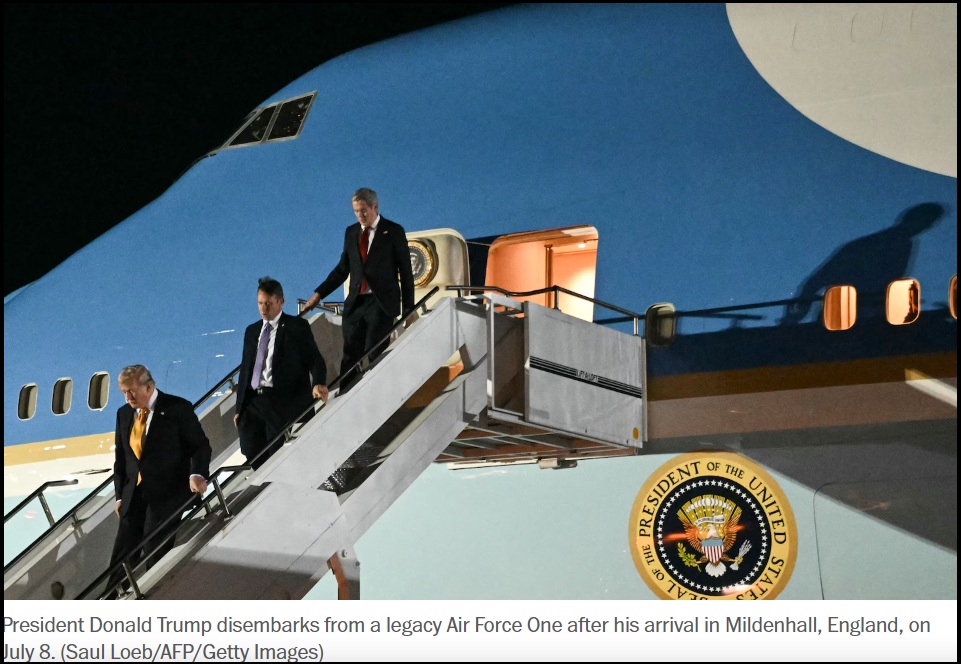
Making a statement from Air Force One, President Trump seemed to encapsulate the dynamic saying he did not think any progress was likely until he personally met with Russian President Vladimir Putin. “Look, nothing is gonna happen until Putin and I get together,” Trump told reporters on board Air Force One en route to the United Arab Emirates. “And he wasn’t gonna go … He wasn’t going if I wasn’t there. And I don’t believe anything will happen, whether you like it or not, until he and I get together. But we are gonna have to get it solved because too many people are dying.”

Later this afternoon Secretary of State Marco Rubio seemed to confirm that a Putin/Trump meeting was going to be needed to break the stalemate.

(more…)