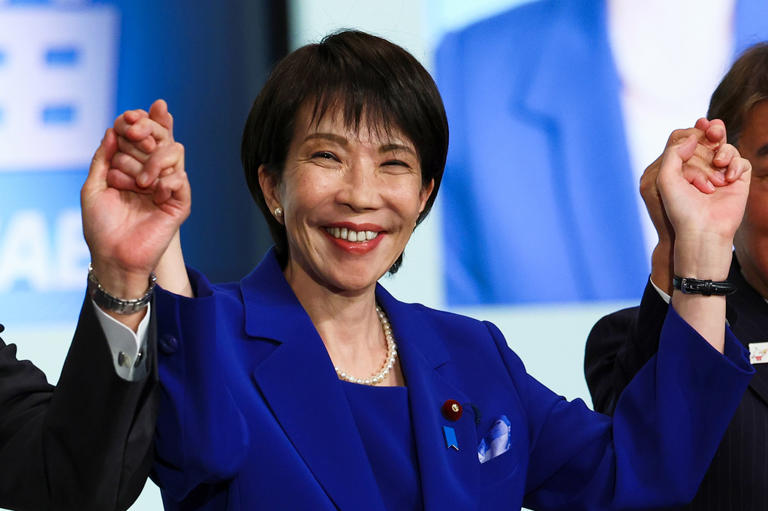
U.S. President Donald Trump received a grand welcome from Japan’s first female Prime Minister, Sanae Takaichi, in Tokyo before the two leaders held a bilateral meeting focused on trade, defense and regional stability.
Video segments below, as presented, starting with the formal welcome ceremony.
.
At the grand Akasaka Palace, President Donald Trump met Japan’s Prime Minister Sanae Takaichi for a historic U.S.–Japan summit. The leaders celebrated shared achievements, discussed new trade and defense commitments, and promised a stronger alliance for peace and prosperity.
President Trump delivered very touching remarks about former Prime Minister Shinzo Abe, Mrs Takaichi’s friend and mentor in politics.
Tremendous warmth surrounds President Donald J Trump participating in a bilateral meeting with new Japanese Prime Minister Sanae Takaichi at Akasaka Palace in Minato, Japan.
United States Trade Rep. Jamieson Greer is a very solid member of the Trump trade team. Having learned at the knee of former USTR Robert Lighthizer, you can see the stability of thought in the consistency of approach.
USTR Greer outlines the ongoing discussions between the U.S. and China on the framework of a stable trade relationship. Against a myriad of geopolitical chess moves on the economic and trade front, Greer and Treasury Secretary Bessent play key roles in executing the Trump Doctrine.
.
In the background of the President Trump and Chairman Xi meeting, we can see the broad contours of President Trump’s strategy toward both the Russia-Ukraine conflict and the China-Canada trade relationship.
If President Trump can formulate a strong, actionable and enforceable free trade agreement with Chairman Xi, it will undercut the ability of Canada to assemble cheap component goods not available in the U.S. manufacturing equation for total cost of goods. This puts Trump in an even stronger position heading into the 2026 USMCA (CUSMA) dissolution phase.
Additionally, despite the mainstream thoughts to the contrary, putting distance between Russia and China is not averse to the interests of Russian Federation Vladimir Putin, who would strategically prefer to do business with the ‘West’ over Beijing. However, China does not want to see their Biden-created tentacle weakened in Russia.
Sanae Takaichi, 64, won the Liberal Democratic Party leadership election on October 4, 2025, positioning her as Japan’s likely first female prime minister.
Takaichi is a conservative ally of the late Prime Minister Shinzo Abe, and supports revising the pacifist constitution, boosting defense spending, and imposing stricter immigration policies. Her victory was unexpected and now she will face parliamentary confirmation potentially becoming Japan’s first female Prime Minister.
TOKYO (AP) — Japan’s governing party on Saturday elected former Economic Security Minister Sanae Takaichi, a hard-line ultra-conservative and China hawk, as its new leader, making her likely to become the country’s first female prime minister.
In a country that ranks poorly internationally for gender equality, the 64-year-old Takaichi makes history as the first female leader of Japan’s long-governing conservative Liberal Democratic Party. Takaichi is one of the most conservative members of the male-dominated party.
An admirer of former British Prime Minister Margaret Thatcher, Takaichi is a protege of former Japanese Prime Minister Shinzo Abe ‘s ultra-conservative vision and a regular at the Yasukuni Shrine, seen as a symbol of Japan’s wartime militarism, which could complicate Tokyo’s relations with its Asian neighbors. (read more)
The Japanese essentially did not want to face a 25% tariff on automobiles exported to the USA. At the same time, they did not want to permit full USA access to several sectors of their market. The solution is quite remarkable.
Japan agrees to be the bank, to essentially finance any national security priority of President Trump to the tune of $55o billion. In return, Japan gets a 15% tariff on automobiles, and 10% return on the profit of the ¹business they finance in the U.S. Japan is essentially purchasing a lower tariff rate.
PRESIDENT TRUMP – “We just completed a massive Deal with Japan, perhaps the largest Deal ever made. Japan will invest, at my direction, $550 Billion Dollars into the United States, which will receive 90% of the Profits. This Deal will create Hundreds of Thousands of Jobs — There has never been anything like it. Perhaps most importantly, Japan will open their Country to Trade including Cars and Trucks, Rice and certain other Agricultural Products, and other things. Japan will pay Reciprocal Tariffs to the United States of 15%. This is a very exciting time for the United States of America, and especially for the fact that we will continue to always have a great relationship with the Country of Japan. Thank you for your attention to this matter!”
Commerce Secretary Howard Lutnick explains:
EXAMPLE: President Trump wants generic drug manufacturing in the USA. U.S. company ‘Main Street Drugs’ agrees to build a $100 billion manufacturing plant. Japan finances the building and company creation. Main Street Drugs owns and operates the business, keeps 90% of the profits, Japan gets 10%.
Trump (USA) has $450 billion in financing left to spend on the next priority, perhaps a railroad connection or transit system.
President Donald Trump has begun posting the country specific tariff rate announcements on his Truth Social account.
Beginning with Japan and South Korea, President Trump is sending letters to each nation not currently in direct negotiations with the USA. Japan example below:
Both Japan and South Korea are assigned 25% baseline tariff rates “separate from all Sectoral Tariffs.” Additionally, if the nation participates in transnational shipping, the rate attempting to be avoided will be applied to the country violating the trade position.
Example: South Korea (25%) acts as a passthrough for a country with a higher tariff rate like Vietnam, 40%. If South Korea is caught engaging in transnational shipping then the applied tariff rate on the South Korean goods is 40%.
There is some interesting information within the video of President Trump aboard AF-1 as he returns from Florida. However, one of the more interesting aspects comes around 05:39 when asked if he was thinking about extending the tariff pause beyond July 8, 2025.
As noted by President Trump, very firmly, no. There is no reason to extend the deadline for reciprocal tariffs beyond July 8th for any country not in direct negotiations as of that date. Trump intends to just send them a letter outlining the applied tariff rate and that’s it. Done is done. WATCH:
This firm date is why India has extended their negotiation team in Washington DC, and is also the reason why Europe is coming Thursday. The baseline tariffs are done, everyone pays 10% regardless of a FTA or not. The reciprocal tariff rate will be applied to those without an FTA effective July 9th.
[The EU (who wants a trade deal now) is eventually going to align with Canada (who will need a trade deal later). This factors into the current trade dynamic and looms over the decision making.]
Post July 9th, President Trump moves on to other important geopolitical matters with the tariffs as an ancillary weapon for adherence to the new international trade alignment. Those who want to benefit commit to the U.S. dollar as the trade currency (that’s the reason for India’s announcement today), and trade preferences are then used to shake up the geopolitical alignments. Watch for how this plays out with Trump’s planned UK visit.
From there, and after the gnashing of teeth settles down, later in the summer President Trump then triggers the USMCA renegotiation phase with Mexico and Canada. President Trump is essentially ambivalent to the pleas from nations who want to continue their trade imbalance. This sequencing and outline appears clear; but let’s watch and see what happens.
Canadian Prime Minister Mark Carney welcomes President Donald Trump at the beginning of the working sessions for the G7 assembly in Canada.
During the press availability President Trump notes the G7 used to be the G8, however following the Crimea referendum and President Putin’s response to accept the outcome of the vote, the NATO alliance led by President Barack Obama took Russia out of the group. President Trump says he “agreed” with Putin’s reaction to the decision.
The G7 speak about Russia consistently at almost every meeting, without a willingness to listen to the voice or opinion of Russia in context to their protestations. Quite simply it is easier for Italy, Canada, the U.K, France, Germany, Japan and the USA to exist inside an echo-chamber without having their multilateral arguments challenged. President Trump does not fear the debate of ideas with Russia present in the room, another point of distinction between Trump and the assembly.
Wrong is wrong even if everybody does it; and right is right even if nobody does it. It takes strong confidence to assert a position counter to popular opinion, this is what makes President Donald Trump a transformative political influence.
In the background, President Vladimir Putin is undoubtedly paying attention.
Also, read carefully what President of the European Council António Costa said today:
[AUTHORS NOTE: Having attended the ASEAN conference to make contacts, after a brief respite at home I spent the past several weeks traveling Southeast Asia to research the likely impact from Trump’s tariff and global trade reset. Visits included manufacturing and distribution facilities in the Philippines, Malaysia, Thailand, Vietnam, Cambodia, Sri Lanka and South Korea. What I will share with you in the next few months is an overview from direct first-hand discussions, contrast against the MSM financial media outline.]
The predictable doomsday Wall Street Journal narrative includes a forecast for a massive drop in exports from China as shipping conglomerates begin to outline a drop in trans-pacific sea cargo and container carriers.
What I would say to concerned Americans is to filter out the political narrative and remind yourself of the expanded footprint throughout SE Asia that Beijing has already established. Chinese companies, many of them subsidized by the CCP, are pre-positioned to begin transnational shipping. I have witnessed it first-hand. However, here’s the WSJ narrative as it begins.
WSJ – The number of ships sailing from China to the U.S. laden with clothes, electronics, furniture and other goods is plunging, as an accelerating number of cargoes are canceled.
The scrapped sailings come after the Trump administration ratcheted up tariffs on China while giving a three-month reprieve on punitive levies for much of the rest of the world.
At the Port of Los Angeles, one of America’s biggest gateways for imports from China, executive director Gene Seroka told port officials Thursday that he expects a 35% drop in import volumes in two weeks “as essentially all shipments out of China for major retailers and manufacturers has ceased.”
The decades long relationship between former Japanese Prime Minister Shinzo Abe and President Donald Trump permeates through a recent announcement that Japan will be the first nation to enter the new era of trade negotiations with the United States.
Shinzo Abe was assassinated in July 2022, as he traveled throughout Japan gaining support for increased national military development. As businessmen and later politicians Donald Trump and Shinzo Abe (RIP) had a decades long friendship grounded in mutual respect and competition.
To understand the dynamic of President Trump giving the nation of Japan the position as the first nation to enter new trade negotiations, a high honor, is to understand the business relationship between the U.S and Japan in the post-World War II (40 yr) period between 1950 and 1990. The formative years for both Japanese industry and President Trump’s business empire.