Quantcast

Zelenskyy Says U.S. Will Not Provide Security Guarantees Unless Ukraine Concedes Donbas Region to Russia

The more NATO/EU hypocrisy creates friction with President Trump; the less U.S. support exists for Ukraine.  That’s the dynamic Zelenskyy is trying desperately to navigate with his EU allies.

During a lengthy interview with Reuters, Zelenskyy says he has been directly told the only way for Ukraine to get security guarantees from USA participation is if he concedes the contested Donbas region to Russia and ends the conflict.

Assuming what Zelenskyy says is accurate, at this point in the ongoing stalemate, this seems like the pragmatic optimal solution.  Concede Donbas to Russia, and the U.S. will mediate terms that emphasize an American willingness to protect Ukraine from further encroachment.

That said, when Zelenskyy once again starts asking who is going to pay for the needs of his country, the U.S. taxpayer eyeroll commences.

KYIV, March 25 (Reuters) – The U.S. ​is making its offer of security guarantees for a peace deal in Ukraine conditional on Kyiv ceding all of the country’s eastern region of Donbas to Russia, President Volodymyr ‌Zelenskiy told Reuters in an interview.

[…] Two vital questions remained unresolved regarding security guarantees, Zelenskiy said: Who would help to fund Ukraine’s weapons ​purchases to sustain its military deterrent, and how exactly would its allies respond in the face of any future Russian aggression?

“The Americans are prepared to finalise these guarantees at a high level once Ukraine is ​ready to withdraw from Donbas,” said the 48-year-old leader, who added that he understood the “subtleties” of the American position although he had not participated directly himself in the trilateral talks.

(more…)

President Trump Holds a Cabinet Meeting – Video

Earlier today, President Trump continued the process of allowing media to participate in the first segment of the cabinet meetings.  President Trump begins with remarks on current events and then goes around the table for a discussion of action taking place in all executive cabinet agencies.

At 21:55 JD Vance delivers his statement.  At 23:57 Secretary of State Marco Rubio delivers his statement. At 27:05 Emissary and Negotiator Steve Witkoff delivers his statement. At 32:10 Secretary Pete Hegseth delivers his statement.  At 57:14 Secretary Scott Bessent delivers a statement. At 1:02:23 the media questions begin.

.

(more…)

Susan Kokinda Outlines the Shift in Strategic Alliances

The rebranded Lyndon LaRouche PAC has another good outline on the new strategic alliances assembled by President Trump as the ongoing conflict with Iran continues.

Susan Kokinda reviews how the United Kingdom and Europe have been sidelined as President Trump directly negotiates with key stakeholders in the middle east and Asia.  Kokinda correctly notes the messaging from Russia indicates a strategic awareness that old systems are fracturing and the potential for new strategic alliances is rising.

Susan Kokinda argues President Trump has opened a new diplomatic space to de-escalate the Iran conflict by working through a regional roster—Saudi Arabia, Egypt, Turkey, Pakistan, Gulf States, and back channels into Iran—while the U.K., EU, and NATO are absent and increasingly irrelevant. Citing reporting that ministers met in Riyadh and that Egypt, Turkey, and Oman carried messages, she says this “Board of Peace” architecture is isolating Iran and weakening its proxies, pointing to Lebanon’s move against Hezbollah, the Palestinian Authority’s condemnation of Iran, and Hamas considering disarmament. Kokinda links Europe’s exclusion to self-inflicted energy weakness from Green and anti-Russia policies, noting rushed LNG moves and a delayed Russian oil ban vote. She concludes Ukraine’s outlook darkens as Europe and Britain lack leverage, highlighting Zelenskyy’s scramble for support in London and Washington.WATCH:

.

(more…)

President Trump Notes Iranian Leadership Currently in Negotiations Sent Something of “Great Value” to Verify Their Control of Government

Obviously, one of the challenges faced by President Trump following the elimination of all senior Iran political leadership, is to know who is left in power that has the ability to negotiate terms between Iran and the U.S.

During the Q&A media segment of Mark Wayne Mullin’s swearing in ceremony, President Trump was asked how he can trust the Iranian leadership he is currently communicating with.  President Trump responded that he doesn’t trust anyone; however, the voices in Iran currently negotiating with the U.S. team sent something of great value to the White House to verify their Bonafide’s.  It is an interesting segment.  WATCH (prompted):

.

(more…)

LaRouche PAC Gives London-Centric Perspective on Status of Mid-East Oil Economics

Barbara Boyd gives her perspective on the latest developments and President Trump policy intersects with the Iran conflict and the Mideast oil disruption.

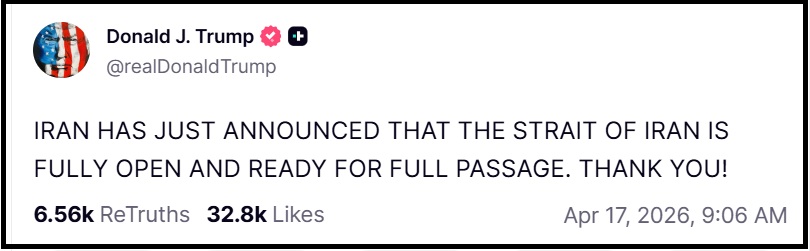
According to the latest information from the region, some ships have begun navigating the Strait of Hormuz despite the conflict.  It is reported that Iran is charging a $2 million fee for safe passage, however those reports are not officially confirmed.

Mrs Boyd notes the Arab nations have historically -and recently- remained under the control of the British, and President Trump has fractured this financial control system.  While there is an obvious historic reference to that relationship, I’m not as convinced the connective tissue is as deep as ¹claimed in the modern era (last 20 years).   WATCH:

In the modern era, thanks to technological advancement and strategic policy (even before Trump), oil and gas development and use has increasingly become regional.  Oil dependencies and the trade partnerships are now associated more with refinement capacity than simply global commodities.  Not all oil is created equal.

In the “producers and users” chart below, you can see the origin of regional production and import relationships.  The oil supplies from the middle east flow mainly to China and Asia.  The oil from Russia is the current wildcard.

(more…)

President Trump Delivers Remarks During Memphis Safe Task Force Roundtable Event

President Donald Trump travelled to Memphis, Tennessee for a roundtable discussion on the DOJ task force operations. The beginning of the remarks touch on the Iran conflict.  Video Below:

.

(more…)

President Trump Holds an Impromptu Press Availability Following Announcement of 5-Day Pause on Iran Strikes

President Trump delivers remarks and takes questions from reporters in Palm Beach, Florida, before boarding Air Force One en route to Memphis, Tennessee.  President Trump emphatically stated that continued negotiations with ‘leadership’ within Iran continues and reaffirms the conditions for a cessation of hostilities.

The military leadership within the Islamic Revolutionary Guard Corps. (IRGC), do not recognize any political representation over their military control of Iran.  This fracture within the political structure of Iran is what seems to create the conflict with U.S. negotiations with political entities the IRGC refuses to recognize.

President Trump is confident the presentation of terms now being discussed with Iranian political leadership will be agreeable to both Israel and U.S. interests.  Additionally, President Trump discusses the issue and circumstances around former NTSC Director Joe Kent and his view on the controversy that have flowed since Kent’s resignation.  WATCH:

.

(more…)

CENTCOM Commander Admiral Brad Cooper Gives Update and Overview Interview

The noise can seem overwhelming at times.  There are those who say the U.S-Israeli joint military operation against Iran is a catastrophic miscalculation.  There are those who say the operation is strategically succeeding.  Many interests even appear to be cheering for the military operation to fail; others want the operation to escalate.

It is difficult to find pragmatic facts about the events without shaped information to promote specific narratives.  However, accepting there is a psychological component to the information flow, it seems like the best option to listen to the experts who are conducting the operation.

Giving his first interview since Operation Epic Fury began, CENTCOM Commander Bradley Cooper outlines the current status of the conflict and the elements he notes are of most importance.  According to Adm. Cooper, Iran is “operating in a sign of desperation… In the last couple of weeks, they’ve attacked civilian targets very deliberately, more than 300 times.”

“The Strait of Hormuz is physically open to transit,” he said. “The reason ships are not transiting right now is because the Islamic Republic is shooting at them with drones and missiles.”  WATCH:

“I’d like everyone to note is I’ve watched this over the last week, this extraordinary contrast between the comfort and protection that you’re seeing with the senior generals in the Islamic Republic, at least those that are still alive, who are up in deep bunkers and facilities in and around Tehran. And contrast that with the soldiers who are down on the ground who are unprotected. The generals are protected. The soldiers are not protected.”

“They’re launching missiles and drones from populated areas and you need to stay inside for right now,” he said. “There will be a clear signal at some point, as the President has indicated, for you to be able to come out.”

(more…)

Sunday Talks: Mike Waltz Says Iran’s 4,000km Missile Range Not Verified

U.S. Secretary to the United Nations, Mike Waltz, appears on CBS to discuss the political angles to the U.S. military operation against Iran.  There was some critical questioning about whether Iran was factually capable of sending a missile from Iran to the U.S. base at Diego Garcia in the Indian Ocean.   Ambassador Waltz seems to question the reporting on their capabilities.  Video and Transcript Below:

[Transcript] – MARGARET BRENNAN: That’s Charlie D’Agata reporting in Arad, Israel. We’re joined now by the U.S. Ambassador to the United Nations, Mike Waltz, and it’s good to have you here in person.

AMB. MIKE WALTZ: Thank you, Margaret.

MARGARET BRENNAN: So Ambassador, on Friday, the president tweeted, “The Hormuz Strait will have to be guarded and policed, as necessary, by other Nations who use it — The United States does not!” And then last night he threatened that if Iran doesn’t fully open the Strait of Hormuz within 48 hours from the time of his post, the US will “hit and obliterate” their power plants, starting with the “biggest one first.” So which is it, is the U.S. opening Hormuz by force or having others do it.

AMB. WALTZ: Well, I think it can be both. It’s not necessarily mutually exclusive. I am glad you are having NATO Secretary General Mark Rutte on. I think at his urging and his leadership, we have now seen Italy, Germany, France and a number of others commit to help with this effort.

(more…)

Sunday Talks: NATO General Secretary Mark Rutte Outlines Support for Operation Epic Fury

Margaret Brennan’s husband is a Syrian Muslim named Major Ali Iyad Yakub, who goes by the nickname ‘Yado’.  He served in the U.S. military. Mrs. Brennan studied abroad at Yarmouk University in Irbid, Jordan, and Yakub’s sister, Samia Yakub, was her roommate. Mr. Yakub founded Y2 Global Advisory specializing in global intelligence, communications, and government relations. He also worked for Senator Joe Biden on the Senate Foreign Relations Committee.  Margaret Brennan and Ali Iyad Yakub have two children together.

NATO General Secretary Mark Rutte appears on CBS Face the Nation to discuss the European opinion of the U.S. military operation against Iran, and outline how many countries within the NATO alliance are prepared to support the ongoing effort to eliminate the threat Iran represented.  Video and Transcript Below:

[Transcript] – MARGARET BRENNAN: We turn now to NATO Secretary General, Mark Rutte, who joins us this morning from The Hague in the Netherlands. Welcome back to ‘Face The Nation.’

NATO SECRETARY GENERAL MARK RUTTE: Margaret, good to be back on the program. Good morning.

MARGARET BRENNAN: Good morning. We did see that Iran fired two missiles at Diego Garcia. That’s that island in the Indian Ocean, which houses a U.S. UK joint base. That was 4000 kilometers from Iranian territory, furthest Iran has ever gone. You just heard Ambassador Waltz say there might be a difference there in how Israel and the U.S. assess that capability Iran has in terms of what they fired. But Israel says these were intercontinental ballistic missiles that could hit Berlin, Paris and Rome. Does NATO share that Israeli assessment?

SECRETARY GENERAL RUTTE: We cannot confirm that at the moment, so we’re looking into that. But if this would be true, it is the more evidence that what the President is doing here, taking out the ballistic missile capability, taking out the nuclear capability from Iran, is crucial. And exactly as the ambassador just said, Ambassador Waltz, we have seen with North Korea, if we negotiate for too long, you might pass the moment where you can still get this thing done, and North Korea now has the nuclear capability. If Iran would have the nuclear capability, including, together with the missile capability, it will be a direct threat, a existential threat, to Israel, to the region, to Europe, to the stability in the world. So the president doing this is crucial, and I’ve seen the polling, but I really hope the American people will be with him, because he is doing this to make the whole world safer.

(more…)