Quantcast

India Reverses Prior Position and Will Now Block Further Wheat Exports, Triggering G7 Concerns

In April India said it was hoping to expand its wheat exports from 7 million tons to 10 million.  However, as precarious winter wheat harvests reflect lower outputs, they are reversing position and will now block any wheat exports in order to ensure their own supply.

INDIA – […] The announcement drew sharp criticism from the Group of Seven industrialized nations’ agriculture ministers meeting in Germany, who said that such measures “would worsen the crisis” of rising commodity prices.

“If everyone starts to impose export restrictions or to close markets, that would worsen the crisis,” German Agriculture Minister Cem Ozdemir said at a press conference in Stuttgart.

Global wheat prices have soared on supply fears following Russia’s February invasion of Ukraine, which previously accounted for 12% of global exports.

(more…)

Tucker Carlson Explains the Govt Created Subsidized Baby Formula Monopoly and Current Shortages

Tucker Carlson did a pretty decent job tonight outlining the current issues with shortages of baby formula and why it is specifically galling for the Joe Biden administration to claim they don’t know anything about the problem they helped create.  WATCH:

(more…)

Marjorie Taylor Greene, Food Security is National Security

Earlier today ultra-MAGA representative Marjorie Taylor Greene delivered remarks about the failures of the Biden administration as they are reflected in the continual food security and pricing crisis.   I strongly recommend watching these brief remarks, very impressive.

MTG accurately identifies the origin of the current baby formula crisis, as an outcome of stress within the supply chain caused by government intervention into the overall system.  MTG then notes that FDA rules and regulations make supply interruptions worse.

Additionally, in the background of the federal DHS and HHS contracts for food products, including baby food/formula, most of those federal contracts contain a ‘first right‘ or ‘prioritized continuity‘ provision, creating a distribution outcome (via contractual mandate) where illegal aliens end up with preferential allocation.  WATCH (2:55 mins):

(more…)

Producer Price Inflation Continues Surging at 11 Percent, Annualized Processed Food Increases Now 34.8 Percent

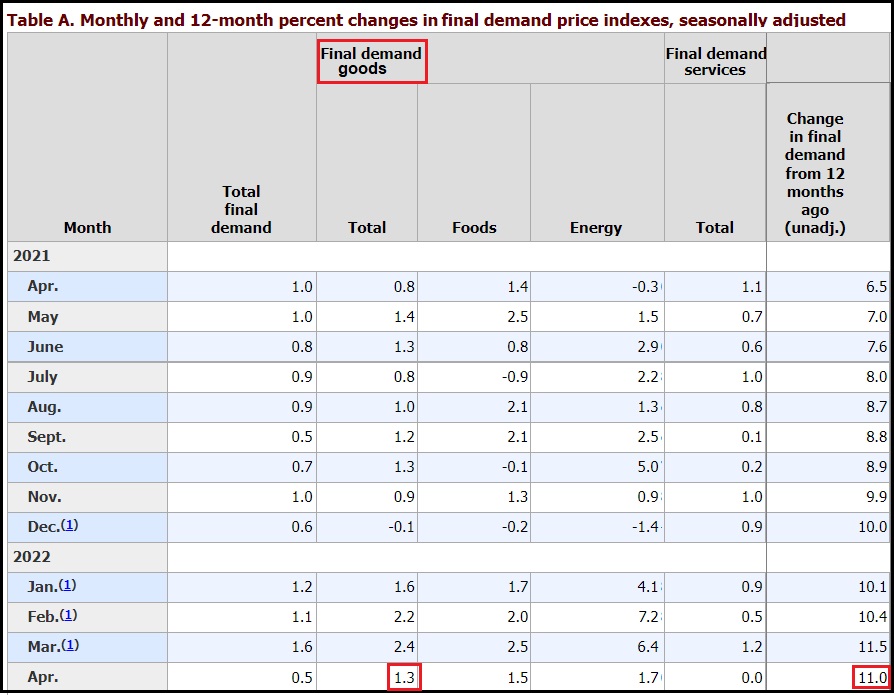
The “Producer Price Index” (PPI) is essentially the tracking of wholesale prices at three stages: Origination (commodity), Intermediate (processing), and then Final (to wholesale). Today, the Bureau of Labor and Statistics (BLS) released April price data [Available Here] showing another 11.0% increase year-over-year in Final Demand products at the wholesale level.

Last month when looking at internal economic activity that showed a contraction in consumer purchases of goods, we said pay attention to the service side of the ledger now.  Knowing people have stopped buying ‘stuff’, if people are starting to run out of money, they will cut back in the service sector (dining out, etc).

While the PPI focuses on prices, the PPI data for April shows exactly that service side contraction now taking place.  Wholesale inflation in goods is determined heavily by higher costs for raw materials and processing.  However, the rate of inflation within the service sector is more connected to what consumers can afford.   Modified Table-A, look at the April difference between goods (1.3%) and services (0.0%):

[Ex. The lawn company might pay 50% more for oil and gasoline (goods side), but they may not be able to increase the rate they charge you by 50% to mow the grass (service side).]

The major current production inflation in both goods and services is directly connected to the cost of energy.  Energy prices are embedded in every sector of the economy.  For “goods” higher electricity, heating/cooling and petroleum costs (packaging, materials, transportation, etc) are unavoidable and passed on to consumers. For “services,” individuals and companies raise their prices to compensate for increases in their own costs.  It is a cumulative inflation snowball.

(more…)

Diesel Fuel Shortage Sets Stage for Next Biden Created Crisis

It has often been said that if you chase the global climate change ideology to its natural conclusion, we end up in communal groups sitting around a tepid campfire eating some form of sustainable algae cakes and picking parasites off each other…  Prior to Joe Biden that prediction might have seemed like hyperbole. Now, not so much.

Indeed, the Green New Deal energy policy of Joe Biden creates massive downstream consequences.  Unfortunately, the White House doesn’t seem to care. The high prices and scarcity of critical goods are a feature, not a flaw, as they chase their climate friendly Build Back Better agenda.

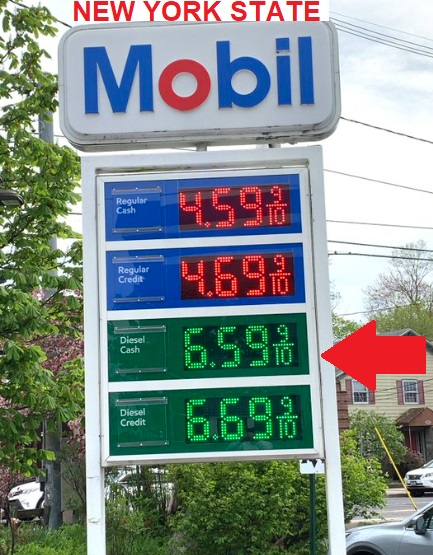
Following the continuum of intended consequence, now we have diesel fuel shortages beginning to hit the U.S. economy; and with scarcity comes higher prices of an almost astronomical scale. “The national average price of diesel is now $5.54 per gallon, which is an increase of 22 cents from last week, which was when the most recent record was set. Data shows there’s no state that’s currently seeing diesel prices below $5.12 per gallon.” (LINK)

Making matters even worse is a drop in available inventory of diesel fuel which is about to become a crisis for the east coast of the U.S.  Some Truck Stop operators like Love’s and Pilot are already warning their big rig customers they may not have fuel for truckers.

[…] “Love’s is monitoring the fluid situation on the East Coast, we have experienced minimal outages during low traffic hours,” Oklahoma-based Love’s Travel Stops said in an emailed statement. “The company has no plans to restrict purchases of diesel.”

[…] Earlier on Wednesday, the U.S. government’s Energy Information Administration said total inventories of distillates, which is mainly diesel fuel but also heating oil, fell last week to a 17-year low of 104 million barrels, which is 23% below normal.

(more…)

BLS Data 8.3 Percent, Inflation Not Falling Despite Demand Side Moderation, Boosted by Continued Production Inflation

The Bureau of Labor Statistics (BLS) released the inflation data from April today [DATA HERE] showing 0.3% increased inflation in April and a continued 8.3% ‘sticky’ inflation year-over-year.

CTH is going to say something slightly unusual, this data is actually worse than expected.   The hidden canary in the mine is within this BLS sentence which shows in the statistics, “the index for gasoline fell 6.1 percent over the month, offsetting increases in the indexes for natural gas and electricity.”  Remember, these are backwards reflections of price captured in early/mid-April.

The actual price of gasoline dropped 1% in April during the timeframe captured.  Yes, there was an actual 18 days in April when gasoline prices moderated and slightly ticked down; however, those prices immediately jumped again late April through today.
Because the BLS puts a 5x weight on the importance of gas [Table A], the 1% temporary drop in gasoline led to 6.1% downward “seasonally adjusted” price pressure.

All of that said, and with the heavy weighting of the gasoline prices considered, the net inflation results barely moved from March (8.5%) to April (8.3%). I modified Table-A to take out the noise.  You can see the downward pressure from gasoline and simultaneously the upward price pressure from food, specifically food at home.

This outcome is a reflection of what we have been seeing in the supermarkets and grocery stores.

(more…)

Joe Biden Rails Against Inflation He Created

Even with dementia I doubt seriously Joe Biden believes the nonsense he read from his prepared script today.  Every economy policy the Biden administration has triggered, specifically including the Green New Deal energy policy, has caused massive inflation.

The national average price per gallon of gasoline was $2.33 in January 2021, according to the U.S. Energy Information Administration (EIA). It has increased nearly 84% when compared to the current national average price of $4.28 per gallon {link}.  Petroleum and refined gasoline costs are embedded in every aspect of the production economy.  Additionally, Biden’s restrictions, and later policies, on natural gas and coal have caused overall energy costs to skyrocket. Again, these are cornerstones of economic inflation.

During a ridiculously obtuse speech today [Full Speech Here], part of which is in the excerpt below, Biden claims there are only two sources of inflation: (1) the pandemic (covid-19); and (2) Russia’s invasion of Ukraine.  I often accuse democrats of pretending not to know things, however these false attributions are far beyond pretense, they are purposeful lies. WATCH:

Beyond the claims about inflation, a visible pile of bovine excrement is noted in the sentences around Ukraine grain supplies.  Notice there is no supply chain issue pushing thousands of tons of military hardware into Ukraine; however, Biden claims they cannot get grain supplies out of Ukraine.  He cannot even see the hypocrisy in his own script.

Sending more than $50 billion in U.S. taxpayer money to Ukraine while those same U.S. taxpayers are crushed under the weight of the inflation that type of spending creates, is beyond blood-boiling.  We are currently in an abusive relationship with our own government and Joe Biden is the cognitively challenged, disposable front man sent to the cameras to gaslight the American people.

(more…)

Fertilizer Prices Continue Rising, Increasing Fears of Global Grain Costs and Shortages

As CTH has noted since last October the rapid increases in fertilizer costs could potentially create a major issue for global food supplies later this summer.  As the farming costs continue escalating, including fertilizer and diesel fuel prices, this will eventually lead to major price increases on the harvests.   Field to fork inflation is looking increasingly severe later this year; what we have called the third wave of inflation.

Beyond prices, a primary impact in the U.S. market, concerns are now escalating about grain shortages {SEE HERE} and lower European crop yields which will lead to less food products on a global basis.   According to information shared by ZeroHedge, “We think it will take at least 2-3 years to replenish global grains stocks,” Illinois-based CF Industries Holdings Inc.’s president and chief executive officer Tony Will said in a statement in Wednesday’s earnings report.”

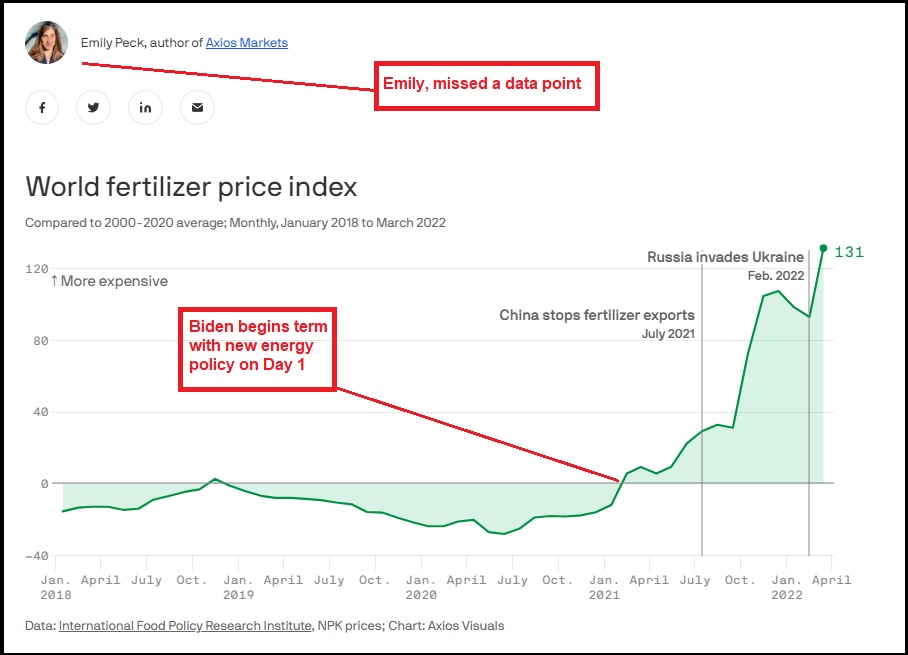
Axios is reporting on the continued escalation of fertilizer prices; however, they conveniently and purposefully avoid noting the origin of the problem in North America is directly the result of Joe Biden’s immediate energy policies that drove up the costs of natural gas (a critical component):

AXIOS – “Skyrocketing fertilizer costs — like those made from nitrogen, phosphorus and potassium (NPK) — are driving up food prices and, worse, threatening food security around the globe.

State of play: Prices for NPK were up 125% in January from a year before, and rose another 17% from the beginning of the year to March, according to data compiled by the International Food Policy Research Institute (IFPRI).

(more…)

Food Supply Protectionism is Rapidly Spreading as Global Organizations Like The IMF Warn of Consequences

This is an update to an ongoing issue we started seriously discussing last October when it became clear that if the trajectory was followed, “the absence of food will change things.”

The International Monetary Fund (IMF) is continuing to send warnings with increased urgency about the very real possibility of widespread food shortages in regions where food instability is a historic issue. [SEE HERE]

The war in Ukraine has triggered a sharp increase in energy and food prices that could undermine food security in the region, raise poverty rates, worsen income inequality, and possibly lead to social unrest,” the Fund said in its annual Regional Outlook for Africa.

This is a recent warning around a topic that has increasingly gained international attention.  Indeed, experts in multiple related agricultural fields have openly started to discuss and predict a looming crisis as the majority of the global food supply is contingent on only one or two growing cycles per year for harvest.  Those harvests are facing multiple headwinds that could likely result in lower yields.

Against this backdrop we can be certain that all nation’s government interests are taking this issue seriously.  Now, we are starting to see a race for supply control by various governments.

(more…)

Goya CEO Bob Unanu Discusses Food Production, Security and Sustainability from Field to Fork

Goya Foods CEO Bob Unanu appeared on Fox Business earlier today in order to give a bigger picture review of the current status of food production. Unanu does a good job outlining how the interconnected systems from field to fork impact consumers.  The Goya CEO appropriately outlines what is happening and what the consequences are from Biden energy policy.  It’s a good interview.

Unanu does not push food alarmism and accurately states the U.S. food production system will ensure that food is available for U.S. consumers to purchase, albeit at higher prices.  The people most at risk from food insecurity are developing countries who rely on exports of food products generated by efficient, productive and exceptional farming operations in North America that feed the world.

For U.S. consumers it is the massive increases in energy and transportation costs that are driving up food prices, putting the issue of food insecurity into the correct context of food affordability.   WATCH:

.

Consumers can offset the price impacts by shopping closer to the field, the origin of the food purchases needed.  Shopping for fresh food products at farmers markets avoids feeling the impact of shipping and transportation costs, and it helps the local economy.  If you are near areas with farm production in the United States consider the financial value of skipping the convenience of the supermarket in favor of shopping closer to the field.

In the field to fork food supply and distribution system, the closer you can get to the field for purchases the less costs you will encounter.  Obviously, for many people this may not be possible.  However, for others it might be time to evaluate the cost of convenience.

(more…)