Quantcast

IMF Director After COVID Spending Spree, Inflation and Global Food Crisis, Perhaps We Need to Pay Attention to Law of Unintended Consequences

It’s not exactly a confidence builder when the Director of the International Monetary Fund answers the question about forward priorities by saying, “Perhaps we need to pay attention to the law of unintended consequences.”  You had one job Kristalina, one job.

During an International Monetary Fund (IMF) spring debate and discussion segment, IMF Managing Director Kristalina Georgieva, outlined her perspective against the backdrop of massive inflation caused by the global financial institutions telling government to spend money and they will print it, during COVID.  [The video is prompted to 01:04:50] WATCH:

The discussion included EU Central Bank President Lagarde, US Fed Chair Powell, Indonesian Finance Minister Mulvani – when IMF Director Kristalina Georgieva admitted they channeled their COVID fear and emotions by unsustainably printing money without pausing to think through the consequences.

Now, the world is facing massive inflation, economic contraction, looming hunger, widespread famine and a pending global financial collapse.

Their response? “Whoops.”

Not to worry, they’ll have a little wine and chocolate and figure things out.  Swear.

(more…)

Treasury Secretary Yellen, We Will Have to Put Up With Inflation a While Longer

The Biden administration is desperate to get to June when they can start to cycle through the anniversary of the 2021 inflation spike beginning and start to see annual inflation comparisons level off.  The rate of inflation will drop once the statistical year-over-year comparisons reach the same moment in the prior year.  The fed will raise interest rates in May and then use the June inflation rate decline as a false talking point to highlight how their policy is working.  They wait for May, because they need to wait for the calendar, nothing else.  Inflation is measured as the percentage of change from the prior year.  By waiting until the inflation is measured against the first wave of rising prices, it will give the illusion of a decline in inflation.

That’s the unspoken background behind Janet Yellen’s statements to CNBC where she says, “We’ll have to put up with inflation a while longer.”  It’s all about kicking-the-can until the statistical comparisons lessen, nothing more.  WATCH:

When we reviewed the last inflation report at 8.5% we noted, “We will need to watch the service side closely now to see if consumers start to lessen travel, entertainment, and other service side expenses.”  We are starting to get the first signals of serious trouble on the service side now.

(USNews) – […] S&P Global said its flash U.S. Composite PMI Output Index, which tracks the manufacturing and services sectors, fell to a reading of 55.1 this month from 57.7 in March. That reflected a moderation in activity in the vast services sector.

(more…)

German Govt Release Inflation Data, Hyper Production Inflation Surpasses 30 Percent, Highest Rate Since 1949

The German government released their version of the producer price index for inflation, and they are reporting 30.9% inflation for products leaving German factories.  [DETAILS HERE] That’s the highest rate of inflation since shortly after the second world war.

The inflation rate is being driven mostly by energy costs which are more than 80% higher than last year.   However, each nation’s overall inflation rate is also driven by the amount of central bank spending they used during the COVID economic lockdowns.  The more any govt spent on subsidies, the more money they printed, the more they devalued their money and subsequently, the higher their current rate of inflation.

Germany is the largest economy in the European Union.  This level of inflation within Germany has major ramifications.

First, with this level of energy inflation Germany cannot afford to stop purchasing Russian energy products.  There’s no way for Germany to join or increase western sanctions against oil and gas they need to stay sufficient.  Germany is dependent on Russian energy.

Second, with Germany’s economy this vulnerable; and with Germany being so dependent on Russian energy; Germany will have to distance itself further from any Ukraine assistance.   In the background of western voices already being upset with Germany for not providing more support for Ukraine, their economic vulnerability explains their unwillingness.   The U.S. proxy war against Russia does not benefit Germany, at all.

(more…)

Sunday Talks, CBS Outlines Causes of Massive Inflation, Identifies Everything Except Biden Policy

This Sunday segment from CBS’s Margaret Brennan allows us to watch narrative engineering in real time.  During a segment outlining the reasons behind the major economic issues American’s are feeling, CBS notes everything except the reason the economy is struggling.  It really is quite a remarkable example of professional gaslighting.

Watch the segment, note the inflation crisis has been underway for more than 18 months, and notice how many justifications are made-up illusions. (1) A Texas-Mexico cargo checkpoint issue that started less than a week ago; (2) Trucker shortages; (3) Ukraine-Russia which started only 6 weeks ago; and (4) Pandemic lockdowns, now causing an excess in demand.  None of these issues are even close to the source of the issue.

The two major drivers of inflation are both Biden policy issues.  (1) Extreme federal government spending and the Fed purchasing debt. (2) The shutting down of U.S. energy development (pipelines closed or blocked, oil leases cancelled, permits pulled and refinery permits cancelled).  All of this is Joe Biden policy.

On the restaurant pricing side, and likely restaurants soon to close, I would note the CTH outline from a few days ago:

(more…)

Union Pacific Rail Line Begins Restricting U.S. Fertilizer Distribution

This is layers of odd.  As many readers are aware, the prices of fertilizer have skyrocketed as supplies have been heavily impacted by increased energy costs and supply chain issues.  Many people have worried if a shortage of fertilizer may impact farm yields this year.

Against this backdrop CF Industries, one of the world’s largest manufacturers of hydrogen and nitrogen fertilizer, is warning its customers that Union Pacific Railway Lines is now restricting the amount of container tonnage they will permit.  [Press Release Here]
CF Industries Holdings, Inc. (NYSE: CF), a leading global manufacturer of hydrogen and nitrogen products, today informed customers it serves by Union Pacific rail lines that railroad-mandated shipping reductions would result in nitrogen fertilizer shipment delays during the spring application season and that it would be unable to accept new rail sales involving Union Pacific for the foreseeable future. The Company understands that it is one of only 30 companies to face these restrictions.

CF Industries ships to customers via Union Pacific rail lines primarily from its Donaldsonville Complex in Louisiana and its Port Neal Complex in Iowa. The rail lines serve key agricultural areas such as Iowa, Illinois, Kansas, Nebraska, Texas and California.

(more…)

CNBC Forced to Tell the Horrible, Terrible, Bad, Bad Results of Their Biden Performance Poll

CNBC commissioned a poll by Hart research and associates, a friendly outfit for the left.  Unfortunately, that means CNBC then needed to tell everyone what the results were [Full Poll pdf Here].  That task fell to CNBC’s Steve Liesman; an appropriate name given the task at hand.

The irony doubles when you remember this was the same CNBC pundit who refused to accept the horrible economic data that began surfacing last fall.  There was even a public broadcast where Liesman said the BLS statistics had to be wrong, because the results were so horrible.  A few months later, and here he is explaining how the country now feels about Joe Biden.   WATCH:

(CNBC) – […] The pessimism is clearly dragging on Americans’ opinions of President Joe Biden. In fact, nothing looks to be working in the Biden presidency from the public’s viewpoint.

The president’s approval rating sank to a new low of just 38%, with 53% disapproving. Biden’s -15% net approval rating is measurably worse than his -9% approval in the CNBC December survey. What’s more, his approval rating on the economy dropped for a fourth straight survey to just 35%, with 60% disapproving, putting the president a deep 25 points underwater. (article link)

(more…)

Multiple Simultaneous Food Production Impacts Create Global Concern

I want to be very careful here, because multiple people have sent me a version of this outline asking for opinion. Basically, is David Friedberg correct?

The discussion in this video surrounds farming as a construct of global caloric creation.  Meaning, with all that is taking place in the farming system on a global scale, will there be dramatic food shortages?  It is a complex issue.  In the larger picture what Friedberg, a former scientist within the Monsanto organization, explains is accurate; however, I would inject some nuanced dissension as it relates to U.S. farm production specifically.

The first four and a half minutes of the video are an accurate representation of the global state of farming, albeit with a little too much weight on the Ukraine-Russia aspect.  There was a preexisting issue long before Russia entered the picture. The price of fertilizer was already skyrocketing, Russia-Ukraine has made that already looming issue, worse.  WATCH First 04:30 minutes:

https://youtu.be/1xtGTVWrw-M

The problem described, about farmers deciding not to plant, is weighted more heavily in less developed countries where access to the financing for a future crop is not stable {AP Article Here}.  For most of the developed world farming will continue; it is the end product where prices will reflect the additional costs of bringing a harvest to market.  Bottom line, as the futures market is showing, crops will be more expensive.

There is going to be a problem in the same areas of the world where food stability and dependency is already an issue.  Yes, the convergence of current farm challenges will make those areas more vulnerable.  We do not know, to what extent.

(more…)

During Speech to Blame Vladimir Putin for Massive Inflation, Bird Poops on Joe Biden

Joe Biden was in Iowa today attempting to justify the massive Bidenflation his economic policies have created.  As a result of Biden energy, fiscal and monetary policy, rising oil and gasoline prices are contributing to pre-existing inflation and crushing the U.S. economy.

As part of the White House plan to blame anyone and everyone except the Joe Biden policy agenda, Biden took to the microphones to blame Russian President Vladimir Putin.  However, reflecting the synergy of human and avian opinion, a bird flew overhead and pooped on him.  WATCH:

(more…)

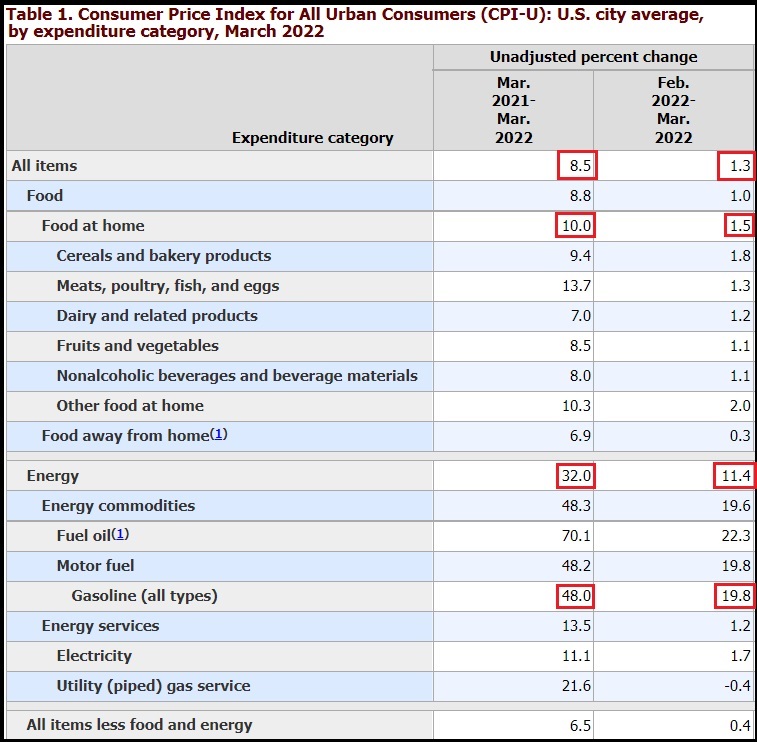
Inflation Rate Jumps to 8.5 Percent as Energy, Food and Gasoline Prices Skyrocket

This is not going to be news to CTH readers and intellectually honest analysts.  The Bureau of Labor and Statistics has released the March consumer pricing data [DATA HERE] showing the recent surge in energy, gasoline and food costs that we have all felt.

The monthly increase of 1.3% brings the annual rate of inflation to 8.5 percent year-over-year.  However, the details tell the exact story we have been outlining for well over six months.   This is the second wave of inflation being recorded.  Grocery store prices (food at home), energy prices, and gasoline prices are all driving the inflation rate. [BLS Table 1]

Again, I modified Table-1 to take out the noise.  The data shows what we have felt for the past two months.  Working class families are feeling the pinch as their wages cannot keep pace with the increase in prices on products that are a priority.  Food, housing, gasoline, energy.

If we were using the old CPI method for analysis, current inflation would be well above 20%.

That said, there are issues also inherent and visible in the data for the non-food and energy segments, what I would call the durable goods side.  First, we are seeing the beginning of the durable good contraction getting quantified as we have previously discussed.   The prices for used vehicles, electronics, appliances and other non-critical durable goods are now flatlining, or even dropping in price.

Every indication within the economy indicates this is being caused by a demand contraction.  People are not purchasing durable goods because their disposable income is gone.  This lack of demand also shows up in wage rate suppression.  Despite high employment, wages are not rising – in part because there is excess productivity in the durable good economy.

(more…)

Worsening Food Price Increases Gain Global Attention – UN Food and Agriculture Organization Tracks Highest Prices Ever Recorded

The UN Food and Agriculture Organization reported on Friday they are recording the highest Food Price Index since they started recording thirty years ago. With record highs in prices for cereals, vegetable oils, dairy and meats

This issue has been a slow burning fuse toward the biggest powder keg in modern history, and it is about to get very serious.  We have been warning about it since last fall {Go Deep}.  In the most deliberate and painstaking ways possible, we have been urging everyone to take this issue seriously.

The background cause is complex and started with the 2020 government response to the pandemic.  U.S. and international government intervention in the food supply process has been FUBAR from the beginning. Every action taken since early 2020 has been one bad policy after another; building failure upon failure, crisis upon crisis, bad decision upon bad decision, bringing us to a precipice summed up by saying “the absence of food will change things.”

Some will say the food prices we are about to experience –and the crisis it will create– was deliberate.  Others will say this was the cumulative outcome of major failures on the part of the government.  At this point the former makes more sense, and the latter looks like a justification and excuse, because if government entities were really serious about food prices and shortages, they would be taking pragmatic steps to mitigate the problem; they are not.

There are simple things government could do, such as helping farmers offset targeted fertilizer costs, providing relief for diesel fuel and energy costs, and taking other simple steps that would help the agricultural industry.

Instead of responding with the urgency this would demand, the collective government action has been to ignore the problem (talk soundbites), and give speeches about using subsidies to offset the end result (consumers) – without ever addressing the root cause.  All this while fueling conflict in Ukraine and chasing radical energy policies under the guise of global climate change.

The UN Food and Agriculture Organization (UNFAO) keeps track of food prices and projections using a global index [SEE HERE].  What they are calculating, and what they are projecting based on the current calculations, is a major increase in food prices combined with a major increase in food scarcity due to the unaffordability of food products.

(more…)