President Trump transmitted a message to congress, warning them not to cut Social Security and Medicare {Direct Rumble Link}. Many politicians and pundits will look at Trump’s position from the perspective of it being good to campaign for older voters, but that’s not the core of his reasoning.
In 2016 CTH was the first place to evaluate the totality of President Trump’s economic policies; specifically, as those policies related to the entitlement programs around Social Security and Medicare. We outlined the approach Trump was putting forth and the way he was approaching the issue. In the years that followed, he was right. He was creating a U.S. economy that could sustain all of the elements the traditional political class were calling “unsustainable.”
Before getting to the details, here’s his video message and policy as delivered yesterday. WATCH:
Fortunately, we do not have to guess if President Trump is correct. We have his actual economic policy results to look at and see how the expansion of the economy was creating the type of growth that would sustain Social Security and Medicare. This was/is MAGAnomics at work.
The New Year brings a look of forward-looking economic perspectives from major financial institutions. Unfortunately, if the perspective of Bank of America Chief Economist Michael Gapen is reflective of the larger institutional analysis, the financial pretending is anticipated to continue.
[Side Note: Notice how they will all start talking about ‘deglobalization’ in 2023. There’s a reason for that that I will touch on in the IMF interview to follow]
Appearing on Face the Nation Gapen accurately indicates the U.S. housing market is already in a steep economic recession, housing prices falling rapidly with a considerable amount of distance to go (-30% range), and the overall housing market will likely be in this situation for around two years. On a macro level the Bank of America indicators line up with the general housing trajectory. From a lending standpoint, Gapen would have specific insight.
Beyond the housing sector, Mr. Gapen starts to get sketchy. He anticipates inflation taking 24 to 36 months to lower to the norm 2% range. That is generally in line with CTH expectations; however, nowhere in the analysis does Gapen even mention energy costs and the overall impact to the economy from energy policy. You will note this absence will be present in almost all financial punditries. Mentioning “energy policy’ as a cause of economic pain is a third rail amid his peer group; it is simply not permitted.
Astute readers will note the great financial and economic pretending that surrounds the Build Back Better and Green New Deal climate change agenda will not be discussed by anyone, ever. The massive price impacts, the supply side inflation pressures, are baked into the western global economic outlooks. It is strictly verboten to talk about climate change policy being stopped, modified, reversed or even, well, gasp, removed. WATCH:
[TRANSCRIPT] – […] BANK OF AMERICA CHIEF ECONOMIST MICHAEL GAPEN: Happy New Year as well. Thank you for having me on.
MARGARET BRENNAN: You know, a majority of voters polled by The Wall Street Journal say that the economy is going to look and feel worse in 2023. What is your forecast?
GAPEN: So I think that’s probably true. I think we’re in a situation where the risk of recession is high, may not be a deep and prolonged one. But we’re in a situation where the economy has recovered very rapidly from- from COVID, and it’s come with a lot of inflation. And the Federal Reserve is trying to slow down the economy, to bring inflation down. And in the past, more often than not, that’s coincided with some sort of recession in the US economy and the U.S. labor market. It’s not baked in. It’s not for certain. We may be able to avoid it, but I would agree that the outlook by most people who sit in the position that I do think 2023 could be a difficult year for the U.S..
MARGARET BRENNAN: So we may be able to avoid recession?
In the background of international geopolitics and all things economically attached, the larger climate change agenda, the Build Back Better program, has been unfolding.
Energy driven inflation has destabilized most western economies as the various governments (politicians) and central banks (bureaucrats) work together on behalf of the corporations (World Economic Forum). All of these interests can only advance if they work together. If any individual nation breaks from the group energy agenda, their economy will thrive beyond the limits created by the BBB operation and the association of western nations.
It is with this context at the forefront where we have said to watch Mexico closely. In North America, Mexico has the least to gain from economics behind the climate change agenda. Conversely, if Mexico were to go rogue, they would gain the most. This dynamic puts Mexico in a more powerful position than most realize.
During a July 2022, meeting at the White House, Mexican President Andres Manuel Lopez-Obrador (AMLO) appeared to indicate -for the first time- his understanding of his new position as the ‘Green New Deal’ (climate change) energy agenda was being deployed by the U.S. and Canada. AMLO read from a prepared script in the oval office during a public bilateral meeting with Joe Biden. AMLO’s remarks were quite remarkable in their independence.
“In our country, we shall continue producing oil throughout the energy transition. With the U.S. investors, we are going to be establishing gas-liquefying plants, fertilizer plants, AMLO said, striking a chord that is not in alignment with Joe Biden and Justin Trudeau. AMLO continued, “and we’re going to accomplish this with the support of thermal electric plants and also through transmission lines to produce energy in the domestic market, as well as for exports, to neighboring states in the American union, as for instance, Texas, New Mexico, Arizona, and California.” It’s not just what he said, it’s how AMLO said it.
Keep in mind, the month before that July visit to the White House, AMLO boycotted Joe Biden’s Latin-America Summit. AMLO joined the leaders of Bolivia, Guatemala, Honduras and the tiny Caribbean state of St. Vincent in refusing to attend the Biden summit because Cuba, Venezuela and Nicaragua were blocked from attending by the Biden administration.
We have been closely monitoring the signs of a global cleaving around the energy sector taking place. Essentially, western governments’ following the “Build Back Better” climate change agenda which stops using coal, oil and gas to power their economic engine, while the rest of the growing economic world continues using the more efficient and traditional forms of energy to power their economies.
Within the BBB western group (identified on map in yellow), the logical consequences are increased living costs for those who live in the BBB zone, and increased prices for goods manufactured in the BBB zone. In the zone where traditional low-cost energy resources continue to be developed (grey on map), we would expect to see a lower cost of living and lower costs to create goods. Two divergent economic zones based on two different energy systems.
This potential outcome just seemed to track with the logical conclusion. The yellow zone also represented by the World Economic Forum, and the gray zone also represented by an expanding BRICS alliance. Against this predictable backdrop we have been watching various events unfold, some obvious and some less so.
When we are intellectually honest with each other, we accept the traditional Republican apparatus has always been in favor of Wall Street interests, multinational corporations, multination trade agreements, offshoring jobs, overseas manufacturing, open borders to provide endless supplies of unskilled service workers to fulfill their affluent needs, and, in the most general sense, economically no different than the traditional Democrat apparatus. After all, both wings of the DC UniParty feed from the same trough.
The counter economic position to this multinational system has always been the America First outlook. An economic outlook that puts the U.S. worker at the heart of policy. Perhaps encapsulated by saying ‘Main Street over Wall Street’ etc.
It was also the economics of the thing that created the Bernie Bros (Bernie Sanders) and the MAGA team (Donald Trump) commonality.
As a result, the Big Club distraction and distinction game has always been played on the field of social issues. Social issues continually used as a wedge to keep the working class from recognizing their common assembly.
Skilled politicians, those tenured in the ways of the club power retention, play up the social stuff publicly, while both wings of the UniParty give a wink and a nod to each other as they pass through the halls. The “reach across the aisle” code of Omerta exists.
I have no idea how the pragmatic and angered view of President Trump, with full intent to fracture this UniParty apparatus, is going to play out. Fighting both enemies simultaneously has proven to be a massive whac-a-mole undertaking. However, that said, what is abundantly clear is the reassembly of the group trying desperately to block the populist upheaval.
The Multinational corporations are all-in within the process of this inverted Fascism. Corporations now determining the political agenda, and it’s not just here in the United States. We are seeing in in North America, Great Britain and throughout Europe. The larger “western democracy” assembly is expanding the corporate dynamic, while media run cover for the totality of modern expansion.
They have proposed and refined so many of the carbon trading schemes, it becomes difficult to remember which iteration each new formula replaces. Heck, I’ve lost track of how many of the individual components of the larger plan are already in place. However, John Kerry has introduced the western elites at COP27 to the latest acceptable proposal surrounding coal fired energy.
Against the backdrop of sped-up Build Back Better urgency, this coal-based carbon trading platform is called the Energy Transition Accelerator (ETA).
When you stay elevated to the larger way the Energy Transition Accelerator works you can clearly see the transferring of wealth from your bank account to the global control mechanism that will eventually determine your energy allotment. The companies that provide energy are simply the collectors for the fees you will pay to the World Economic Forum income disbursement group.
(Reuters) – […] The scheme, known as the Energy Transition Accelerator (ETA), was launched at the United Nations’ COP27 conference this week by John Kerry, the United States’ climate envoy, in collaboration with the Rockefeller Foundation and the Bezos Earth Fund.
[…] Voluntary carbon markets, in which companies get emissions credits in return for channeling cash to poor countries that cut their carbon output, have often been riddled with fraud and double-counting. Many critics think rich countries should just fork out the cash themselves to close coal plants – or tax fossil fuel companies to get the money. (read more)
There’s the system in a nutshell. Energy providers must purchase emission credits from the ‘carbon market’ (govt); in the U.S. likely the EPA as they do with RIN credits. The electricity provider puts the carbon purchase credit fee in your electricity bill.
Folks, we have all watched the North American economic moves with great interest ever since the first discussions about reforming NAFTA were triggered by Donald Trump. Well, things are about to get even more interesting, and we will have a front seat to see how this plays out.
Joe Biden and Canada’s Justin Trudeau are in ideological alignment, willing to destroy the entire North American economy as they construct the new climate change energy systems for the U.S and Canada. However, Mexican President Andres Manuel Lopez-Obrador (AMLO) has already indicated -including direct statements to Joe Biden at the White House– that he is not willing to put the Mexican economy into collapse and try to engineer an economic future on solar panels and windmills.
As a direct result of following an independent path, the Mexican currency has strengthened against the U.S. dollar providing AMLO with evidence his current strategy to stay away from the U.S. energy policy has benefit. Factually, AMLO is a soft-socialist (immigration); however, he is also a strong economic nationalist who has previously expressed a strong dislike for the influence of multinational corporations in Mexico. AMLO is not a World Economic Forum acolyte. AMLO ideologically aligned toward team BRICS.
The U.S. and Canada are going to push every possible political pressure point in order to force Mexico to change energy policy. The stakes are high. It is going to be remarkable to watch what happens as this battle takes place. The Wall Street Journal starts to notice:
(Wall Street Journal) – A shake-up of Mexican trade officials has clouded prospects for a quick resolution of a dispute with the U.S. and Canada over what are seen as Mexico’s nationalist energy policies.
The changes at the Economy Ministry are part of an effort by Mexican President Andrés Manuel López Obrador to put people who support his stance in charge of negotiations, according to people familiar with the situation.
A few months ago, amid all of the headline warnings about inflation and prices of essential products, CTH noted that if we were to continue waiting about six months, we would see a massive backlog of unsold goods and as a consequence the prices of non-essential durable goods would begin a rapid decline. That exact scenario is about to unfold.
Keep in mind, this is not necessarily a collapse of total global economic activity; what we are seeing is a collapse of western nation economic activity that is impacting the rest of the world. A great economic fracturing is taking place as the western nations intentionally shrink their economy. The supplier nations are feeling the consequences.
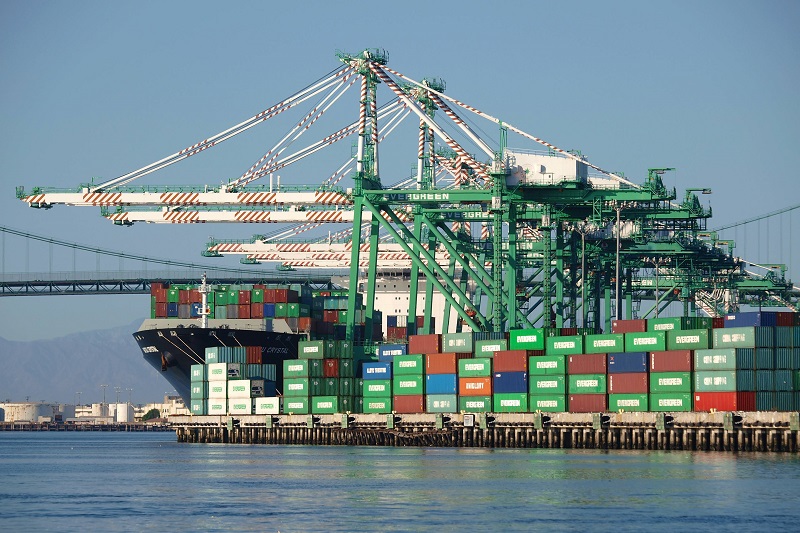
Maersk is the international shipping company that delivers millions of containers of goods all around the world, mostly by ship. They are warning that warehouses are full of previously delivered goods, unsold consumer durable goods, as retail sales have come to a standstill.
The amount of inventory in warehousing is so extreme, major wholesale and retail groups have run out of storage space (link).
COPENHAGEN, Aug 3 (Reuters) – Shipping group Maersk (MAERSKb.CO) expects global container demand to fall this year as sales of durable goods come to a “standstill”, leaving flat-screen TVs and furniture piling up in warehouses, the company said on Wednesday.
A surge in consumer demand and pandemic-related logjams holding up containers in key ports had boosted freight rates and profits in the shipping industry in recent quarters, yet the cost-of-living crisis has reversed that trend.
We are seeing the cascading impacts of the energy-driven inflation starting to ripple throughout the globe, specifically worsening economies who are dependent on the export of non-essential durable goods. South Korea manufacturing is the latest example.
The first quarter of 2022 started with a drop in U.S. consumer spending on non-essential durable goods like electronics. The net result of contracted consumer spending was a 1.6% negative GDP.
Inventories of goods started to build and by April/May of 2022 the Consumer Price Index (CPI) showed negative inflation in those sectors as discounts to move inventory were offered.
In June major manufacturer Samsung, headquartered in South Korea, announced they had told suppliers to stop sending component manufacturing parts for finished goods. (link)
By the end of July, the second quarter GDP in the U.S. again showed a contraction of 0.9%. Energy inflation was now creating a consumer spending recession, demand for non-essential goods dropped fast over the first half of the year.
Today, South Korea announces July manufacturing output contracted for the first time in two years, matching the prior announcement by Samsung:
Transportation Secretary Pete Buttigieg, a cabinet ideologue with zero experience in business or transportation, appears in the news admitted the high price of gasoline is part of the Biden energy agenda to push people into purchasing electric vehicles. You’ll have a higher car payment, but you won’t pay for gasoline. WATCH: