Press Briefing by the White House Press Secretary Karoline Leavitt and Treasury Secretary Scott Bessent on Unleashing Economic Greatness.
Inbound Investments So Far:
Project Stargate, led by Japan-based Softbank and U.S.-based OpenAI and Oracle, announced a $500 billion private investment in U.S.-based artificial intelligence infrastructure.
Apple announced a $500 billion investment in U.S. manufacturing and training.
NVIDIA, a global chipmaking giant, announced it will invest $500 billion in U.S.-based AI infrastructure over the next four years amid its pledge to manufacture AI supercomputers entirely in the U.S. for the first time.
IBM announced a $150 billion investment over the next five years in its U.S.-based growth and manufacturing operations.
Only President Trump could get the Canadians to vote for an exit to the USMCA, and he did it brilliantly.
To understand President Trump’s position on Canada, you have to go back to the 2016 election and President Trump’s position on the NAFTA renegotiation. If you did not follow the subsequent USMCA process, this might be the ah-ha moment you need to understand Trump’s strategy.
During the 2016 election President Trump repeatedly said he wanted to renegotiate NAFTA, the North American Free Trade Agreement. Both Canada and Mexico were reluctant to open the trade agreement to revision, but ultimately President Trump had the authority and support from an election victory to do exactly that.
In order to understand the issue, you must remember President Trump, Commerce Secretary Wilbur Ross and U.S. Trade Representative Robert Lighthizer each agreed the NAFTA agreement was fraught with problems and was best addressed by scrapping it and creating two seperate bilateral trade agreements. One between the USA and Mexico, and one between the USA and Canada.
In the decades that preceded the 2017 push to redo the trade pact, Canada had restructured their economy to: (1) align with progressive climate change; and (2) take advantage of the NAFTA loophole. The Canadian government did not want to reengage in a new trade agreement.
Canada has deindustrialized much of their manufacturing base to support the ‘environmental’ aspirations of their progressive politicians. Instead, Canada became an importer of component goods where companies then assembled those imports into finished products to enter the U.S. market without tariffs. Working with Chinese manufacturing companies, Canada exploited the NAFTA loophole.
Justin Trudeau was strongly against renegotiating NAFTA, and stated he and Chrystia Freeland would not support reopening the trade agreement. President Trump didn’t care about the position of Canada and was going forward. Trudeau said he would not support it. Trump focused on the first bilateral trade agreement with Mexico.
Russian Foreign Minister Sergey Lavrov appears on CBS Face the Nation to discuss the position of the Russian Federation toward the ‘ceasefire’ in Ukraine. The interview took place on Thursday April 24th and was broadcast today.
This interview also takes place one day before President Trump Special Envoy Steve Witkoff flew to Moscow for his fourth meeting with Putin to discuss the settlement of the war in Ukraine. According to the Kremlin, the conversation between Witkoff and President Putin lasted about three hours.
Following the last meeting between President Putin and Ambassador Witkoff, Kremlin spokesman Dmitry Peskov stated President Putin is willing to meet with President Volodymyr Zelenskyy without any preconditions. According to Peskov, the statement was made at a meeting with Trump’s special representative, Steve Witkoff. “Putin at the meeting with Witkoff confirmed Russia’s readiness for negotiations with Kyiv without any preconditions” according to the Kremlin.
In this interview, Sergey Lavrov dismisses the narrative building, maintains respect for the integrity of private negotiations, and outlines an optimistic view the terms of a ceasefire can be agreed between President Trump and President Putin. It is the CIA and their operative Volodymyr Zelenskyy that represent the challenge that might cause President Trump and Marco Rubio to walk away. WATCH:
[Transcript] – MARGARET BRENNAN: We go now to Russia’s Foreign Minister, Sergey Lavrov. Good morning, Minister Lavrov, I want to ask you about what happened in Kyiv. There was a large Russian attack on that capital city about one o’clock in the morning. President Trump has said publicly, the Russian strikes are not necessary and very bad timing. “Vladimir, STOP!” was his quote. What made it worth killing civilians when Ukraine says it’s ready for a ceasefire?
FOREIGN MINISTER SERGEY LAVROV: We only target military goals or civilian sites used by the military. President Putin expressed this for so many times, and this is not different this time as well. We never consciously target civilian sites unlike- unlike the Zelensky regime.
[AUTHORS NOTE: Having attended the ASEAN conference to make contacts, after a brief respite at home I spent the past several weeks traveling Southeast Asia to research the likely impact from Trump’s tariff and global trade reset. Visits included manufacturing and distribution facilities in the Philippines, Malaysia, Thailand, Vietnam, Cambodia, Sri Lanka and South Korea. What I will share with you in the next few months is an overview from direct first-hand discussions, contrast against the MSM financial media outline.]
The predictable doomsday Wall Street Journal narrative includes a forecast for a massive drop in exports from China as shipping conglomerates begin to outline a drop in trans-pacific sea cargo and container carriers.
What I would say to concerned Americans is to filter out the political narrative and remind yourself of the expanded footprint throughout SE Asia that Beijing has already established. Chinese companies, many of them subsidized by the CCP, are pre-positioned to begin transnational shipping. I have witnessed it first-hand. However, here’s the WSJ narrative as it begins.
WSJ – The number of ships sailing from China to the U.S. laden with clothes, electronics, furniture and other goods is plunging, as an accelerating number of cargoes are canceled.
The scrapped sailings come after the Trump administration ratcheted up tariffs on China while giving a three-month reprieve on punitive levies for much of the rest of the world.
At the Port of Los Angeles, one of America’s biggest gateways for imports from China, executive director Gene Seroka told port officials Thursday that he expects a 35% drop in import volumes in two weeks “as essentially all shipments out of China for major retailers and manufacturers has ceased.”
President Donald Trump will be holding a celebration of his 100 days in office during a stop in Michigan. It makes sense to pick Michigan as the auto industry is representative of the Trump global trade reset and tariff program.
So far, eleven new or expanded U.S. automotive factories have been announced as major automakers seek to establish production lines in the USA to avoid 25% auto tariffs. The latest announcement was from Toyota, for expanded facilities in West Virginia.
“Toyota Motor Corporation’s North American manufacturing subsidiary, Toyota North America Inc, announced this week that it plans to invest a further US$88 million in its West Virginia plant in the US to assemble its next generation of hybrid transaxles.” {source}
Additionally, South Korea is on the losing end of negotiation leverage due in large part to their position within the auto sector. Japan has already had preliminary discussions with the Trump administration on a new free trade agreement. Now we see South Korea coming to the table for the agreement outline today.
(Reuters) – A South Korean delegation will meet U.S. counterparts on Thursday for an opening round of trade talks, with cooperation on shipbuilding and energy expected to be on the agenda, and possibly shared defence costs, as Seoul seeks lower tariffs.
Wednesday, President Trump held an executive order signing ceremony in the oval office and took questions from the media on current topics. Video Prompted:
.
President Trump notes the economic team have been in contact with 90 countries from around the world who have called to renegotiate trade agreements. Additionally, Trump notes that 11 new automotive assembly plants have been announced by car companies in order to avoid U.S. tariffs. That’s a lot of American jobs.
Vice-President JD Vance travels to India as part of a diplomatic tour that includes geopolitical relationships and trade deals. With the Trump administration emphasizing an Indo-Pacific strategy to help thwart aggressive Chinese expansion, India plays a key role. Indeed, the Trump plan in term #1 always included close economic ties with India; in term #2 that strategy remains.
Enhancing term #2 and the geopolitical strategy around the Indo-Pacific approach, JD Vance represents a close personal relationship with India that fits inside a natural synergy he has with Silicon Valley and the Indian tech community. The Tech Bros love India, and with JD and Usha Vance representing close ties to the nation, JD Vance fits the pro-India trade position like a glove. Usha Vance’s parents are Telugu-speaking teachers from Andhra Pradesh. They had moved to the US in the early 1970s.
For President Trump the relationship with India is ‘business strategic’, a hedge against Beijing. For Vice President JD Vance the relationship with India is personal.
Vice President JD Vance praised India’s Prime Minister Narendra Modi, saying, “Our kids just like him. And because children have such a good sense of character, I like Prime Minister Modi too. It’s a great foundation for the future of our relationship.” Vance highlights personal warmth alongside diplomatic ties because for him and the Tech Bros, this relationship with India is personal. WATCH:
There are a ton of geopolitical influences happening in the background and foreground of Secretary of State Marco Rubio, President Trump voice and envoy Steve Witkoff, and Keith Kellogg meeting in Paris with delegations from France, U.K, Ukraine and EU stakeholders. The intent is to get the EU/UK on board with a Trump/Putin ceasefire plan.
French President Emmanuel Macron (seeking a distraction from his own internal political turmoil) has appointed himself as representative for EU interests in the peace negotiations. No one in the EU wants to hear Macron keep whining, so they just roll with it. Macron even bought new lifts for the occasion.
The UK comes into the picture in Paris because France and the UK have decided to lead the coerced EU “coalition of the willing” (not many are willing) to create the boots on the ground peacekeepers if there is going to be a ceasefire. REMINDER: Macron and Starmer demand the U.S. backstop their proposed Ukraine peacekeeping with USA military power.
Those of you who bet on Macron using the opportunity to leverage a better tariff position; actually, the entire reason he appointed himself leader; can take a victory lap. “At Thursday’s talks in Paris, Macron also discussed the impact of Trump’s tariff policies and the conflicts in the Mideast.” (source) We all knew the little French rat would. We were right.
Ahead of the upcoming election, Tucker Carlson interviews Canadian government official, Maxime Bernier.
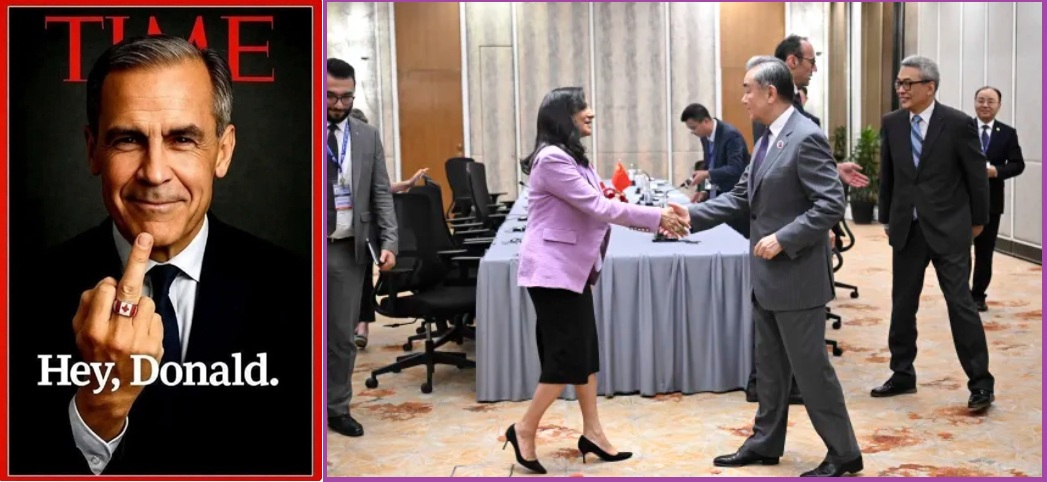
In the background of the conversation the leading candidates for Prime Minister, Mark Carney and Pierre Poilievre both hold similar trade and tariff views, both support a new alignment with the EU, and both support cultural Marxism. Canada has their own version of the UniParty. WATCH:
Chapters:
0:00 Who Was Justin Trudeau Really Working For?
7:53 the Invasion of Canada
9:19 Pierre Poilievre Is a Fraud
13:25 The Attempts to Destroy Christian Countries
15:51 The Trade War Between Canada and the US
20:03 The Canadian Government’s Ridiculous Climate Change Agenda
21:59 China’s Control Over Canada
President Trump’s special envoy Steve Witkoff traveled to St Petersburg (interesting venue), and spent approximately 5 hours in discussion with Russian President Vladimir Putin and his top two advisors. This was Witkoff’s third direct face-to-face meeting with President Putin.
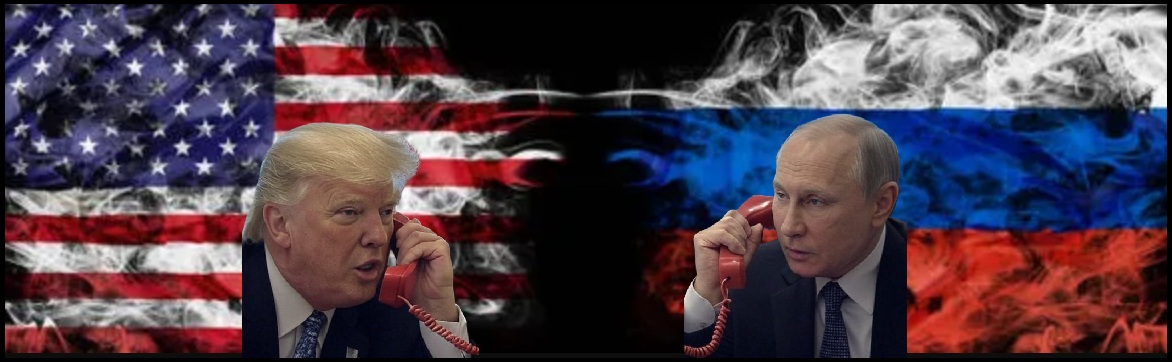
First, President Putin would never give this much time to a non-principal in any geopolitical conversation, unless Putin felt he was directly talking to the principal through the voice in front of him. In essence, Trump has told Putin that Witkoff is his mouth and ears, Putin responds accordingly. When Putin speaks to Witkoff he is speaking to Trump, and when Putin hears from Witkoff he is hearing from Trump.
Following the five-hour meeting with President Putin, Witkoff appears on Fox News so that Sean Hannity can tell Witkoff what his meeting with Putin really means. Hannity is not only insufferable, at this point in time he is best considered a confidential human source, ¹acting on behalf of the CIA who influence him. WATCH:
Within the brief moments provided by Hannity for Witkoff to speak, the envoy of President Trump noted both Putin and Trump understand the core issues and are aligned to solve the problem despite the CIA and SSCI efforts to keep wedging them apart. Additionally, Trump and Putin see a future where geopolitical and economic alignment can be very beneficial for both Russia and the United States; they just need to find a way to navigate the complex politics on the U.S/NATO side of the mess.