President Trump and U.S. Trade Representative Jamieson Greer waited to see if Canada was going to follow through with their retaliatory tariffs against U.S. imports.
 The Canadian government carried out their tariffs, so today the White House introduced 50% ‘stacking tariffs’, on top of pre-existing tariff rates, and additional import bans against several Canadian products.
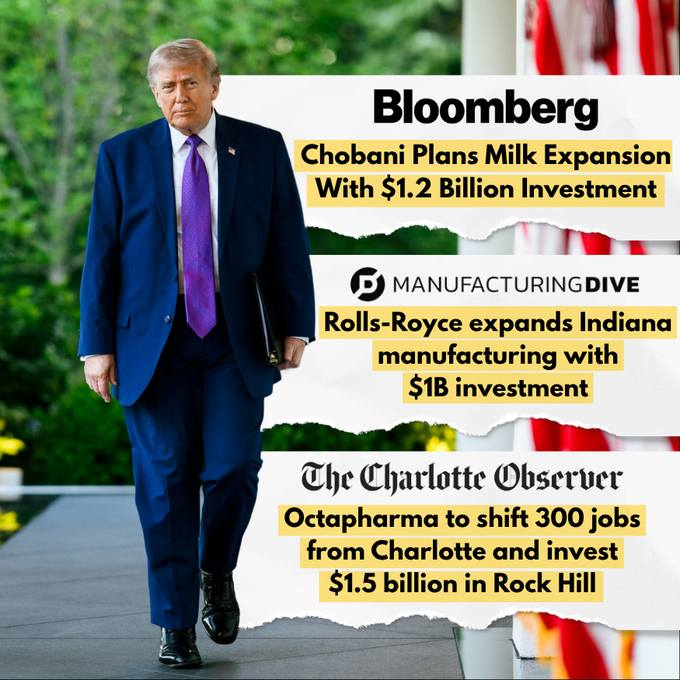
It should be quickly noted that several North American corporations are already making moves to avoid the issues by shifting production lines and adding additional investment into U.S. manufacturing. As expected, getting locked out of a 32 trillion economy is not an option for survivability.
The easiest way to review the issues is not to read media reports, but rather to read the actual outcomes as announced by the White House and USTR. CTH has noticed several Canadian outlets are already making false claims.
A White House FACT SHEET IS HERE. The USTR ANNOUNCEMENT IS HERE.
It is worth reviewing both sets of outlines as well as accompanying links to determine the exact types of Canadian products being targeted by stacking tariffs and import bans.
WHITE HOUSE – Today, to address Canada’s increased discrimination against U.S. commerce, President Trump signed five Proclamations pursuant to Section 338 of the Tariff Act of 1930 to ban certain products from Canada and modify the scope of the tariffs on certain Canadian products previously announced on July 20, 2026. President Trump is taking decisive and appropriate action to respond to Canada’s additional retaliation and continued discriminatory treatment of crucial American exports.
- After breaking off trade talks with the United States last month, today Canada imposed new retaliatory tariffs on about $20 billion of U.S. exports, including steel, dairy, and agricultural equipment.
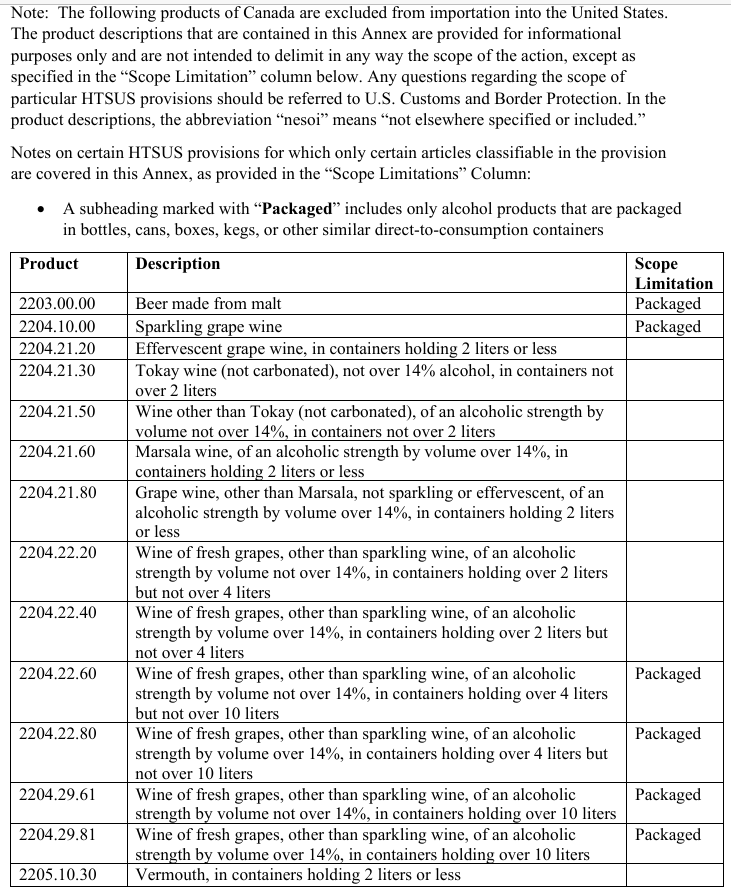
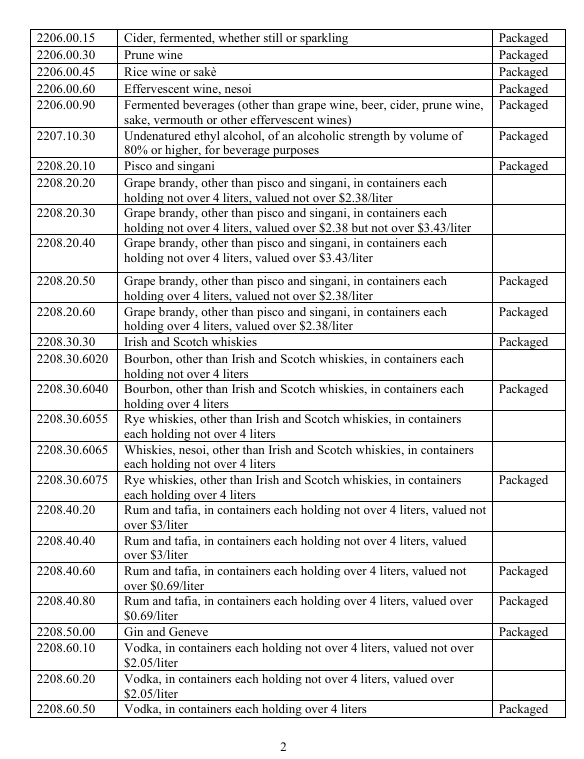
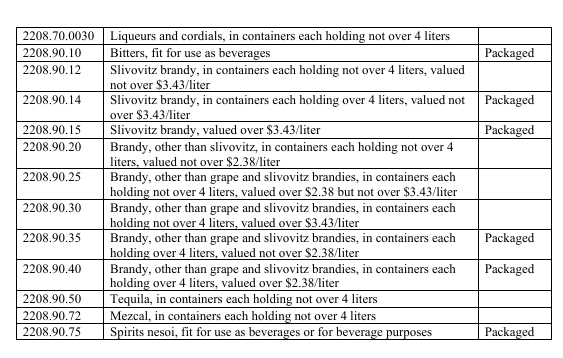
- Because Canada maintained and in fact increased its discrimination against U.S. commerce with respect to U.S. alcoholic beverages, President Trump, under Section 338, imposed import bans on certain Canadian alcohol and other products that were subject to the 50 percent tariffs imposed under Section 338 in Proclamation 11046.
- Moreover, because Canada maintained its discrimination against U.S. commerce with respect to dairy, President Trump, under Section 338, imposed import bans on certain Canadian dairy and other products of Canada that were subject to the 50 percent tariffs imposed under Section 338 in Proclamation 11047.
- To offset the burden to U.S. commerce while better serving the public interest, President Trump is also modifying the July 20, 2026 actions by removing certain products, such as rock salt and cement, from the scope of the Section 338 tariffs and replacing those products with new ones, ranging from all-terrain vehicles (ATVs) to additional dairy products.
- These Section 338 tariffs apply to all covered goods regardless of whether a good originates under the U.S.-Mexico-Canada Agreement (USMCA) and apply in addition to tariffs imposed under Section 232 of the Trade Expansion Act of 1962.
- The import bans will take effect on September 29, 2026, and the product additions and removals will take effect on September 15, 2026.
- {SOURCE}
WASHINGTON – Today, Ambassador Jamieson Greer issued a statement after President Trump exercised his authority under Section 338 of the Tariff Act of 1930 to ban certain Canadian products from entering the U.S. market and modify the scope of the July 20 actions to effectively offset the burden or disadvantage to U.S. commerce by Canada’s discriminatory measures.
“After weeks of good faith and intensive efforts between U.S. and Canadian negotiators, Canada walked away from a near-final trade deal that offered better treatment than any other trading partner, and instead Canada chose to embark on senseless retaliation against the United States,” said Ambassador Greer. “Today’s action, combining targeted import bans as authorized by Section 338 and a calibration of the underlying Section 338 tariffs, is a natural consequence of Canada’s continued discriminatory treatment of crucial American exports, ranging from alcoholic beverages to dairy products to motor vehicles. President Trump will continue to leverage the tools at his disposal to defend the interests of American workers and exporters, and restore reciprocity in our bilateral trade relationships.”
Additionally, the President has directed USTR (Office of the United States Trade Representative) and GSA (General Services Administration) to remove $50 billion dollars’ worth of Canadian-origin products from GSA’s Multiple Award Schedules.
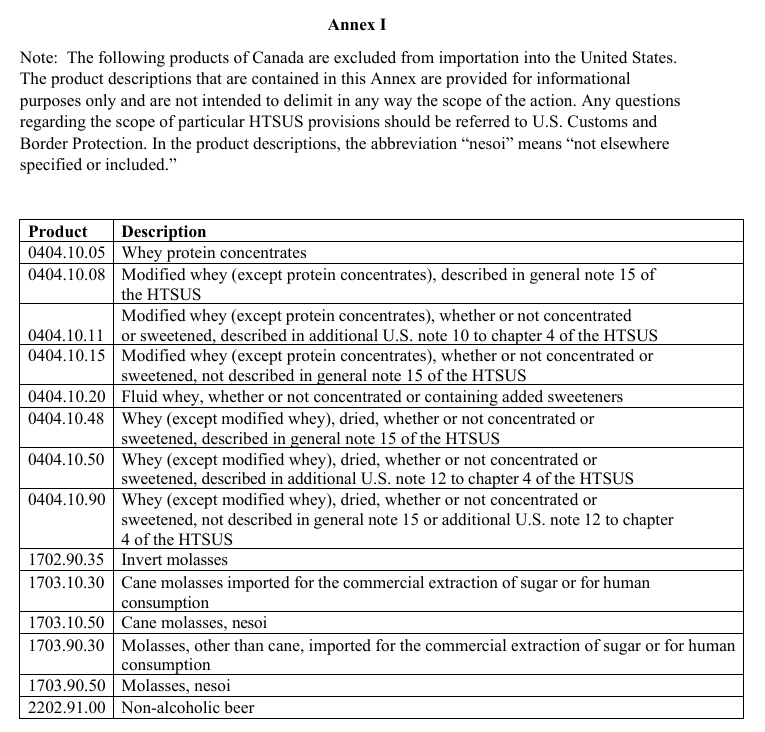
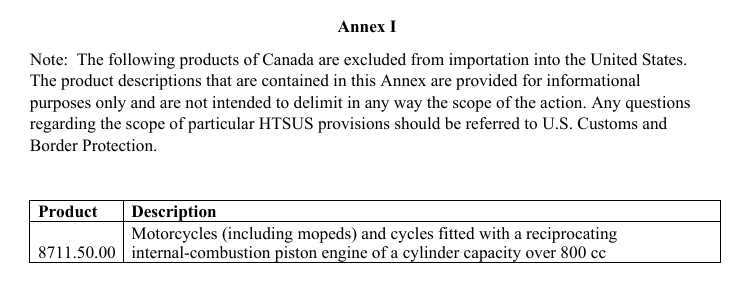
To view the lists of Canadian products banned under the Section 338 actions, click here (motor vehicles), here (dairy), and here (alcohol).
To view the lists of product modifications to the Section 338 actions, click here (motor vehicles) and here (alcohol).
To read the proclamations making the above changes, please see:
To read the White House Fact Sheet, click here.
Background:
Section 338 of the Tariff Act of 1930 (19 U.S.C. 1338) empowers the President to, among other things, impose duties of up to 50 percent on imports of a foreign country to offset the burden or disadvantage from a foreign country’s unequal imposition on or discrimination against the commerce of the United States. On July 20, 2026, finding that the public interest will be served by his actions, President Trump took three separate Section 338 actions to level the playing field for important American exports to Canada—motor vehicles, alcoholic beverages, and dairy. Section 338 further empowers the President to exclude products from importation into the United States if a foreign country maintains or increases its discriminatory practices against U.S. commerce.
Based on Canada’s continued retaliation and discrimination against U.S. commerce, President Trump has determined that it is necessary and appropriate to ban certain Canadian products from entering the U.S. market and refined the scope of the July 20 actions to target strategic Canadian sectors while removing certain non-sensitive Canadian goods from the scope of the actions. {Source}
It appears that some of the product categories would be limited by ‘stacking tariffs’, as a consequence the U.S. is simply moving to ban the products altogether.

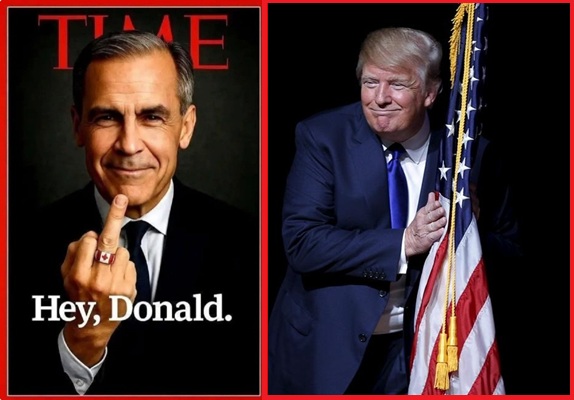
I wonder what Carney thinks of all that leverage he thinks he has now?
IKR
He knows exactly what he’s doing.
He’s allowed by WEF and CCP to remain in power as long as he continues to facilitate their goal of destroying President Trump’s new America, which is an existential threat to their NWO.
His only goal is to become a billionaire, which depends on the Great Green Grift via US-based Brookfield and/or the success of the US economy where about 90% of his private investments are held.
Canada and its people are of no consequence to him.
Note that even in his latest “dear leader” video to the nation he still wears his Order of Canada pin (a personal accolade), not the Maple Leaf. You will never see him wear the Maple Leaf.
So, in honor of what the Canadian govt did to it’s citizens who protested a few years ago, the US should seize all his US assets, accounts. That would grab his attention. 🙂
Kinda like the Russian sovereign wealth fund. We should take all his assets and use them to build the northern border wall.
Carney doesn’t have any leverage. All he has is a line of BS. A long standing economic rule of thumb is that there are usually 3 service sector jobs for every high paying manufacturing job. Meaning when Canada’s limited production facilities start laying off people, 3 other people in the service industries will eventually lose their jobs as well. Things will begin crashing really fast and really hard for Canadians
What makes you think the man is rational?
I think that Sane Mambrane was being sarcastic.
I like that
When you are willing to sacrifice your own society you do not understand rational.
The propaganda machine has always worked for them, until now. Trump is full speed ahead and damn the midterms, which is why he may win the midterms.
will win*
Yes!
May it be so.
Trying to change the outcome of a bordering nations election can be very costly to your brainwashed citizens.
You can count on the CBC to spin it in Canada’s favor and the Canadians(for the most part) eat it up.
He never had any leverage……and this will hurt Canada big time…….and maybe it’s good….sometimes in order to wake up…….you need to experience reality….maybe even something traumatic to slap you in the face so that you can see through the lies and the illusions that Carney and the state owned media is portraying to their people!
They don’t have any idea what an idiot Carney actually is…….he will be gone and a other will take his place. That’s why…..it’s the system….their system that needs to come down….that way no matter who is next in line….it won’t matter because there will be no position to fill if their system does not exist!
He’s just doing what is expected of him by his co-conspirators and superiors. He could do no less as this is his worldview.
Pathetic!!!
Advice to the PM:
A man’s got to know his limitations.
-Harry Callahan
Delusional Carney is quickly trying to enrich himself before Canada’s economic collapse.
Wow,
Fool around and find out Carney you fool..
He’s no fool. See my post above.
He’s the ultimate WEF puppet psycho-lizard green (fake) zealot CCP-lackey Fabian-disciple child-mutilation-enabling Satanist on the planet imho.
Financially smart. Intelligent by education. Connected globally at the highest levels.
And pure evil.
And still a fool.
Economic Fauci..
It’s mearly a flesh wound.
Why do I get the impression that LeBlanc is there to try and make a deal so that Canada can still continue to transship into the U.S.?
Pretty sure China is going to want that (and not that I blame them persay — China just went through another round of recapitalization; they need any and all export markets; this is existential for them; they won’t be in the mood to play games). China needs to keep the global trade conveyor belt running — both export/import and financial instruments. Even if they wanted out of it (and there are likely significant interests within the country that wouldn’t), they’d need it to continue for awhile to keep the country somewhat stable.
The EU/Commonwealth like to use this for their own advantage (they need it too, they’ve got their own liquidity problems and their own goals): keeps the Chinese onside. And Carney was tasked to do this as well as try and bring down the U.S. (and all the rest of the Canadian politicians are onboard as well; the last year has shown no signs of any party there doing a Trump like maneuver).
Just some random thoughts.
The exodus has begun, the pain will follow rather quickly!
I get a kick out of “Sundance” listed under comments about a Sundance post!
😎
Nice to hear some commentators in Canada live in the real world.
One thought that comes from listening to him is the continued Alinsky move of focusing on, demonizing, working to isolate an individual – in this case Trump – it’s like these people are caught in a time loop and have no idea the world has moved on.
That Start Trek meme that unseen1 uses “it’s dead Jim, it’s dead” comes to mind seeing how badly the media remans caught in TDS mode.
Exactly! Unlike our odious Senator Mark Warner Canada’s Mark Warner was a voice of reason and intellect! He isn’t suffering from TDS like Premier Carney and so many in Canada!!!
I am shocked that CBC aired that interview.
An honest, intelligent and knowledgeable interviewee giving Canadians the real goods on the problem.
This just doesn’t happen every day in Canada.
Well in all fairness, whoever it was interviewing Mr Warner tried and failed miserably to get him to give a boost to Carney and his suicide mission.
A thoughtful, analytical, , knowledgeable Mr Warner gently disemboweled him.
Haha, that’s why I’m surprise they aired it.
well since hardly anyone in Canada actually listens to the CBC – who will actually see that interivew. I wouldn’t have without the Treehouse. Pray for Alberta’s bid for freedom – Canada’s only hope for survival since PollyParrot, Dog Ford and the Conservatives are all aligned with Carnage and the Libtards war against Trump. TDS rules Canadian politics these days.
Trade/financial instruments are diplomacy by other means.
War is diplomacy by other means.
Ergo, trade/finance is war by other means.
We’re already well into 5th generation warfare with Canada, which is a proxy. The only thing left is for it to go kinetic.
Canada’s actions remind me of the child that gets grounded for a weekend for bad behavior and then in an act of defiance when told his punishment does something worse so the punishment becomes an entire week which triggers the child even more and before he knows it he’s looking at three weeks.
Eventually the kid figures it out and stops making it worse.
Not sure how long it’s going to take Carney/Canada to figure it out.
I agree Canada is acting like a defiant child.
Side note: Grounding is so pointless, imo. Grounded from going out. I go out anyway and get grounded longer for going out, but I’m still going out every day. lol.
For me it is worse than a defiant child. The Canadian Leadership is purposefully hurting the Canadian people and lying about it. Makes me understand that the Communist/Liberals of Canada do not mind having Canadians wait for health care until they die before treatment, aide in the early termination of life, and finally allow good Canadian jobs migrate to the USA. All the while promoting the Green Energy Carbon Credit grift. They are evil.
You also described America under the Uniparty. Trump is freedom’s only chance. The globalists know this far better than most Americans.
Absolutely, sDee! The Repugnant Party is our worst enemy….along with the brainwashed Americans hooked on MSM.
Obviously your parents did not increase the consequences for each violation of grounding like my parents did!
Can you go out now, or are you still grounded thirty-two years later? ;o)
Oh snap! The motorcycles are made by Bombardier (CanAm) and retail for an average of 18K. 79% of their initial sales (10K of 12K) were sold in the US. This has to hurt.
Idk how much actual profit they make on 180m to make it affordable enough for Bombardier to move their plant to the US. They’ll definitely be shrinking the one in ca though!
Carney’s August tariffs on bikes greater than 800cc was aimed squarely at Harley Davidson.
Our response aimed squarely at CanAm.
The junk Chinese bikes that Canada is reassembling/rebadging is a bonus
I do like Crown Royal- don’t laugh at me. lol. It’s good with ginger ale. But I just got a handle so I’m good for a year
There’s lots of good scotch and Japanese whiskies too.
Scotch is an acquired taste. Most all the good Scotch is single malt! Sippin stuff, not shooter stuff. imho.
Laphroaig for me. I like the peat. Their Lore is also very nice.
A nice Irish whiskey will hit the Spot.
sigh, I miss Bushmill green label – but we’ve no shortage of whiskey in the US
If this is the one you were referring to, miss no more:
https://www.totalwine.com/spirits/irish-whiskey/bushmills-single-malt-10-yr/p/4765750
thx!
Try this one if the first link won’t ship to you.
https://www.binnys.com/spirits/whiskey/bushmills-year-old-irish-single-malt-139230/
I do like Scotch. Willing to pay more because for me Chivas is like a medical need. Cannot sleep without it. However, I am fully functional, I think.
🙂 Last year hauling our travel trailer around this great nation I made it a point to find small batch American whiskey and bourbon distilleries. Bourbons cover a wide spectrum. Montana’s tuning out some fine wheated whiskeys you might find comfort in.
Sadly, the Crown Royal Vanilla and Crown Salted Caramel are quite good. Fortunately, I have some on the shelf. Gotta make it last through the midterm elections. Guessing that’s when all this will eventually reverse.
Tiffthis — Oh, just admit that you like the bottle and the pouch. :-))
Carney is going to keep up the destruction until the Midterm election in November under the hope that the Democrats take the House or Senate.
If the Republicans keep the House and Seante, Carney will resign, and his replacement will reverse everything Carney did, and BEG Trump for a new bi-lateral deal on Trumps Terms.
Not hard to see who chose the stick over the carrot. The magnitude of the economic abuse we US taxpayers have subsidized is staggering and infuriating.
dee state liberal neighbors,
Motorcycles? That’s it? Alcohol will become black market for those who truly have to have the brand. Sorry to be negative but there’s hardly anything I see that will affect ca too much. Cancel USMC today and get it over with!
American politicians have spent decades bleeding Americans to fund globalist states and globalist agendas. It is death by 100,000 cuts, Trump and his teams are stitching them up one at a time.
FAFO.
MAGA.
Wouldn’t surprise me if both those in power in Canada and those here in Congress found a way to manipulate investments ahead of these changes.
Some schmuck judge will stick his or her nose in and thwart PDJT.
Sources are reporting that PM Corneyball has a 62% approval rating. Proving all corporate media on an international scale is as bad or worse than our own.
Boy, that’s a lot of booze.
Prune wine, are many drinking that?
>Prune wine, are many drinking that?<
Only during “hard” times………mic drop
Bathtub Gin comes to mind!
You have to do what you have to do. :-))
Carney’s masters have laid out his role, Canadians are at best a sideshow.
The USA is in effect banning and tariffing China, Family-Desk/Investment-grade banksters and the EU.
It is rather funny at the root of things. Classic “Tail tries to wag Dog” story. Sort of shame that the Cucks self-selected to be made the example, as I am sure every other country is taking notes.
The “SnowGrifters” have been shown the door.
Who is running Chobani! Ban it!
Carney’s trade war with the U.S. reminds of The Mouse That Roared, where the Duchy of Grand Fenwick declared war on the United States and invaded New York harbor with an army of 20 soldiers led by Peter Sellers, dressed in chain mail and armed with bows and arrows.
Carney , the London globalist POS leftist, when the free money runs out they throw a temper tantrum, and take it out on the serfs, as socialists everywhere do
Looks like Carney is not only suffering from TDS, but also craniumrectomology, not enough oxygen up there.
Still nothing regarding the “American” auto industry ?
Carney acts like a petulant 2-yr-old. Won’t work in grown up trade negotiations.
The NHL hockey season is going to be interesting when U.S. based teams play in Canada.
The playing of the national anthem will be greeted with lots of hostility.
We’ll have to wait and see how the American audience treats their anthem.
Which is kind of hilarious considering how many Snow Mexicans play for the 26 U.S. – based clubs.
I recommend silence.
With a vast majority of NHL players coming from Canada and NHL operations in Canada there should be massive tax tariffs on the money they make in this country.
Wait, there are Canadian mopeds with engines > 800cc?!
This I need to see!
This sends a message to companies to quickly mive their operations south as they may be next to be banned!
Carney, is the Sleepy Joe Biden of Canada!
With a leader like Carney, his sole accomplishment will be destroying the Canadian economy from within. When you sacrifice your own society such as Great Britain is doing, we survived (barely) sleepy Joe’s attempt, all for the green scam.
These people are truly sick, if the earth is to be saved from real issues the likes of Ursula Von DerLyon, Great Britain’s entire Parliament, and the sissy from France who has the man wife need to meet the strange and unusual Clinton fate.
Just like that the world suddenly improves.
Carney doesnt give a shit about Canada.
Lots going on because of the election. Much will change if we hold the house and senate. If we lose either then stupid stuff will continue at extreme levels.
What!?!? They banned Canadian tequila?! What ever am I going to? Clearly, these Trump bans hurt US consumers! 🤣 (sarcasm)
And we will no longer be getting any Canadian bananas. We’re so screwed. ;o)
Well, I don’t drink (alcoholic – dry for 40 years), I don’t drive mopeds, and buy my dairy local. Being diabetic, I limit the maple syrup and molasses…and those, I can get from Vermont and New Hampshire.
This response from Trump won’t bother me in the least.
I’d rather him just simply start the 60 day clock already, but I suspect there’s a political timing point involved here that would make it much more impactful when PTrump decides to pull that trigger in his time.
Carney offers me nothing I can’t do without. He can go take a very long walk off a very short dock, because that short dock is all he has.
Canadian Comedy Roast:
https://www.facebook.com/reel/1818748702898176
Plus Trump is in the process of de-sanctioning Belarussian Potash which is a huge supplier. And meanwhile, potash is a huge industry within Canada whose majority market is U.S. and that market can’t be replaced with an equivalent market. Once again it is a cut off your nose to spite your face option for Canada.
Perfect. What I voted for!
“Ambassador Greer?”