Quantcast

President Trump Delivers Remarks from Ford Truck Plant – “The USMCA Means Nothing to Me”

President Trump’s impromptu remarks from inside the Ford F150 plant will probably not make headline news because, well, quite frankly, what President Trump says below is something the financial media just don’t want to discuss.

This is really an important point.  In the era where information is skewed based on the interests of the organization sharing the information, government or private sector media, it is extremely valuable to just listen to what President Trump says directly.  In comments such as this brief segment below, you can see exactly where he is going with manufacturing and trade policy.

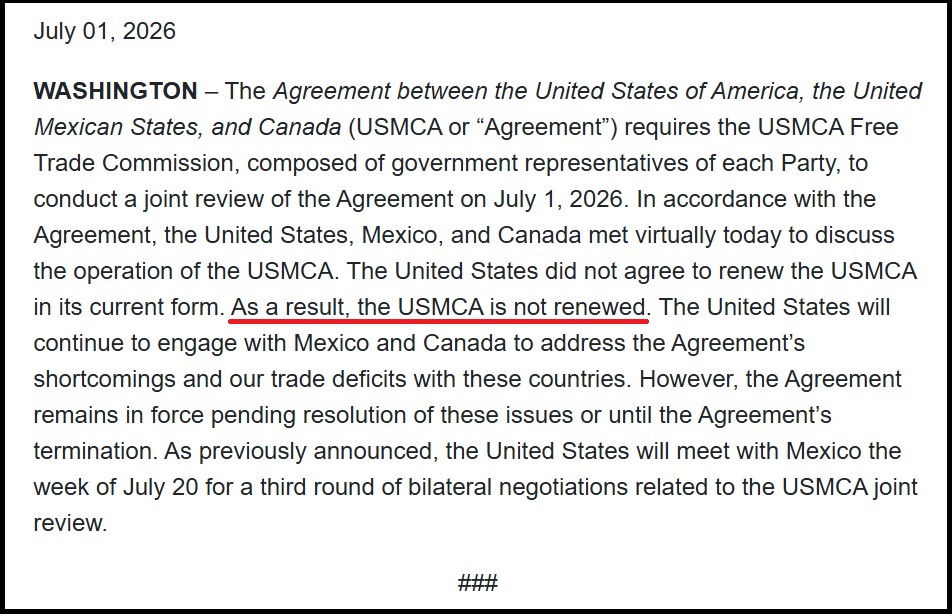
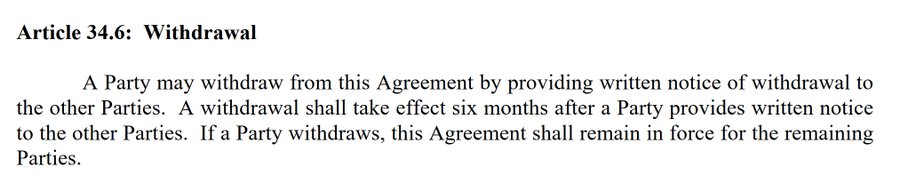
Specifically pay attention to how President Trump emphasizes, then reemphasizes the irrelevance of the USMCA from his perspective.  As we have noted all along, the Trump administration (USTR Greer) will abandon the trilateral USMCA this year and instead begin a formal process for two bilateral free trade agreements.

Now, the entire financial media system is pretending this is not going to happen, especially in the statements by every stakeholder north of the border.  However, listen to how President Trump himself describes the USMCA or CUSMA as the Snow Mexicans like to call it.  Trump is completely nonplussed about what is going to happen.  WATCH:

.

(more…)

President Trump and Mexican President Sheinbaum Conduct Brief Phone Call

According to reporting from the Associated Press the telephone call lasted approximately 15 minutes; however, Mexican President Claudia Sheinbaum called it “a very good conversation.”

(AP) “Sheinbaum said the two leaders did not speak about Cuba, which Trump threatened Sunday. Mexico is an important ally of the island nation, including selling it oil that it will need even more desperately now that the Trump administration says it will not allow any more oil shipments from Venezuela to Cuba.”

According to the AP report, President Trump again told President Sheinbaum that he was ready to support Mexico with U.S. law enforcement should she decide to take on the cartels.  Sheinbaum again said that Mexico did not need the U.S. help and progress was being made.

“We told [President Trump], so far it’s going very well, it’s not necessary, and furthermore there is Mexico’s sovereignty and territorial integrity and he understood,” Sheinbaum is reported as saying, which, if you think about it, is really quite an alarming statement even within a brief phone call.

When asked about combatting cartel influence, “so far it’s going well” is not exactly confidence inspiring.  Within the answer itself is an admission the Mexican government has an issue with cartel control.  – AP REPORT HERE 

Saying they have it under control is an admission there is something that needs to be controlled.  Apparently, success on this issue in Mexico is defined as, “a significant drop in homicides, falling U.S. fentanyl seizures and fentanyl overdose deaths.

According to Mexican Foreign Affairs Secretary Juan Ramón de la Fuente, these are the “tangible results” Secretary Rubio previously said were needed.  So, there’s that.

(more…)

President Trump: “The Cartels are Running Mexico”

Once again giving context to the immediate reaction from Mexican President Claudia Sheinbaum following the operation to exfiltrate Venezuelan dictator Nicolas Maduro, during the return flight to Washington DC President Trump spoke about how President Sheinbaum is “a little afraid” of the cartels in Mexico.

When asked about his previous offer to have the U.S. military intervene in the drug and human trafficking operations within Mexico, President Trump said, “I would say every single time I’ve talked to her I’ve offered to send troops.” Following up with, “she’s concerned, she’s a little afraid, the cartels are running Mexico. Whether you like it or not, the cartels are running Mexico.”  WATCH:

This is not just an ordinary off-the-cuff statement when you consider the ramifications. There is no closer geographic nation to the mainland United States other than Mexico, and President Trump is being brutally honest in his statement that Mexican President Sheinbaum is afraid of the cartels.  The cartels run the Mexican government.

Mexican residents living in the United States and sending money back to Mexico are a major economic driver of Mexico’s GDP.  Currently the best estimate of GDP is that personal remittances make up around 4% of their domestic economy.  The United States sent $62.5 billion dollars in remittances to Mexico in 2024, 96.6% of the total received by the country. 47% of remittances from the United States to Mexico are sent from California and Texas [source].

The remittances essentially subsidize the average Mexican family, while the illegal cartel income is estimated around $12 billion annually [source].   The total Mexican GDP is around $1.7 trillion [source], Canada is roughly $2.4 trillion, the United States is around $30 trillion.

(more…)

Canada Trying to Find Trade Partners

A recent article in Politico quoting several cabinet members of Prime Minister Mark Carney reflects a particular reality of the problem their economy will face in 2026.

It appears that Canadian government officials have finally recognized the Trump administration plans to dissolve the USMCA or what Canada calls CUSMA next year.  With that reality they have a big problem.

Mexico has been working throughout the year to initiate economic policies in alignment with the United States.  However, structurally and politically this is an alignment that is impossible for Canada to do.  Like many contracting European countries, the economic policies of Canada are centered around their climate change agenda and green energy goals.

For the past few decades Canada bought into the carbon scam and enacted climate change goals into law for carbon pricing, alternative energy production, industry and manufacturing costs.  These mechanisms to control “climate change” are nuts in the big picture.

In order for Canada to position their economy to be in alignment with the rest of North America (USA and Mexico), Carney would have to reverse years of legislated rules and regulations.  That is not going to happen, and Canada will always be at a disadvantage because of it.

(Politico) – […] It’s a moment of existential crisis for Canada, a senior Carney government official told POLITICO. Waiting out the Trump administration isn’t an option, the official said, arguing that what’s happening in the United States reflects a generational shift — not a temporary disruption — and that returning to a policy of closer integration with America would be foolish. (more)

With three quarters of their economic production tied to exports into the USA, and with the USMCA likely to be dissolved in favor of a bilateral trade agreement, Canada now has to find other markets for its products or lower all the trade barriers currently in place.  Prime Minister Mark Carney is trying to find alternative markets.

(more…)

Secretary Bessent Announces Treasury Operation on Southern Border to Target Money Laundering

This is very interesting.  Treasury Secretary Scott Bessent has announced [Press Release Here] an operation to target money service businesses on the southern border.

The objective is to identify targeted financial transaction businesses who participate in money laundering for cartel and criminal activity.

WASHINGTON— Today, the U.S. Department of the Treasury’s Financial Crimes Enforcement Network (FinCEN) announced a multi-tiered operation targeting more than 100 U.S. money services businesses (MSBs) operating along the southwest border. These MSBs—which provide financial services outside of a formal bank—are being examined for potential non-compliance with regulations designed to detect money laundering and combat illicit finance. FinCEN’s operation resulted in the issuance of six notices of investigation, dozens of examination referrals to the Internal Revenue Service (IRS), and over 50 compliance outreach letters.

“At President Trump’s direction, the Treasury Department is utilizing all tools to stop terrorist cartels, drug traffickers, and human smugglers,” said Secretary of the Treasury Scott Bessent. “This sweeping operation will help root out potential cartel-related money laundering from the U.S. financial system.”

(more…)

President Trump Participates in Border Defense Medal Presentation – 3:00pm ET Livestream

Today, President Trump will participate in a Mexican Border Defense Medal award ceremony at the White House. The anticipated start time is 3:00pm ET with livestream links below.

.

(more…)

Strategic Positioning: Mexican Legislature Passes Trump-Level Tariffs Against Chinese Textiles, Shoes, Appliances and Autos

Taking a very significant step to be in alignment with President Trump’s North American trade bloc construct, Mexico has passed a sweeping set of tariffs against Chinese imports.

The motive for the move by President Claudia Sheinbaum and her political party, Morena, which controls both legislative chambers is clear.  Mexico is moving into direct alignment with President Trump as the likelihood for the end of the current USMCA trade agreement looms.

President Trump has sent clear signals expressing his intent to dissolve the USMCA trade agreement in favor of two bilateral agreements, one with Mexico and one with Canada.

The Mexican government led by Sheinbaum have made moves throughout the year to stay in alignment with a favorable trade agreement, while the Canadian government led by Mark Carney has been more antagonistic toward any change.

The Mexican trade leadership seem to have long expected the change to the USMCA, and now there are indications Canada realizes what is about to happen, albeit reluctantly.

As a consequence of their proactive position, Mexico has now passed up to 50% tariffs against a host of imports, mostly textiles, shoes, appliances, cars and automobile parts.  The tariffs will apply to any imports that are not part of a previously organized free trade agreement, which has the practical outcome of hitting mostly imports from China. That approach aligns directly with the tariff rate applied by President Trump toward Beijing.

(more…)

Federal Officials Bust Two Mississippi Sheriffs and 16 Law Enforcement Officers Running Drugs for Mexican Cartels

This is a remarkable story that has not gained significant attention.  Late last week FBI Deputy Director Andrew Bailey, the Dept of Justice and various law enforcement agencies announced the indictment of two Mississippi Sheriffs, city police chiefs and more than a dozen police officers who were running drugs and taking bribes from Mexican drug cartels.

The U.S. Attorney’s Office in the Norther District of Mississippi coordinated the indictments [SEE HERE].  U.S. Attorney Clay Joyner of the Northern District of Mississippi; Deputy Director Andrew Bailey of the FBI and Special Agent in Charge Robert Eikhoff of the FBI Jackson Field Office made the announcement and held a press conference.

Apparently, what tipped off the feds was several arrested criminals complaining to state and federal law enforcement that local police were demanding bribes they could not afford.  The Mexican drug cartels were paying up to $30,000 to the individual officers, sheriffs and police chiefs’ and the local criminals could not compete with that scale of bribery demand.

(more…)

U.S. Ambassador to Canada Informs Govt and Business Leaders No Trade Deals Possible

For those who have followed along with the U.S-Canada trade positioning, the current status of conflict between the Trump administration and the government of Canada is not surprising.  {GO DEEP} Going all the way back to the replacement of NAFTA, with the USMCA, President Trump always said he did not favor multilateral trade deals with multiple countries; instead, he preferred bilateral free trade agreements.

Some people have construed the bilateral preference of President Trump to be the elimination of globalism in favor of nationalism in trade agreements.

While the outcome of the Trump approach indeed aligns with that theme, it is not specifically the objective of President Trump to eliminate global trade, but rather to focus on specific interests in trade that benefit the unique nature of each party involved.

As a result, the USMCA -or CUSMA as said in Canada- is not in alignment with a bilateral free trade agreement, and the conflicted differences between trade with Mexico and trade with Canada are an outcome of this dynamic.  The solution is simply to eliminate the multilateral in favor of the bilateral approach.  This is the objective of President Trump as expressed.

That said, the USMCA covers approximately 60% of U.S-Canada trade, and the remaining 40% is being debated and argued.  President Trump would prefer to just deal with 100% of the trade sectors in one free trade agreement; hence, his ambivalence until the USMCA is dissolved.

Canada, on the other hand, continues to demand that all trade conflicts be resolved without opening up the entire USMCA. Again, another conflict. Canada is like the dependent spouse in a divorce arguing for child support payments when the “children” are in their twenties.

The current status is President Trump pulling back completely from discussions with Canada, while the various provincial Premiers and Prime Minister Mark Carney antagonize over the issue.

At a certain point, when the entire national economic plan of Canada is based on “Donald Trump bad”, and all political messaging internally is to proclaim they have no alternative policy positions, the Canadians might not realize it, but they are confirming complete and total dependency on the nation Donald Trump represents.

(more…)

Former Canadian NAFTA Trade Negotiator Starts Noticing Trump Doesn’t Intend to Keep USMCA

In Canada they call the USMCA trade agreement “CUSMA” putting Canada first.  President Trump calls it the USMCA because that’s the order of sequence when the trade negotiations took place, the USA then came Mexico and much later, Canada.  However, Trudeau used his typical Alinsky gaslighting to pretend Canada was always participating; they were not, they came in at the end.

That said, the former NAFTA trade negotiator for Canada, John Weekes, has finally realized President Trump does not intend to renew or renegotiate the USMCA, he intends to dissolve it in favor of two bilateral free trade agreements; one with Mexico and one with Canada.

I’m not sure what finally, and I do mean FINALLY, triggered a Canadian to realize this, but perhaps they finally listened to President Trump telling Canadian Prime Minister Mark Carney [IN MAY] he intends to end it. DUH!  WATCH:

The reality of the U.S-Canada economic relationship and the position of President Donald Trump is not that difficult to understand if you take all the disparate datapoints and quotes from Trump and put them into context.

During a White House meeting with Mark Carney, President Trump essentially told the Canadian Prime Minister why he was in no hurry to get to a deal with Canada.  The 35% tariffs on non-USMCA goods triggered August 1st because the main priority of Trump -looking toward Canada- is to dissolve the USMCA.

(more…)