Quantcast

President Sheinbaum and President Trump Have Cordial Trade Call as First Sinaloa Official is Nabbed by U.S. Federal Agents

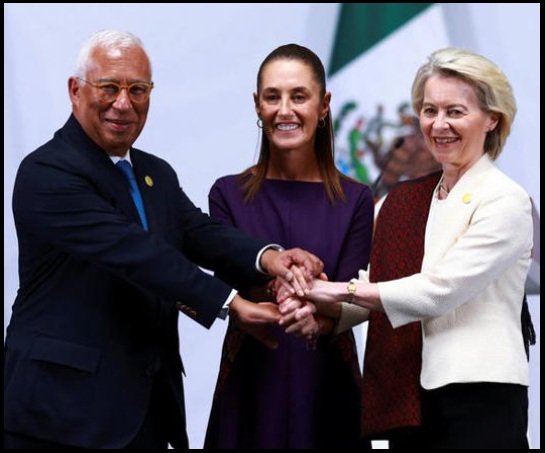
It was reported yesterday that Mexican President Claudia Sheinbaum and U.S. President Donald Trump had a cordial conversation about ongoing trade and security discussions. {link} The phone call likely took place as President Trump was aboard Airforce One returning from China.

Previous to this phone call, “Gerardo Mérida, a retired Mexican army general who served as public-security secretary in northwestern Sinaloa state, was detained on Monday in Tucson, Ariz., court records show. Mérida is one of 10 current and former Sinaloa officials, including Gov. Rubén Rocha, indicted last month in the U.S. for allegedly taking bribes from Sinaloa cartel leaders to protect their billion-dollar drug empire. U.S. prosecutors say that the Sinaloa cartel is one of the world’s top producers and smugglers of fentanyl into the U.S.” {link}

The Trump administration is not slowing down on the intention to remove Mexican drug and human smuggling cartels, despite the reported domestic protestations from within the Mexican government.  There appears to be a rather unusual dynamic at play.

Inside Mexico the federal government is publicly criticizing the U.S. position; however, simultaneously Mexican President Sheinbaum is promoting a working relationship with President Trump and the U.S. position.

According to the New York Times, Acting Attorney General Todd Blanche has now shifted the prosecutorial focus to charge the designated Mexican cartel targets as terrorists.

(more…)

President Trump Releases 2026 Counterterrorism Strategy

The White House has published the official 2026 Counterterrorism Strategy with a foreword by President Trump. [SEE HERE]

Within the outline the White House breaks down the threats and strategies for each region.  It is well worth reviewing the entire document which is written in plain language that avoids any misinterpretations.

[READ HERE]

Regionally, the White House outlines specific threats and policies.  Given the current situation with drug and human trafficking cartels as well as regional conflict in the Middle East and vulnerabilities in Europe, each of these points of material interest should be highlighted (emphasis mine).

(more…)

Indicted Mexican Governor Ruben Rocha Moya Steps Aside During Investigation

Last week the DOJ indicted Mexican Governor Ruben Rocha Moya along with nine current and former Mexican officials for participating “in a corrupt and violent drug trafficking conspiracy with the Cartel to import massive amounts of fentanyl, heroin, cocaine, and methamphetamine from Mexico into the United States.” {GO DEEP} This has put Mexican Governor Claudia Sheinbaum in a precarious position.

Both President Sheinbaum and Governor Rocha Moya are from the Moreno political party in Mexico.  Following the indictment, Sheinbaum said she would not assist in any extradition effort of Governor Rocha and denounced the U.S. indictment; however, she said the federal government within Mexico would launch their own independent investigation.

Mexican President Claudia Sheinbaum denounced the U.S. prosecution of a sitting Mexican governor and other officials on drug trafficking charges as “political,” and said Thursday that Mexico would not comply with Washington’s demands that the accused be arrested and extradited to the United States.

“We are not permitting a foreign government to say what is the future of Mexico,” said a defiant Sheinbaum, who repeatedly assailed U.S. “meddling” in the incendiary case. (more)

There is considerable support within Mexico to eliminate the corrupt activity of the Cartels who many admit are in control of large sectors of their regional and federal government.  As a consequence, many Mexicans support the position of President Trump and the Dept of Justice in prosecuting Governor Rocha Moya if there is evidence to support it.

Today, Sinaloa Governor Rocha Moya said he would step down from his position as the federal investigation of the claims get underway.

(more…)

U.S. Dept of Justice Indicts the Current Governor of Sinaloa, Mexico, with Drug Trafficking and Weapons Smuggling

Oh boy, this indictment puts Mexican President Claudia Sheinbaum in a really precarious position.  If President Sheinbaum gives up the Governor of Sinaloa, Mexico, Ruben Rocha Moya to extradition the Sinaloa cartel will go ultra-violent against Sheinbaum and Moya will likely take down the entire government apparatus with him.

[Read Indictment Here]

[Ancillary to this, it now makes sense why all the various Mexican federal officials were publicly criticizing the Trump administration and CIA in recent days.  They knew this in advance.]

The DOJ (SDNY) has indicted Mexican Governor Ruben Rocha Moya along with nine current and former Mexican officials for participatingin a corrupt and violent drug trafficking conspiracy with the Cartel to import massive amounts of fentanyl, heroin, cocaine, and methamphetamine from Mexico into the United States. 

“The defendants have played a variety of essential roles for the Cartel:  among other things, the defendants have allegedly shielded Cartel leaders from investigation, arrest, and prosecution; caused sensitive law enforcement and military information to be provided to members of the Cartel and allied drug traffickers to assist the Cartel’s criminal activities; directed members of state and local law enforcement agencies, such as the Sinaloa State Police, the Investigative Police for the Sinaloa State Attorney General’s Office, and the Culiacan Municipal Police, to protect drug loads stored in and transiting through Mexico to the United States; and allowed brutal drug-related violence to be committed by members of the Cartel without consequence.  In exchange, the defendants have collectively received millions of dollars in drug money from the Cartel.” (link)

(more…)

Canadian Prime Minister Claims All Nations Tell Him Privately They Regret Making Trade Deals with President Trump

Today is not a good day for the Canadian trade team.

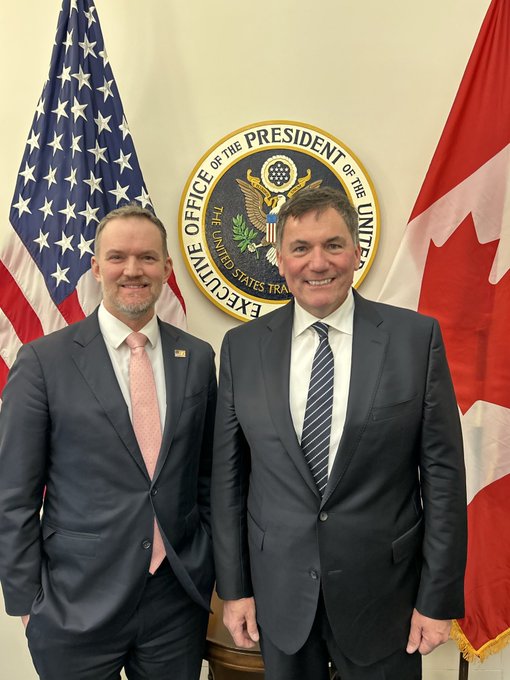
It started with Quebec’s new Premier in Washington DC meeting with U.S. Trade Representative Jamieson Greer {citation} in order to talk trade {SEE TIMELINE} saying on Twitter, “Quebec wants a renewal of the [USMCA] to ensure a stable and predictable framework for our economic exchanges.” However, Mrs. Christine Fréchette (pictured left) then bragged about having strategic discussions with the U.S. Chamber of Commerce. {citation}

For those who might not know, the U.S. Chamber of Commerce is a parasitic Wall Street and K-Street lobbying organization that has been locked out of trade influence since President Trump took office in 2017.  It was the U.S. CoC who sold out our manufacturing base, paid-off prior administrations and wrote the actual trade language in almost every trade deal that destroyed U.S. manufacturing.

The U.S. Chamber of Commerce is a lobbying organization who focuses on the bottom-line profits of U.S. multinational corporations, and they don’t care what happens domestically to American jobs, American manufacturing and American wages.  The CoC is the organization who created the rust belt and destroyed our manufacturing base under the guise of promoting a “service driven economy.”

If Canada want’s a successful trade negotiation with the USA, the Chamber of Commerce is the last organization they should be strategizing with.

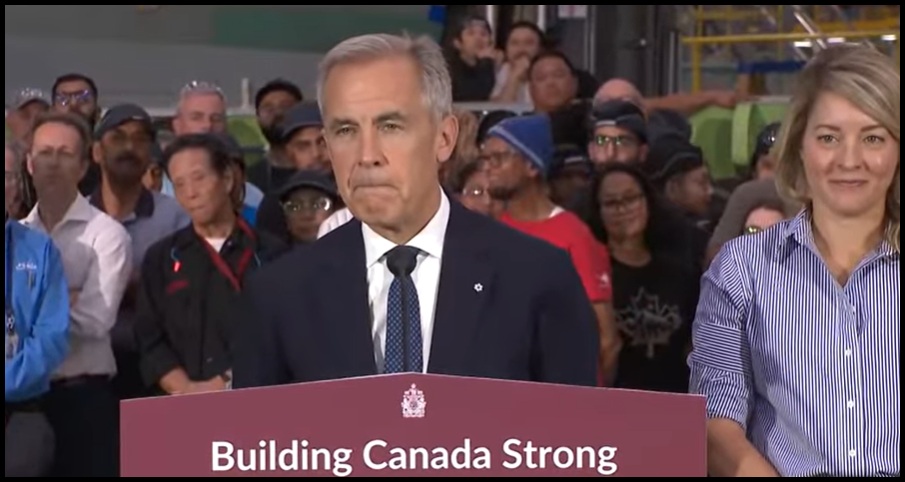
Then comes Prime Minister Mark Carney who not only steps on a rake, but he also publicly insults President Trump and the entire U.S. trade team by saying every country in the world privately tells him they regret making a trade agreement with President Trump. ¹{Citation at 28:10 of Video}

I’m going to post the entire video of Prime Minister Mark Carney discussing USMCA (Canada calls CUSMA) trade negotiations because the tone deafness of it is off the charts. That includes the Canadian Prime Minister saying that Section 232 national security reviews are a violation of the U.S-Canada trade agreement.  Carney believes any independent U.S. trade position that negates trade with any Canadian sector is a violation of trade rules, yet he is afraid to sue over Sec 232 because he doesn’t want to discover the flaw in his mindset.

(more…)

Canada Pushes Closer to the FAFO Threshold as Prime Minister Carney Says USA Will Not Dictate Terms of USMCA Renegotiations

Following direct remarks from both Commerce Secretary Howard Lutnick and U.S. Trade Representative Jamieson Greer, a triggered Canadian Prime Minister Mark Carney says the U.S. will not be permitted to dictate terms of the USMCA renegotiation, now scheduled for formal talks with Mexico only beginning May 25th.

According to the Canadian leadership they do not need the United States in order to maintain their economy.  The unfortunate people of Canada are very close to finding out exactly what that level of arrogance delivers.

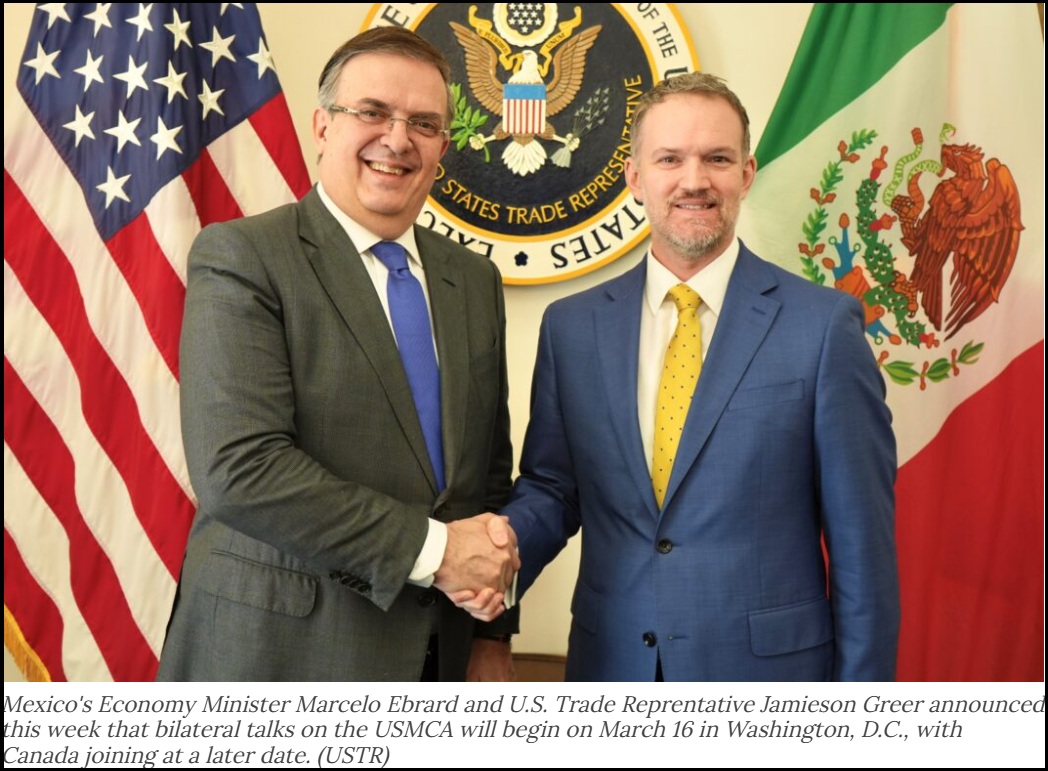
USTR Jamieson Greer was just in Mexico meeting with Mexican President Claudia Sheinbaum and the Mexican trade delegation. “Mexico’s economy minister Marcelo Ebrard ​said on Monday that ‌formal negotiations to review the U.S.-Mexico-Canada trade pact, known ​as the USMCA, ​are due to begin the ⁠week of May ​25.”

“Tomorrow and this afternoon we ​will hear the U.S. side’s views. Once that is done, ​we will move ​on to the next phase, which ‌is ⁠formal negotiations. We expect formal negotiations to begin the week of May ​25,” ​Ebrard ⁠said following a meeting with U.S. Trade ​Representative Jamieson Greer.” {source}

Meanwhile Canadian Prime Minister Mark Carney continues talking to his domestic audience about fighting Donald Trump and refusing to accept any terms that do not meet his current pontifications: “It’s not a case that the United States dictates the terms. We have a negotiation, we can come to a mutually successful outcome – it will take some time,” he continued.

In Washington, Trade Representative Jamieson Greer said unless Canada engaged in talks about broadening the so-called rules of origin that allow goods to enter the United States tariff-free, Washington might have to impose other border controls. {source}

As the rhetoric continues increasing, the possibility of a full block against the import of Canadian goods increases.

It is worth remembering, the recent Supreme Court decision that overturned the IEEPA tariffs also reinforced the unilateral power of the U.S. President to regulate any/all trade with any foreign country including a full block of trade if designated.  Canada is positioned to be the first nation to discover the expressed power of the U.S. President as affirmed by the United States Supreme Court.

One of the reasons why Canadians are oblivious to the potential collapse of their economy is because U.S. media reports are blocked from Canadian social media sites.  One of the infringements within the USMCA is the Canadian Law Bill [C-18, the Online News Act] that blocks information to Canadian citizens that is not supported by the Canadian government.

The people of Canada are stuck inside an Orwellian government constructed echo-chamber unable to hear opposing viewpoints.  They simply have no idea what is heading in their direction.  Which is incredibly ironic considering how much Mark Carney rails against Russian President Vladimir Putin, yet Canada has more restrictions on information than Russia.  Think about it. The need for control is a reaction to fear.

(more…)

Canada Does NOT Want to Open USMCA (CUSMA) for Renegotiations

Consider the amount of money involved in the trilateral USMCA trade agreement.  It’s not just about trade and commerce between the USA, Canada and Mexico; the totality of the equation is derived from all of the third-party nations who trade into the North American trade bloc.  There are tens-of-trillions at stake.

As we have outlined for several years the trilateral trade agreement has several material flaws.  With the U.S. economy as the primary consumption economy, both Mexico and Canada derive significant benefits within the USMCA.  Additionally, both Canada and Mexico leverage their unique positions to gain economic benefit from third parties who want to use either country as a backdoor into the U.S. market.

President Trump has long wanted to eliminate the trilateral trade deal in favor of two more controllable bilateral deals, one with Mexico and one with Canada.  In large measure this approach is specifically to end the exploitation by third parties.  President Trump also noted in his discussions with Canadian Prime Minister Mark Carney that the primary function of the USMCA was to eliminate NAFTA.

Keep this in mind.  The purpose of the USMCA was to eliminate NAFTA.

Now we enter the phase of the USMCA where President Trump can exit the agreement or modify the core foundation of the agreement.

For the past fourteen months Mexico has been modifying their trade and economic policy in anticipation of a USMCA change. However, for the past fourteen months Canada has been combative against President Trump, stoking anger toward Trump, and the government of Canada has been openly proclaiming their intention to economically and politically fight and defeat President Trump.

Again, remember the scale of the money involved here.  Additionally, Canada doesn’t have an organic economy if they cannot exploit their market access.  If Trump restricts third party exploitation, Canada loses massive amounts of money.  This is the baseline for Canada’s reluctance to open up the USMCA for renegotiation; they cannot lose their third-party loophole or else they are really in a bad place.

This sets the stage for trillion-dollar interests to frame opposition not only toward President Trump, but also toward any of his economic team who are in alignment with the renegotiation of the USMCA.  Commerce Secretary Howard Lutnick is chief among those targets along with U.S. Trade Representative Jamieson Greer.

Commerce Secretary Howard Lutnick outlines the issue in the first part of this recent discussion. WATCH:

(more…)

U.S. Trade Representative Jamieson Greer Discusses USMCA Review and Two Different “Protocols”

During an appearance at the Hudson Institute, U.S. Trade Representative Jamieson Greer is asked to summarize the administration’s approach to upcoming USMCA (CUSMA) renegotiations.

USTR Greer emphasized the focus is on outcomes in review of the USMCA, not focusing on the previous trade structure itself. The results carry more weight than reviewing what was intended.  On June 1st Greer anticipates telling congress that the U.S. intends withdrawal, pending unilateral negotiations with both Canada and Mexico to resolve conflict.

Greer describes two different protocols within any negotiation to deal with the structural differences between both Canada and Mexico.  Those differences include a completely different import/export profile with each country, different sectors of goods, difference in the wage rates within each country and a structural difference in the way each country is establishing their own, independent free trade agreements with other third-party countries.  These baselines form the reason to tell congress of the dissolution, and on July 1st inform both Canada and Mexico about it.

In the interim, the points of conflict are currently being negotiated with Mexico toward resolution.  The same negotiation is expected later between the U.S. and Canada; however, it sounds like that engagement will take place after congress is informed of the points of conflict.  WATCH (prompted):

.

(more…)

Understandable Disappointment with Mexican President Sheinbaum – Trump: “The Cartels are Running Mexico”

While the original focus was on questions about the Iran war, at the tail end of an impromptu presser yesterday, President Trump was asked about Mexican President Claudia Sheinbaum and the status of U.S. national security.

President Trump said he was very disappointed that President Sheinbaum refused his offer of assistance in eliminating the cartels in Mexico.  Ultimately culminating in the statement, “the cartels are running Mexico.”

Considering everything President Trump is doing to secure the Western Hemisphere objective, it must be very frustrating to eliminate various narcotraffickers, human smugglers and transnational agents of chaos, and yet still have one of the closest geographic nations unwilling to address the biggest criminal elements near our borders.

The bilateral USMCA discussions between the U.S. and Mexico are ongoing, I think we can expect this element of friction and ultimately leverage to be present in the overall outcome.

Personally, I think if the government of Cuba flips, there will be exceptional pressure on Mexico to finally address the issue.

(more…)

Democrat Senator Ruben Gallego Urges President Trump to Renegotiate USMCA

It is transparently obvious now that Canada is going to rely on UniParty (Corporate) opposition to President Trump in the dissolution of the USMCA (CUSMA) in favor of two distinctly different bilateral trade agreements; one with Canada and one with Mexico.

A bilateral trade negotiation between the United States and Canada would be devastating to the interests of the Canadian government.  Particularly after the Venezuela operation and new strategic relationship with the United States, Canada has almost zero points of leverage to negotiate anything similar to their current exploitative trade position.

Canada is going to rely on congress to stop Trump from forcing reciprocity in the bilateral discussions. However, as a positive indicator that President Trump will factually have congressional support for the elimination of the USMCA, Democrat Senator Ruben Gallego has written a letter to President Trump requesting a comprehensive review. [LETTER HERE]

[SOURCE]

This is a key Senate democrat who notes the problem.  One of Gallego’s top points of concern is the loophole that Canada uses to assemble Chinese component parts into finished goods for tariff free distribution into the United States.

Ever since President Trump won the 2024 election, Mexico has been taking proactive independent action to block Chinese component goods. But Canada has done the opposite and begun to enhance their trade relationship with China to take even more Chinese component and finished goods.

Gallego writes to U.S. Trade Representative Jamieson Greer from the position of wanting to increase wages and enhance jobs in both Mexico and the USA, growing both economies. However, Gallego’s advocacy simultaneously bolsters why the USMCA should be dissolved and also puts Canada at a distinct disadvantage.

(more…)