Quantcast

The Global Trade and Economic Restructuring That Centers Around Energy Use

Anyone can tell those nations who are at greatest risk from the current oil/gas shortage are those nations who either: (a) do not have the infrastructure or capability to derive their own oil/gas, or (b) those nations who intentionally chased the “net-zero” climate change nonsense and thereby created the same problem as group (a).

The middle east oil/gas disruption is clearly showing which nations intentionally put themselves into the worst possible position.  The U.K and Europe are at the top of that list.  In this 20-minute recap, Mike Steger expands on his former outline about a new global reset and points out how the crisis in Iran is only a symptom of a more structural geopolitical shift that is underway and irreversible.

Steger’s analysis explores how the United States is mobilizing its industrial base, securing global energy flows, and positioning itself for a new century of economic and strategic dominance. From emergency energy directives and nuclear expansion… to the rebuilding of the American grid and supply chains… to the unraveling of Europe’s political order — this is a turning point moment. The question is not whether the world is changing, but rather who will shape what comes next. WATCH (prompted):

TIMESTAMPS:
0:00 A new American century begins
2:30 The global energy crisis explained
5:15 Trump’s industrial strategy
8:20 Ending the climate agenda
10:50 Defense Production Act mobilization
13:50 Rebuilding America’s energy system
16:25 The global order shifts
19:10 Final message
(more…)

Lyndon LaRouche PAC Notes Importance of Trump Position Toward NATO and Upcoming Xi Summit

Three days ago, the Financial Times wrote an article framed around the central thesis of the LaRouche PAC, now branded as Promethean Action PAC.  The FT article accused Treasury Secretary Bessent of structuring a U.S. Federal Reserve policy disconnected from the framework of the U.K banking and finance model; essentially the article said what Promethean has been claiming about the British banking system and President Trump’s intent.

Treasury Secretary Bessent immediately responded saying the article and its claims were false, “There is much to be said about the storied Bank of England, but any recreation of its operating framework on this side of the Atlantic has never been contemplated.”  CTH was waiting to see how the Lyndon LaRouche PAC would react to the Trump administration denial of their central thesis.  As expected, the LaRouche group ignored it.

That said, Barbara Boyd, former organizer of “Students for LaRouche” (SLR), put together a video highlighting some of the recent remarks by Secretary Rubio, Secretary Bessent and President Trump that accurately point out how the U.S. is disconnecting America First policy from the European Union/NATO perspective.   The upcoming summit between President Trump and Chairman Xi will be very interesting to watch:

While the LaRouche team at Promethean Action PAC are good at following the Trump America-First policy outcomes, the LaRouche team are British-centric in all things related to it.   Decoupling the USA from the “special relationship” with the U.K is an outcome of a pragmatic approach toward America First; it is not the intention of the policy.

Lastly, each time a LaRouche PAC video is shared, the promoters of Promethean Action PAC try to obfuscate the relationship.  It is a fact that Susan Kokinda and Barbara Boyd are life-long LaRouche followers and organizers.  A recent tweet shared below will hopefully put this pretending (willful blindness) to rest.

(more…)

Susan Kokinda Outlines the Shift in Strategic Alliances

The rebranded Lyndon LaRouche PAC has another good outline on the new strategic alliances assembled by President Trump as the ongoing conflict with Iran continues.

Susan Kokinda reviews how the United Kingdom and Europe have been sidelined as President Trump directly negotiates with key stakeholders in the middle east and Asia.  Kokinda correctly notes the messaging from Russia indicates a strategic awareness that old systems are fracturing and the potential for new strategic alliances is rising.

“Susan Kokinda argues President Trump has opened a new diplomatic space to de-escalate the Iran conflict by working through a regional roster—Saudi Arabia, Egypt, Turkey, Pakistan, Gulf States, and back channels into Iran—while the U.K., EU, and NATO are absent and increasingly irrelevant. Citing reporting that ministers met in Riyadh and that Egypt, Turkey, and Oman carried messages, she says this “Board of Peace” architecture is isolating Iran and weakening its proxies, pointing to Lebanon’s move against Hezbollah, the Palestinian Authority’s condemnation of Iran, and Hamas considering disarmament. Kokinda links Europe’s exclusion to self-inflicted energy weakness from Green and anti-Russia policies, noting rushed LNG moves and a delayed Russian oil ban vote. She concludes Ukraine’s outlook darkens as Europe and Britain lack leverage, highlighting Zelenskyy’s scramble for support in London and Washington.” WATCH:

.

(more…)

Sunday Talks – Secretary Scott Bessent -vs- NBC Kirsten Welker – Video and Transcript

Treasury Secretary Scott Bessent appears on NBC News to outline the purpose and intents of the lifting sanctions as it pertains to Russian and Iranian oil shipments currently in transit.  The video and transcript below:

[Transcript] – KRISTEN WELKER: And joining me now is treasury secretary Scott Bessent. Secretary Bessent, welcome back to Meet the Press.

SEC. SCOTT BESSENT: Kristen, good morning.

KRISTEN WELKER: Good morning. Good to have you back. I want to start with the latest of what we’re hearing from President Trump. Let me read you what he posted overnight. He says, “If Iran doesn’t fully open, without threat, the Strait of Hormuz within 48 hours from this exact point in time, the United States of America will hit and obliterate their various power plants, starting with the biggest one first.” Has the president changed his mind about winding down the war, as he said a day earlier, and instead plans to escalate?

SEC. SCOTT BESSENT: I think he said he could wind the war down at any time he wants. And, Kristen, this is the only language the Iranians understand.

KRISTEN WELKER: But this seems to be an escalation, a threat of escalation, and it seems to run counter to his statement that he, in fact, wants to wind down the war.

SEC. SCOTT BESSENT: Again, Kristen, the president’s been very clear from the beginning that the goals are: destroy the Iranian air force and the navy, to completely demolish their missile capabilities, demolish their ability to replenish those capabilities, make sure the Iranians cannot have a nuclear weapon and stop their ability to project power internationally. And the president will take whatever steps it takes to achieve those goals.

(more…)

President Trump Calls on Oil Dependent Nations to Send Military Ships to Backstop Security in Hormuz

President Trump’s latest two messages via Truth Social present an interesting geopolitical approach with multiple enmeshed aspects.

First, some background context is needed.  Treasury Secretary Scott Bessent and USTR Jamieson Greer are in Paris to meet with Chinese government officials ahead of a scheduled meeting between Chairman Xi Jinping and President Trump.

The main objective of the pre-summit assembly before President Trump goes to Beijing, is to hammer out the actionable agreement details that can be signed off by Xi and Trump.  Bessent and Greer are looking to put a deal together with their Chinese counterparts so that Trump and Xi can announce mutually beneficial outcomes during their summit.

Second, President Trump has already indicated the March 31/April 1 meeting with Xi will be all business. The traditional pomp and splendor will not be present, and Trump will only be visiting Beijing – no sidelines.

Third, Secretary Rubio will be accompanying Trump on this trip to Beijing, which might seem ordinary were it not for the fact that in 2020 China sanctioned and banned Rubio from entering China for criticizing Xinjiang and Hong Kong.

Fourth, there are rumors that President Trump is going to announce a significant weapons deal with Taiwan at some point immediately following the trip.  If those rumors are true, it would be a top priority for the Chinese advance team in Paris to stop that from happening.

Regardless of what happens in the next few weeks, President Trump will be meeting with Chairman Xi with full Eagle eye confrontation toward the returning dragon stare.  There will be no panda mask on this trip whatsoever; this face to face is an apex predator showdown, while the world watches intently.

(more…)

Ahead of Paris Meeting with Chinese Trade Officials, USTR Jamieson Greer Discusses Goals and Objectives

U.S. Trade Representative Jamieson Greer and U.S. Treasury Secretary Scott Bessent are traveling to Paris this weekend to meet with the Chinese trade officials.  This meeting is in advance of President Trump’s visit to China for direct face-to-face discussions with Chairman Xi Jinping.

Given the recent events in Venezuela and Iran a lot of groundwork must be taking place for the Trump-Xi meeting.  Multiple Chinese interests have been impacted directly.  USTR Jamieson Greer discusses those preparatory issues as well as the recent announcement for Section 301 investigations and tariffs.  WATCH:

.

(more…)

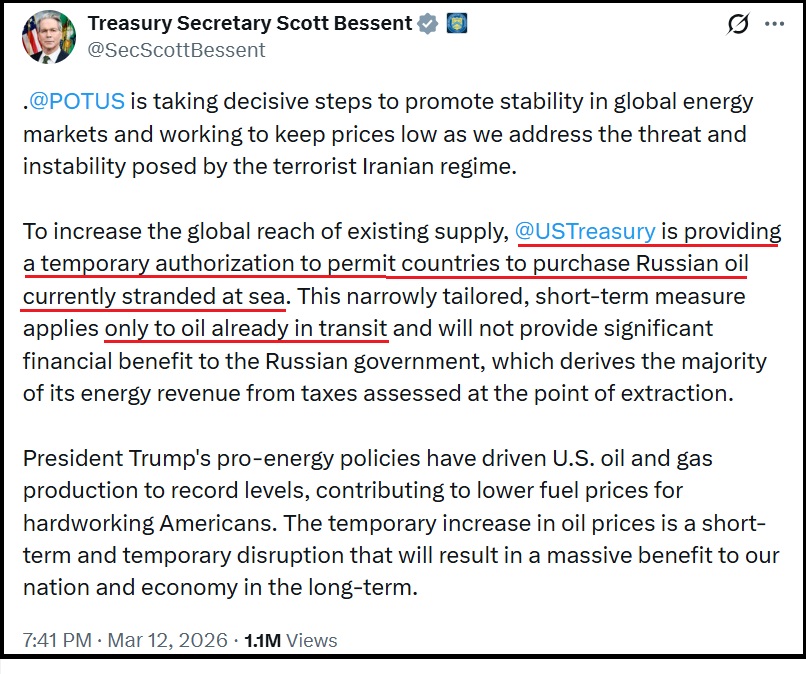
Secretary Bessent Announces “Narrowly Tailored, Short Term Sanction Relief” for Russia

‘Trump, you magnificent bastard, I read your book!’

President Trump and Treasury Secretary Scott Bessent are facing mounting criticism for creating a window for Russia to sell oil and gas to the global market via “narrowly tailored, short-term” sanction relief.  However, few people are putting the issue into context, and the background here is exceptionally interesting.

According to the terms announced by Secretary Bessent, the license to sell applies solely to Russian crude or petroleum products loaded onto vessels as of March 12 and is valid through midnight Washington time on April 11. [Treasury Notice Here – OFAC Technical Details Here]

[source]

The sanction relief license to sell will be done in globally recognized petrodollars and applies only to preexisting oil and petroleum products that are already in transit at sea.  However, here’s where it gets very interesting and the ramifications are significant.

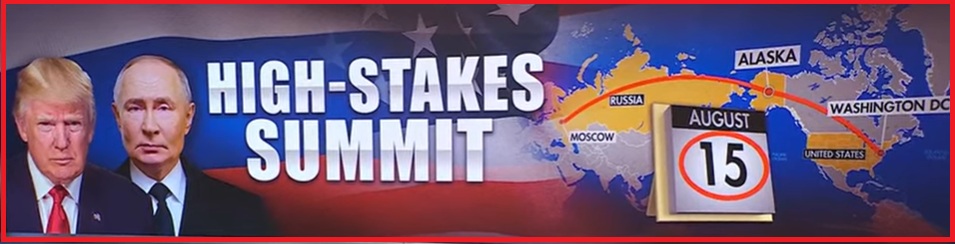
Immediately following the Alaska summit between Russian President Vladimir Putin and President Trump, Russia restarted Arctic-2 LNG terminals and began increasing oil production for storage on ‘floating platforms.’  President Trump met with Putin on August 15, 2025, and the curious increase in Russian production began on August 18, 2025.

In the past six months Russia has been pumping sanctioned oil and gas and storing it on ships and mobile sea platforms, seemingly (at the time) with no customers.  Suddenly, against the background of the Iran conflict, all of that previously stored ‘on the water‘ production, now worth double, is authorized for global sale (in petrodollars).

Either Russian President Putin is the luckiest guy in the world, or Russia knew something.

In 2025 what Russia did following the Alaska summit did not make sense; now it does and the ramifications are stunning.

(more…)

USTR Greer Announces Launch of Sec 301 Trade Investigations into 16 Economies Including the EU

When the Supreme Court made their ridiculous decision to nullify the import tariffs under the International Emergency Economic Powers Act (IEEPA) use, the high court noted several alternate approaches would not be legally problematic.  One of those approaches would be the use of Section 301 trade tariffs.

Yesterday USTR Jamieson Greer quietly announced that a Section 301 review would be taking place for the following countries: China, the European Union, Singapore, Switzerland, Norway, Indonesia, Malaysia, Cambodia, Thailand, Korea, Vietnam, Taiwan, Bangladesh, Mexico, Japan, and India.”

♦ Section 301 tariffs are a trade enforcement mechanism established under the Trade Act of 1974. They allow the U.S. government to impose tariffs on imports from countries that are found to be engaging in unfair trade practices. The Office of the United States Trade Representative (USTR) conducts investigations to determine if a country is violating trade agreements, and if so, it can impose tariffs as a corrective measure {SOURCE}

USTR PRESS RELEASE – WASHINGTON — Today, United States Trade Representative Jamieson Greer announced the initiation of investigations regarding the acts, policies, and practices of various economies under Section 301(b) of the Trade Act of 1974 relating to structural excess capacity and production in manufacturing sectors.

The investigations will determine whether those acts, policies, and practices are unreasonable or discriminatory and burden or restrict U.S. commerce. The economies subject to these investigations are: China, the European Union, Singapore, Switzerland, Norway, Indonesia, Malaysia, Cambodia, Thailand, Korea, Vietnam, Taiwan, Bangladesh, Mexico, Japan, and India.

(more…)

Part II – Europe and China Have an Energy Problem

When President Donald Trump and President Vladimir Putin met in Alaska on August 15, 2025, the focus of the geopolitical world was on discussions surrounding Ukraine.  Unfortunately, it didn’t take long, merely a few hours, for both the U.S. and Russia to say that no progress was made.  However, also noted at the time was both the USA and Russia saying sideline discussions took place surrounding the possibility for a strategic relationship surrounding energy development.

What follows below is a review of the current energy dynamic, specifically surrounding LNG, against the backdrop of the Iran war with a hindsight review of that previous discussion between Putin and Trump.

What most people are missing in their current analysis was something that took place immediately following that Alaska summit six months ago.  Something that did not make any sense until now. {GO DEEP PART I HERE}

Three days after that summit meeting, on August 18, 2025, Russia announced they were restarting Russia’s Arctic-2 LNG production facility.  Russia would be more than doubling their capacity to generate and store liquified natural gas (LNG).

It absolutely did not make sense that Russia would start producing even more LNG considering the previously imposed western sanctions against them, and the fact that Russia was already overproducing LNG. As noted by analysts at the time:

AUGUST 18, 2025 – Russia’s Arctic LNG 2 export facility, which is sanctioned by the United States, is coming back to life after a year of no activity and is looking for buyers in Asia.

[…] The U.S. and EU sanctions on Russia’s Arctic LNG 2, which was billed as Russia’s flagship LNG project, have effectively frozen the start-up of the export facility in the Gydan Peninsula.

[…] Last year, Russia started shipping LNG from its flagship Arctic LNG 2 project—but not to customers. The shipments were made from the Arctic project to floating storage units either in Russia or in European waters, as potential customers were unwilling to buy the sanctioned LNG. {SOURCE}

In August of 2025, Russia was essentially producing more LNG than they could sell into the available market.  Russia was storing the overproduction from Arctic-1 on floating storage units and slowly selling to countries that did not align with the sanctions, specifically China and some Asian buyers.  Then suddenly, after the Trump summit, Russia decides to bring Arctic-2 online and produce even more LNG.  You can see how this did not make sense.

If they could not even sell all the Arctic-1 LNG output, then why would Russia bring Arctic-2 LNG production online?

That was six months ago.

(more…)

U.S. Treasury Secretary Scott Bessent Discusses U.S. Maritime Reinsurance and Global Energy Markets

The geopolitical ramifications of the oil and liquified natural gas (LNG) impact from the ongoing conflict with Iran is changing many of the world’s energy supply chains. Given the nature of the issues there are a myriad of complex dynamics to discuss. However, one key component is the U.S. policy shift to deal with the supply.

With that in mind, Treasury Secretary Scott Bessent appears with Larry Kudlow to discuss the United States’ new $20 billion maritime reinsurance plan as well as the ongoing conflict in Iran. CTH will be expanding the conversation specifically as it relates to Russian oil/gas sales. This is a good precursor interview. WATCH:

.

(more…)