Following an oval office meeting and later discussion with Philippine President Ferdinand Marcos, President Trump announced a trade agreement has been reached.
President Ferdinand Marcos, of the Philippines, is just leaving the White House, with all of his many Representatives. It was a beautiful visit, and we concluded our Trade Deal, whereby The Philippines is going OPEN MARKET with the United States, and ZERO Tariffs. The Philippines will pay a 19% Tariff. In addition, we will work together Militarily. It was a Great Honor to be with the President. He is Highly Respected in his Country, as he should be. He is also a very good, and tough, negotiator. We extend our warmest regards to the wonderful people of The Philippines! (link)
Additionally, the White House has announced a trade agreement with Indonesia for a similar 19% tariff rate.
In 2018, Canadian Prime Minister Justin Trudeau relied heavily on House Speaker Nancy Pelosi for assistance when the U.S. and Mexico constructed the majority of the USMCA trade pact. Today, Canadian Prime Minister Mark Carney takes the same approach.
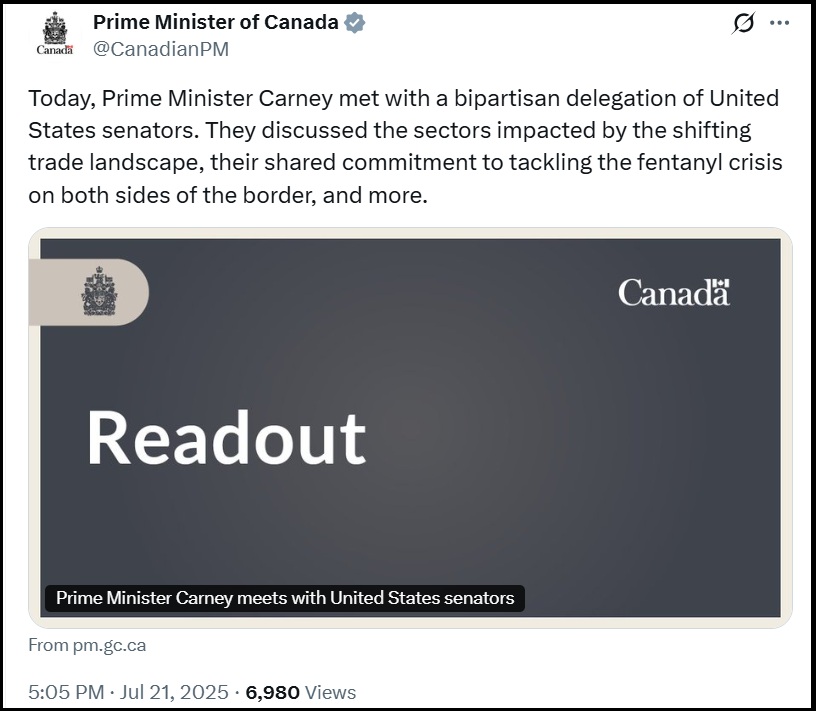
PRESS RELEASE – “Today, the Prime Minister, Mark Carney, met with a bipartisan delegation of United States senators in Ottawa. The Senator for Oregon, Ron Wyden, the Senator for Alaska, Lisa Murkowski, the Senator for New Hampshire, Maggie Hassan, and the Senator for Nevada, Catherine Cortez Masto, were present.” (more)
The 35% tariffs against Canada are scheduled to go into effect on August 1st.
We are approximately 10 days away from the baseline and reciprocal trade tariffs taking place on August 1, 2025. The U.S. economy is strengthening; inflation is not a factor, and the existing tariffs are bringing in a tremendous amount of revenue.
The most difficult trade deal to make is with the European Union as Secretary Bessent notes. It is unlikely that any trade agreement with the EU will be reached because the EU has all the benefits and no desire to lose their status (ie. Marshal Plan).
White House Trade and Economic Advisor Peter Navarro takes a well deserved victory lap on the latest U.S. consumer sales news. The Census Bureau report, yesterday, highlighted that consumer sales remain strong at +0.6% – significantly higher than all economists forecast [DATA HERE].
Retail sales growth is important, because approximately two-thirds of the U.S. GDP growth is driven by consumer sales. With inflation low, retail sales high, and with a previously reported drop in U.S. imports, the ¹second quarter GDP is likely to be much stronger than anyone previously predicted. Thus, Peter Navarro is leaning forward against the naysayers.
This is essentially a repeat of the 2017/2018 economic outcome from President Trump’s first term in office. The tariffs, which are applied to the ‘cost’ side of the dynamic, are mostly being absorbed by major producing nations who are reliant upon export to the U.S. market. Simultaneously, the tariffs are generating income – essentially exfiltrating foreign wealth and returning those funds to the USA; a complete reversal of the rust-belt dynamic. WATCH:
What Peter Navarro outlines is the core of MAGAnomics. This is also the baseline for our CTH assembly in support of economic nationalism, which is why we ended up in conflict with the Chamber of Commerce Republicans.
Tariffs are a tool to leverage reciprocal trade, and as long as nations like China continue taking measures to subsidize their exports, the tariffs simultaneously take wealth (those subsidies) from Beijing and return it to the USA.
This reality has always been the model we predicted would be successful for Americans, and I will remind everyone that ONLY DONALD TRUMP could deliver this MAGAnomic program. Everything else, Epstein, Musk, etc. is chaff and countermeasures deployed by both Democrats and Republicans in an effort to take back control of the money flow.
Well, what do you know? An interesting article about Canada suddenly proposing to put limits on the amount of Chinese steel and aluminum they import. Although missing in the article is a reference to what this means about the prior process that did not have such limits.
Essentially, if you drop the pretending within the Wall Street Journal/MSM narrative, the decision by Mark Carney to limit Chinese Steel is a direct admission of their knowledge to a preexisting level of imports that violated the USMCA and all previous demands to block imports of Chinese steel.
Trump always said Canada was a transnational shipper and entry into the USA. Trudeau and Carney previously denied this was the reality. Well, if that wasn’t the reality, then why the need to change? I digress.
OTTAWA—Canada introduced limits on how much foreign steel produced in countries other than the U.S. and Mexico can be imported, as the Liberal government tries to help a domestic sector reeling from President Trump’s 50% tariffs on Canadian steel.
Prime Minister Mark Carney said Wednesday that the series of import limits and the tariffs targeting steel products with Chinese links are required because the Canadian economy has been too reliant on foreign steel to meet the needs of the construction and manufacturing sectors. He cited data indicating that two-thirds of total steel consumption in Canada comes from abroad, compared with one-third for the U.S. and one-sixth in Europe.
As expected, no one in the media pool asked the key question. If Ukraine is not a NATO member, and Russia is not a NATO member, then why is NATO even involved? Not a single media outlet cared enough to even ask the brutally obvious.
LET US NOT PRETEND. There is good news and there is bad news within the outlined strategy. More good than bad, despite the spin room narrative engineering being immediately spread by U.S. media.
First, President Trump is giving Russian President Vladimir Putin 50 days to finish his strategic military operations in Ukraine, before a 100% tariff rate is executed against the Russian economy. With direct U.S. trade with Russia already not happening, the tariff would likely be applied toward any country purchasing any goods or resources from Russia (specifically India, China, Iran, etc.).
Second, despite Lindsey Graham and the EU leaders discussing the confiscation of Russian assets held in EU/USA bonds, neither President Trump nor NATO General Secretary Mark Rutte mentioned it. Again, the media never asked that question. Thankfully, President Trump seems to realize if such a confiscation took place, the financial credibility of the entire western finance system would be compromised. No nation would want to put their national wealth at risk by buying U.S. and EU treasury bonds.
Third, the part the MSM will focus on. In the interim of the 50 days, NATO will be both purchasing and moving offensive and defensive weapons systems into Ukraine. On the defensive weapon side, Germany will likely send Patriot missile batteries, and NATO will replace them with new U.S. purchases. In addition all NATO states will provide increased offensive weapons and purchases will be made from U.S. stockpiles. Those new offensive weapons will likely be held back until the end of the 50 days, giving Putin something to think about to bring him to the table.
Summary. Putin has 50 days. In the interim NATO is approved by Trump to ship offensive and defensive weapons into Ukraine. The Senate sanctions package will continue to be assembled, perhaps approved, but not deployed until after the 100% tariffs are executed if Russia is non compliant in getting to the table.
The carrot is the 50 days to get finished. The stick is all hell will break loose on Russia, including new and powerful offensive weapons, if Putin doesn’t end the conflict prior to the 50-day deadline.
President Donald Trump sits down with daughter-in-law Lara Trump on Fox News. President Trump talked about the deportation operation, trade, tariffs, Elon Musk & what comes now with the Big, Beautiful Bill signed into law. WATCH:
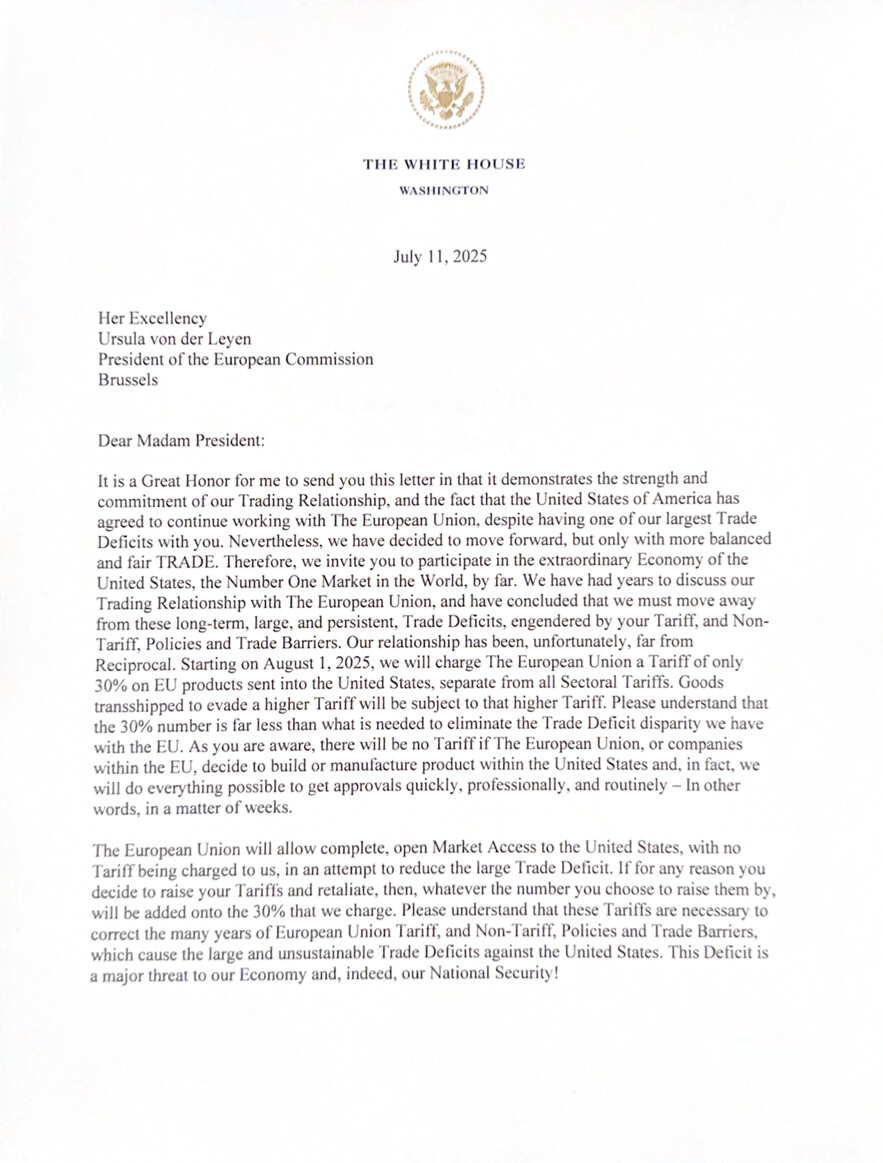
President Trump announced on Truth Social a baseline tariff rate of 30% for both the European Union and Mexico. Other sector specific tariffs still apply.
The EU rate is interesting in that the 30% rate is lower than the Canadian rate of 35%, yet the EU rate exceeds the current ‘chicken tax’ rate historically applied to imported SUVs and Trucks. Strategically, the 30% tariff rate on Europe is a major incentive for various EU sectors to shift manufacturing into the USA.
Without a formal declaration of the end of the Marshall Plan, the reciprocity rate of 30% for all EU imports also equalizes the transatlantic trade benefit. It will be interesting to see how the EU responds, given any retaliation could be added to the existing baseline.
Canada is currently trying to organize a trade agreement with the EU, in the hopes of positioning themselves toward the transatlantic group as they were toward the transpacific group (vis-a-vis China).
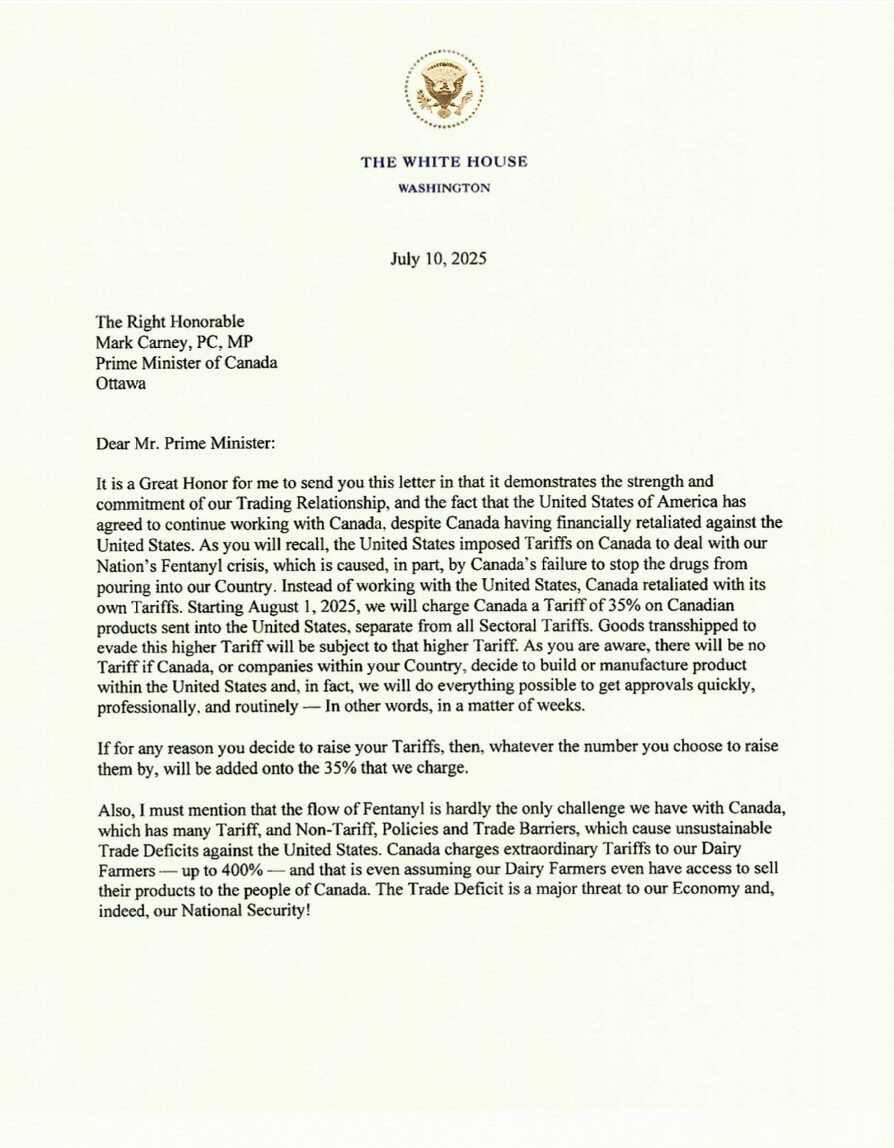
President Donald Trump has announced a 35% baseline tariff rate for Canada on all imported goods not currently covered under the soon-to-expire USMCA trade agreement.
“Instead of working with the United States, Canada retaliated with its own Tariffs,” President Trump shared on Truth Social. “Starting August 1, 2025, we will charge Canada a Tariff of 35% on Canadian products sent into the United States, separate from all Sectoral Tariffs.”
As noted by President Trump in his remarks during Prime Minister Mark Carney’s visit to the White House, Trump plans to renegotiate the USMCA and end the trilateral agreement in favor of two bilateral trade deals.
During the oval office meeting President Trump said, “as you know [USMCA] terminates fairly shortly. It gets renegotiated fairly shortly.” Then the biggest statement, “this was a transitional deal, and we’ll see what happens, we’re going to start renegotiating that”… “I don’t know if it serves a purpose anymore.” …. “And the biggest purpose it served was, we got rid of NAFTA.”
President Trump is going to exit the trilateral USMCA in favor of two distinctly different bilateral trade agreements between the U.S and Mexico; and the U.S and Canada. The only consideration now is the timing. President Trump is 100% focused on the BIG ECONOMIC PICTURE; it’s not about the politics, it’s all about the economics.
Secretary of State Marco Rubio speaks to reporters at the conclusion of the ASEAN Summit in Kuala Lumpur, Malaysia. While the topic of trade and tariffs was not the intention of the assembly, the issues around trade with the USA and tariffs was obviously of keen interest. WATCH: