This is a rather remarkable and insightful short segment interview with the British Defense Secretary, who outlines how the great British Navy will defend their interests.
Once you realize what is said in this segment, you start to realize just how dependent NATO is on the protection provided by the United States. WATCH:
…”Britain was forced to ‘borrow’ a German vessel for a NATO operation next month, led by the United Kingdom, after HMS Dragon was deployed to Middle East.”…
The more NATO/EU hypocrisy creates friction with President Trump; the less U.S. support exists for Ukraine. That’s the dynamic Zelenskyy is trying desperately to navigate with his EU allies.
During a lengthy interview with Reuters, Zelenskyy says he has been directly told the only way for Ukraine to get security guarantees from USA participation is if he concedes the contested Donbas region to Russia and ends the conflict.
Assuming what Zelenskyy says is accurate, at this point in the ongoing stalemate, this seems like the pragmatic optimal solution. Concede Donbas to Russia, and the U.S. will mediate terms that emphasize an American willingness to protect Ukraine from further encroachment.
That said, when Zelenskyy once again starts asking who is going to pay for the needs of his country, the U.S. taxpayer eyeroll commences.
KYIV, March 25 (Reuters) – The U.S. is making its offer of security guarantees for a peace deal in Ukraine conditional on Kyiv ceding all of the country’s eastern region of Donbas to Russia, President Volodymyr Zelenskiy told Reuters in an interview.
[…] Two vital questions remained unresolved regarding security guarantees, Zelenskiy said: Who would help to fund Ukraine’s weapons purchases to sustain its military deterrent, and how exactly would its allies respond in the face of any future Russian aggression?
“The Americans are prepared to finalise these guarantees at a high level once Ukraine is ready to withdraw from Donbas,” said the 48-year-old leader, who added that he understood the “subtleties” of the American position although he had not participated directly himself in the trilateral talks.
The rebranded Lyndon LaRouche PAC has another good outline on the new strategic alliances assembled by President Trump as the ongoing conflict with Iran continues.
Susan Kokinda reviews how the United Kingdom and Europe have been sidelined as President Trump directly negotiates with key stakeholders in the middle east and Asia. Kokinda correctly notes the messaging from Russia indicates a strategic awareness that old systems are fracturing and the potential for new strategic alliances is rising.
“Susan Kokinda argues President Trump has opened a new diplomatic space to de-escalate the Iran conflict by working through a regional roster—Saudi Arabia, Egypt, Turkey, Pakistan, Gulf States, and back channels into Iran—while the U.K., EU, and NATO are absent and increasingly irrelevant. Citing reporting that ministers met in Riyadh and that Egypt, Turkey, and Oman carried messages, she says this “Board of Peace” architecture is isolating Iran and weakening its proxies, pointing to Lebanon’s move against Hezbollah, the Palestinian Authority’s condemnation of Iran, and Hamas considering disarmament. Kokinda links Europe’s exclusion to self-inflicted energy weakness from Green and anti-Russia policies, noting rushed LNG moves and a delayed Russian oil ban vote. She concludes Ukraine’s outlook darkens as Europe and Britain lack leverage, highlighting Zelenskyy’s scramble for support in London and Washington.” WATCH:
Margaret Brennan’s husband is a Syrian Muslim named Major Ali Iyad Yakub, who goes by the nickname ‘Yado’. He served in the U.S. military. Mrs. Brennan studied abroad at Yarmouk University in Irbid, Jordan, and Yakub’s sister, Samia Yakub, was her roommate. Mr. Yakub founded Y2 Global Advisory specializing in global intelligence, communications, and government relations. He also worked for Senator Joe Biden on the Senate Foreign Relations Committee. Margaret Brennan and Ali Iyad Yakub have two children together.
NATO General Secretary Mark Rutte appears on CBS Face the Nation to discuss the European opinion of the U.S. military operation against Iran, and outline how many countries within the NATO alliance are prepared to support the ongoing effort to eliminate the threat Iran represented. Video and Transcript Below:
[Transcript] – MARGARET BRENNAN: We turn now to NATO Secretary General, Mark Rutte, who joins us this morning from The Hague in the Netherlands. Welcome back to ‘Face The Nation.’
NATO SECRETARY GENERAL MARK RUTTE: Margaret, good to be back on the program. Good morning.
MARGARET BRENNAN: Good morning. We did see that Iran fired two missiles at Diego Garcia. That’s that island in the Indian Ocean, which houses a U.S. UK joint base. That was 4000 kilometers from Iranian territory, furthest Iran has ever gone. You just heard Ambassador Waltz say there might be a difference there in how Israel and the U.S. assess that capability Iran has in terms of what they fired. But Israel says these were intercontinental ballistic missiles that could hit Berlin, Paris and Rome. Does NATO share that Israeli assessment?
SECRETARY GENERAL RUTTE: We cannot confirm that at the moment, so we’re looking into that. But if this would be true, it is the more evidence that what the President is doing here, taking out the ballistic missile capability, taking out the nuclear capability from Iran, is crucial. And exactly as the ambassador just said, Ambassador Waltz, we have seen with North Korea, if we negotiate for too long, you might pass the moment where you can still get this thing done, and North Korea now has the nuclear capability. If Iran would have the nuclear capability, including, together with the missile capability, it will be a direct threat, a existential threat, to Israel, to the region, to Europe, to the stability in the world. So the president doing this is crucial, and I’ve seen the polling, but I really hope the American people will be with him, because he is doing this to make the whole world safer.
Representative Don Bacon is openly and publicly in opposition to every President Trump policy. Bacon is a ‘professional republican’, a traditional DeSantis republican.
Appearing on CNN the Nebraska Republican says if President Trump were to leave NATO, “there would be a civil war in the republican caucus.” WATCH (prompted):
Sometimes things are just too funny. Less than 24 hours after President Trump said Europe’s refusal to escort their own oil shipments through the Strait of Hormuz might lead him to reconsider staying in NATO, suddenly ships are en route.
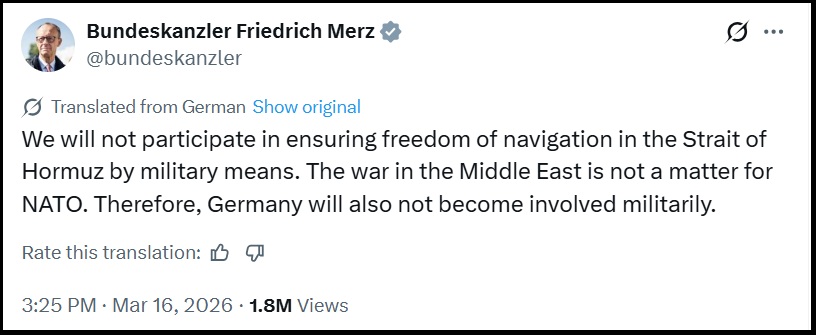
The EU has balked at the request of President Trump to support military escorts for EU oil shipments through the Strait of Hormuz destined for European Ports. However, it is the position of German Chancellor Fredrich Merz which really highlights the arrogance of the issue.
Germany has deactivated its nuclear reactors and decided not to purchase Russian oil/gas. As a consequence, the German industrial economy is contracting; the German auto industry is collapsing; German manufacturing plants are closing – and mass layoffs have been announced.
Into this self-created dynamic, Germany has become dependent on (1) Oil and Gas from the middle east, and (2) LNG from the USA. Germany is a completely dependent nation on the issue of energy production. Yet, this is Germanys position:
Setting aside for a moment that “the middle east is not a matter for NATO,” while reminding ourselves Ukraine is also not a NATO member state – yet Germany is supporting the pro-war ‘coalition of the willing,’ President Trump previously pointed out that NATO would never come to the aid of the USA when the Greenland Arctic Security debate was going on.
The EU in general, and Germany specifically, is essentially proving President Trump’s point. However, as a result of intentional migration, Germany has over five million Muslim residents now residing inside the country. We should consider that this overlay is also part of their internal political consideration.
What Chancellor Merz said next is almost too European to be real, but it is:
President Trump holds a bilateral meeting with German Chancellor Friedrich Merz in the Oval Office. After brief remarks of mutual appreciation, President Trump and Chancellor Merz responded to questions from the assembled press pool.
Chancellor Merz expressed support for the objective of eliminating the regime threat from Iran. President Trump notes at the beginning how Iran is targeting civilian targets in the region and generating even more support from the Gulf states for the USA.
When asked about the British and Spanish refusal to support U.S. military logistics and deployment, President Trump let the media be aware he is not happy with the position of Spain and the U.K. President Trump also announced [11:00 of video] an economic embargo of trade with Spain as an outcome of their position.
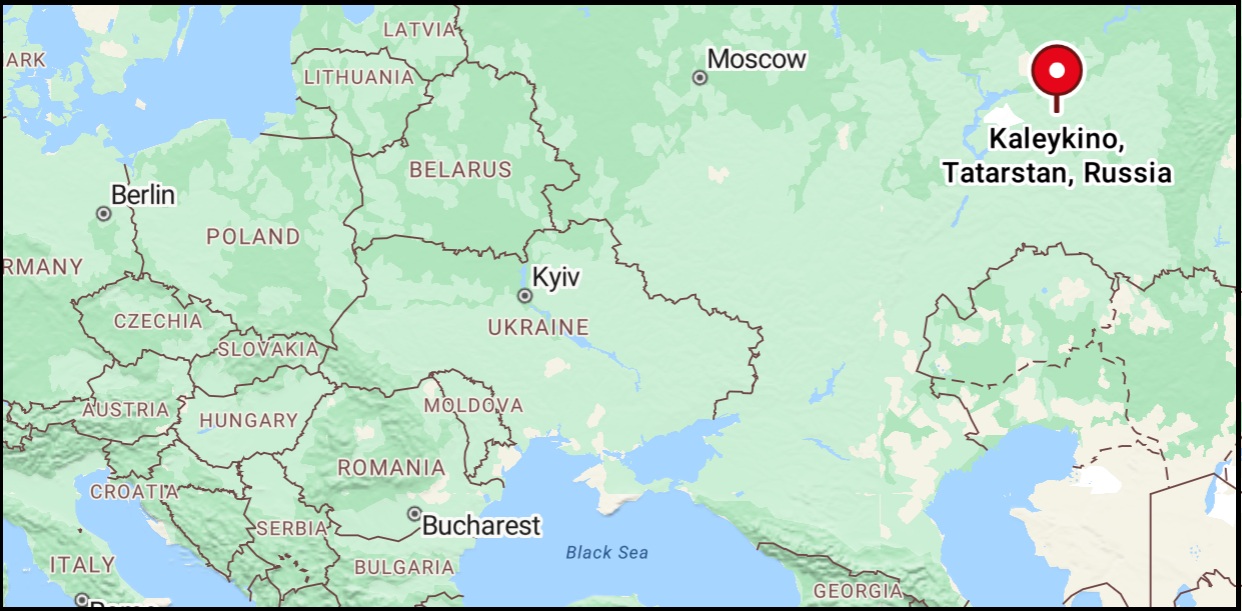
The Ukraine military, technically and non-pretendingly accepted as the EU military, has targeted a key oil pumping station in Russia that feeds into the westerly directed oil supply. However, if you stand back from the western media, what you will notice from this attack is not the target in Russia, but the customers at the end of the pipeline in Europe, mainly Hungary and Slovakia.
[…] Through local stations, including infrastructure around Kaleykino, oil from Tatarstan and neighboring regions feeds into the main pipeline, which runs through the Samara region and continues westward toward Belarus and further to countries in Eastern and Central Europe. […] There were also earlier reports that Ukrainian forces carried out several attacks on Druzhba pipeline infrastructure inside Russia, which at times disrupted Russian oil supplies to Hungary and Slovakia. {source}
So, what’s going on here?
Well, with the anniversary of the Russian Federation beginning the war into Ukraine, the Europeans who now control the military operations inside Ukraine are targeting European countries who do not align with their bloodlust, specifically Hungary and Slovakia.
Both Hungary and Slovakia are land locked countries without easy access seaports. Because of their geographic locations, they rely on Russian oil and gas for their energy needs. Hungary and Slovakia have not wanted to expand the war against Russia. The EU is demanding Hungary and Slovakia agree to expanded war.
The European ‘coalition of the willing’ is now targeting key Russian infrastructure that supplies energy products to European countries who are not in compliance with the EU dictates of war.
The European Union has a major targeting effort against Hungarian Prime Minister Viktor Orban, an ally of President Trump who does not support giving additional funding to the Ukraine war effort. Hungary is having national elections in April.
Previously, USAID Administrator Samantha Power spent considerable time in Hungary organizing activist groups to conduct operations against the government {2023 – Go Deep}. Last week a German based NGO called Democracy Reporting International, won a ruling from a Berlin judge to force the X platform to turn over data related to support for Viktor Orban and the government of Hungary.
All of this opposition to Prime Minister Orban seems to be coordinated by quasi government agencies on behalf of Brussels and their interventionist intentions. We may remember it was also information from German intelligence, that was behind the nullification of the Romanian first-round election {GO DEEP}.
However, Viktor Orban is fighting back and refusing to approve the funding of the Ukraine war despite the massive pressure campaign from inside the European Union.
💶 If the war ends, funding ends. Ukraine’s plan: make sure the war doesn’t stop.
🇭🇺🇨🇿🇸🇰 Thankfully, common sense still prevails in Hungary, the Czech Republic, and Slovakia. We will not risk our families’ future by sending € billions to fund someone else’s war.
As noted by Hungarian Minister Zoltan Kovacs, “Many have asked how Hungary can block the €90 billion Ukrainian war loan if we are not participating in it. clarified that the loan does not affect Hungary and does not entail any financial commitment for us. As Hungary is not part of the cooperation, in most of the decision-making procedures we do not even vote. However, he pointed out that for the scheme to function, the EU’s seven-year budget guarantee rules must be amended – and this requires the approval of all 27 member states, not only the financing member states. We are now blocking this decision, without which the war loan cannot be disbursed.”