It was predictable [SEE HERE], and it happened exactly as predicted.
BlackRock investment firm writes the regulatory and economic policy for Joe Biden’s administration. That’s the quid-pro-quo that maintains the Biden political financial operation. All of DC know it. No one does not know. The ones who claim they do not know about it are all pretending. Republicans take the background BlackRock bribes and pretend.
BlackRock positioned massive investment assets inside Chinese auto manufacturers, MG, BYD, and Chery. The three Chinese companies are in the process of moving North American auto manufacturing to Mexico, specifically to make EVs. The Chinese EVs made in Mexico will come into the U.S market tariff free under the USMCA trade agreement. China and BlackRock will make billions.
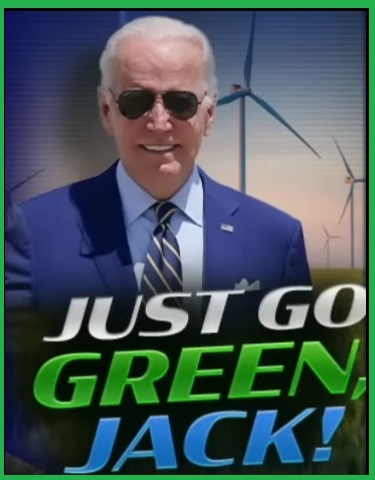
Today, Joe Biden announced a series of tariffs against China in the EV industry. [SEE HERE] The Chinese EVs are not being made in China. The tariff regime is a farce – a total joke.
Biden might as well be announcing tariffs on Chinese swimming pools flown into the USA via hot air balloon. There will be more Chinese swimming pools delivered from China than Chinese EVs. The Chinese EVs come from Mexico. The tariff is fake.
Guyana President Dr. Irfaan Ali sat down with BBC narrative engineer Stephen Sackur, host of BBC’s HardTALK, to talk about Guyana’s vast offshore oil and gas reserves and how it is transforming their national economy.
The BBC production crew came with an intent to confront President Ali about climate change and the unwillingness of the emerging nation to adhere to the dictatorial fiats of the Western world. BBC arrived fully immersed in the climate change agenda, with a narrative that stands aghast at the nerve of another nation to look out for the best economic interests of their citizens.
President Ali was not going to allow the BBC to avoid the hypocrisy within their position and he fired back brilliantly. WATCH (prompted):
.
Pretending leftists wonder why the world is cleaving. Then again, in order to advance their insane ideology, the progressive left must always pretend not to know things. The BBC narrative engineer is a case study in this pretense.
An entire generation within the walled and occupied West have been indoctrinated to believe in the cult of climate change. As the same ‘Western world’ loses a grip on their historic influence, the global cleaving does not come as a surprise.
People have asked me about the origin of the CBDC planning, the motive for the master design of the WEF and Western financial and corporate world. Why would they need to wall-off the West through banking, finance and economics?
There’s some nuance in the story, but essentially the Biden administration is not approving or extending Liquified Natural Gas (LNG) export permits to nations who do not have free trade agreements (FTA’s) with the United States. This is causing expansion issues in the LNG industry as needed investment capital by the industry is negatively impacted.
The Biden administration says they are pausing the permitting while they study climate change. However, the Biden administration is also unilaterally sending LNG to Europe to support the NATO objective to hamper the Russian economy (not working).
As a consequence, the Biden administration (think Biden family) is controlling the outflow of LNG; essentially putting themselves in a position of financial influence over the LNG industry. Who is controlling whom, and why?
HOUSTON, Texas — The liquefied natural gas industry has criticized the Biden administration for pausing export permits on LNG as uncertainties arise for developers planning massive amounts of investment.
Major U.S. exporter Freeport LNG’s Chief Executive Officer Michael Smith said Wednesday in an interview on the sidelines of the CERAWeek energy conference in Houston that “you won’t get this resolved till after the presidential elections” in November.
The U.S. Department of Energy, which issues permits for LNG export projects to countries that are not part of free trade agreements, announced in January that the government will pause permits to review how the projects affect climate change, national security and the economy.
This is a good opportunity to emphasize a key point that is often missed. In the research and discussion outline yesterday, about Joe Biden’s EPA publishing new regulations for the auto industry, we dove deep into the background of what actually creates the issue. {GO DEEP}
The issue that should concern everyone is not the Joe Biden administration and their ideology around climate change, or the EPA, or even the viability of EVs themselves. The issue that should draw the biggest concern is how the regulation originates; what is the impetus; who are the beneficiaries?
The regulation itself did not originate in the EPA, nor was it created from an origination process amid climate ideologues in the administration. Everything starts with BlackRock positioning their assets. From that empirical point, all political activity then takes place, which includes the regulations to support the BlackRock objective.
A massive, multinational investment firm is in control of political outcomes in the USA. That should be the emphasis, not necessarily the regulation that flows as an outcome of that control, and certainly not the debate over whether EVs are a viable alternative to combustion engines.
BlackRock, and the control agents of finance, banking and investment, would like nothing more than to see Congress have debates about climate change, the viability of EVs as an alternative to combustion engines, the nuances of power grid generation from alternative energy sources, the scale of energy need as estimated and debated for the next two decades, etc.
All these points of debate become useful political policy issues that divide and contrast. Sure, Congress would love to hold hearings about EV viability, U.S. grid compliance, the need for subsidized charging stations, etcetera, etcetera. Because what is not discussed in this debate is where the subject matter comes from.
Gary Cohn appears on Face The Nation to discuss the finance, the economy and the pain felt by consumers. He won’t say it directly, for obvious reasons, but what Cohn describes in terms of political support boils down to Main Street business supporting Donald Trump and Wall Street Multinational Corporations supporting Joe Biden. That is ultimately what is obvious at a macro level.
I’m starting the video at 03:08for the purposes of emphasizing inflation. What Cohn says about U.S. inflation is essentially accurate and I have a Cliff Notes, tldr, HERE. However, what Cohn says about tariffs creating inflation is not accurate, as outlined by the 2017 through 2020 results of Trump tariff policy. Cohn says, “No one absorbs tariffs, except the consumer,” this is false. As we saw in 2017, 2018, and 2019 China, Asia and the EU essentially dropped their export prices to retain access to the USA market and offset tariff costs. That’s just a statistical reality.
The transcript is HERE; however, I want to draw attention to a geopolitical aspect that is not getting enough attention. Specifically, the cost of FOOD PRODUCTS and the attached inflation.
Why is food inflation continuing to be a problem? Why is food inflation not just a USA problem? Why are the EU farmers protesting? These questions are easily answered, and yet no one in the Western financial press will explain.
The Build Back Better agenda, known in the USA colloquially as the Green New Deal, carries with it massive increases in cost for energy products. Fertilizer, which needs natural gas, and farming, which needs large amounts of fuel, diesel and fuel oil, uses costly energy products. Packaging, plastics (petroleum derivatives) and cardboard also require large amounts of energy.
The manufacturing (heating, cooling, freezing) as well as storage and transportation of food products also use massive amounts of energy. Additionally, and specifically because of the nature of their consumption, the increased energy costs associated with generating food travels quickly through the supply chain.
Food inflation is always the first thing you notice when the prices of energy products skyrocket. This is well known and not subject to debate; everyone accepts this.
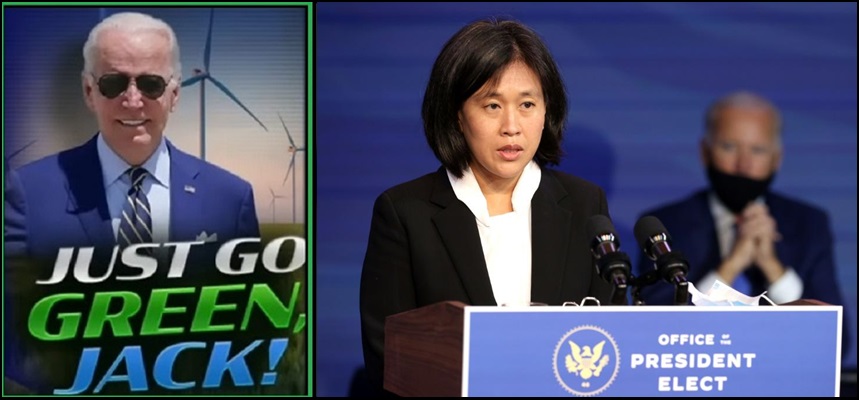
A story surfacing in Politico about the collapse of the office of the United States Trade Representative (USTR) and the inability of the entire trade policy group to find any willing trade partners was entirely predictable.
You might remember how the insufferable U.S. business media constantly said the Trump trade team was not going to be successful because the administration was disliked by global trade partners. Every Trump trade approach from tariffs to section 301 compliance, to U.S. demands around foreign policy tied to the economic Trump Doctrine was decried by U.S. multinational corporations as too divisive, too intransigent. However, Donald Trump and his trade wolverines racked up more trade wins and established more trade agreements than any administration in history.
From KORUS (Korea/US) to the Middle East, Saudi Arabia, India, Japan, European energy deals, massive changes with China, new Ag agreements, demanded technology sector investment back in the USA, and the successful renegotiation of NAFTA (Canada, Mexico, USA) into the USMCA – all of it was stunning in scale, scope and success. Trump’s global trade success was exactly the opposite of every predictive declaration by the professional media. All of the Trump strategic policy shift created the framework for the largest domestic expansion of the U.S. economy, evident in every 2019 economic metric prior to the pandemic.
Biden took office with the full support of the lying liars who lie in the media, and they said Biden’s team was a shoo-in for success. Again, exactly the opposite has happened.
The ideological leftists who came with the Obama/Biden plan forcibly tried to push their Green New Deal policies into every trade agreement. The result and response from all U.S. trade partners has been a massive failure of epic proportions.
Despite the international pontifications around support for the globalist energy policies, ie. the “Build Back Better” bulls**t pushed by western government, the World Economic Forum and the globalists, when it comes to where the rubber hits the road no nation is willing to attach themselves to the economically destructive millstone demands of U.S trade. In material fact, many of the BBB agenda priorities are now completely rejected by the same politicians who promoted them.
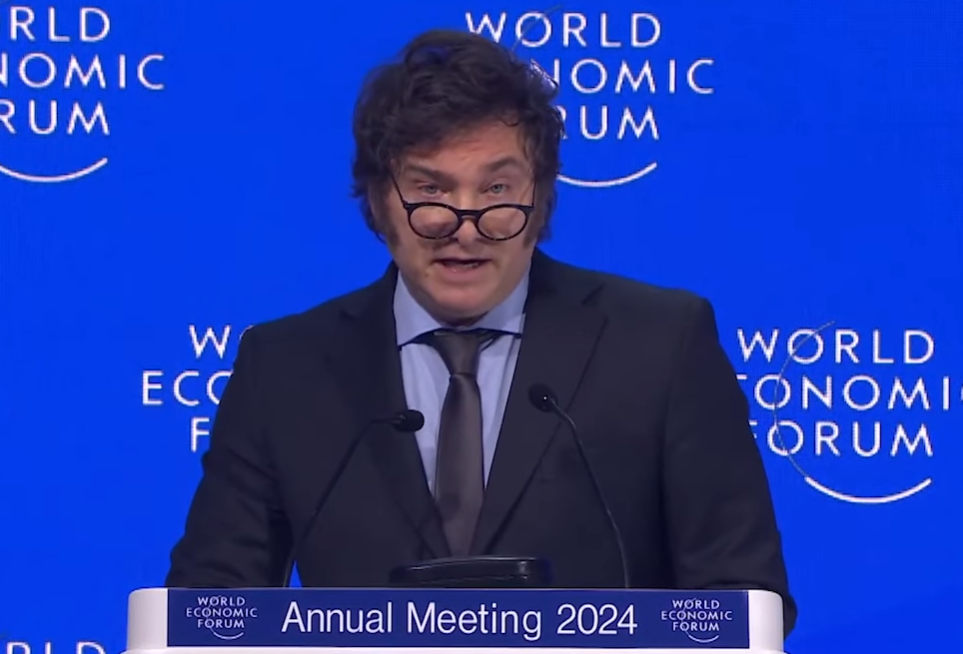
Many people are heralding this speech given by Javier Milei as a confrontation to the mindset of the World Economic Forum (WEF) meeting in Davos.
Because so many people made a similar assertion, I had to listen to it twice, because I just didn’t get that takeaway. I still don’t. The first 10 minutes is an academic review of the history of free-market capitalism; the latter 10 minutes decries the failures of those economic systems who attempted socialism, including his own homeland of Argentina.
While the last half of the speech is strong, factually good pushback against the academic socialistic mindset, he never really addressed the issue that is at the core of modern, Western, economic corruption – the merge of the corporation and the state.
Capitalism vs Socialism was a debate well covered during the Soviet era and subsequent collapse of the Berlin wall. The 2020’s challenge is entirely different, fascism.
Traditional Fascism was defined as an authoritarian government working hand-in-glove with corporations to achieve totalitarian objectives. Essentially, a centralized autocratic government headed by a dictatorial leader, using severe economic and social regimentation, and forcible suppression of opposition.
That governmental system didn’t work in the long-term because free people rejected government authoritarianism; so, we went to war and killed the fascist support system. Fascist governments collapsed, and the corporate beneficiaries were nulled and scorned. Then along came a new approach to achieve the same objective.
The World Economic Forum (WEF) was created to use the same fundamental associations of government and corporations. Only this time the corporations organized to tell the governments what to do. The WEF was organized for multinational corporations to assemble and tell the various governments how to cooperate to achieve control.
Fascism is still the underlying premise, the WEF just flipped the internal dynamic.
The German farmers are not negotiating with a government who is supposed to represent their interests. No, the farmers are telling their elected officials what they will accept, and what they will not accept. And this approach has the German government in fits of apoplexy…. The farmers are revolting.
[Background Here] The second week of massive protests in the streets of Germany has the overwhelming majority of the people in support of the farmers. However, to show just how large the gap between the people and their government has become, the German officials think a process of negotiating terms is possible. The farmers are having none of that.
Really, this is awesome to see. The Dutch farmers are in full support and truckers from around the EU are aligned with the German farmers. The simple message is “enough is enough” and there are more EU interests that just the German government paying attention. Keep in mind, the World Economic Forum meeting in Davos began today.
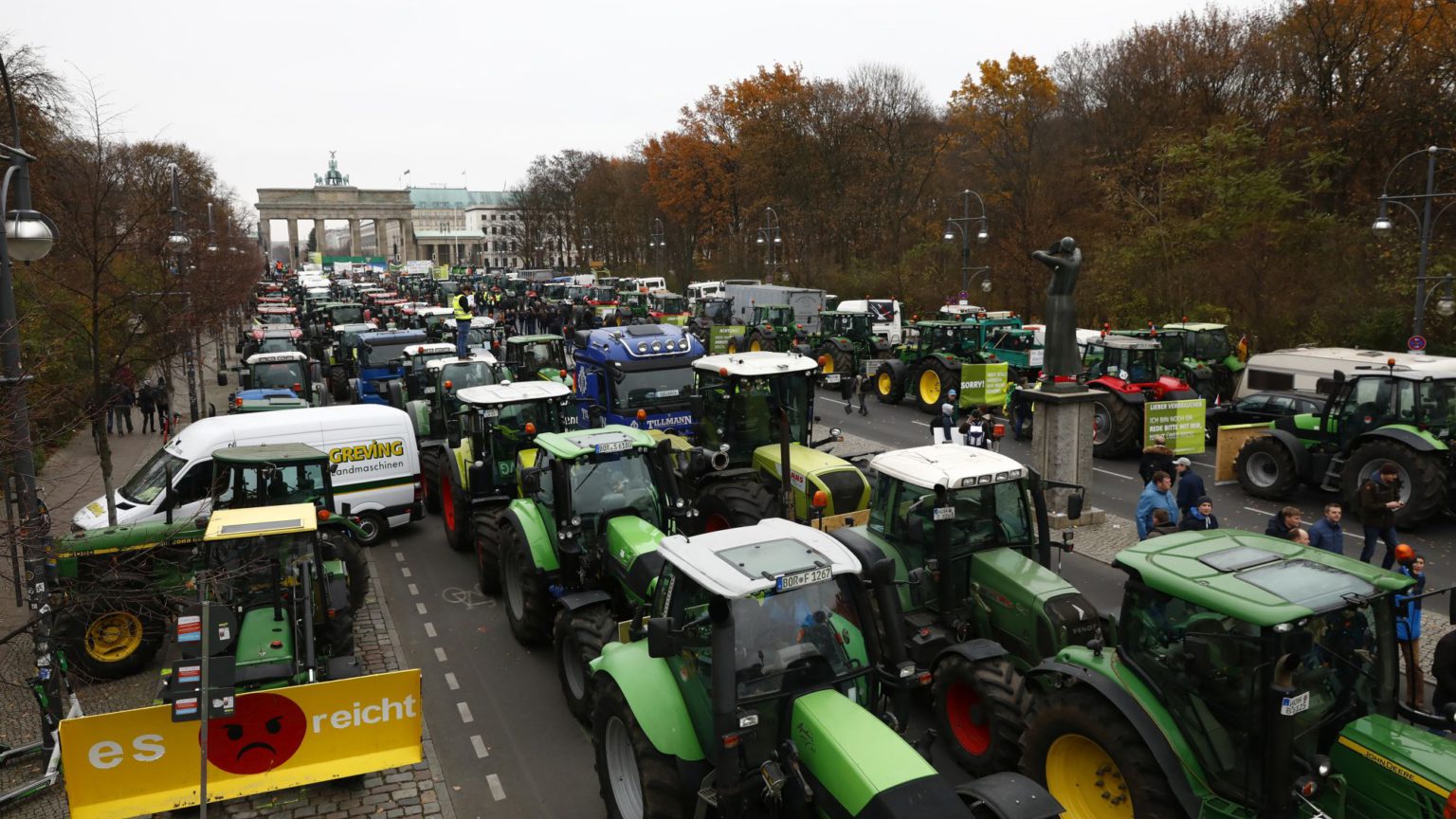
GERMANY – Farmers clogged Berlin streets with their tractors on Monday, honking their horns in protest at a plan to scrap tax breaks on the diesel they use, the climax of a week of protests that has tapped into wider discontent with Germany’s government.
Columns of tractors rolled into the capital ahead of the demonstration at the landmark Brandenburg Gate. Over the past week, farmers have blocked highway entrances and slowed traffic across Germany with their protests, intent on pushing Chancellor Olaf Scholz’s government to abandon the planned cuts entirely.
Keep watching this story as much as possible folks. It might be difficult to find the details because Western corporate media do not want to cover the specifics, but the pushback deep inside the EU is well organized, planned and strong.
On day one, the German farmers began their protest, and began blocking transport hubs, main arteries and government buildings around the country.
Today, on day #3 of the protest, the German railway workers have joined.
You might remember the “solidarity” movement from the 1980s when the general working class in Poland took to the streets and triggered mass protests – eventually forcing the collapse of the governing structure. Well, here we are 40 years later, and a multi-nation force is aligned in the effort to duplicate the outcome. This is massive pushback against the globalist and WEF system.
The railway strike forces transport companies to use trucking. The truckers are supporting the farmers. The farmers are blocking the roads. This is a multidimensional approach, well thought out and well planned. Do not disregard what is taking place and understand there are many EU politicians watching closely. Germany is by far the largest economy in the EU.
I’m very serious when I share with people that almost everything we understand about the geopolitical purposes and impacts of sanctions against Russian economic interests is entirely fabricated. However, because the scale of the propaganda against us is so effective, breaking the mental/cognitive barrier is almost impossible.
It’s not that situations are ‘shaped’ or information is ‘manipulated,’ like would be the definition of the term “disinformation.” But rather that the entire construct of reality regarding the economic issues -as presented- is fabricated, created by massive financial interests, and flat-out lies; I mean, total unadulterated nonsense. Complete fiction.
We are through the looking glass folks. Literally captive to the narrative as sold by our Western government officials, and there’s a huge one-way mirror; beyond which, massive segments of the grey zone are looking at us as if we are pathetic victims of professional propaganda.
The worst part of this dynamic is how the USA looks insufferably weak, because we are playing this massive game of pretending that only the Yellow Zone is participating in.
MOSCOW, Dec 27 (Reuters) – Almost all of Russia’s oil exports this year have been shipped to China and India, Deputy Prime Minister Alexander Novak said on Wednesday, after Moscow responded to Western economic sanctions by quickly rerouting supplies away from Europe.
Russia has successfully circumvented sanctions on its oil and diverted flows from Europe to China and India, which together accounted for around 90% of its crude exports, Novak, who is in charge of the country’s energy sector, told Rossiya-24 state TV.