The professionally furrowed brows are forced to admit high prices remain problematic for the proles while retaining the sympathetic pretense. WATCH:
.
Comrade rebels, when things get spicy, I’ve got dibbs on his swimming pool.
The professionally furrowed brows are forced to admit high prices remain problematic for the proles while retaining the sympathetic pretense. WATCH:
.
Comrade rebels, when things get spicy, I’ve got dibbs on his swimming pool.
 Seriously, it’s stunning, yet oddly not surprising, that the same multinational forces who created the global inflation crisis as a result of following the World Economic Forum spending agenda, are now claiming the global economy is simply too hot, too successful, there is just too much demand, and that justifies their raising of interest rates:
OTTAWA, July 13 (Reuters)– The Bank of Canada surprised on Wednesday with a full-percentage-point increase to its policy rate, a super-sized hike last seen in 1998, citing “higher and more persistent” inflation and the increased risk of those price gains becoming entrenched.
The central bank, in a regular rate decision, raised its policy rate to 2.5% from 1.5%, and said more hikes would be needed. The move was more forceful than the 75-basis point increase economists and money markets had forecast.
….”With the economy clearly in excess demand, inflation high and broadening, and more businesses and consumers expecting high inflation to persist for longer, the Governing Council decided to front-load the path to higher interest rates,” the bank said. [LINK]
This is the actual justification from the Bank of Canada.
The Bureau of Labor Statistics (BLS) has released the June Consumer Price Index (CPI) [DATA HERE] showing yet another “surprising” increase in overall inflation. For the month of June overall inflation increased 1.3% bringing the annual rate of inflation to 9.1% as calculated.
Economists and financial pundits are “shocked”, “surprised” and the proverbial “unexpected” is running amok again amid the typeset. The reality of Joe Biden energy policy being the origin of our current inflation crisis is being avoided at all costs by the pretenders. The federal reserve raising interest rates can only impact the demand side, but it’s the supply side (total energy policy) creating the problem. Table-A shows the overview.
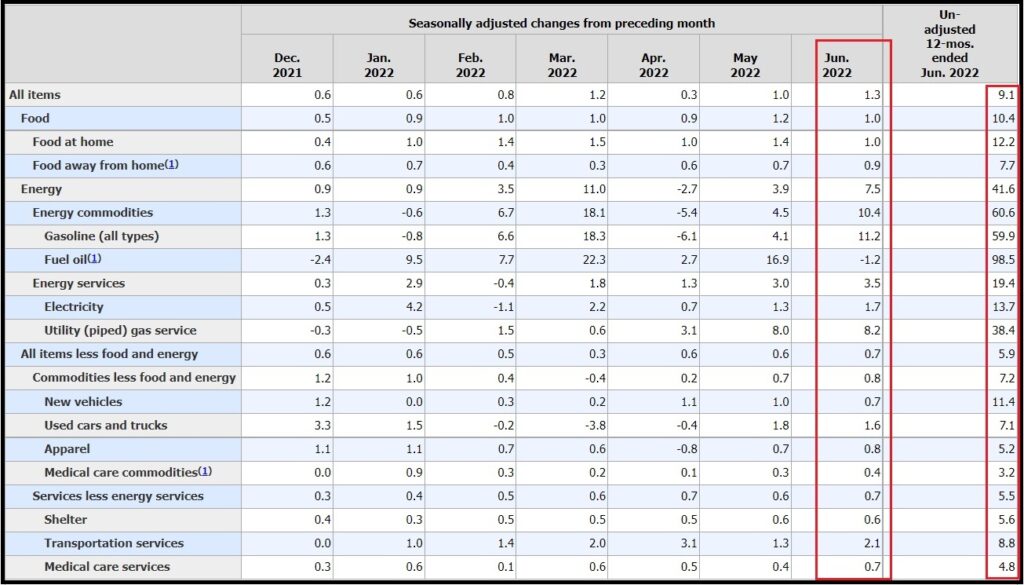
(CNBC) – […] The consumer price index, a broad measure of everyday goods and services related to the cost of living, soared 9.1% from a year ago, above the 8.8% Dow Jones estimate. That marked the fastest pace for inflation going back to November 1981.
Eva Vlaardingerbroek is a GB News correspondent and conservative voice from Holland. In this interview segment with NTDNews Ms. Vlaardingerbroek outlines what is happening in the Netherlands with the Dutch farm protests and how it connects to the larger Agenda 2030 goals.
In the last 20 seconds of the segment, Vlaardingerbroek has some solid advice for Americans. WATCH (2 mins):
https://youtu.be/nQ-dIFyYXPI
To really get a strong reference point for how the global ruling elites at the World Economic Forum think about farming and climate change, which includes the brain trust at the World Health Organization, I would urge you to read THIS ARTICLE from the Irish Farmers Journal.
A slowdown in the housing market is being identified as the primary cause of a significant increase in cancelled homebuyer contracts in the month of June. Bloomberg Report Here and Redfin Report Here. It would appear the inflated housing bubble has popped.
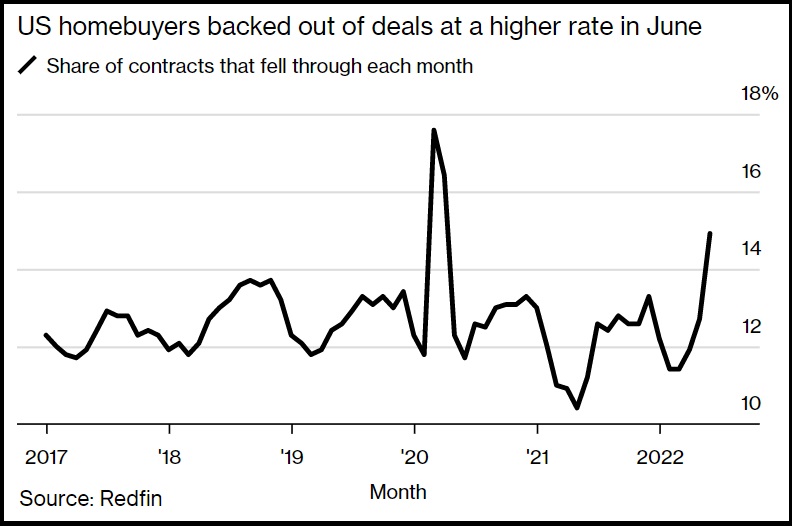 According to the data 60,000 home sales were cancelled while under contract in June, that represents 14.9% of all contracts cancelled by the buyer before the transaction closed. If you take out the forced cancellations due to the pandemic, a 15% cancellation rate equals the highest monthly cancellation rate ever recorded.
The economy is contracting, economic activity and consumer purchases have stopped, and the contraction is now fast and sudden.
(Redfin) – Nationwide, roughly 60,000 home-purchase agreements fell through in June, equal to 14.9% of homes that went under contract that month. That’s the highest percentage on record with the exception of March and April 2020, when the housing market all but ground to a halt due to the onset of the coronavirus pandemic. It compares with 12.7% a month earlier and 11.2% a year earlier.
Appearing on GBNews with Dan Wootton, UK commentator Neil Oliver discusses and connects the Sri Lanka protests, the uprising in the Netherlands, and the aligned protests in Poland, Italy, Germany and much of the European continent.
As Oliver notes the pretorian guards for western politicians, aka the ‘western media’, are doing everything they can to ignore the global scale of the popular uprisings that are directly connected to the globalist agenda of the World Economic Forum and their Build Back Better orders to the western politicians. The media ignore the issue until it reaches a point like Sri Lanka where it can no longer be ignored. WATCH:
The Canadian trucker protests were targeted by Canadian Prime Minister Justin Trudeau in an effort to quickly stop the spread of any opposition to the globalist agenda. However, in the Netherlands the Dutch farmers have several distinct advantages in their ability to impact the life of ordinary Dutch people, as they refuse to become victims to the new global feudalism.
Like Sri Lanka, the Netherlands is a case study in raw people power, where the government is represented by a select few people. The only thing keeping the Dutch from storming the politicians’ palaces and government buildings is a preference for polite society. If that preference changes, and it might as people get more desperate, well, katy-bar the door.
Two things about this report showing Rivian is planning layoffs for its workforce.
 First, the larger ‘layoff‘ issue is going to be more prevalent as the economy contracts and consumer demand declines. There is almost no expanded investment going into any Main Street business that sells non-essential goods.
The economic contraction, the drop in consumer demand that indicates a recession, is very real and now very easy to spot.
Second, Rivian is backed by the financing of Ford and Amazon and operates in California, Michigan and Illinois (three deep blue states). Rivian is also the supplier for Amazon electric delivery vehicles having previously announced (in 2019) a deal to purchase 100,000 vehicles from Rivian. Additionally, Rivian has lost 69% of its market value this year.
LA TIMES – Rivian Automotive Inc. is planning hundreds of layoffs to trim its workforce in areas where the electric-vehicle maker has grown too quickly, according to people familiar with the matter. […] The Irvine company, which has more than 14,000 employees, could target an overall reduction of around 5%, the people said. The layoffs are still in the planning stage, and nothing has been decided.
You might have heard about an online grocery distribution center called Picnic in the Netherlands burning to the ground {LINK}. The backstory of how the Picnic operation connects to the Dutch government is fascinating, and with context it looks like Picnic was targeted as part of the Dutch farmer protest.
In the Netherlands the government official who organized the regulations to take farmland from farmers and reduce their livestock is a politician named Christianne van der Wal-Zeggelink {wiki link}. Mrs van der Wal-Zeggelink is the current Minister for Nature and Nitrogen Policy in the Dutch cabinet of Prime Minister Mark Rutte.
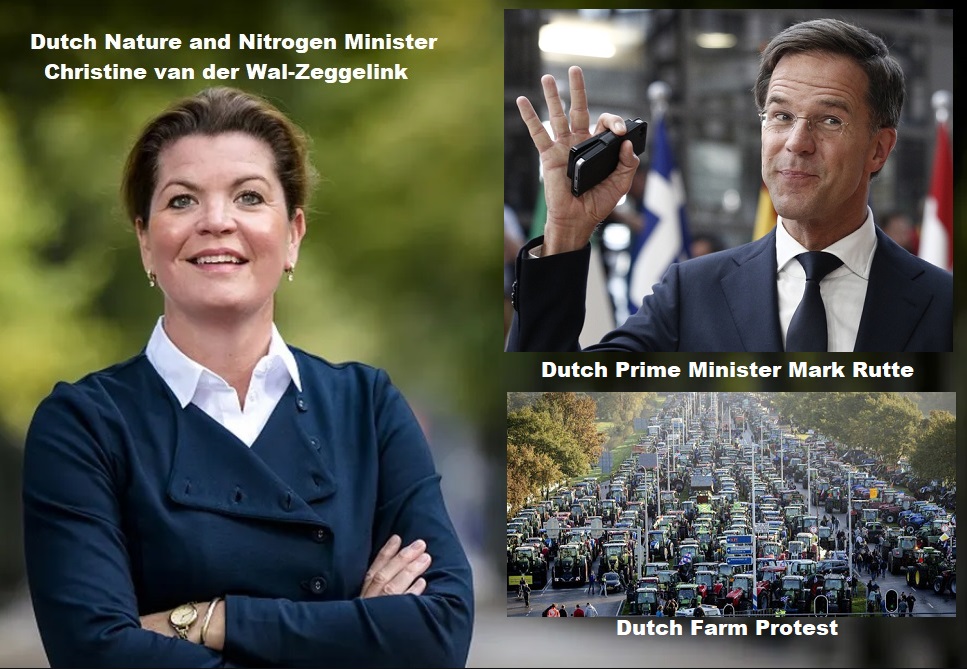
Minister Christianne van der Wal-Zeggelink and Prime Minister Mark Rutte are climate activists, so it makes sense that the “Minister of Nitrogen Policy” would be the person who would attempt to reduce nitrogen by targeting the farmers. It is Mrs. van der Wal-Zeggelink who created the regulations that the farmers are protesting.
Now, stay with me… Christianne van der Wall-Zeggelink is married to Piet van der Wal, an heir to the wealth of the family who owns a supermarket chain called Boni. {citation} So, when Dutch farmers sell product to Boni they are directly funding the wealth of the government minister who seeks to destroy their livelihoods.
Additionally, when Dutch shoppers spend their money at the Boni supermarket they are funding the family of the government minister who is seeking to destroy the farmers who provide the food to the supermarkets. Do the Dutch farmer blockades of the supermarkets and distribution centers make more sense now?
Here is where it gets interesting…. The supermarket chain Boni is one of a small group of four big investors in the online supermarket chain Picnic. {citation} The van der Wal family was part of a group of investors in 2015 and 2019 who generated €450 million for the Picnic grocery operation.
Amid a heatwave throughout most of Texas, The Electric Reliability Council of Texas, or ERCOT, is urgently asking Texas residents to conserve electricity because “it has projected a shortage in energy reserves Monday “with no market solution available.” Voluntary conservation is needed between 2 p.m. and 8 p.m. Monday.”
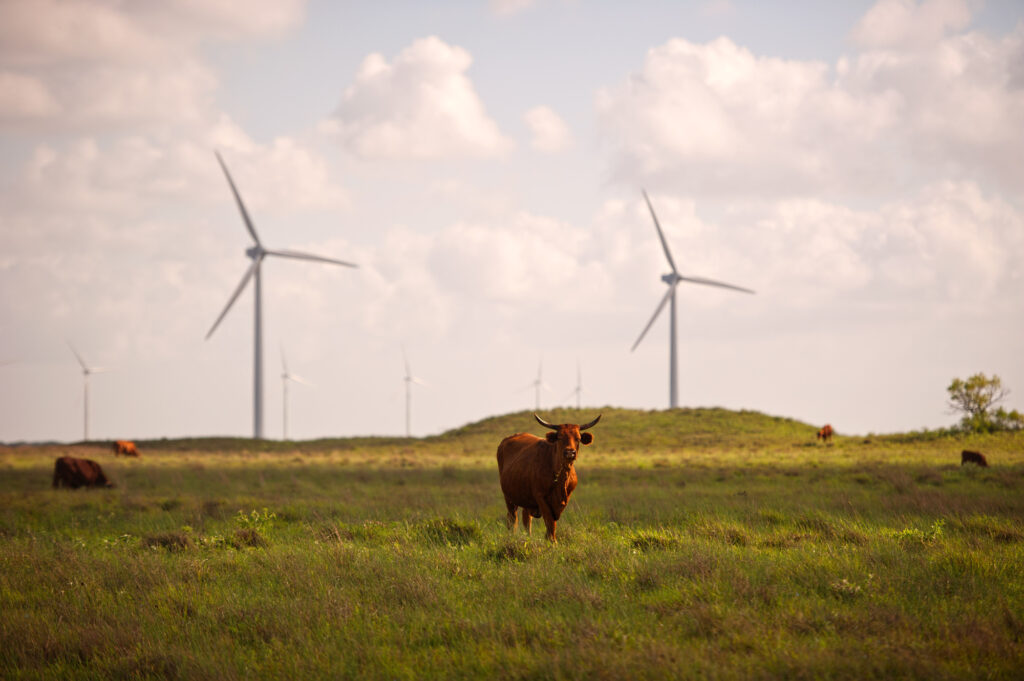
The problem, as the Texas power authorities have identified it, is outlined via NBC News:
According to ERCOT, factors driving the need for this important action by customers:
Conservation notifications are issued when projected reserves may fall below 2300 MW for 30 minutes or more, according to ERCOT. (link)
Barrons has an interesting article on an increase in bank auto repossession rates connected to defaults [see here]. Essentially, used car prices have surged significantly and the timeline seems to indicate the temporary covid-19 stimulus spending had a lot to do with the increase in demand.
According to data assembled by CoPilot, used cars are currently priced approximately 10,000 higher than they would be without any pandemic related influence, supply side or demand side. Banks and financial institutions loaned money into the climbing market price. However, the artificially inflated car prices now create a bubble where the liability on the books is significantly higher than the repossessed asset is worth.
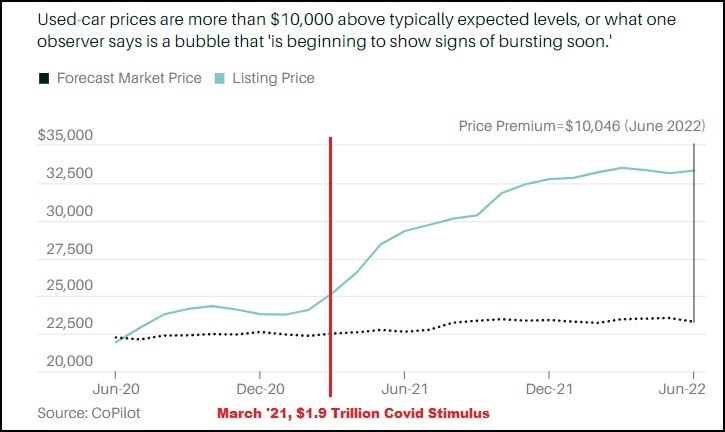
A higher rate of auto loans are now defaulting for both sub-prime and prime borrowers (double for both), indicating the former buyers are under financial pressure and can no longer make their car payments. The loan to value ratio was as high as 140% when the banks made the loans, a more traditional or normal ratio is 80%.
The banks have a vested financial interest in limiting the number of repossessed vehicles they allow into the used car auction market in order to keep the book value of the cars as high as possible. Those banks and financial institutions have recently rented more storage space for the vehicles being repossessed.