Quantcast

Sri Lanka Inflation and Food Crisis Results in Widespread Social Chaos

I have stated for the past year ‘the absence of food will change things‘.   The inflation and food affordability crisis has now surfaced in Sri Lanka. Global media is paying attention, even sending out warnings about what this might represent for other nations.

Sri Lanka has a debt to GDP ratio of 120%, approximately the same as the United States.  However, Sri Lanka does not have the benefit of their currency being supported as the global trade currency; therefore, the debt and domestic inflation rate are directly tied together.

The rate of food inflation in March has exceeded 30%…. the absence of the public being able to afford food has now surfaced and the government is collapsing.  Read the news from Sri Lanka through the prism of what could happen in U.S. cities if we lose the dollar as the global trade currency.

(Via Reuters) – Reuters Breakingviews) – Sri Lanka’s collapse is front of mind for many. Protesters fed up with crippling shortages of essential food and fuel items are on the streets, prompting multiple members of Prime Minister Mahinda Rajapaksa’s cabinet to offer to resign late on Sunday.

Social unrest will probably accelerate a restructuring of some $44 billion of international sovereign debt. Though Sri Lanka’s problems follow years of mismanagement, its speedy unravelling is a warning to sturdier economies from Europe to Asia suddenly grappling with a spike in the cost of living.

(more…)

German Grocers Warn Consumers of Significant Second Wave Price Increases

The inflationary impact to any specific country is directly proportionate to the scale of the government intervention in the COVID lockdown spend.  Almost all of the nations who deployed the WEF program are in the same inflationary position.

The U.S., U.K., New Zealand, Australia, Canada and the EU, within which Germany is the largest economy, all followed the WEF spending instructions.
(Germany) – According to the German Retail Association (HDE), consumers should prepare for another wave of price hikes for everyday goods and groceries.

Even before the outbreak of war in Ukraine, prices had risen by about five per cent “across the product range” as a result of increased energy prices, HDE President Josef Sanktjohanser told the Neue Osnabrücker Zeitung on Friday.

With Russia’s invasion hitting economies and the supply chain harder, yet another series of price increases is on the horizon. “The second wave of price increases is coming, and it will certainly be in double figures,” Sanktjohanser warned. (read more)

Every time the supermarket checkout rings, a yellow vested rebel is created.

Report: Chicken, Pork and Beef Prices Likely to Skyrocket Due to Massive Increases in Feed Costs

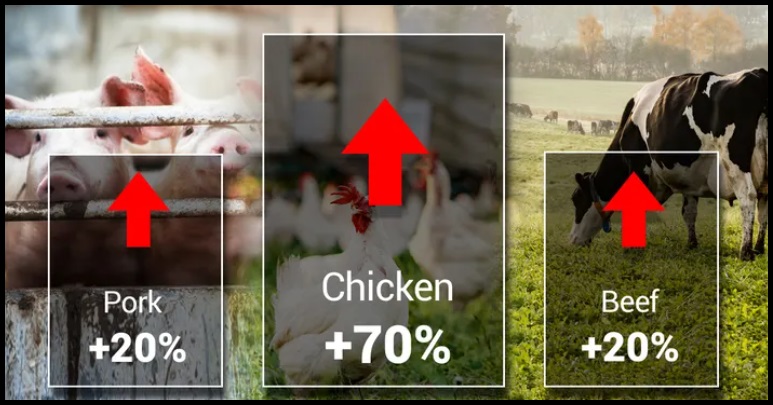
Hopefully this does not come as a surprise to readers here; however, according to analysis by industry insiders, Chicken prices are likely to increase by 70% this year once the full price increases in grain, used as feed, start to take hold.  Overall, we will likely see a leveling off in beef prices, but pork (due to soybeans) and chicken (due to grain) will increase significantly.

The issue is one we noted in December of last year when identifying the downstream consequences of fertilizer and component products used for the production of corn, wheat and soybeans crops. “You might say those crops do not seem like they are that important.  However, keep in mind that Corn, Wheat and Soybeans represent the baseline for not only grain production in the U.S, but they are also the primary feed products for proteins: chicken, pork and beef.” {Go Deep}

(Fox Business) – Evercore ISI issued a protein inflation note this week projecting that most protein prices are forecasted to increase “substantially” due to the higher feed costs, with chicken breast reaching as high as 70% year-over-year in the first half of 2022.  The analysis said pork and ground beef could climb as high as 20% year-over-year during the same period. (more)

(more…)

We Are in Trouble, White House Journalist Asks Senior WH Official if Farmers Should Change Crops This Year

There are often questions raised about whether the crises created by the Biden White House policy are incompetence or intentional.  For the group that believes ‘incompetence‘ is behind the chaos, well, they gained a significant data point today.

During a White House press briefing a reporter asks, “My question is about how the White House plans to prepare for food shortages, particularly as it comes to wheat …. should U.S. farmers grow more wheat this year instead of corn and soybeans given the possible food shortages?”

The Chair of the Council of Economic Advisers, Cecilia Rouse, answered” …”farmers respond to price signals. So, with the price of food rising, they will be responding by making additional plantings and trying to take advantage of the increased price signal.  So, the market will work as the market will work.”  Please WATCH 16:32 Prompted

The reporter and the Chair of the CEA seemingly have no idea how long it takes to farm or grow a crop.  As if switching from corn to wheat was just a Monday decision.  Good grief, June/July harvests for winter wheat this year were planted in October of last year.

Changing a crop in the spring for harvest in the summer is not akin to changing your regular order of beverages at Starbucks.

(more…)

Tenuous Winter Wheat Crops Could Become Problematic

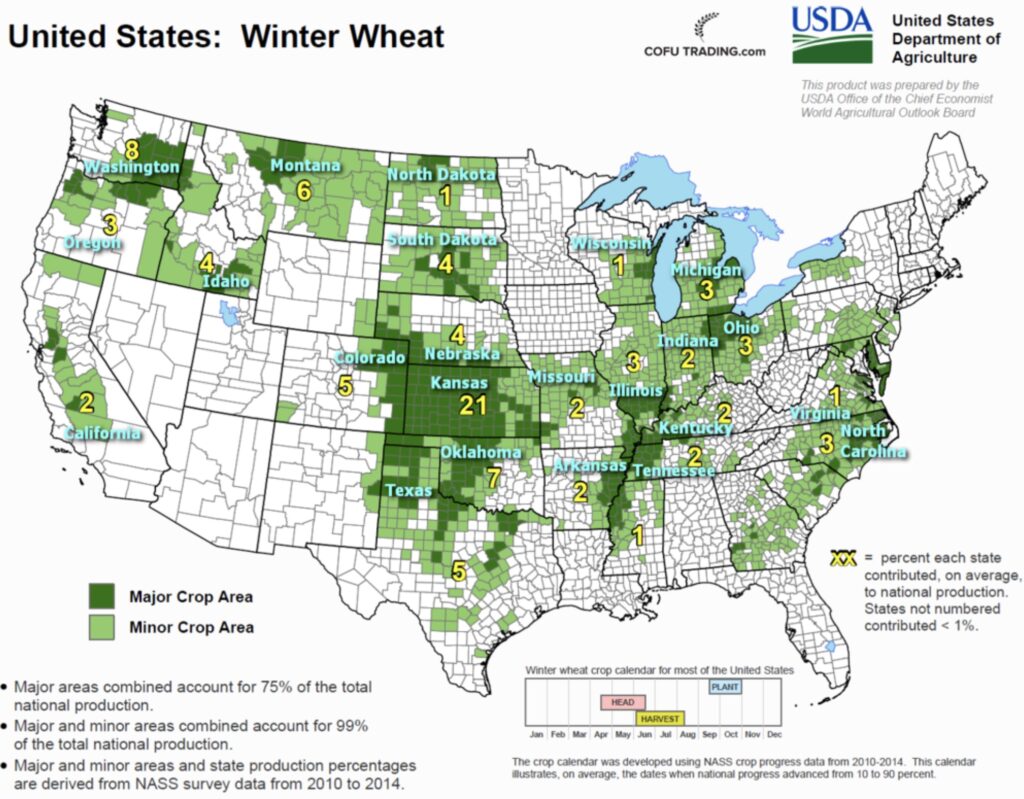
Wheat is an essential grain harvest in the overall food chain.  Winter wheat is planted in October and harvested the following June and July, however, the U.S. crop this year is in a tenuous position because of severe drought in the plains.  Kansas represents about a quarter of the U.S. harvest and is currently suffering through an extended dry season.

Last week, “Kansas Governor Laura Kelly declared a drought emergency, warnings and watches for every county in Kansas on Thursday due to dry conditions causing high fire danger.” (link)

We need to keep an eye on this, and it would be wise to make proactive preparations now for the possibility of a severe shortage.  This potential is what has driven the price of wheat futures, and when combined with the issues in Europe’s largest wheat producer, Russia, there’s a very real possibility of a global shortage of wheat.

The early March warnings are beginning to become more important.  “The world has grown hugely dependent on Ukraine and Russia for their wheat, a crop used in everything from bread to couscous and noodles. The nations account for a quarter of global trade. They are also cheap suppliers, which makes their exports favorites for importers in the Middle East and North Africa, including in Egypt, the world’s biggest wheat buyer.” (link)

(more…)

Unprecedented Inflation Setting Records, No End in Sight

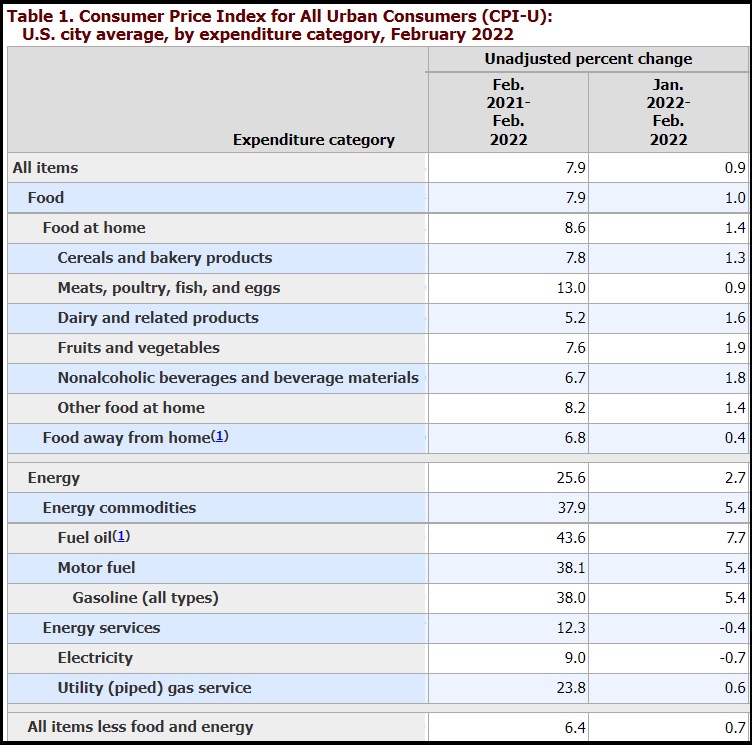
The Bureau of Labor and Statistics (BLS) has released the February capture of the current inflation situation {DATA HERE} – the results are alarming and unfortunately will get worse.

The February rate of inflation was 0.8% (adjusted), an increase from the prior month (Jan 0.6%), and the calculated year-over-year inflation rate is now 7.9 percent and climbing fast.   There are some important indicators and aspects that need to be emphasized.  [Modified table-1 graphic]

First, the capture of the current February data was BEFORE the Russia-Ukraine crisis came into play.  Despite the White House attempting to justify the release data today by blaming it on Russia-Ukraine influence on oil and gas prices, the data itself was assembled before the recent spikes in oil and gasoline.  This is an important distinction, because that means what is coming next is even higher.
Second, what is surfacing now in the data is what we previously outlined in October and November as the inflation hurricane heading our way.  All of this was predictable, given the nature of the inflation, at all three stages of the supply chain (raw material, intermediate and wholesale).

The price of goods is still rising inside the supply chain, and the rate of petroleum price increases (energy and transportation) is making the final products even more expensive.

Third, the forward-looking rate of annualized inflation is higher in almost every category than the year-over-year backward looking data. This means future price increases will be even higher than previous price increases.  The rate of inflation monthly (in almost every category) is exceeding the previous rate of inflation.

(more…)

Kraft-Heinz Announce Price Increases for Next Wave of Wholesale Grocery Inflation, Rates in Low Teens

Kraft-Heinz has announced the next wave of anticipated inflationary prices for their products.  The announcement, and the timeline they provide for the price increases, is exactly in line with our prior estimations.

Prior CTH outlines on the path of inflation for this specific company are HERE (Dec) and HERE (Jan).  Keep in mind, depending on the size of the buyer or wholesaler, and depending on the terms of the contracts for purchase, generally speaking, terms are net payment in 30, 60 or 90 days based on 180 day contracted price agreements which include rebates to retailers.

(Reuters) […] “The company expects inflation to be in the low-teens percentage range for 2022, with higher levels in the first half than in the second, said Chief Financial Officer Paulo Basilio.” (link)

Both Proctor & Gamble and Kraft-Heinz provide the best data points to predict future retail grocery inflation.  Based on their previous notifications, we can now see that Kraft is anticipating the March – July rates of increase to remain approximately where they have been (20 to 30%) and then stabilize in the last half of the year bringing the yearly average into the “low teens.”  This timeline is what we predicted back in October.

The prices we will see at the grocery stores will rise again in the spring (this is the backside of the inflationary cycle), continue through mid-summer, and then price increases should likely level off at the end of summer this year.  Between the price today and the price at the point of leveling is approximately a 20% increase.

(more…)

January Wholesale PPI Inflation Doubles Economic Expectations, Diesel Fuel Jumps 9.4% in January Alone, 56.5% For Year

Here we go folks. Jumpin’ ju-ju-bones, the first wave of producer driven inflation has just been quantified.  The economic analysts are shocked, stunned, flabbergasted and surprised, because the January single month wholesale inflation of 1.0% is double what they expected.

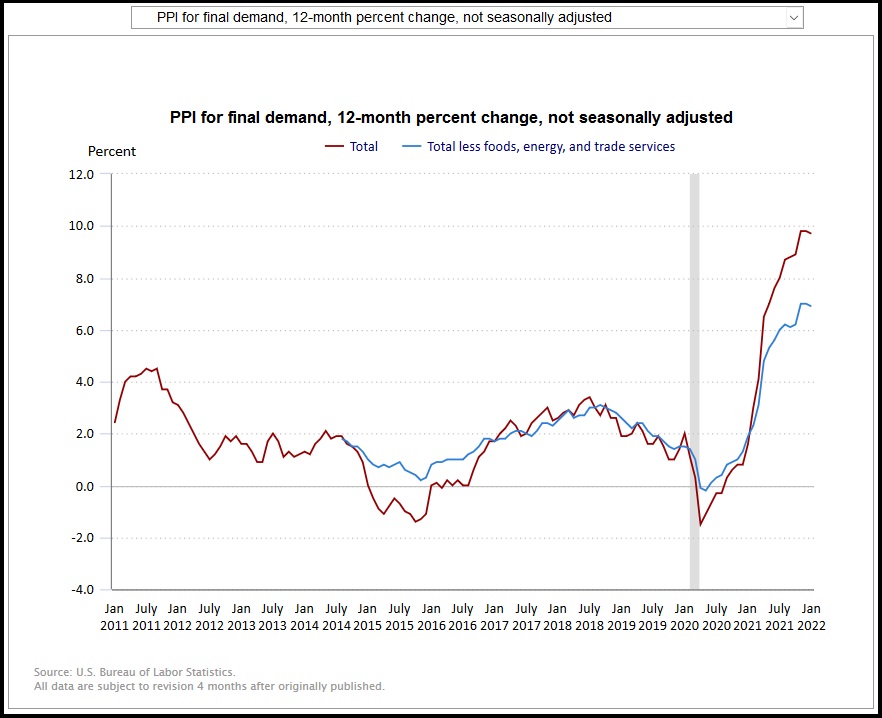
The “producer price index” is essentially the tracking of wholesale prices at three stages: Origination (commodity), Intermediate (processing), and then Final (to wholesale). Today, the Bureau of Labor and Statistics (BLS) released January price data [Available Here] showing a dramatic 9.7% increase year-over-year in Final Demand products at the wholesale level.

Check out the single month wholesale price increases in these categories [Table 2]: Beef jumped 6.5% in January (43.9% for year). Gasoline jumped 1.9% in January, (53.9% for year).  Diesel fuel jumped 9.4% in January (56.5% for year). Cooking oil 4.7% in January (36.4% for year).  Home heating oil jumped 7.3% in January (47.4% for year).  Pasta jumped 3.0% in January (16.2% for year). Tires jumped 4.6% in January (9.0% for year). Wholesale cleaning supplies jumped 3.8% in January (34.9% for year).

Unfortunately, there is nothing upstream in the supply chain and manufacturing pipeline to suggest that higher prices at the retail level are not coming.  The price of raw materials, and the wholesale energy costs to process those materials into finished goods, are still rising.

(more…)

Modified and Weighted Inflation Data Shows 7.5 Percent Annual Increase, Highest Increase in 40 Years

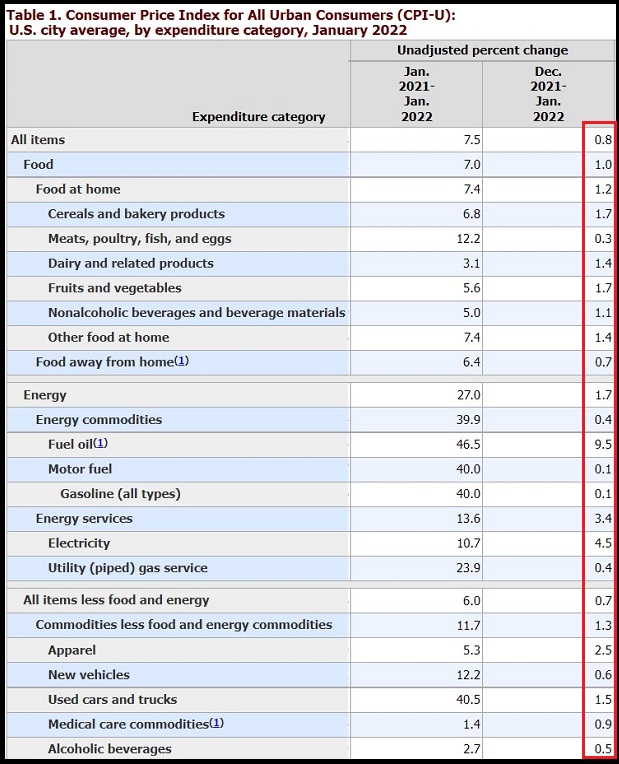
The Bureau of Labor and Statistics (BLS) released the January inflation data [DATA HERE] along with the yearly data from 2021.   The “first round” of retail grocery price increases starts to surface; but this is only the first round.  January inflation was actually much worse than the bad data inside the BLS analysis.

Additionally, the BLS readjusted the weighting for relative price importance, putting added weight to urban economic priorities (ie. food at restaurants), which indicates their intent to downplay the scale of inflation overall.  The topline statistic of 7.5% annual inflation (year over year) is bad; however, because of weighting that figure belies the bigger issue, it’s actually much worse.  In January alone inflation jumped 0.8% (unadjusted), primarily driven by the first-round of 2022 consumer inflation that preexisted since early December 2021.

To give an idea of how much prices have increased, we modified BLS Table 1 to take out some noise.  Look at the single month of January (red box).

Look at January “electricity” price increases.  A jump of 4.5% in one month alone, and keep in mind the BLS puts far less importance on electricity than “food away from home”.

In fact, the weighting for economic importance of restaurants is 5 times greater than the electricity to power your house.

Always keep in mind inflation data is backward looking.  So it is a capture of the price increase at a former moment. In this example the pricing survey was early January.

The timing part is important because gasoline has jumped again since this survey was completed.  The BLS data only has gas increasing at 0.1% in January; in reality it increased much more.

You can see the statistical smoothing to present the softest inflation data by looking at Food at Home, Meats, Poultry and Fish.  The actual rate of inflation in that category is 40%+ at retail.  The BLS deemphasizes the price increase by putting less economic importance on the category and they come up with a 12.2% increase, one third of the actual price we are feeling.

(more…)

Maryland Residents React to Current Grocery Store Prices

It’s always good to review ground reports from middle class Americans.  Much like the feedback from CTH readers, there is a raw honesty you don’t find in any of the economic outlines from financial punditry.

In this Fox News Digital report, Maryland residents react to the consequences of Joe Biden’s economic and energy prices. Maryland has been shifting further to the left socially as the DC-centric commuter base has moved into the suburbs.  However, they are not happy with prices.  WATCH:

The same sentiment is reflected in a recent Gallup poll [data here] highlighting a large majority who note the direction of the country is not good.  Joe Biden policy is crushing the working class, and we can all feel it.  Middle America knows we are going in the wrong direction.