President Trump holds a roundtable discussion with Agriculture Secretary Brooke Rollins and various farm state senators as he outlines $12 billion in support and subsidy for American farmers.
With energy prices lowered, the costs for natural gas, fertilizer, diesel and gasoline prices have fallen; however, food costs have remained high. President Trump announced with Brooke Rollins an initiative to help support American farmers with the intended objective to lower production costs from the field that will hopefully transfer to the fork.
Secretary Rollins and President Trump announce a $12 billion bridge subsidy to assist farmers with proactive planning for the 2026 planting season. The money is coming from revenue generated by tariffs, and row crop farming will be the first subsidies delivered. WATCH (media questions begin at 31:40):
If there is one economic dynamic we have talked about on these pages more than the rest, its inflation. {Background}
The root causes of inflation are two-fold, monetary policy and energy policy. However, when combined they represent a predictable outcome. Specifically predictable, when it comes to highly consumable goods that require a lot of industrial effort, labor, distribution and warehousing processes. Thus, food inflation was/is worst.
Kamala Harris and her boss did this to millions of Americans
If I was in charge of the RNC research, or the Trump campaign, this would be my new ad pic.twitter.com/WJ4QCbuJmm
Within all of the sectors most vulnerable to upward price pressure as a result of policy (monetary and energy), the main industry impacted by immediate and severe inflation is food, farming and agriculture. Food, a highly consumable product with a thin supply chain, sees the results of inflation first and fastest. Durable good inflation lags behind high-velocity consumable goods.
It was with this understanding CTH first warned in 2020 of what would happen coming out of the COVID Pandemic economic crisis. We predicted and watched in 2020 as one-third of all food supplies were destroyed because 50% of the food supply chain (restaurants, cafeterias, schools, food trucks, essentially food away from home) was shuttered.
Gary Cohn appears on Face The Nation to discuss the finance, the economy and the pain felt by consumers. He won’t say it directly, for obvious reasons, but what Cohn describes in terms of political support boils down to Main Street business supporting Donald Trump and Wall Street Multinational Corporations supporting Joe Biden. That is ultimately what is obvious at a macro level.
I’m starting the video at 03:08for the purposes of emphasizing inflation. What Cohn says about U.S. inflation is essentially accurate and I have a Cliff Notes, tldr, HERE. However, what Cohn says about tariffs creating inflation is not accurate, as outlined by the 2017 through 2020 results of Trump tariff policy. Cohn says, “No one absorbs tariffs, except the consumer,” this is false. As we saw in 2017, 2018, and 2019 China, Asia and the EU essentially dropped their export prices to retain access to the USA market and offset tariff costs. That’s just a statistical reality.
The transcript is HERE; however, I want to draw attention to a geopolitical aspect that is not getting enough attention. Specifically, the cost of FOOD PRODUCTS and the attached inflation.
Why is food inflation continuing to be a problem? Why is food inflation not just a USA problem? Why are the EU farmers protesting? These questions are easily answered, and yet no one in the Western financial press will explain.
The Build Back Better agenda, known in the USA colloquially as the Green New Deal, carries with it massive increases in cost for energy products. Fertilizer, which needs natural gas, and farming, which needs large amounts of fuel, diesel and fuel oil, uses costly energy products. Packaging, plastics (petroleum derivatives) and cardboard also require large amounts of energy.
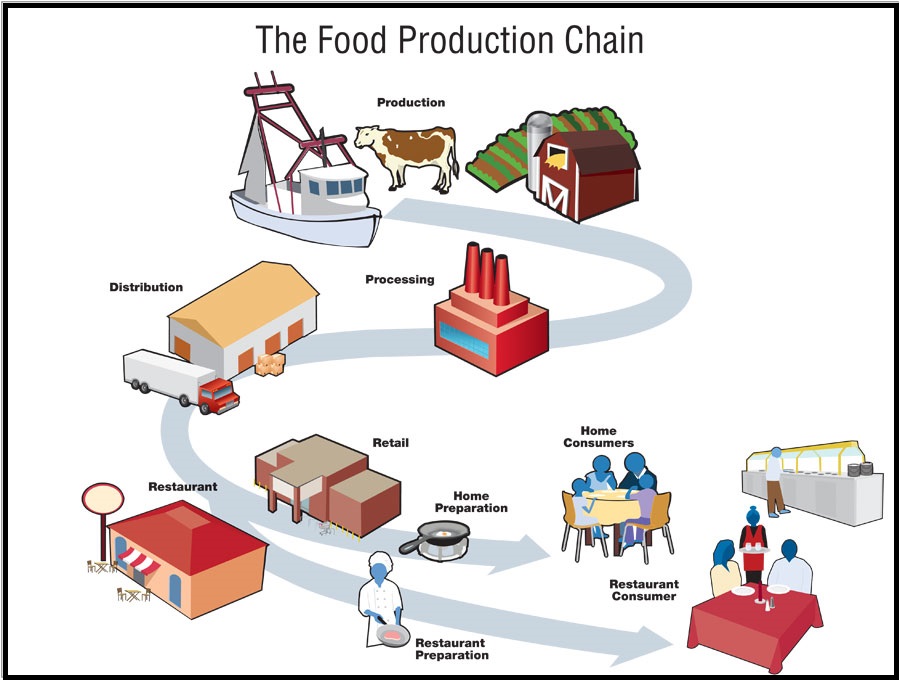
The manufacturing (heating, cooling, freezing) as well as storage and transportation of food products also use massive amounts of energy. Additionally, and specifically because of the nature of their consumption, the increased energy costs associated with generating food travels quickly through the supply chain.
Food inflation is always the first thing you notice when the prices of energy products skyrocket. This is well known and not subject to debate; everyone accepts this.
Joe Biden took gaslighting to an entirely new dimension today during remarks to brag about the recovery of U.S. supply chains during his administration tenure.
As incredible as it sounds, Joe Biden actually claimed Thanksgiving food prices were the fourth lowest in history despite the astronomical prices we pay at the grocery store. This is economic gaslighting in the extreme as the inflationary data from the Bureau of Labor and Statistics proves.
First, here is the claim by Joe Biden:
See below for a chart of food and energy price increases since Biden took office.
I wouldn’t normally write a post like this, but WE ARE NOT going to find this level of ground reporting anywhere in U.S. media. As you might be aware, I have been doing extensive research on the Russian economy specifically with the outcome of western sanctions.
In his video a Youtuber I follow visited a local supermarket, similar to a WalMart Super Center to share information for his USA followers.
Dima Dear, a remarkably nice young man, lives in St Petersburg, Russia (formerly Leningrad), and he shares various experiences with his audience at their request. There is a lot of U.S interest as people following his story are starting to realize life in Russia is not what western media portray.
If you are familiar with USA grocery prices, what Dima shares in this ground report is stunning from a U.S. perspective. If you watch this livestream, keep in mind that 100 rubles equals $1.00. 350 rubles is $3.50. Additionally for weighted products 1kg equals 2.2 lbs. So generally speaking, if something is 100 rubles/kg it is $1 for two pounds.
Example from the video:
•Lean ground beef at 329 rubles/kg is less than $1.65/lb.
•Bacon at 250 rubles/kg is less than $1.25/lb.
•20 eggs are 139 rubles or $1.39.
•Boneless skinless chicken breast $4 for 4lbs.
•Typical Bagged salad mixes .79¢ each. etc.
The wild part is that in Russia they are getting worried these prices are too high. 👀
The average rent for a nicely furnished 2-bedroom modern apartment in St Pete Russia is around $500/month. Something akin to downtown Manhattan. Including rent, utilities, food, transportation, personal items and purchases, a Russian citizen can live very comfortably, remarkably comfortably, on an income of around $1,200 to $1,500/month. In downtown St Pete which is considered a more expensive place to live.
Put that into a USA middle-class perspective and evaluate the impact of western sanctions against the average Russian cost of living.
We have talked about the stunning price increases in pet foods during our discussions about food price overall. However, a remarkable study by Veterinarians Org gives some context to just how much the Joe Biden inflation has driven up the cost of pet foods. [ARTICLE HERE]
Mostly driven by Biden’s created inflation hitting raw farm materials, energy prices, manufacturing and transportation costs, the prices for the most popular wet and dry dog foods have skyrocketed.
One in four pet owners have even contemplated giving their animal up for adoption because they can no longer afford them. This is terribly sad.
(Veterinarian Org) – […] The largest percentage increase compared to 2020 prices is for a wet dog food product by PEDIGREE, which has increased by 207% compared to its 2020 price.
The largest dollar amount increase compared to 2020 prices is for a dry dog food product by Royal Canin, which is currently $43.99 more expensive per bag than it was in 2020.
In a recent Veterinarians.org survey of 1,000 U.S. pet owners, 50% of respondents indicated having to shop for cheaper alternatives to pet food as a result of rising costs. Pet owners also found themselves shopping for cheaper alternatives to pet treats (41%), pet toys (34%), and pet health supplements (28%).
55% of surveyed pet owners indicated having to cancel pet food subscriptions on Chewy.com, Amazon.com, or through a raw food/pre-cooked meal service as a result of rising costs.
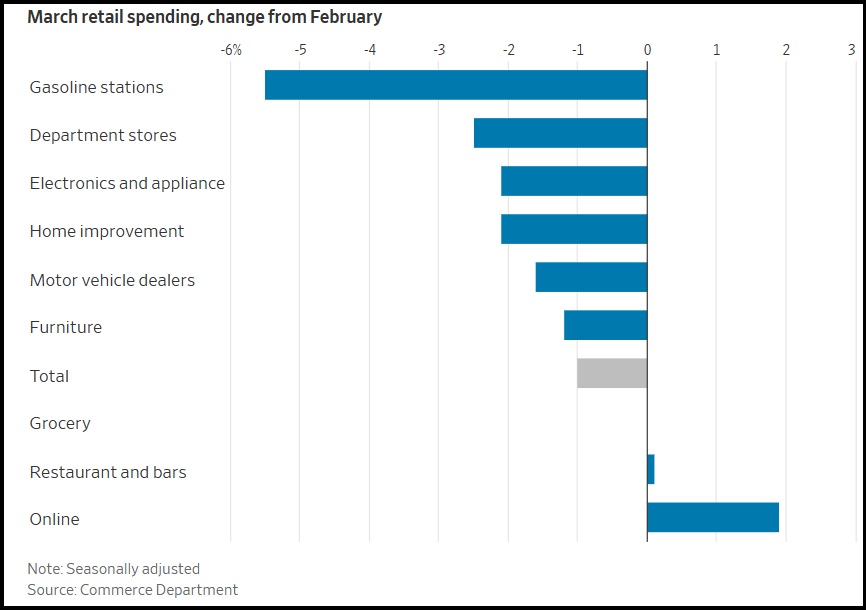
Always keep in mind that retails sales from the Dept of Commerce [DATA HERE pdf] are always calculated in dollars. Inflation can artificially skewer retail sales if prices increase, and yet consumer purchases decline at a rate lower than the increase in price. Fewer units sold at higher prices can give the false impression of increased sales.
During an inflationary environment, when prices increase yet retail sales drop, there are substantially fewer units being purchased. Overall purchases at stores, restaurants and online declined a seasonally adjusted 1% in March from the prior month.
During the time measured gasoline was less expensive, so that led the drop in fuel sales; however, drops in dept stores (-2.5%), General Merchandise (-3.0%), electronics (-2.1%), and building supplies (-2.1%), shows another broad-based pullback of Main Street consumer spending. (pdf here)
These outcomes are in general alignment with what many people have shared via regional ground reports. Grocery store sales are flat despite major increases in grocery store prices (+10 to +20%). People are buying fewer grocery store units and making their food budget stretch as far as possible.
Durable goods are not considered essential, and sales of cars, electronics and department store products are much lower.
I am actually a little (pleasantly) surprised to see restaurant sales holding (+0.1%), despite the massive increase in fresh food costs. I thought people would eat out less, but the total decline in restaurant foot traffic seems to be in the single digits. I guess people can afford it more than I anticipated.
Before getting to the headline, I want to remind you what CTH outlined two years ago about these massive food price increases.
You might remember me saying that processed food prices will increase at a much greater rate than fresh or lesser processed foods. Factually, even organic products (ie. produce) could/would end up less expensive (in relative terms) to the increase in price at your supermarket, as compared to the price increases for the more processed foods.
The reason is simple, processed food use more energy; energy prices are skyrocketing; the processing costs (packaging, transportation, freezing, sanitizing, storage, warehousing and distribution etc.), at each step of the processing cycle, in addition to higher labor costs, drive up the end result of the price.
In this energy driven inflationary environment, less processing and handling equals lower overall cost increases from field to fork. More processing, handling, distribution equals higher overall costs. This is simply a supply chain, truism.
Into this issue comes McDonald’s Corp. Last I heard, approximately 85% of McDonald’s business was franchise. The franchise has to purchase the product (food) from the main company. Supply side cost increases in the food are transferred from the company to the franchisee via higher product costs. The restaurant is then forced to raise prices to accommodate their increased costs. A portion of the revenue from sales then flows back to the main company.
It is important to note here, there is a natural disconnect in supply side price increases within the franchise model. The parent company must, must, negotiate the best possible contract terms with the suppliers because the increases in costs are passed directly to the franchise. The parent company doesn’t immediately feel any problem until the revenue from the franchise drops due to the forced raising of retail prices and diminished sales. There is a lag.
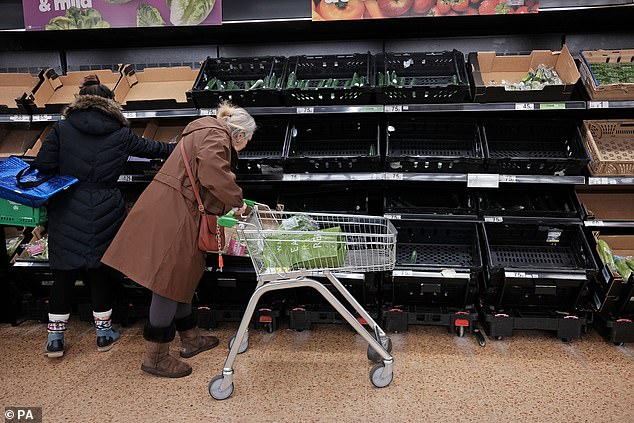
(Via Daily Mail) Vegetable rationing could last for ‘weeks’, it was warned today, after Morrisons joined Asda to became the second major supermarket to limit sales of certain items.
Perishables like tomatoes, potatoes, cucumber and broccoli have been restricted to just two or three per customer in a host of stores up and down the country.
The crisis has developed in recent weeks due to soaring energy costs which have forced British farmers to switch off greenhouses as they desperately try to make ends meet – leaving a dearth of home-grown produce. (read more)
While it is prudent to remind everyone how fortunate we are to have Florida, California and Mexico for North American vegetable supplies, ie. no dramatic supply shortages, the energy price pressure being applied by Biden policy will lead to even higher consumer prices for all row crops.
18 months ago (Oct 2021), CTH first strongly recommended restarting victory gardens at home. The same recommendation only strengthens.
Not only does the buck not stop with Biden, the installed occupant of the White House refuses to admit the buck even started with him. It did!
During remarks to the press today, even Brian Deese looked stunned as Joe Biden incredulously claimed he didn’t cause the rampant inflation that is crushing middle class Americans. Oh, he started it alright…. He not only started it, but he also created it.
The combination of the January 2021 immediate move to block any domestic energy development, in combination with the April 2021 unneeded explosion of deficit spending triggered both a supply side and demand side inflationary impact; with the former continuing to put massive upward pressure on prices still. WATCH:
The lies from the lying, liar who lies, just flow so easily from his mouth.