Quantcast

Manipulated Economic News on Inflation – Prepare for Bad Corporate Earnings Reports as a Result of Poor Holiday Sales

There has always been a general shaping and interpretation surrounding economic news, specifically as it relates to the impact of pricing on consumers and corporations. However, against the backdrop of supply side inflation, the financial gaslighting from the Wall Street Journal stands out at the top.

Without pretending, and looking directly at the Main Street reality, CTH has outlined inflation as a matter of monetary and energy policy.  From that standpoint the timing and scale of price increases (inflation measured over time) was predictable.  Our current status is an inflationary plateau, where prices remain high but stabilize for likely two quarters.

What the Wall Street Journal outlines as a “shopper rebellion against high prices” is complete hogwash.  Notice in the construct of the narrative, the demand side (consumers) is identified as the cause of diminished revenue & profits for corporations.  They continue pretending that inflation was not driven by energy costs.

(WSJ) – […] Many companies raised their prices substantially last year to offset higher fuel costs and higher prices for ingredients, parts and labor. As fuel prices have dropped and pandemic supply-chain snarls have eased, some of those costs have come down.

That is a good sign for the economy. It suggests that some inflation in the past year resulted from extreme supply-demand imbalances brought on by the pandemic and the war in Ukraine and which are now fading.

Notice the transparent lack of mentioning ‘energy policy’ as the inflation driver.

(more…)

Inflation is Crushing the Middle Class and Unfortunately More Price Increases are Likely in 2023

It’s almost painful to go to the grocery store today, not just because the prices for everything are so high, but also because seeing the stress amid the working-class shopping is palpable.  Unfortunately, while we may have a momentary plateau on current pricing, there’s a strong possibility another wave of higher prices is yet to come.

At the core of the issue are energy prices which continue to rise.   The immediate cycle of energy price hikes, a direct consequence of political policy, has lessened somewhat and we are now in that slow tick upward as the pressure on oil, gas, heating and electricity prices continues.

Michael Burry, famous for his predictions in/around the U.S. housing market, is noticing the same thing as CTH.  “Inflation peaked. But it is not the last peak of this cycle,” he said. “We are likely to see CPI lower, possibly negative in 2H 2023, and the US in recession by any definition. Fed will cut and government will stimulate. And we will have another inflation spike. It’s not hard.”

Peak demand side inflation is long in the rearview mirror, but the peak of supply side inflation is questionable at best – I would say it’s a plateau, not a peak.

The price of goods, including industrialized and processed raw materials from China are going to increase again – and simultaneously become less consistent in availability.  This is going to make prices extremely volatile in 2023.

Essentially, everything around price is tenuous as the western economies absorb the full impact of this Build Back Better energy policy, and into this foray comes China with production and processing challenges as a result of COVID bubbles being removed.   We are seeing this problem right now in the pharmaceutical industry and with ordinary medicines becoming scarcer on store shelves.

(more…)

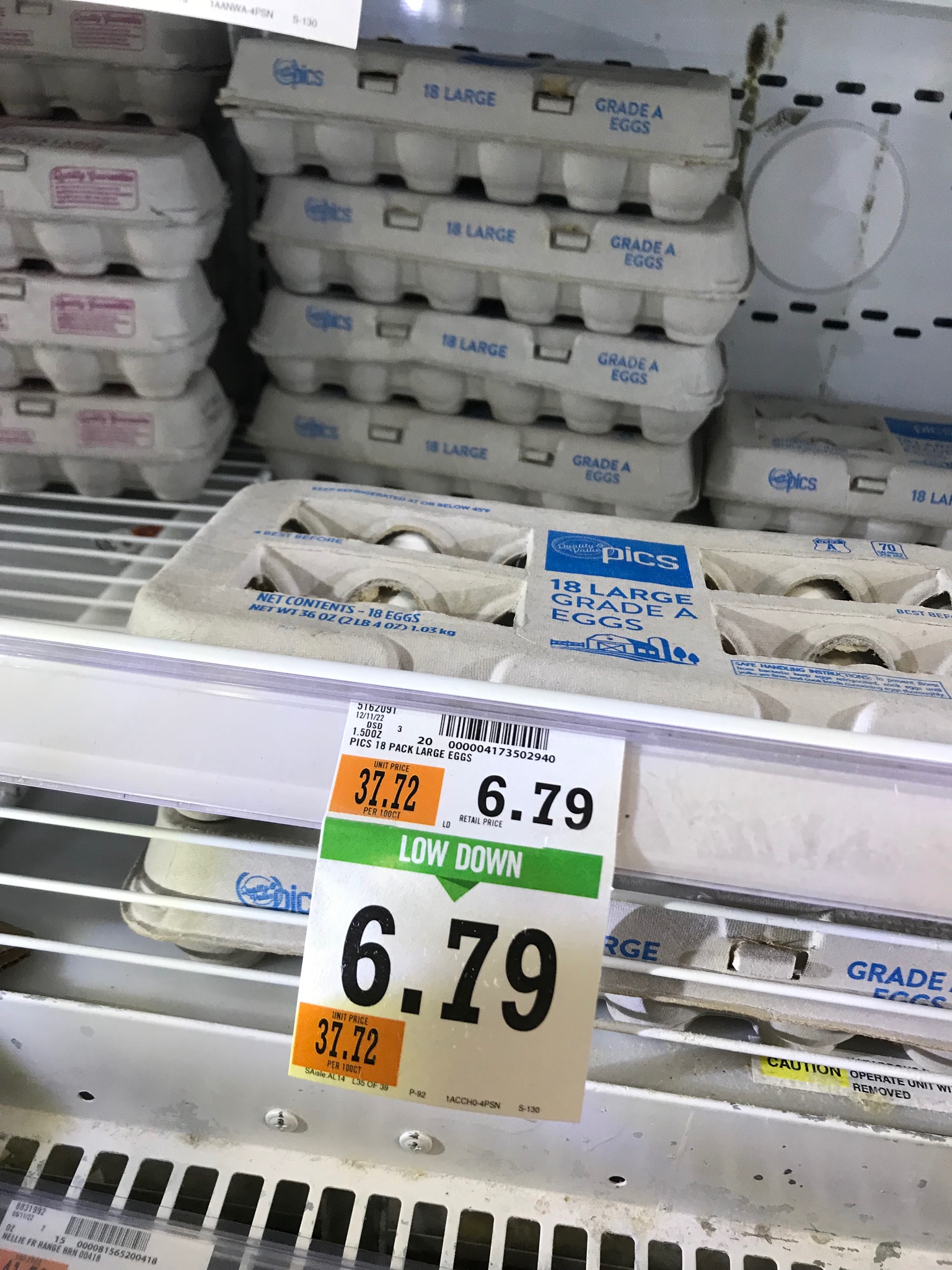
Egg Prices Surge to Record Levels as Christmas Grocery Prices Hit Consumers

The price for a dozen eggs continues climbing as explanations turn toward blaming bird flu.  However, the avian influenza may explain a recent spike, but the longer duration of escalating food price commodities is much deeper than momentary fluctuations.  These are energy dependent products.

As CTH noted last year, watch egg prices as a general gauge for overall food inflation (eggs hit almost every process in the supply chain), and watch potato availability to gauge overall row crop stability (staple commodity on every plate, venue).

Additionally, as previously noted, as energy prices continue rising pay attention to the prices on ‘organic’ products.  Rising energy prices drive up costs for large commercially processed food supplies at a much higher rate than smaller organic production.  People are starting to notice the ‘organic’ option is almost at price parity.

Wall Street Journal – […] Wholesale prices of Midwest large eggs hit a record $5.36 a dozen in December, according to the research firm Urner Barry. Retail egg prices have increased more than any other supermarket item so far this year, climbing more than 30% from January to early December compared with the same period a year earlier, and outpacing overall food and beverage prices, according to the data firm Information Resources Inc.

For supermarkets, eggs are a staple product that most consumers pick up on trips to the grocery store, similar to milk and butter. To maintain store traffic, grocers said they have been sacrificing some profits on eggs to keep prices for consumers competitive. Some suppliers are projecting potential relief in price by February or March, but cold weather could hamper production in the near term, executives said.

(more…)

Imagine That – Wall Street Journal Finally Admits Energy Inflation Will Keep Retail Food Prices High, Regardless of Commodity Price Market

A slight drop in the overall national pretending index is noted today; actually, more like a twitch toward the reality side of the meter.

CTH has been outlining the supply side inflation issue in the highly consumable goods sector, specifically the foods sector, for almost two years now.  Mainstream and financial pundits have denied its existence.

According to the Friedman view of traditional economics, only monetary policy drives inflation.  However, Friedman never lived in -nor fathomed- an era when the collective western governments would intentionally shrink the economy in order to save the planet via climate change.

The intentional diminishment of energy production is the #1 source of increasing consumer prices.  Inflation is not an issue of high demand for the subsequent goods produced.  Raising interest rates diminishes demand for durable goods but has zero impact on the increasingly higher prices of intentionally scare resources like oil, coal and natural gas.

While maintaining the pretending due to the alignment with multinational and corporate interests, the Wall Street Journal starts admitting today that prices are not likely to drop, regardless of commodity prices.  Even with abundant harvests, strong grain & soybean production, abundant pork and beef commodities, the costs associated with the production of food products will stop any downward price pressure.

(WSJ) Global prices for commodities such as wheat and sugar have fallen back to where they were a year ago, but consumers are still likely to feel the pinch at the checkout.

(more…)

Farm Bureau Calculates Thanksgiving Dinner Price Jumps 20% Over Last Year

The American Farm Bureau price estimation for the Thanksgiving Day basic foodstuffs seems underestimated every year.  However, this year with grocery store prices jumping dramatically the basic Thanksgiving Dinner as calculated is up 20% [Data Here]

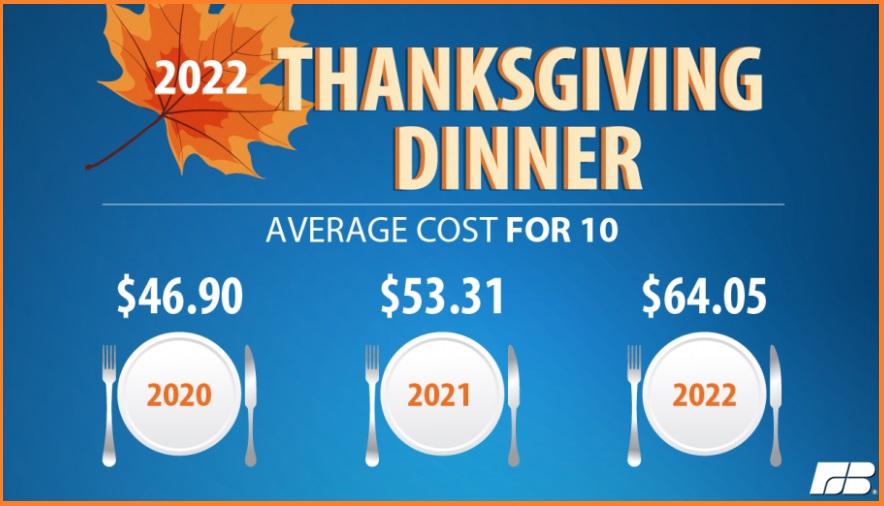
(AFB) – Spending time with family and friends at Thanksgiving remains important for many Americans and this year the cost of the meal is also top of mind. Farm Bureau’s 37th annual survey provides a snapshot of the average cost of this year’s classic Thanksgiving feast for 10, which is $64.05 or less than $6.50 per person. This is a $10.74 or 20% increase from last year’s average of $53.31.

The centerpiece on most Thanksgiving tables – the turkey – costs more than last year, at $28.96 for a 16-pound bird. That’s $1.81 per pound, up 21% from last year, due to several factors beyond general inflation. (read more)

On the positive side of things, we note two points: #1) the third wave of food inflation should crest the beginning of December; and #2) a lot of readers here were proactive and purchased holiday ingredients long before the massive price increases showed up.  Great job.

(more…)

CPI Report – Inflation on Food, Fuel, Home Heating and Essentials Continues Growing – Overall Inflation Moderation Now Claimed as Calendar Cycles

The Bureau of Labor and Statistics (BLS) provides the latest data on consumer prices (inflation) [DATA HERE].  We explained in 2021 how inflation would grow on a month-over-month and year-over-year basis until the calendar became more friendly and the government officials could claim “diminished inflation growth.”  Well, we are now entering that phase of economic parseltongue.

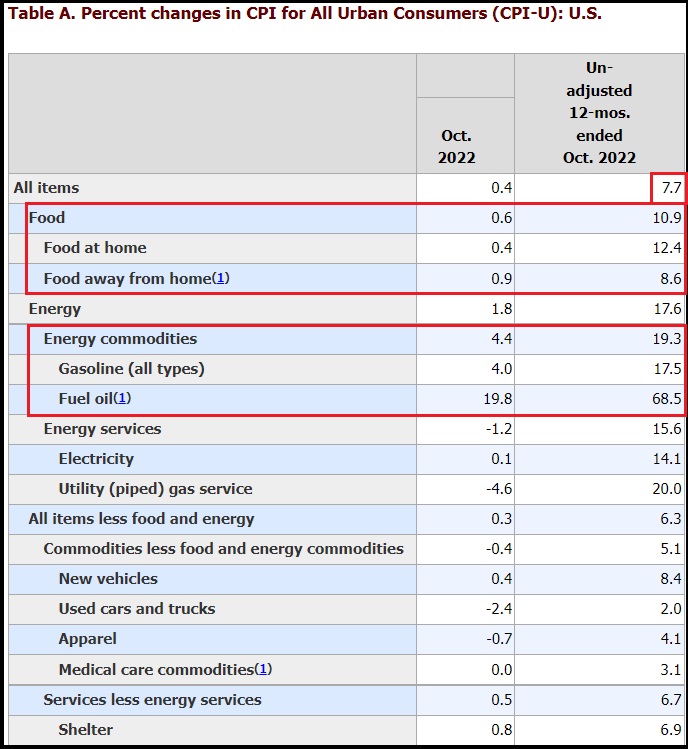
October consumer prices increased 0.4% over September.  However, we are now comparing year-over-year (Y0Y) inflation to the period where last year’s prices had already skyrocketed, so YoY inflation seems to be moderating at 7.7%, it’s a false premise. {Go Deep}

As expected, the energy-driven consumer inflation in the food sector has arrived.  The proverbial field inflation is arriving at the fork, and the October CPI now shows the third wave of food price increases we had previously discussed.

Table 2 Details: Egg prices increased +10.1% last month and now 43% higher than last year.  Butter +1.9% last month, 26.7% for year.  Margarine +1.3% for month, 47.1% for year.  Coffee +1.3% for the month, 15.6% for the year.

Heading into baking season we find flour +0.2% for the month, +24.6% for year.  Essentially, as expected, all of the holiday foodstuffs are now rising in price as the increased field and commodity prices hit the store shelves.

Some row crops are starting to moderate in price growth, while dairy products continue rising throughout the fall season.  It is going to be painful on the checkbook grocery shopping this holiday season.

(more…)

Biden Solution to High Retail Food Prices, Eat Generics and Store Brands

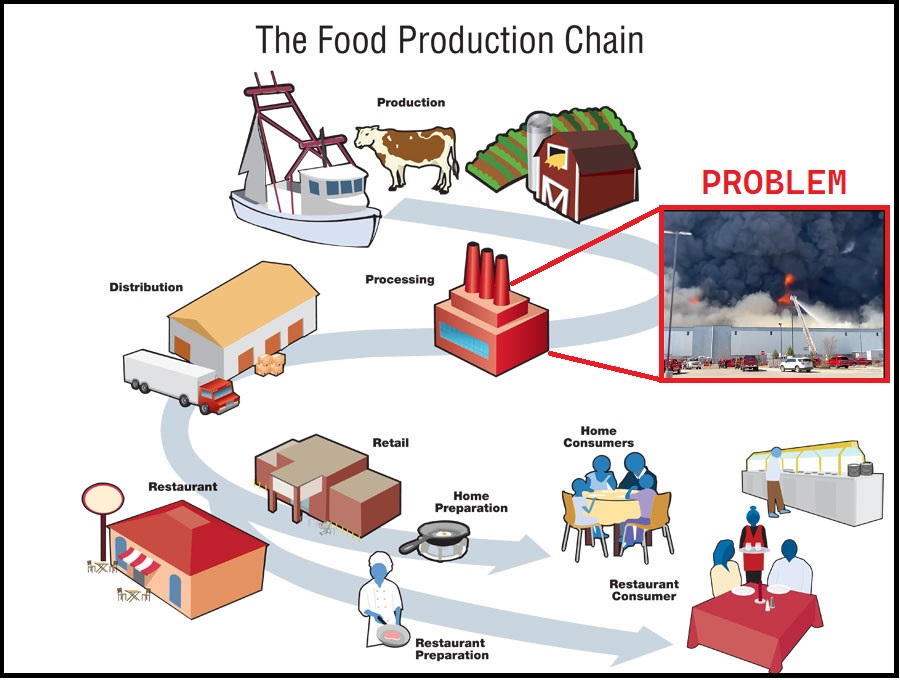
CTH has covered the origin of food inflation since we first raised the alarms in the spring of 2020.  A confluence of events starting with the fracturing of the food supply chain (shutting down restaurants, hospitality venues, schools, cafeterias, etc), created the initial major problem.  Consumer Packaged Goods (CPG) sold at retail stores could not keep up with demand after 50% of the food supply system was shut down.

Within the U.S. retail food supply chain (350+ million people), manufacturing CPG products relies on a system of staying one to two harvest cycles ahead of demand.  However, when restaurants and fresh food venues were closed, very quickly frozen, bulk stored and siloed U.S. food storage systems, the storage needed for CPG products, were emptied.

Long after the time when all food distribution was reopened, the shortages of CPG products continued. You saw the result with empty shelves at the supermarket.  It takes a long time (years) for those inventories to refill.

We warned of this in 2020 and then followed the predictable outcome in 2021 and 2022.

When Joe Biden then shut down the U.S. energy production system in early 2021, the massive increases in energy costs -and the shortages of natural gas- became fuel on the inflationary fire of CPG goods.  Again, in October 2021 CTH noted that retail prices were going to rise quickly, and they did.

Throughout 2022 food prices have risen dramatically as the food distribution and processing system was now under pressure from all sides.  The shortage of inputs (to refill food storage and warehousing needs) combined with the much higher costs to generate those inputs -the direct result of the exploding energy costs- created massive inflation pressure.  The pricing result we are seeing now (third wave of food inflation) is exactly what we have stated, discussed and predicted for more than two years.

While all food costs are skyrocketing, the prices for manufactured or processed food are much higher than the price increases for fresh food.

(more…)

The Albertsons and Kroger Merger Faces Legislative Scrutiny as European Company Ahold Assembles Competitive Bid

Last week we discussed the announcement of a $24.6 billion merger deal between Kroger and Albertsons supermarkets {Go Deep}.  The majority stockholders in both companies are institutional investment groups, Blackrock, Vanguard and Cerberus.

The merger would consolidate the second and third largest food retailers in the U.S. and would certainly dilute the competitive dynamic amid the supermarket industry.  Concern over price controls and decreased competition has now arrived on the desks of DC legislators who are reviewing the deal.

(Reuters) – […] U.S. Democratic Senator Amy Klobuchar and Republican Senator Mike Lee were quick to say that they would hold a hearing to discuss the merger. A European interloper could make deal plans even harder.

Frans Muller, Chief Executive of Stop & Shop owner Ahold Delhaize (AD.AS), has made no secret of his desire to consolidate U.S. grocers. The Netherlands-based firm is already the fourth largest grocery chain. If it managed to cobble together a better offer than Kroger’s bid for Albertsons, it would become the second largest supermarket. Plane spotters tracked two Albertsons jets next to Ahold Delhaize’s U.S. base in Massachusetts in early August. Ahold declined to comment.

(more…)

Leading Edge of Field to Fork Inflation Starts to Arrive in September Producer Price Index

The “Producer Price Index” (PPI) is essentially the tracking of wholesale prices at three stages: Origination (commodity), Intermediate (processing), and then Final (to wholesale). Today, the Bureau of Labor and Statistics (BLS) released September price data [Available Here] showing another 8.5% increase year-over-year in Final Demand products at the wholesale level.  However, that’s not the bad news in this data.
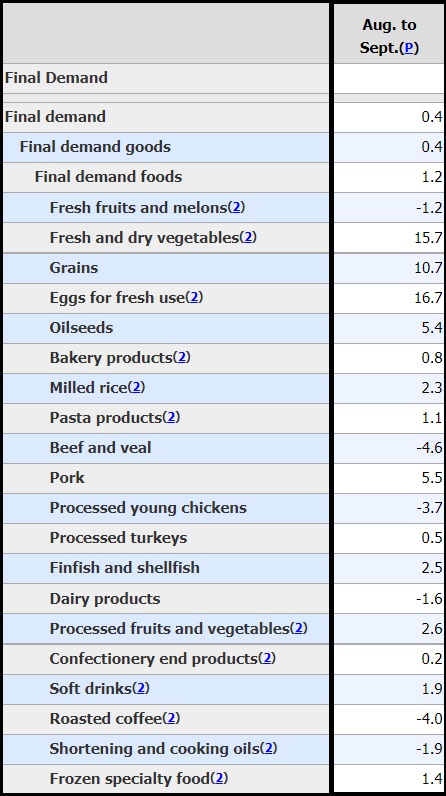
While the overall September PPI was higher than expected at 0.4%, the Final Demand Producer Price for food products in September was a whopping 1.2% (14.4% annualized).

The BLS notes the driver by saying, “a major factor in the September increase in prices for final demand goods was a 15.7-percent advance in the index for fresh and dry vegetables. Prices for diesel fuel, residential natural gas, chicken eggs, home heating oil, and pork also moved higher.”

That’s a 15.7% increase in price, in one month, for fresh and dry vegetables.  Annualized that’s a rate of price increase of 188.4% for vegetables.   Remember the warning about farm costs (energy, fertilizer, fuel) driving field to fork inflation at harvest?  This is the leading edge of that third wave of food price increases.

I have modified BLS Table-2 to focus specifically on food costs.  The data is on left.

You will note that ‘row crops’ are the big drivers along with grain and seed products.  This is exactly as we predicted it would be because those specific farming costs are the ones with greatest increase from energy, fuel, fertilizer, weed and insect control, and diesel costs.

All of those higher costs have been growing in the fields and will now surface at harvest.   The higher farm costs transfer from the field to the fork via the food supply chain.  This is only the leading edge of the price increase.

In October 2021 we first warned of the food price increases coming in distinct waves.  The first was Jan, Feb and March 2022.   The second wave was May through July 2022.  This third wave will be bigger than the first two and starts arriving this month, October 2022.

People laughed at me when I said in late 2022 eggs were going to reach .50¢ EACH ($6/doz).

Well, in September the price of fresh eggs jumped 16.7% in a single month.  That’s an annualized rate of price increase for eggs over 200%.

(more…)

On The Radar, Wave 3 of Food Price Inflation Soon to Arrive

You know that moment just before the tsunami hits, when the water is pulled out to sea?  Yeah, that.

Media are starting to realize what a destabilizing force ‘food insecurity’ can become as the pre-existing high prices are about to go even higher.

(WASHINGTON, Via The Hill) – […] the five items that have seen the largest year-over-year price increase based on the latest report from the Labor Department, and how much the price has changed: Eggs 39.8%, Margarine: 38.3%, Butter: 24.6%, Flour/prepared flour mixes: 23.3%, Olives, pickles, relish: 19.4%

Many of the items listed in the Consumer Price Index have seen prices rise by more than 15% compared to August 2021. That includes chicken (16.6%), soups (18.5%), cereals (17.4%), and milk (17%).

(more…)