As video of U.S. military operations inside Venezuela began to surface on social media, President Donald Trump has announced that overnight the U.S. military carried out a “large scale strike” against Venezuela and captured President Nicolas Maduro.
My grandpa, and later my father, used to say something at particular moments that generally annoyed me but turned out to be entirely accurate, much to my youthful angst… “Well, hang around a one-legged group long enough, and you’re eventually going to end up limping.”
Yup, I learned to hate that lesson because the truth of it was always annoying.
This is perhaps the first time in memory when I look forward to Donald J Trump getting out of the Mar-a-Lago bubble and back to Washington DC. Good grief, just typing that I can’t believe I’m saying it. Here’s why:
Having followed and written about the optimal solution approach within the Trump Doctrine, a process that assigns responsibility to regional actors, then exits while providing support but not direct involvement [the delegation metric of high-support/low-direction], perhaps that is unfolding again in the background. However, it seems like Trump is accepting the annoying Iran monkey problem on our behalf. [REF: How to Make The Monkey Jump]
To be clear in my personal position, charity begins at home. (1) I don’t want conflict with Iran, nor do I really care about their internal political struggles; most of my day-to-day contacts feel the same. (2) At the same time, yes, I can imagine a scenario where Venezuela represents a threat to our continental objectives and national security, but would prefer to see them isolated from the outside. Embargo them, stuff them inside an economic confinement zone (if needed), tell them why, then let the internal mess work itself out; most of my day-to-day contacts seem to feel the same.
Granting President Trump the long view of support; I mean, we don’t know what he is aware of; I sure hope all of this Iran stuff has a direct connection to American strategic interests.
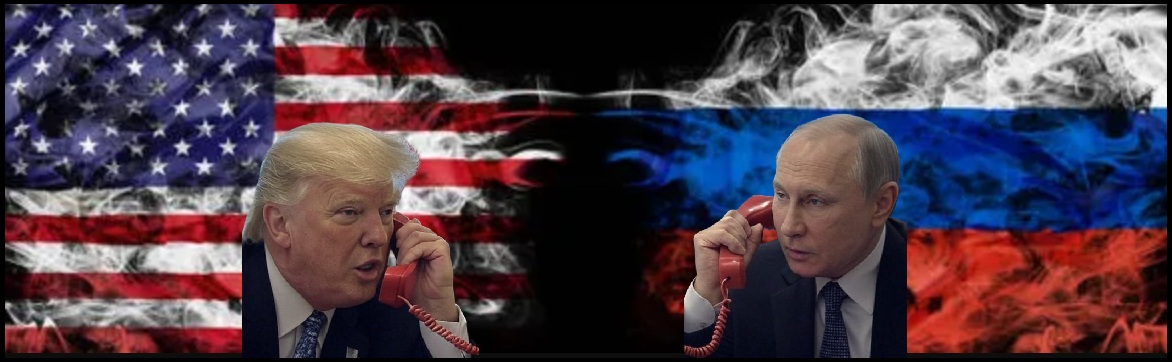
Simultaneously, I can certainly see where deconflicting the USA, vis-a-vis Ukraine (literally London and the EU) from friction with Russia, has a strategic interest and factual bearing on the dollar-based trade system. Attention on the Ukraine vs Russia stuff does have direct, albeit complicated outcomes attached to the economic standing of the average American. Iran less so.
The Wall Street Journal is reporting that Ukraine did not target the personal residence of Russian Federation President Vladimir Putin, “according to U.S. officials.” However, Russia captured one of the drones intact and have said they were able to “extract a file containing a flight plan from the navigation unit” which they plan to share with the Trump administration through established channels. {LINK}
WSJ – WASHINGTON—U.S. national-security officials said Wednesday that Ukraine didn’t target Russian President Vladimir Putin or one of his residences in an alleged drone operation, challenging Moscow’s assertion that Kyiv sought to kill the Russian leader.
That conclusion is supported by a Central Intelligence Agency assessment that found no attempted attack against Putin had occurred, according to a U.S. official briefed on the intelligence. The CIA declined to comment.
The U.S. found that Ukraine had been seeking to strike a military target located in the same region as Putin’s country residence but not close by, the official said. (read more)
Who are we going to believe, Russian “special service” operations or anonymous “U.S. Intelligence Officials”?
Unfortunately, this question is no longer easy to answer given the history of the U.S. Intelligence Community, and yes, that includes the current embedded IC officials within the National Security Council, DNI and CIA even with Marco Rubio, Tulsi Gabbard and John Ratcliffe in position.
I would be very surprised if the U.S. Intelligence Community would be honest with President Trump on this issue if, and that is a big “if”, they even factually had any specific intelligence about it. [This WSJ narrative could be fake news]
Again, CTH will also assert the likelihood that Volodymyr Zelenskyy likely didn’t carry out the attack; everything about the timing of it during his meeting with President Trump just doesn’t fit. Instead, it is more likely British intelligence, specifically MI6 carried out the attack, timed specifically for the Trump/Zelenskyy meeting.
The tenuous legal theory permitting the U.S. government to conduct surveillance on U.S. citizen data (emails, texts, phone calls, messages etc.) rests on the unconstitutional ability of the government to intercept your “private papers” with the use of the Foreign Intelligence Surveillance Act, specifically FISA-702. The “702” aspect is the term for U.S. citizen intercepted.
The authority for the United States government to capture the electronic records of all Americans without warrant falls under the auspices of FISA-702. The current authority expires in April of 2026. The 702 authorities have been abused to conduct political surveillance for just about everything in Washington DC. Millions of unauthorized searches have been identified; it is unconstitutional.
Politico, an outlet for the concerns of the administrative state, begins the new year by noting there is increased resistance to the reauthorization. However, in order to carry out the domestic national security agenda of the Trump administration, the Deep State considers JD Vance, Marco Rubio and others as likely supporters for reauthorization.
(Politico) – […] During the last reauthorization debate in 2024, then-candidate Trump urged Congress to “kill” the Foreign Intelligence Surveillance Act, the larger spy law that Section 702 is nested under. Trump’s decision frustrated supporters of the program — in part because they believe he conflated the foreign-target spy program with the broader surveillance law that was not up for reauthorization.
A crucial Biggs-sponsored House amendment that would have added a warrant requirement for any communications involving Americans failed on a 212-212 tie, with Speaker Mike Johnson casting a rare and decisive vote to kill it.
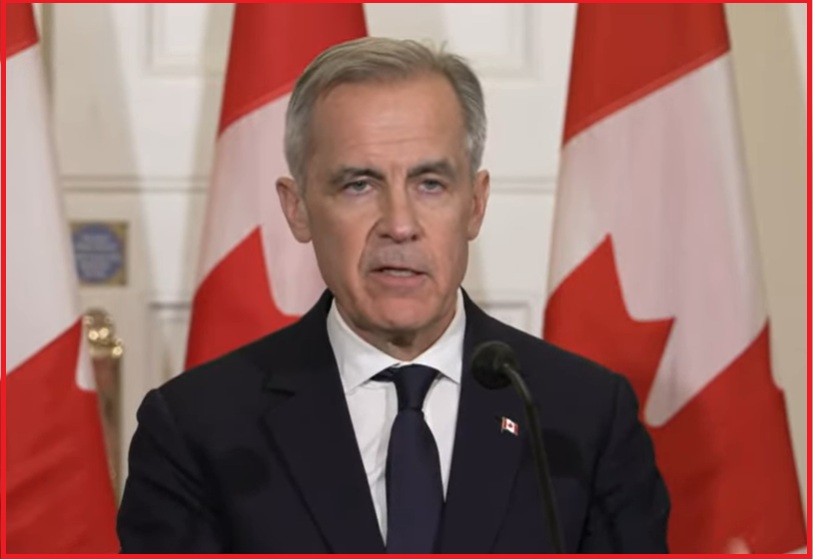
A recent article in Politico quoting several cabinet members of Prime Minister Mark Carney reflects a particular reality of the problem their economy will face in 2026.
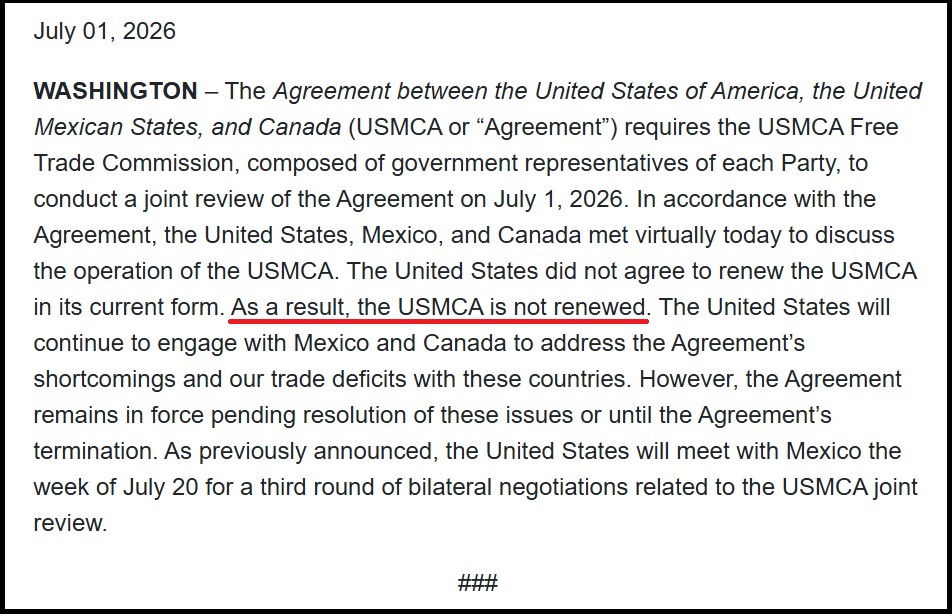
It appears that Canadian government officials have finally recognized the Trump administration plans to dissolve the USMCA or what Canada calls CUSMA next year. With that reality they have a big problem.
Mexico has been working throughout the year to initiate economic policies in alignment with the United States. However, structurally and politically this is an alignment that is impossible for Canada to do. Like many contracting European countries, the economic policies of Canada are centered around their climate change agenda and green energy goals.
For the past few decades Canada bought into the carbon scam and enacted climate change goals into law for carbon pricing, alternative energy production, industry and manufacturing costs. These mechanisms to control “climate change” are nuts in the big picture.
In order for Canada to position their economy to be in alignment with the rest of North America (USA and Mexico), Carney would have to reverse years of legislated rules and regulations. That is not going to happen, and Canada will always be at a disadvantage because of it.
(Politico) – […] It’s a moment of existential crisis for Canada, a senior Carney government official told POLITICO. Waiting out the Trump administration isn’t an option, the official said, arguing that what’s happening in the United States reflects a generational shift — not a temporary disruption — and that returning to a policy of closer integration with America would be foolish. (more)
With three quarters of their economic production tied to exports into the USA, and with the USMCA likely to be dissolved in favor of a bilateral trade agreement, Canada now has to find other markets for its products or lower all the trade barriers currently in place. Prime Minister Mark Carney is trying to find alternative markets.
The sense you get from reviewing the interactions is that Israeli Prime Minister Benjamin Netanyahu is nervous in his need to maintain very close support from U.S. President Donald Trump. When we review the interaction, we see Netanyahu’s praise of President Trump through a prism of tenuous dependency.
Netanyahu needs to retain a close and favorable position of influence; yet there is something in the engagement that seems to indicate an unease, a nervousness visible within the Prime Minister of Israel.
The moment at 10:48 is important, “Someone said in the room: if you don’t have Trump“… and the U.S. President strategically decided to let that thought trail off without finishing. However, in context it was very clear what would have come next if Trump didn’t restrain himself. “Someone said in the room: if you don’t have Trump”… you don’t have Netanyahu, was likely the end of that thought, and Trump isn’t wrong. Benjamin Netanyahu’s body language, facial expressions and overall demeanor imply agreement.
Bibi knows the unspoken words are accurate, so does everyone who supports Bibi – especially those pro-Israel voices inside the USA. Also, within that geopolitical dynamic, you will find President Trump’s leverage and an understanding of the behavior for those who support Netanyahu’s government. WATCH:
The non-pretending review of Netanyahu’s purpose for the visit, is to get additional support from President Trump for more military action against Iran. President Trump knows the intents and motives behind the shaped information from Netanyahu, the Israeli government and U.S. donors and voices.
President Trump emphasized strongly how the Arab coalition supports the elimination of Hamas as a terrorist threat, not just the United States. This emphasis on retaining the original peace agreement continues to pull the narrative away from the U.S. having to give support to ongoing Israel military action in Gaza. “If Hamas doesn’t disarm voluntarily” the Arab countries will disarm them President Trump suggested.
Benjamin Netanyahu is not going to be able to pull the Trump administration into military engagement in Iran. That part is clear from the tone and presentation of Netanyahu as well as the space between the words of Trump.
BUMPED Due to Importance:
Following a series of FOIA lawsuits, memos from conversations between Russian Federation President Vladimir Putin and former US President George W. Bush have been released online by the National Security Archive. [Original Source Here]
I know it’s Christmas, but bookmark or review as time allows, because the content is very interesting and very important. As early as 2001 and 2008, President Putin clearly told President Bush of his opposition to Ukraine’s accession to NATO, along with other key positions.
Despite what popular media might say, these are NOT full transcripts. Rather, they are memos containing quotes from both leaders as they discuss geopolitical relations between the U.S. and Russia. [SOURCE HERE]
♦ June 16, 2001 – Memorandum of Conversation. Subject: Restricted Meeting with Russian President Vladimir Putin. [LINK HERE] In this first personal meeting at the Brno Castle in Slovenia Vladimir Putin and George W. Bush express respect for each other and desire to establish a close relationship. Putin tells Bush about his religious beliefs and the story of his cross that survived a fire at his dacha. In a short one-on-one meeting they cover all the most important issues of U.S.-Russian relations such as strategic stability, ABM treaty, nonproliferation, Iran, North Korea and NATO expansion. Bush tells his Russian counterpart that he believes Russia is part of the West and not an enemy, but raises a question about Putin’s treatment of a free press and military actions in Chechnya. Putin raises a question of Russian NATO membership and says Russia feels “left out.” [READ MEMO HERE]
Prior to the 2012 Republican presidential primary, many conservative Americans -including myself- were confused by the consistent illusion of choice offered in Republican presidential candidates. The Republican Party’s successful installation of Mitt Romney was the final straw.
Going into the 2016 Republican presidential primary, we became more attune to how the illusion of choice is created. By closely following the Republican Party’s assemblies, tracking the participants, researching the networks and looking at how the Republican Party professionals modified their election rules at a state level, revealed the closed system used to create the illusion of choice.
The GOP winter meeting in Washington DC, December of 2014, outlined the playbook. The sequencing of state elections, the distribution of delegates (proportional or winner-take-all) and various internal mechanisms all play a part. This led to our first breakthrough – we began to understand the “splitter strategy”.
A small group of internal party officers, in combination with powerful established politicians and major donors, could coordinate a party objective to support the “acceptable candidate.”
The outcome of the GOP 2014 winter meeting was a pathway for Jeb Bush in 2016. The outcome of the DNC construct was a pathway for Hillary Clinton. Regardless of which wing of the UniParty system won the election, the actionable outcome in policy would be the same – the institutions of DC maintained, and network affluence apportioned according to the victor.
In this form of party democracy, voting is an outcome of the illusion of choice. The real decisions were/are not being made by voters. The party system determines the candidate. DNC or RNC the policy outcome is a few degrees different, but the direction is the same.
In 2016, the left-wing of the Uniparty would diminish any challenger to Hillary, Bernie Sanders would be controlled. The right-wing of the Uniparty would diminish any challenger to Jeb, divide the voting base and use party rules to clear his path.
The opaque nature of this party control system became clearer when the last GOP candidate entered the race. In the clearest exhibition of controlled politics in modern history, Donald Trump was the wildcard.
Mainstream “conservative” voices, what a later vernacular would describe as “influencers,” began exposing their ideological special interest in this political control system through opposition to Trump, the popular people’s choice candidate.
You know the history thereafter. However, the problem for the GOP wing in 2016 was not Donald Trump per se’, their biggest problem was that American ‘conservatives‘ had discovered their playbook. The illusion of choice was now becoming very well understood by a subset of voters later named MAGA voters, the original “silent majority” was silent no more.
This review is simply context; however, it is important context if we are to understand exactly where we are in late 2025 going into the midterm election in 2026. [Star Wars (2016), the Empire Strikes Back (2020), the Return of the Jedi (2024)]
The fourth chapter of this conflict is now upon us. It is a battlefield that has been unfolding all year.
When you understand the larger objectives behind what is happening, you can clearly see -even predict- each of the moves.
EU leaders from across the spectrum of their collective assembly, are furious with the administration of President Donald Trump for restricting their entry into the United States by blocking their visa permissions. However, these same EU leaders are the people who sent operatives into the United States in order to interfere in our 2024 election.
The Vice President of the European Commission, Kaja Kallas, sums up the European position: “The decision by the U.S. to impose travel restrictions on European citizens and officials is unacceptable and an attempt to challenge our sovereignty. Europe will keep defending its values — freedom of expression, fair digital rules, and the right to regulate our own space.”
The “attempt to challenge our sovereignty” statement is a particular type of hubris when we consider THIS:
GREAT BRITAIN (October 2024) – The British Labour Party is sending approximately 100 current and former staff members to the United States to work for Vice President Kamala Harris’ campaign in key swing states.
Not only did the U.K attempt to challenge our sovereignty, but they also actively worked to influence the outcome of our national election in 2024.
The same pearl-clutching assembly, now standing jaw-agape at the Trump administration recognizing their censorship, are the same assembly who engaged in political operations intended to influence the voting voice of the American electorate.
Methinks they doth protest too much.
Ukraine President Volodymyr Zelenskyy is promoting support for his 20-point peace plan via phone calls with various EU stakeholders including, President of Finland Alex Stubb, Prime Minister of Canada Mark Carney, NATO General Secretary Mark Rutte, the Prime Minister of Estonia Kristen Michal, German Chancellor Friedrich Merz and the Prime Minister of Denmark Mette Frederiksen.
The overall position of Zelenskyy is a continuum of public relations and constructs intended to maintain the illusion of support in order to retain receiving funding from western interests. Ukraine is the proxy war between the ‘west’ and the Russian Federation.
Zelenskyy is scheduled to meet with President Trump on Sunday. However, in an interview with Politico U.S. President Donald Trump tamps down expectations.
(Via Politico) – […] Trump appeared lukewarm to Zelenskyy’s latest overture and in no rush to endorse the Ukrainian president’s proposal. “He doesn’t have anything until I approve it,” Trump said. “So we’ll see what he’s got.”
[…] Still, Trump believed he could have a productive meeting this weekend. “I think it’s going to go good with him. I think it’s going to go good with [Vladimir] Putin,” Trump said, adding that he expects to speak with the Russian leader “soon, as much as I want.”
Trump’s comments came the day after Zelenskyy spoke with special envoy Steve Witkoff and Jared Kushner, the president’s son-in-law. Zelenskyy called that a “good conversation.”