Remember last weekend when we outlined how the sudden sense of urgency from Europe toward a trade agreement with Mexico? that agreement had little to do with purchasing row crops from Mexico, and everything to do with what Europe needs as access to the United States {Go Deep}.
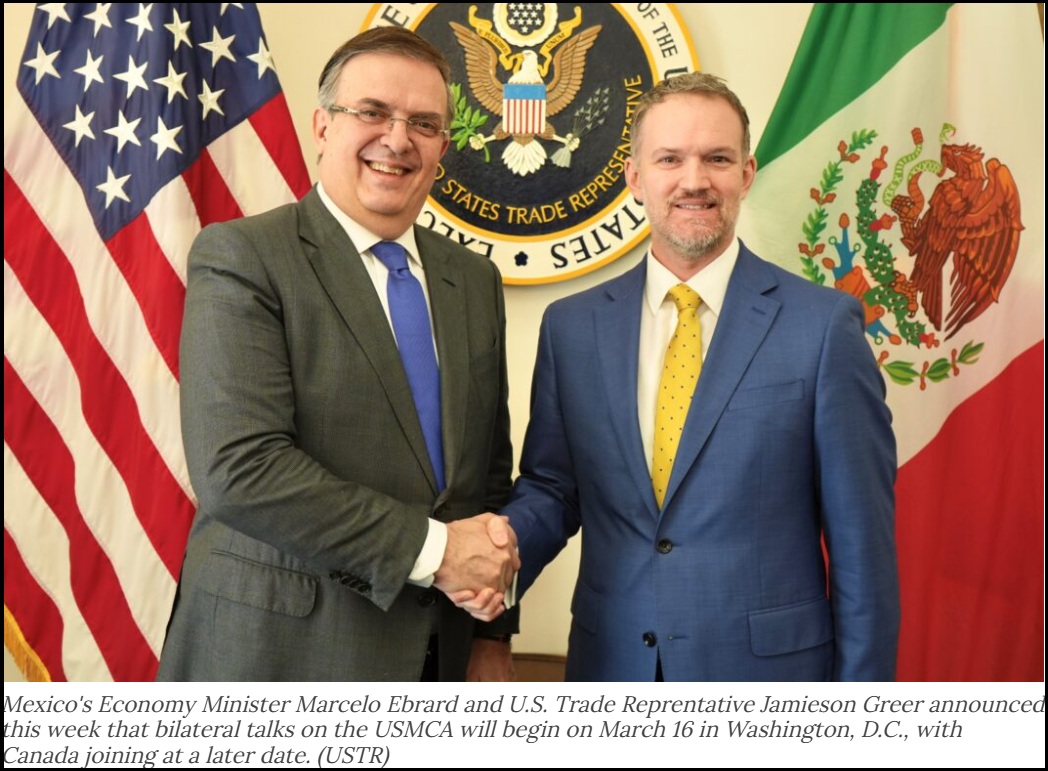 The language being used by the United States trade office is specific. [SEE HERE] The first bilateral round of negotiations between the United States and Mexico for the USMCA free trade agreement has concluded. (Emphasis mine)
PRESS RELEASE – “MEXICO CITY — “Today, the United States and Mexico concluded the first bilateral round related to the Joint Review of the United States-Mexico-Canada Agreement (USMCA).
The United States concluded discussions with the goals of reducing the trade deficit with Mexico and strengthening American supply chains. During this first round, negotiators discussed priority issues related to automotive rules of origin, steel and aluminum, and economic security.
The United States and Mexico recognize the importance of advancing cooperation to enhance regulatory compatibility to strengthen sectors, including medical devices, pharmaceuticals, cosmetic products, and others.
We will continue advancing these discussions on June 16-17 in Washington, D.C., in addition to agriculture and a level playing field. The third round will be held during the week of July 20 in Mexico City.
The United States continues to emphasize the importance of ensuring the Agreement benefits U.S. manufacturers, farmers, ranchers, workers, service suppliers, and businesses of all sizes, and of addressing free-riding from third countries.” (source)
Currently, European automakers have billions invested in Mexican auto plants. Much of the component material for those vehicles comes from Europe for assembly in Mexico. That was the primary focus of the Europeans in their trade agreement with Mexico.
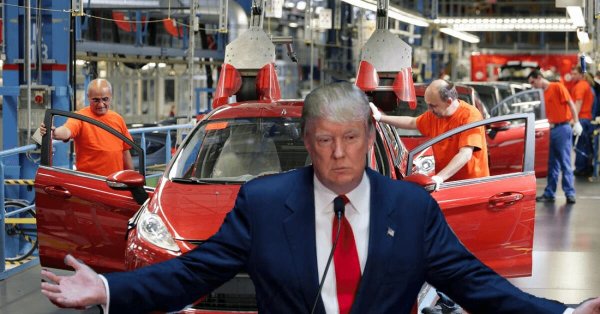 According to information coming from within the U.S-Mexico bilateral discussion, President Trump and USTR Greer are now changing the USMCA trade rules to require 50% of all automobiles be from American manufacturing. [The previous USMCA agreement was 70% from North America.]
When you consider EU and Asia component use in North American autos, and when you consider this is a bilateral discussion between only two nations, there is a big difference between 50% of the vehicle made in America (bilateral equity) and 70% of the vehicle made in North America (old trilateral FTA).
If European auto giant BMW is building cars in Mexico, in order to sell them into the U.S. market 50% of the vehicle must be components from the USA.
Then shift this baseline dynamic toward a bilateral with Canada, and again if Asia auto giant Toyota wants to build cars in Canada, then 50% of the vehicle must come from the USA.
Even the use of the statistic “fifty percent” or “half” implies equity by consequence; a bilateral agreement between two parties where both parties benefit. What I am emphasizing is the core baseline for the bilateral itself predicts the outcome of the next phase, another bilateral.
Once the U.S-Mexico bilateral is completed, Trump and Greer will then turn to Canada to begin another bilateral. This is the part that Canada is not prepared for – at all. Canada needs the granular stuff inside a trilateral trade agreement that permits the exploit of a one-third division. Take that foundational block out of the USMCA (CUSMA) and turn it into a two-way bilateral deal, and there’s no room for maneuvering.
A sector-by-sector agreement amid a group, becomes an agreement between just you and me. That’s an entirely different agreement.
Restoring world order brick by brick based on common sense and fairness. God bless him, because no one else ever did or would.
The days of the EU and Canada parasitically feeding of the U.S. tax payer is over.
“Fairness” means: stopping the current situation wherein U.S. taxpayer, through debt, insufficient wage growth and inflation, pays for the EU and Canada’s healthcare, defense, early retirement, and shortened work week.
The U.S. wage earner is a slave to Our uniparty, the EU and Canada… no more of the BS will be tolerated.
Carney and others may wish for a continuation of the status quo, but it is unsustainable. It would rely upon the U.S. to continue to subsidize Canada, the EU and others. The debt levels and interest portion of the budget have reached eye-watering levels. This necessitates a change in course, much to the dismay of others reliant upon the old order. It would be good experience for Mr. Carney and Mr. Stammer to take jobs in the private sector. Start a small business, develop and market products, hire staff, manage a budget, meet payroll and pay business and income taxes.
It’s a good thing he doesn’t have to deal with Chile.
Mexico may not be able to con Carney…
But it’s likely that Chile con Carney 🙂
😅
Suddenly, I want a bowl!
He would certainly receive a Chile reception if he ever set foot in that country.
You clearly don’t have that handle for nothing.🤣 Good on ya
A true wordsmith!
We have an interesting cast of characters. A picnic with us all would be a hoot. Be glad to run the grille.
grill*.
He might be the Carney in the coal mine.
Or in a circus…
Austin Powers describes carnies as
“Circus folk. Nomads, you know. Smell like cabbage. Small hands.”
Not even close. But I give you half a point for effort.
Yep.
How many hours did this take you to configure ?
You might have other hobbies that need attention.
I would give it 5 minutes – 10 tops based on the author…
Well played.
If the US could pay down 1 trillion of debt this year, 2 trillion next year, 3 trillion the year after….etc
Then we would have a smart World Order.
The British, Swiss, NYC, UN protected Banking Crowd will not be happy, but f’em.
THAT’s why they want to assassinate Trump.
It’d always been the same fight.
Hamiltton. Lincoln. McKinley. Trump….
Make them Somalians and all the grifters in the U.S. pay it back, we go faster….
Yes, AND… That’s a relatively new problem –
The installed “officials” aka corrupt politicians & staffs, bankers and all their minions who’ve been robbing the public purse for literally longer than we’ve been alive…
aaaaall, each & every one, have **amassed assets** to contribute to the solution of the National debt problem they criminally manipulated US into.
“Mercy to the guilty is cruelty to the innocent.”
We are getting out of these abusive relationships, praise the Lord.
rinos love socialism for profit. never trust the backstabbers
Amen, B Masuda. I never really watched or even cared about Donald J. Trump until he said he was running for President. Then I started researching him and saw a pattern that I liked. When he came down the escalator I thought “Hmmm, maybe he could be our guy”.
Fast forward 10 freaking years……(time flies when you get more mature, haha) and here we see a man who has traversed the political swamp to come out as a CHAMPION FOR THE PEOPLE and a destroyer of evil in America and the world.
I’m a retired scientist who questions everything but I also believe in GOD and I believe that our prayers, from millions of Americans praying to God to keep him safe in order to give us a chance to save our country, have given us a little window of opportunity.
My words, like many on this magnificent blog, ring true. Sometimes God doesn’t answer our prayers and we all have felt a sense of denial, bitterness and gloom.
So we wait….and then something happens that reminds us how God works, not in our time but in His time.
It’s happening. If we all stick together, stick with GOD and use the wisdom, the courage and the strength to fight off the Demoncrats and their evil intentions, we can be victorious.
Like the song says, “I’m proud to be an American…..”
Include RINO in that group.
Yes, keep praying every day.
“For where two or three are gathered in my name, I am there with them.”
Matthew 18:15–20
“This is the part that Canada is not prepared for – at all.”
Carney either thought that his reputation as being a world banker and a mover and shaker would grease the skids as the skids have always been greased for him (like Epstein, whose handlers moved him into strategic positions to get kompromat on the target), OR Carney thought that the world would line up behind him and against Trump and that Trump would be put into the position of being the odd man out (which is exactly where Trump thrives).
Another way or putting it might be to say that Carney thought Trump would believe Carney’s press office releases.
How a pinhead like Carney manages to cross the street without getting hit by a bus is a minor miracle. He has no internal gravitas, no force of ideas that make his plans go forward. All he has ever had is the power of the State (to hand out favors to wavering MPs from other Parties in order to secure his own Parliamentary majority, for example), who merely need a doofus (is that the word Sundance uses for Clapper ?) to pull the trigger on their plans.
Please, President Trump….. Grind Carney into powder. Close the border to all things Canadian, expel diplomats, visitors, dual citizen Canadians. Isolate Canada into poverty. In 2 days, after the country has collapsed, you can have your 51st State. Make anyone who wants to be an American sign a loyalty pledge. Those who don’t can have Carney to lead them.
I would only want Alberta, Saskatchewan, Yukon and the Northwest Territories, and not as states but territories.
You may wish to consider adding British Columbia to the list of territories.
Just rid us of the communists in Greater Vancouver…( President Trump did it in Venezuela)
We have a beautiful coast stretching to Alaska, and Vancouver Island is quite the place.
Cheers!
Canada is an extraordinarily beautiful country. The trip up the west coast to Whistler is breathtaking as well as the Banff area. It just doesn’t seem right that such gorgeous God given country should be terrorized by idiot leftists.
My daughter is in Langly right now horse showing. The clients like to go there partly because of the exchange rate.
Langley is a 30 minute drive from us, and is renowned for horsey folk.😉
Yes thousands of Americans are enjoying the exchange advantage.
Just yesterday here at our cottage on Vancouver Island we saw vehicle with a Texas licence plate.
At around 0300 today we saw the last of the days Alaska Cruise ships head north.
Cheers!
BC holds many people from India.
One element of those from India is criminal gangs in Vancouver but I don’t know the scope.
Having said that, any additional coastal territory under control of the US is great for national defense.
Yep, Indian ( east) gangs are well established.
Easily dealt with if there is a will.
Presently there is not.
Spent about 6 months in Toronto in the 80’s and there wasn’t much will there then. Maybe they use up all the fight they have in them via Hockey.
Remember when there were fights in the NHL?
“Broad Street Bullies” fan here since 1972. Things started to change when former NBA senior VP/general counsel Gary Bettman became the first Commissioner of the NHL in 1993. That is also when long – time linesman Kevin Collins started to get between two potential combatants before they either one could throw a punch. Hell, a player can’t even throw a legal open ice body check anymore without being assessed a penalty. Plus, a properly executed hip check is a lost art.
Amen Brother Dekester! 🎯🙏🏽
Maybe the US could carve out Greater Vancouver with a two lane access road to Eastern Canada with no off ramps the entire way except for charging station parking lots with restrooms and a diner.
I remember in early 70’s Vancouver was the cleanest city I had ever been to . Of course after hitchhiking from NJ to Ca. and then up the coast to Vancouver.Hitched back and forth 3 times. Stayed at some place on Alberni st. Remember a beautiful park nearby. Then off to Calgary. Have friends on Vancouver Island. Be well .
Pray and help others
You are likely thinking of Stanley Park.
Ty
The Chinese Mafia completely control BC Canada.
It would be fun to run them out.
My guess is we could buy them pretty cheap these days.
They could make a fortune in tourism no more nuts job Canadian regs.
Oh Carney…. The Force is Weak with this one…. 🙂
Not gonna happen. First of all, Albertans for independence is only at 30% in the polls. Second, the First Nations want it stopped and will successfully tie it up in litigation for years. Carney hasn’t yet to raise an eyebrow over secession. The fix has long been in. Kabuki theater nothing more.
The 1st Nations are afraid of their taxpayer-paid indigenous gravy train getting cut off?
Comment deleted….
Next time you choose a site to comment on – read their commenting guidelines.
Be civil. Certainly the point he raises about their version of Native Americans is valid. We’ve seen it here.
Unnecessary comment. Cool down.
Use caution: You don’t want to end up with a Chinese backed and owned puppet on our Northern Border.
I fear that will be Carney’s retaliation. The guy thinks only of himself and how to salvage his ego.
But, but Orange Man is a narcissist! /s
I am curious as to who he takes directions from. Is he creating his policy choices and charting the course for Canada on this trade business? Or is there some unseen handler pointing him and giving him direction? Some of our elected officials in the U.S. are complete buffoons (e.g. Mayor Bass), and it is clear that they are in complete ownership of their idiocy.
The Old Rule Book for the NWO is being used by our great President Trump, et al, for toilet paper.
I don’t believe Carney, Mertz, …, are stupid; they just don’t know how to cope with the “We ain’t playing by your stupid rules no more” paradigm shift.
Reminds me of that meme of COMEY standing out on a road by himself in the middle of nowhere.
Imagine Comey running into a seashell message that said “86 Comey.”
I bet he’d not be happy to stumble upon it.
Or 8644
Ha ha. 😀
The one with the dialog balloon that reads “Oh, f***!”? 😄
I’ve been consuming a good amount of input from Promethean and they say he’s a puppet of London/Globalism.
My statement is general and I don’t claim to be an expert but I’m learning.
If you like, you could poke around here:
https://www.youtube.com/@PrometheanAction
Or more specifically here:
Absolutely true.
Promethean Action are some of the brightest bulbs in a store of light fixtures.
I watch everything they post. Avidly. I would only suggest they count the number of times “ you know” is said, in a segment. (Sorry, Barbara. Kindly meant)
They are not alone. A good friend made that suggestion to me after a radio interview, and I am grateful for it The practice seems to be spreading to media “professionals”.
Why are you posting this again? It’s boring and helps no one.
If you think this is such a big deal, send an email to Promethean Action. If you think they will ignore you, you are probably correct. This is not a problem except in your mind.
The reason Barbara speaks is to share ideas. Maybe you could start listening to the ideas and that would help you get unstuck from your past?
And they work pretty much as hard as President Trump. We are lucky to have them in the fight.
You do know he used to be a top dog for the Bank of England, don’t you? 🙂
It feels like Carney is one of those guys who has been failing up his whole life, and that ride is about to stop.
The best thing to do is to invite Carney to the White House, and then make him wait 2 hours for a meeting.
Humiliate the bastard.
And so Carney aligns with Starmer and speaks of a reamortized Rules Based Order.
So terribly sad. 😭
Many years ago, my work took me to many locations within America and I always felt so bad seeing the decaying businesses and manufacturing sites, the loss of good jobs and good people. So sad, and I subscribed to the WSJ for decades since college. I got so sick of reading the WSJ constantly telling us this was the best way forward. I canceled my subscription decades ago. Now, I hear Bessant telling us the truth and it sounds like music to hear from men and women who want America to be what it once was, GREAT! Thank God and POTUS for all this!
Yes they told us to surrender company and industry one after another, there was no other way. BS.
Phil Knight, Nike founder and billionaire, apparently did his Stanford thesis on outsourcing to Asia. Well..it benefited him and the original shareholders but the now CEO says they’re really a Chinese company, partially staffed by Indians in India, and their US market for their lousy shoes is American hating thugs and meanwhile they get away with underpaying their Oregon staff since they’re practically the only game in town.
This is what I learned about corporate America when I went to work there.
Comical, but sad. I haven’t bought Nike in decades.
And China stole all of their intellectual property and now has domestic shoe makers more popular than Nike with Chinese consumers and which sell at lower prices. China’s not going to save Nike like Nike probably thought would happen. Nike’s popularity in China is dropping rapidly.
Thank God they can always fall back on Colin Kopernink!
Early on during Michael Jordan’s peak when you’d see his Nike commercials quite often he was once asked why he doesn’t talk politics. He replied “Republican’s buy shoes too.”
True enough.
Who knew back then that decades later it’s more about China bought access to take shoe intellectual property.
I heard stories about people waiting for an elevator, the door opened and there was Michael Jordan. Ey yi yi! I think I would have fainted. He was so incredibly extraordinary!
On the other hand – we had HUGE posters of LeBron James – I never liked that guy. And the final insult was turning on my computer in the morning and seeing that ugly Kaepernack with the word “SACRIFICE” superimposed over his ugly mug. Sacrifice? He kneeled during the anthem and Nike gave him 25 million. I was plotting to take all my Nikes and dump them outside of the CEO’s office but then realized there were likely cameras and I’d probably end up without a job and I decided to quit when I wanted…not when they wanted.
So glad to be gone! Never regretted leaving for a second.
I want AI to determine when I call a help line if the responding desk is in India or the Philippines or wherever OUTSIDE the USA. UIf so, I don;t want to talk with them.
I want AI to redirect me to a site where actual, real Humans, who speak clean American English will help me solve whatever is my problem….
And I have many problems these days.
Not the least of which is the irritating robot replies….”Press 1 or 2….Listen carefully because our options have changed recently….”
etc etc. barf barf barf.
When it is necessary to speak to a customer service rep in the Philippines, I always tell them about my mother’s first cousin, an American soldier who was killed by a Japanese sniper during the liberation of the Philippines during WWII. The reps have always expressed sympathy and some have expressed gratitude.
Wall Street Journal-official mouthpiece for the Professional RepubliCons. A paper that has no legitimate purpose other than being used as fish wrap.
My father has been a faithful reader of the WSJ for many decades.
Every time I visit my parents and see that excrement of a paper on his kitchen table, I always pick one front page story and point out all of the lies in that story. CTH is my main source for the truth.
It used to annoy him. Not so much anymore as he continues to learn. It has become fun discussing these things with him.
CTH is my main source for the truth.
Me, too!
Same here.
This is the ONLY place where I take the info very seriously. Very multilateral coverage of the issues.
Is it really safe to eat a fish which has been wrapped in the WSJ?
I grew up in 50’s watching my mom read the WSJ religiously. I started, but quickly realized that it is a Marxist rag! Only item in WSJ of any value is Pepper & Salt!
Traveling around and comparing other places gives you an insight into the reality of things. Macro economic numbers reported in the WSJ might look impressive, but the reality on the ground can be polar opposite. I am certain that the drug use problem in the U.S. is partially driven by the hollowing out of the middle class and shuttering of so many businesses. It was a breath of fresh air to hear Bessent speak the other day at the Reagan library. Let’s hope that he and many of his colleagues in the administration continue to serve in 2029 and beyond.
We can thank Gerald Ford, Jimmy Carter, Ronald Reagan, George H. W. Bush, Bill Clinton, and George W. Bush for the rusting of America. It was a uni-party endeavor.
Yes, thank God and PDJT for turning it around.
I hope the voters will notice what President Trump has done for them.
I hope so too. Here’s a good data point: After being booked and released from Atlanta police station, President Trump’s motorcade drove through a poor neighborhood of Atlanta. Folks spontaneously lined the streets holding up signs, “we love you president Trump.”
I think that many have recognized that the uni-party has bamboozled the country.
Wow!
Thank LBJ for flipping the switch. We went from a nation spending on infrastructure which created jobs to a nation spending on welfare. Guns and Butter.
The 1966-1982 Secular Bear Market had the country in an economic malaise for that entire time. Inflation, stagflation, and finally high interest rates to combat those things.
Nixon and Bretton Woods was another shock as well as the Saudi oil boycott.
The worst of the worst of this list was Bill Clinton who ushered China into the WTO in exchange for campaign cash. “Maybe not the worst president, but certainly the worst person as president.” ( This quote predates Obama and Biden.)
Thank you so much for providing this information Sundance.
You’re definitely a good human-:)
May God keep blessing you.
Bilateral trade negotiations for a trilateral trade agreement that leaves Canada out in the cold should tell the Snow Mexicans all they need to know! But the same persistently ignorant mindset that advocates electric cars that won’t start in cold weather for a country with half its land mass lying north of the Arctic Circle, can’t be expected to connect the dots on trade negotiations!
Running to the EU for advice won’t help since Canada imported its cow flatulence-hating mindset from the Hague!
They may not be able to connect the dots, but they sure can check the boxes. And I’m not talking about the LGBT, DEI, ESG WEF leftist designed boxes. I’m talking about MAGA – Trump created boxes. They can check those boxes or check out of the deal.
Make it all in America. The other countries can reindustrialize also if they want. We need all the good paying jobs we can get in America. EU is disintegrating.
You have to be able to sell your goods to buyers with some discretionary income, and that means less than union wages for a while. It means lower taxes at every level of gov’t.
It means no free emergency care for illegals, or school, or food, or baby care. Make the welfare very strict, for Americans only. Etc.
It will take us 20 years to return America to prosperity. Then we give a rejuvenated land to our kids & grandkids. It’s not gonna happen overnight.
And unions better stop expecting 40% salary raises without any increase in productivity (looking at you, GM workers).
We will need several more focused administrations, staffed with the likes of Bessent, Lutnik, Greer, etc. and a supportive senate. What’s good about the current team is that it is a mix of very seasoned professionals and some who have additional decades of career work to go. The younger members can take on more senior roles 4, 8, and 12 years out. President Trump is a strong leader that has motivated them towards important goals to save the republic. I hope that the next president continues this and is not an establishment sell-out like Bush 1.
BMW makes a ton of automobiles in Charleston South Carolina. Those are for the US market. The Mexico plant makes a few smaller models and is mainly gearing up for electric car production.
Volkswagen is the big automaker in Mexico.
BMW plant is in Spartanburg County. (Greer)
A BMW high voltage battery assembly factory opened in Woodruff in 2023.
Not Charleston, Greer (near Spartanburg). Most of them are shipped overseas through the Port of Charleston, only 1/3 are sold in the US.
You’re right. My geography is off. 😁
That 1/3rd might be enough to take care of the US market.
Do you know the difference between a BMW and a porcupine?
The porcupine is cheaper
A porcupine has it’s pricks on the outside.
It’s maddening how much MEX and CAN are used as back doors to circumvent the regs. I hope they can close most/all of these loopholes during renegotiations.
Won’t matter to Mexican govt. They will still cheat w/China, as they did before.
Americans misunderstand the MX mindset. Larceny, in every endeavor of life, runs deep in the culture, from rich to poor.
“Getting one over on the gringo” is a nat’l sport, because Mexican schools, popular press, & politicians have blamed the US for all of MX’s problems in the 60 years I’ve been visiting and living there. It’s a perverse form of nat’l pride.
So I hope there are strict, enforceable rules w/penalties in the agreement.
Definitely no fraud or corruption in USA! Wink wink..
Goes all the way back to the Spanish spoils system.
Green climate clutchers on the “wagon” that is falling apart quickly.
Energy is success all the way around,
Having lived in Neuvo Mexico for many years, having told state politicos this state should have been the “handshake” to Old Mexico, watching how the primary education system in New Mexico has sputtered and failed it’s youth for many decades, realizing that this state is run by the democrats, is a sanctuary mecca–woke is so many directions, I am befuddled by the overall stupidity of it’s elected leaders and the continued ignorance of voters.
And yet, within this state operates Los Alamos and Sandia Labs, containing some of the brightest people in the United States!
It would appear Donald Trump just might cross over this bridge where two countries will offer “work” for each other that should inspire citizens on both sides of the border to improve their lives where education of one’s reality–applying common sense, takes center stage.
I don’t expect the leaders presently running New Mexico to figure this out, to grab this opportunity–even to look in a mirror asking how they can involve themselves in a positive way, to get on this bandwagon–to go to work beyond just giving lip service while enriching their pockets and those who voted them into office!
It just might be mental illness operating on a grand scale… maybe it’s time for some Filipino Psycho Surgery!
For all the screaming over equity and fairness, how is it these third countries can’t understand that the welfare payments from the American workers, taxpayers and financial economy is over, done, finished. Whole countries survive off of this arrangement, like they are entitled to it.
Fair and Square is the equitable outcome they desire. No entitlement for everyone.
Oh, snap. And there it is, in the not so much after all.
Insert, Mickey Middle Finger.
Please, please make it so, President Trump. and Cabinet.
Glorious!
Here is a taste of some Canadian chat on X these days one day after learning we are officially in a recession –
https://x.com/WeAreCanProud/status/2060686408969249113?s=20
Carney is making bank though!!
Of course those two are related. Brookfield makes a large % of it’s income from distressed “assets” and Canada has too many of those. So…pennies on the loonie?
For those of us without an X account…
https://xcancel.com/WeAreCanProud/status/2060686408969249113?s=20
Truly living in historic times. So happy to see clearly.
Faith IS believing things when common sense tells you not to!
We are so truly fortunate to have such an outstanding President leading us. Prayers for his continued success.
The wolverines need to make sure the President can at any moment and for (President Trump reasons) increase the percentages of US material and labor within the agreements without reciprocal retaliation. The bigger truck is always given the right of way! 🎯
The amount of manufacturing that the US has lost is staggering. For those of you who lived during the 50’s, 60’s and into the 70’s you may remember all the smaller manufacturers in your city or town. Almost everything was made locally.
For example, in the mid sized city I grew up in, lumber was the big industry. Lumber for building. In addition we had mill work. Doors, casings and trim were all made there. Need a boiler for heating? There was a plant making those as well. Cans and bottles for food, tools, pipes, paint, even the casket you would eventually be buried in was made in town. There was a thriving local trucking industry that transported these things around the region.
So many jobs were available. You could graduate from high school and go right to work if you didn’t want to be a professional. You would make a decent wage too.
All of it is gone. Even the caskets are made overseas now.
Lots of very bright people on this site and I have to ask this question. What is Canada doing?? Do they not see what all of us, and SD of course, see? What is their strategy to get the best deal they can for their country?? As has been said, things are changing and the status quo is no longer an option. Mexico has realized this and is moving forward as the situation dictates. What the hell is the plan for those up north??
Most of the ‘decisions’ for Canada, are made in Ontario/Quebec because that is where the large populations are. The Western Provinces don’t get much ‘say’ in government, I believe.
With everything Mexico has been involved with including facilitating the deaths of over 100.000 Americans yearly there should be no negotiations whatsoever.
The failed Narco state should be treated as such and completely banned including ALL travel and heavily tax and tariff any American company that is in Mexico and make it so they come back.
Negotiating with Narco terrorists and actual terrorists should not be taking place.
Canada is sooooo screwed….they just don’t know it yet.
Soon…. soon…… (like in the PATRIOT movie starring Mel Gibson.)
The western provinces of Canada hate the Ontario crew. Just like the middle American crew hate Wash DC uniparty.
It’s gunna come to fisticuffs soon. Can’t you smell it ?
When this gets finalized, I’d like to see something done on domestic energy as well.
The United States should consider a dynamic energy security tax and incentive system that rewards new production and new refining capacity rather than simply taxing profits.
During periods of normal energy markets, companies would continue to pay normal corporate taxes. During severe energy disruptions that produce extraordinary profits from scarcity, a temporary surcharge could apply. However, that surcharge would be automatically reduced or eliminated for companies that increase domestic oil production, expand refining capacity, or bring new energy infrastructure online.
The key principle is: reward additional supply, not merely ownership of existing assets.
A company that drills new wells, expands refinery throughput, builds pipelines, or increases domestic fuel availability should receive the greatest tax relief.
Companies that simply benefit from higher prices without increasing supply would receive less favorable treatment.
To prevent political manipulation, all triggers should be automatic and based on publicly available metrics such as oil prices, domestic production levels, refinery utilization rates, and fuel inventories. Any revenue collected should be returned directly to taxpayers through automatic rebates or tax reductions rather than routed through new government programs.
This approach would align private incentives with national energy security, encourage investment, reduce the impact of future supply shocks, and ensure that American consumers share in the benefits of America’s energy resources.
I can hope.
GREAT! Let them eat cake….
Let Canada eat crumbs!
That 50 % in America number will bring a response from Carney and Canada. And alberta separatists will point and say look,see ya.
It’s such a shame that he only has 4 years (or 2 if the idiots get control). He could have done so much with 8 years.
China and the EU are using the USMCA to circumvent U.S. tariffs by shipping their U.S. exports via Canada and Mexico, allowing these countries to reap enormous benefits at the expense of U.S. manufactoring
I. Transshipment,
which occurs when an import passes through Mexico or Canada on its way to the U.S.:
II. Circumvention via supply chains
This includes manufacturing in Mexico and Canada to produce products that are then exported to the U.S. Whether a product can enter the U.S. under USMCA zero tariffs or pay the WTO MFN tariff rate will depend on whether the export complies with USMCA Rules of Origon.
III. Foreign direct investment (FDI) into Mexico and Canada to produce goods that are then exported to the U.S.
Foreign companies that invest in the U.S., Mexico, or Canada are deemed as having the nationality of that country, and their products are deemed as made in that country.
It works until Trump is out of office and the next Demonrat puts everything back the way it was before.
… and that is the reason for ,
TRUMP 2028
Guaranteed by the people for the PEOPLE.
Good.
How does the US enforce it?
We finally have a champion in the White House, a champion for all American workers and their families! It is nothing short of rebuilding the middle class which has experienced unprecedented job losses, wealth extraction, and decline. The globalists purposely wanted and still want to destroy the Middle Class because we are what stabilizes our nation. The uniparty has gone along with this purposely designed plan to lie, steal, and cheat from us, becoming multimillionaires for these actions while they sold out their constituents.
President Trump makes complete sense in prioritizing the protection of American workers over workers from other countries, and prioritizing American citizens over non-citizens.
The madness and insanity of destroying American workers and American citizens but favoring foreign workers and non-citizens is in the process of being ended, and if we conservatives stick together we may live to see the day when it is COMPLETELY ended.