Quantcast

Secretary Bessent Announces “Narrowly Tailored, Short Term Sanction Relief” for Russia

Trump, you magnificent bastard, I read your book!’

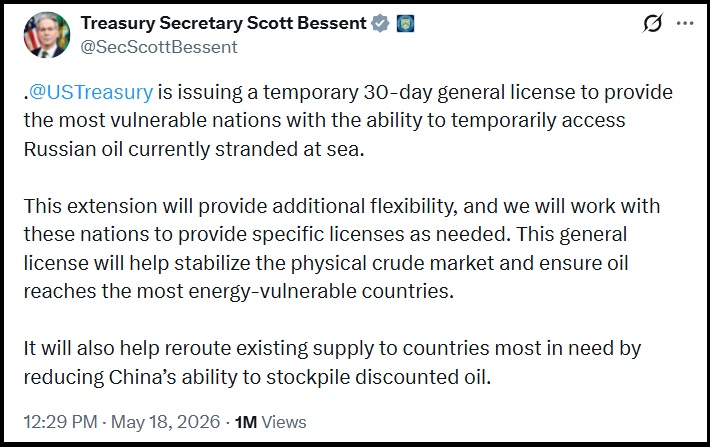
President Trump and Treasury Secretary Scott Bessent are facing mounting criticism for creating a window for Russia to sell oil and gas to the global market via “narrowly tailored, short-term” sanction relief.  However, few people are putting the issue into context, and the background here is exceptionally interesting.

According to the terms announced by Secretary Bessent, the license to sell applies solely to Russian crude or petroleum products loaded onto vessels as of March 12 and is valid through midnight Washington time on April 11. [Treasury Notice HereOFAC Technical Details Here]

[source]

The sanction relief license to sell will be done in globally recognized petrodollars and applies only to preexisting oil and petroleum products that are already in transit at sea.  However, here’s where it gets very interesting and the ramifications are significant.

Immediately following the Alaska summit between Russian President Vladimir Putin and President Trump, Russia restarted Arctic-2 LNG terminals and began increasing oil production for storage on ‘floating platforms.’  President Trump met with Putin on August 15, 2025, and the curious increase in Russian production began on August 18, 2025.

In the past six months Russia has been pumping sanctioned oil and gas and storing it on ships and mobile sea platforms, seemingly (at the time) with no customers.  Suddenly, against the background of the Iran conflict, all of that previously stored ‘on the water‘ production, now worth double, is authorized for global sale (in petrodollars).

Either Russian President Putin is the luckiest guy in the world, or Russia knew something.

In 2025 what Russia did following the Alaska summit did not make sense; now it does and the ramifications are stunning.

(more…)

USTR Greer Announces Launch of Sec 301 Trade Investigations into 16 Economies Including the EU

When the Supreme Court made their ridiculous decision to nullify the import tariffs under the International Emergency Economic Powers Act (IEEPA) use, the high court noted several alternate approaches would not be legally problematic.  One of those approaches would be the use of Section 301 trade tariffs.

Yesterday USTR Jamieson Greer quietly announced that a Section 301 review would be taking place for the following countries: China, the European Union, Singapore, Switzerland, Norway, Indonesia, Malaysia, Cambodia, Thailand, Korea, Vietnam, Taiwan, Bangladesh, Mexico, Japan, and India.”

♦ Section 301 tariffs are a trade enforcement mechanism established under the Trade Act of 1974. They allow the U.S. government to impose tariffs on imports from countries that are found to be engaging in unfair trade practices. The Office of the United States Trade Representative (USTR) conducts investigations to determine if a country is violating trade agreements, and if so, it can impose tariffs as a corrective measure {SOURCE}

USTR PRESS RELEASE – WASHINGTON — Today, United States Trade Representative Jamieson Greer announced the initiation of investigations regarding the acts, policies, and practices of various economies under Section 301(b) of the Trade Act of 1974 relating to structural excess capacity and production in manufacturing sectors.

The investigations will determine whether those acts, policies, and practices are unreasonable or discriminatory and burden or restrict U.S. commerce. The economies subject to these investigations are: China, the European Union, Singapore, Switzerland, Norway, Indonesia, Malaysia, Cambodia, Thailand, Korea, Vietnam, Taiwan, Bangladesh, Mexico, Japan, and India.

(more…)

Part II – Europe and China Have an Energy Problem

When President Donald Trump and President Vladimir Putin met in Alaska on August 15, 2025, the focus of the geopolitical world was on discussions surrounding Ukraine.  Unfortunately, it didn’t take long, merely a few hours, for both the U.S. and Russia to say that no progress was made.  However, also noted at the time was both the USA and Russia saying sideline discussions took place surrounding the possibility for a strategic relationship surrounding energy development.

What follows below is a review of the current energy dynamic, specifically surrounding LNG, against the backdrop of the Iran war with a hindsight review of that previous discussion between Putin and Trump.

What most people are missing in their current analysis was something that took place immediately following that Alaska summit six months ago.  Something that did not make any sense until now. {GO DEEP PART I HERE}

Three days after that summit meeting, on August 18, 2025, Russia announced they were restarting Russia’s Arctic-2 LNG production facility.  Russia would be more than doubling their capacity to generate and store liquified natural gas (LNG).

It absolutely did not make sense that Russia would start producing even more LNG considering the previously imposed western sanctions against them, and the fact that Russia was already overproducing LNG. As noted by analysts at the time:

AUGUST 18, 2025 – Russia’s Arctic LNG 2 export facility, which is sanctioned by the United States, is coming back to life after a year of no activity and is looking for buyers in Asia.

[…] The U.S. and EU sanctions on Russia’s Arctic LNG 2, which was billed as Russia’s flagship LNG project, have effectively frozen the start-up of the export facility in the Gydan Peninsula.

[…] Last year, Russia started shipping LNG from its flagship Arctic LNG 2 project—but not to customers. The shipments were made from the Arctic project to floating storage units either in Russia or in European waters, as potential customers were unwilling to buy the sanctioned LNG. {SOURCE}

In August of 2025, Russia was essentially producing more LNG than they could sell into the available market.  Russia was storing the overproduction from Arctic-1 on floating storage units and slowly selling to countries that did not align with the sanctions, specifically China and some Asian buyers.  Then suddenly, after the Trump summit, Russia decides to bring Arctic-2 online and produce even more LNG.  You can see how this did not make sense.

If they could not even sell all the Arctic-1 LNG output, then why would Russia bring Arctic-2 LNG production online?

That was six months ago.

(more…)

U.S. Treasury Secretary Scott Bessent Discusses U.S. Maritime Reinsurance and Global Energy Markets

The geopolitical ramifications of the oil and liquified natural gas (LNG) impact from the ongoing conflict with Iran is changing many of the world’s energy supply chains. Given the nature of the issues there are a myriad of complex dynamics to discuss. However, one key component is the U.S. policy shift to deal with the supply.

With that in mind, Treasury Secretary Scott Bessent appears with Larry Kudlow to discuss the United States’ new $20 billion maritime reinsurance plan as well as the ongoing conflict in Iran. CTH will be expanding the conversation specifically as it relates to Russian oil/gas sales. This is a good precursor interview. WATCH:

.

(more…)

Importers, Exporters and Producers Trigger Force Majeure Notifications for Gulf LNG Shipments

Force Majeure is a common clause in contracts which essentially frees both parties from liability or obligation when an extraordinary event or circumstance beyond the control of the parties, such as a war, strike, riot, crime, epidemic, or sudden legal change prevents one or both parties from fulfilling their obligations under the contract.

People would be well advised to wait a few days when announcements are made before jumping to immediate conclusions. The announcement by Qatar Energy of a force majeure notification did not originate from Qatar’s inability to produce contractual LNG supplies…..

[SOURCE]

…. two days prior to this announcement, India’s top gas importer Petronet LNG Ltd issued a force majeure notice to Qatar Energy and local buyers because its LNG tanker ships were unable to reach the Ras Laffan load port due to the crisis in the Middle East.  Without ships arriving to take the LNG Qatar Energy cannot keep producing.

Qatar Energy operates 14 liquefied natural gas (LNG) trains with a total annual production capacity of 77 million tonnes {SOURCE}.  If ships don’t reach the terminals, there’s no need for Qatar Energy to keep pumping and liquifying from well heads.  It’s a downstream issue.

Bahrain made the same announcement for their refined aluminum exports {SOURCE}. Indonesian company Chandra Asri made the same announcement for petrochemicals {SOURCE}. Chevron made the same announcement two days ago after Israel shut down the Leviathan natural gas field {SOURCE}.  Thus, we see the ramifications for the entire region around the Iran conflict zone and the downstream destinations (Asia and Europe) for energy products therein.

(more…)

Treasury Secretary Scott Bessent Outlines U.S. Financial/Economic Stabilization Plan, Backstopping U.S. Action toward Iran

Treasury Secretary Scott Bessent appears on CNBC to discuss the Trump administration policies that were proactively deployed during Operation Epic Fury.

The goal of global financial stabilization is actually part of the strategic planning within the White House, including Treasury, Energy and Interior in alignment with the State Dept., Pentagon and national security agencies.  Part of that plan was the announcement for the U.S. to underwrite maritime insurance to ensure a minimal disruption to the global energy markets.

Secretary Bessent discusses the insurance facet at the 3:00 minute mark of the video below. WATCH:

.

(more…)

Treasury Secretary Scott Bessent Outlines “Multiple Tools” Now Deployed in Tariff Policy – Sec. 232, 301 and 122 Explained

Speaking to the Economic Club of Dallas, Treasury Secretary Scott Bessent outlines what technical procedures the Trump administration will trigger now to retain tariff authority.  As anticipated Bessent outlines section 232 tariffs, section 301 tariffs, and Section 122 tariffs.  WATCH (prompted):

Section 232 [Steel and Aluminum examples] of the Trade Expansion Act of 1962 (19 U.S.C. §1862, as amended) authorizes the President to impose trade restrictions—such as a tariff or quota—if the Secretary of Commerce determines, following an investigation, that imports of a good “threaten to impair” U.S. national security. {SOURCE}

Section 301 tariffs are a trade enforcement mechanism established under the Trade Act of 1974. They allow the U.S. government to impose tariffs on imports from countries that are found to be engaging in unfair trade practices. The Office of the United States Trade Representative (USTR) conducts investigations to determine if a country is violating trade agreements, and if so, it can impose tariffs as a corrective measure {SOURCE}

Section 122 of the Trade Act of 1974 allows the U.S. president to impose tariffs of up to 15% to address “large and serious” balance-of-payments deficits. This authority can be exercised without prior congressional approval for a limited duration of 150 days. After this period, any tariffs must be extended by Congress. {SOURCE}

(more…)

President Trump Gives Speech on the Economy from Rome, Georgia – 4:00pm Livestream

President Trump travels to Rome Georgia today to deliver remarks on the economy from Coosa Steel Corporation. The anticipated start time is 4:00pm ET. Livestream Links Below.

.

(more…)

BLS Report – January Inflation from Tariffs Non-Existent, Core Inflation Lowest Since 2021

The pundits, economists and financial media are shocked, perplexed, befuddled and flummoxed.  The Bureau of Labor and Statistics has released the January inflation data [SEE HERE] and the results are much better than they expected.

Overall inflation is 2.4% year-over-year, and there are zero indications that tariffs are having any impact on consumer prices [See Apparel].

[DATA LINK]

CORE inflation, which removes food and energy, comes in at 2.5% year-over-year, the lowest number since March 2021. This is like reliving 2018 all over again, when the pundits proclaimed with absolute certainty that Trump’s tariff approach was going to cause inflation; it never happened.

VIA ABC – Inflation cooled in January, dropping price increases to their lowest level in nine months, new data from the Bureau of Labor Statistics showed. The lower-than-expected reading defied fears of a tariff-induced hike in overall costs.

Prices rose 2.4% in January compared to a year earlier, according to the Consumer Price Index.

(more…)

Sunday Talks – Treasury Secretary Scott Bessent Discusses Trump Economic Plan and Growth Forecast

Treasury Secretary Scott Bessent appears on Fox News to discuss the current state of the U.S. economy as contrast against current growth plans and economic policy.  As noted by Bessent, the future of the Main Street economy generally lags behind the forecast of the Wall Street economy.  All of the domestic investment is currently building out the capacities of the underlying economy to expand.

Additionally, Bessent notes the importance of the cumulative effect of strategic energy policy, the assembly of a critical mineral reserve and the mounting growth in the industrial manufacturing center.  MAGAnomics is creating expanded domestic growth by reshoring many of the industrial jobs due to tariff policy.  Overall, the interview gives a big picture perspective on the short- and long-term economic program. WATCH:

.

(more…)