Quantcast

An Unavoidable Trade War with Canada is Looming – Trigger Date July/August 2025

According to the people present, when former Canadian Prime Minister Justin Trudeau traveled to Mar-a-Lago to meet with President-elect Donald Trump, his primary objective was to inform President Trump his public demands for U.S. trade reciprocity with Canada were unachievable.

Trudeau was not lying.  In this outline we will explain a dynamic that is certain to surface this summer.

President Trump has deferred all North American trade negotiations with Canada and Mexico until later in the year, after the priority trade deals with other large trade partners are completed.  The USMCA trade pact is due for review and renegotiation this year [BACK STORY]. We should expect an entirely different trade pact as an outcome, quite possibly the ending of the trilateral nature of the current agreement.

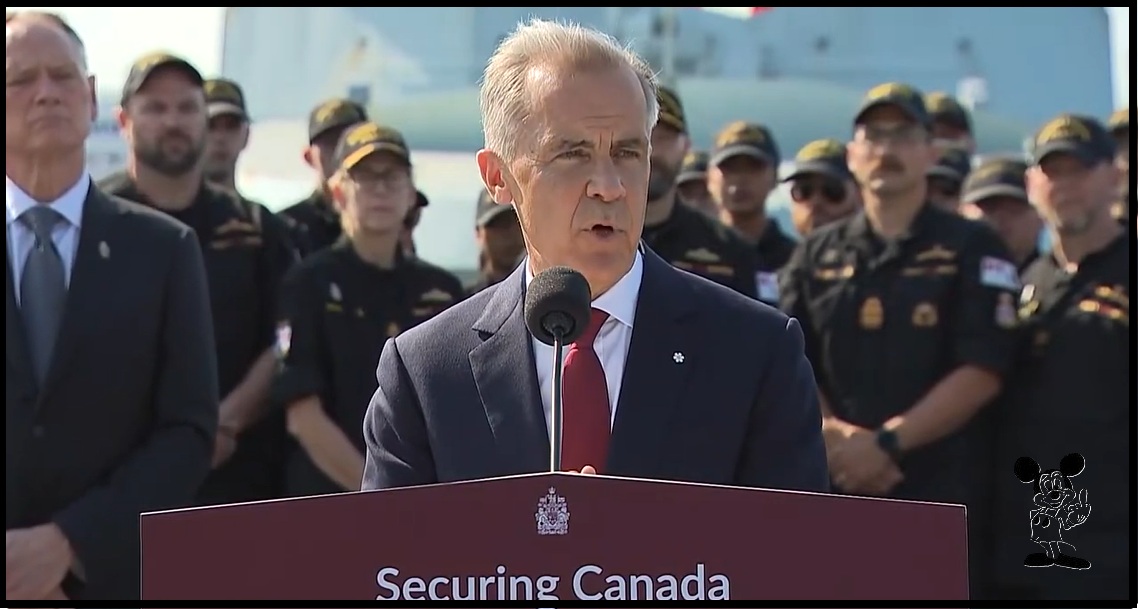
A few days ago, Politico noted that Canadian Prime Minister Mark Carney had a reprieve from his prior campaign points about confronting President Trump on tariffs immediately.  PM Carney is currently trying to align allies for what will likely be a major confrontation that he cannot win.

♦ BACKGROUND – Following the 2024 presidential election, Prime Minister Justin Trudeau traveled to Mar-a-Lago and said if President Trump was to make the Canadian government face reciprocal tariffs, open the USMCA trade agreements to force reciprocity, and/or balance economic relations on non-tariff issues, then Canada would collapse upon itself economically and cease to exist.  In essence, in addition to the NATO defense shortfall, Canada cannot survive as a free and independent north American nation, without receiving all the one-way benefits from the U.S. economy.

To wit, President Trump then said, if Canada cannot survive in a balanced rules environment, including putting together their own military and defenses and meeting their NATO obligations, then Canada should become the 51st U.S state.  It was following this meeting that President Trump started emphasizing this point and shocking everyone in the process.  However, in the emotional reaction to Trump’s statements, no-one looked at the core issues outlined by Trudeau that framed President Trump’s opinion.

(more…)

REPORT: Bezos Announces Country of Origin Labeling for All Imported Products Sold on Amazon – Amazon Denies Report

After spending three months riding his bicycle in slow circles at the bottom of the White House driveway while staring in the windows, it was reported this morning that a frustrated Jeff Bezos would announce his Amazon company would start to label the tariff impact on all products sold by the company.

However, in the angered reaction to President Trump’s tariffs against the majority of his suppliers, what Jeff Bezos likely didn’t realize is the tariff label acts as a “Country of Origin Label” (COOL).

All of the products sold on Amazon that would have tariff cost labeling, are not made in the USA. All of the products without tariff labels would be made in the USA.

Given the nature of American preference toward higher quality products, the “Tariff Label” becomes a DeFacto blacklist. Purchase reviews would proceed accordingly.

WASHINGTON – [T]he e-commerce giant will soon show how much Trump’s tariffs are adding to the price of each product, according to a person familiar with the plan. The shopping site will display how much of an item’s cost is derived from tariffs – right next to the product’s total listed price. (source)

How Amazon could possibly calculate this ‘cost’ given the complex nature and changing dynamics of total cost of production, currency evaluations, subsidies, and countervailing duty offsets, was an unknown.  However, as would be predicted, shares of Amazon stock started to plummet, which led to Amazon quickly denying the report.

(more…)

How the NAFTA/USMCA 2025 Review Underpins President Trump Remarks on Canada

Only President Trump could get the Canadians to vote for an exit to the USMCA, and he did it brilliantly.

To understand President Trump’s position on Canada, you have to go back to the 2016 election and President Trump’s position on the NAFTA renegotiation.  If you did not follow the subsequent USMCA process, this might be the ah-ha moment you need to understand Trump’s strategy.

During the 2016 election President Trump repeatedly said he wanted to renegotiate NAFTA, the North American Free Trade Agreement.  Both Canada and Mexico were reluctant to open the trade agreement to revision, but ultimately President Trump had the authority and support from an election victory to do exactly that.

In order to understand the issue, you must remember President Trump, Commerce Secretary Wilbur Ross and U.S. Trade Representative Robert Lighthizer each agreed the NAFTA agreement was fraught with problems and was best addressed by scrapping it and creating two seperate bilateral trade agreements. One between the USA and Mexico, and one between the USA and Canada.

In the decades that preceded the 2017 push to redo the trade pact, Canada had restructured their economy to: (1) align with progressive climate change; and (2) take advantage of the NAFTA loophole.  The Canadian government did not want to reengage in a new trade agreement.

Canada has deindustrialized much of their manufacturing base to support the ‘environmental’ aspirations of their progressive politicians.  Instead, Canada became an importer of component goods where companies then assembled those imports into finished products to enter the U.S. market without tariffs.  Working with Chinese manufacturing companies, Canada exploited the NAFTA loophole.

Justin Trudeau was strongly against renegotiating NAFTA, and stated he and Chrystia Freeland would not support reopening the trade agreement.  President Trump didn’t care about the position of Canada and was going forward.  Trudeau said he would not support it.  Trump focused on the first bilateral trade agreement with Mexico.

(more…)

Watch Longshoremen Union – A Predictable Democrat Strategy to Weaponize Absent China Goods in Coming Months

[AUTHORS NOTE: Having attended the ASEAN conference to make contacts, after a brief respite at home I spent the past several weeks traveling Southeast Asia to research the likely impact from Trump’s tariff and global trade reset. Visits included manufacturing and distribution facilities in the Philippines, Malaysia, Thailand, Vietnam, Cambodia, Sri Lanka and South Korea. What I will share with you in the next few months is an overview from direct first-hand discussions, contrast against the MSM financial media outline.]

The predictable doomsday Wall Street Journal narrative includes a forecast for a massive drop in exports from China as shipping conglomerates begin to outline a drop in trans-pacific sea cargo and container carriers.

What I would say to concerned Americans is to filter out the political narrative and remind yourself of the expanded footprint throughout SE Asia that Beijing has already established.  Chinese companies, many of them subsidized by the CCP, are pre-positioned to begin transnational shipping. I have witnessed it first-hand.  However, here’s the WSJ narrative as it begins.

WSJ – The number of ships sailing from China to the U.S. laden with clothes, electronics, furniture and other goods is plunging, as an accelerating number of cargoes are canceled.

The scrapped sailings come after the Trump administration ratcheted up tariffs on China while giving a three-month reprieve on punitive levies for much of the rest of the world.

At the Port of Los Angeles, one of America’s biggest gateways for imports from China, executive director Gene Seroka told port officials Thursday that he expects a 35% drop in import volumes in two weeks “as essentially all shipments out of China for major retailers and manufacturers has ceased.”

(more…)

President Trump Takes Questions from Media During Oval Office Presser

Wednesday, President Trump held an executive order signing ceremony in the oval office and took questions from the media on current topics.  Video Prompted:

.

President Trump notes the economic team have been in contact with 90 countries from around the world who have called to renegotiate trade agreements.  Additionally, Trump notes that 11 new automotive assembly plants have been announced by car companies in order to avoid U.S. tariffs.  That’s a lot of American jobs.

(more…)

Sunday Talks: Secretary of Commerce Outlines Purpose of Tariff “Exemptions” – Sector Specific Tariffs Coming Soon

Commerce Secretary Howard Lutnick appears on ABC This Week, to explain and clarify the purpose of the recently announced tariff exceptions.

According to the explanation, there are two “sector specific” tariffs in Semiconductors and Pharmaceuticals that will be announced in the next few months.  The recently announced “exemptions” are products that will be included in the sector specific tariffs that are also identified as “non-negotiable” tariffs.

Semiconductor items, automobiles, steel and aluminum as well as pharmaceutical products will fall under categories or ‘sectors’ of products that will be non-negotiable in all trade agreements for the tariff levy applied.  Any nation who enters negotiations for new Free Trade Agreements (FTAs) will not be permitted to negotiate trade on semiconductor products, automobiles, steel, aluminum and medications.  WATCH:

.

(more…)

Sunday Talks: White House Senior Advisor for Trade and Manufacturing Peter Navarro

White House Senior Advisor for Trade and Manufacturing Peter Navarro discusses the trade reset and tariff impact as it works through the process.

As visible and stated by the Trump team, the broad-based tariff approach was designed to save time and create the environment where foreign countries, including those with bilateral Free Trade Agreements (FTAs) would come to President Trump in an effort to retain their interests.  From there, new trade agreements would be structured.

Navarro rightly notes that both tariff and non-tariff barriers are designed to create a structural trade imbalance in their favor. The trade reset strategy is designed to confront these issues.  Navarro also notes how Vietnam operates as case-study in the use of non-tariff barriers and simultaneously operates as a transnational shipping point for Chinese products. WATCH:

.

(more…)

The Apoplexy Over the Trump Tariffs is the “Trillions at Stake” Part of Our Decade’s Long Discussion

During one of the 2016 Republican debates, the Wall Street Journal’s Kimberly Stassel challenged Donald Trump on the projected revenue from his proposed tax plan. In essence Stassel claimed some economists doubted the growth factor Mr. Trump projects in his tax proposal.

What was highlighted within the question was one of the larger hurdles Trump faced as he needs to re-educate an entire generation on a fundamentally new vision of the U.S. economy. A return to a goods-based manufacturing and industry driven economic model.

President Trump’s MAGAnomic trade and foreign policy agenda is jaw-dropping in scale, scope and consequence. There are multiple simultaneous aspects to each policy objective; they have been outlined for a long time.

Interestingly, many people have forgotten a 1991 (35 years old) video of Donald Trump testifying before congress – as evidence of him being tuned in to the economic consequences of political activity.

The entire video is well worth watching, because it gives us insight into a very specific moment in time as they discuss the ‘Reagan era’ 1986 tax reform act.

However, for the sake of this discussion post, I would like to draw your attention to a very specific exchange between Donald Trump and Representative Helen Delich Bently (R-MD).

(more…)

Canadian PM Mark Carney Says Will Match Trump Auto Tariffs at 25%

Canadian Prime Minister Mark Carney spins a tale of Automaker Stellantis temporarily shutting down auto plants in Canada and Mexico as an outcome of President Trump’s tariffs.  Unfortunately, the gaslighting by Carney might work on less intellectual SnowMexicans, but it fails here.

Stellantis, an EU centered auto company who sell Dodge, Ram (made in Mexico) and Dodge, Durango (made in Canada), have been in a deepening crisis for over a year as a result of poor brand management, poor development and weak North American sales.  In short, their cars and trucks are not selling, that’s why the CEO quit in December, and they fired and replaced the North American leadership team.  It has nothing to do with Trump’s auto tariffs against Mexico and Canada.

That said, Mark Carney used the Stellantis plant closing (Windsor) as cover to announce that Canada would match the auto-tariffs with a 25% countervailing duty against all U.S. made cars and trucks. [Prompted]

This approach only raises the ceiling for the U.S. tariffs against Canada.  Quite frankly, I’m not sure why President Trump would continue to play this game with Carney and should (for the sake of simplicity) just cancel all trade with Canada and begin an immediate embargo and border blockade.

Tell the Carney clown to stay at home, shut it all down and let the Canadians live as a sovereign nation under the rule and regulation of the EU while they continue to destroy their energy resources and import foreign workers.  It’s silly to keep entertaining Canada as if they really matter.

If it wasn’t for the national security threat they could represent on our border, Canada would likely get little policy attention from any administration.   The Trudeau/Carney’s of the world are just annoying now.  Sorry Canada, but this Carney guy is even worse than the last Prime Minister.   They won’t even say “USMCA” because it’s Trump or something.  So, Carney says “CUSMA” 😂🤣😂 Childish, silly and so typically leftist. Too funny!

(more…)

EU President Ursula von der Leyen is Apoplectic, Worries of Asian Product Dumping into EU

The response from the EU is exactly what we would expect to see from the end of the 80-year-old Marshal Plan.

EU Commission President Ursula von der Leyden has three big concerns with the new trade/tariff reset.  I strongly suggest everyone to read the EU concerns slowly to fully absorb decades of hypocrisy now surfacing:

#1 The EU will not be able to compete for U.S. market share with 20% general tariffs and 25% auto tariffs.

#2 The EU must deploy countermeasures against the risk of losing industrial capacity and manufacturing to the United States.

And #3 The EU must defend itself against China dumping cheap products into the EU now rejected by the USA.

von der Leyen is concerned mostly about the extremely valuable U.S. consumer being leveraged by President Trump, essentially blocking exploitation from EU and Asia. The EU will not tolerate losing access to the most valuable customers in the world, Americans.

(more…)