Quantcast

Monmouth Poll Compiles Top 22 Priorities of American People, Ukraine v Russia and J6 Committee Outcome Does Not Appear on List

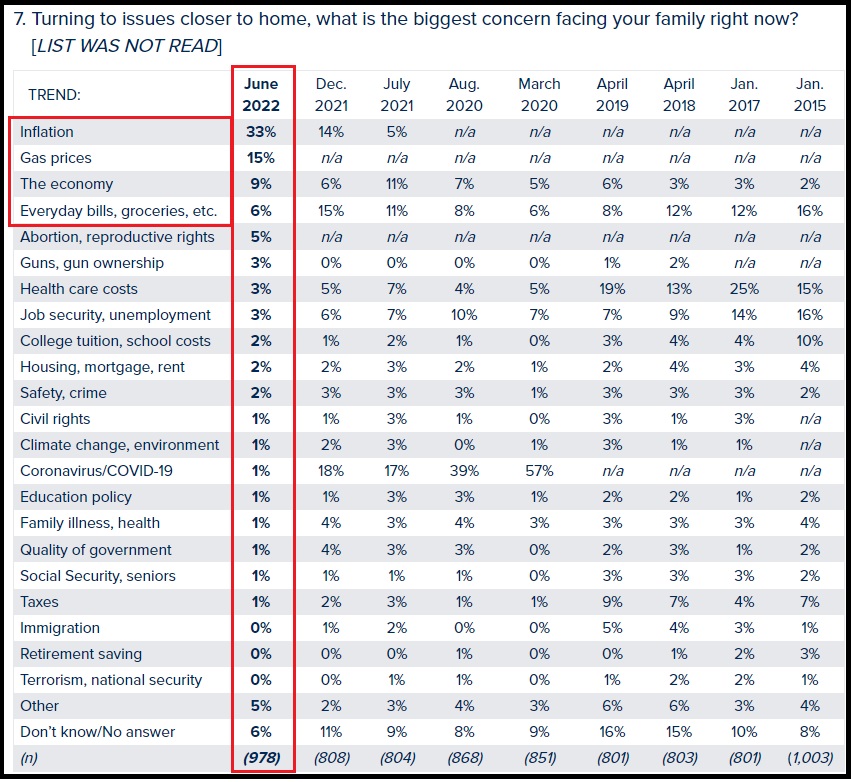
Monmouth University conducted another political poll of U.S respondents [SEE Survey HERE].  In addition to the plummeting approval of Joe Biden, the worst yet approval at 36% according to the survey, the respondents were asked to list their top concerns (Question #7).

The responses were recorded but did not come from a list presented by Monmouth.  They just compiled the results.  As stated, “what is the biggest concern facing your family right now?”  The results show the top priorities of Americans and the disconnect between the priorities of congress and the American people are stark.

(Source, Question #7)

Nowhere on the expressed concerns did anyone identify supporting Ukraine or the Russia -v- Ukraine conflict, as a priority; yet, Ukraine has taken up almost all of the legislative effort from congress.  The total taxpayer-funded congressional spending is nearing $100 billion.  Additionally absent from the concerns of the American people, is any mention of the January 6th committee; again, another time wasted political exercise by a congress detached from the priorities of the electorate.

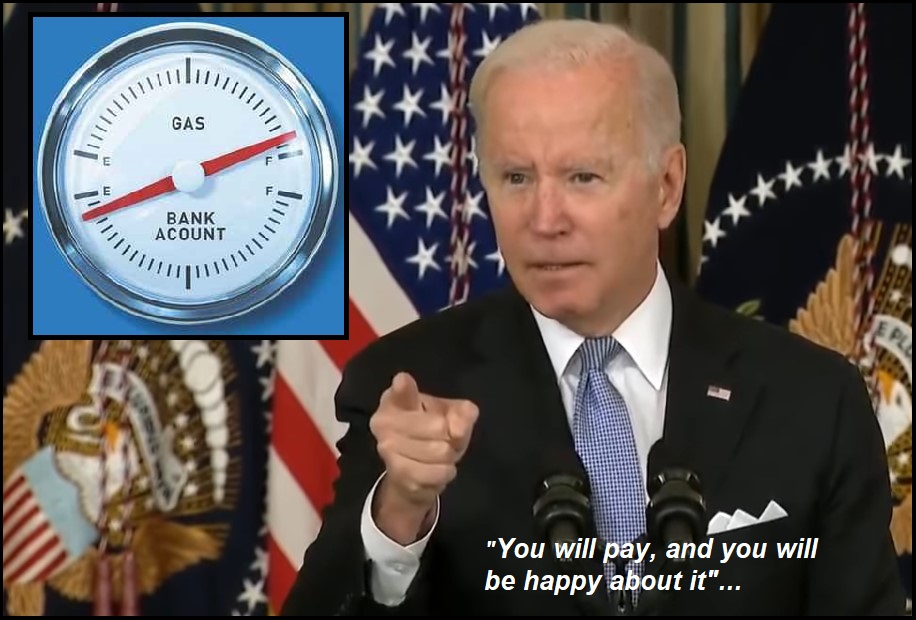
The top priorities are what we would expect to see, economic issues.  Inflation, Gas Prices, the Economy and the ability to pay everyday bills (groceries) are the priorities of the American people.  All of these issues are directly caused by Joe Biden and the policy of his administration.  Climate change, the #1 focus of the administration, is not even in the top ten.  We are in an abusive relationship with our own government.

(more…)

Biden Energy Agency Quietly Starts Manipulating Weekly “On Highway Diesel Fuel Prices”, Looks Like an Effort to Block Higher Fuel Surcharges and Control Transportation Inflation

[Hat Tip Mailroom] This is a very interesting little bureaucratic energy issue with big downstream ramifications.

Almost every transportation and manufacturing company uses the U.S. Energy Information Administration (EIA) “weekly publication of average diesel prices” in order to calculate shipping costs.  According to people in the industry, “this national average is what almost every trucking and logistics company bases their fuel surcharges on.”

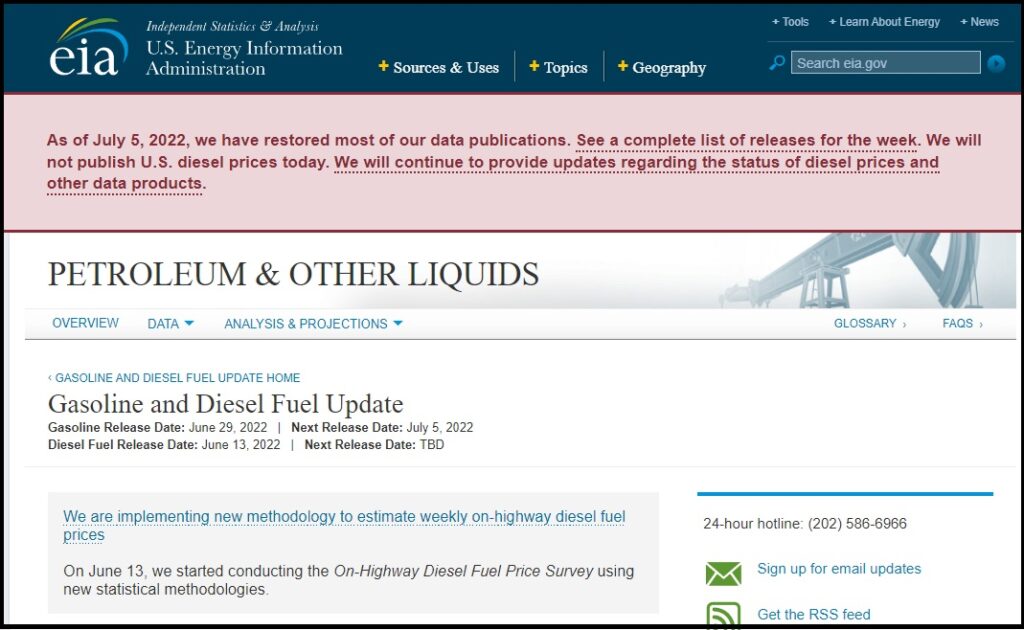
However, on June 13th the U.S. Department of Energy, Energy Information Administration, stopped reporting the average weekly diesel price.  For almost a month companies have been using an outdated average price in order to calculate shipping costs and fuel surcharges. [See Screengrab]

Originally the EIA said, “We are implementing new methodology to estimate weekly on-highway diesel fuel prices. On June 13, we started conducting the On-Highway Diesel Fuel Price Survey using new statistical methodologies.” {LINK} However, the EIA has not updated anything since that announcement.

As a result, all of the transportation charges and fuel surcharges have been underestimated and priced for almost a full month.  The political motive for this move is transparent, it stops higher diesel prices from being passed along in the supply chain… which gives an artificial pause on inflation that comes as an outcome of higher diesel transportation costs (specifically trucking).  As explained to CTH:

(more…)

Post Pandemic Migration Pattern Continues, Red States Gaining, Blue States Dropping Population, Same Applies to Job Recovery

The Wall Street Journal has an interesting article [SEE HERE] outlining inter-connected data points for various state economies in a post-pandemic environment.

The topline takeaways are: (1) Employment in red states has fully recovered, and now exceeds the number of jobs as before the pandemic. (2) Employment in blue states remains below the pandemic numbers; meaning they have not recovered. (3) Net migration still shows people fleeing blue states like New York, California and Illinois; while (4) Net migration into red states like Florida, Texas, North/South Carolina and Tennessee is continuing.

(Wall Street Journal) – […] Forty-six million people moved to a different ZIP Code in the year through February 2022, the most in any 12-month period in records going back to 2010, according to a Moody’s analysis of Equifax Inc. consumer-credit reports. The states that gained the most, led by Florida, Texas and North Carolina, are almost all red, as defined by the Cook Political Report based on how states voted in the past two presidential elections. The states that lost the most residents are almost all blue, led by California, New York and Illinois. (read more)

The professional business class analysts (eyeroll) at the WSJ attribute the demographic shifts to the worker disconnect from the office.  Meaning workers can now work from home and are moving to environments where the quality of life is better.  White collar workers no longer bound to the geographic limitations of central office locations.

While some of that is likely accurate, there is no consideration for the lockdown effect.  The results of the pandemic showcased a very brutal acceptance, more people now seemingly realizing the politics of their regional leadership has a direct and consequential impact to the quality of their life.  The blue state leaders, ideologically disposed to dismissing the opinion of citizens, generally dispatched any consideration for the quality-of-life impact they created.  The people were irrelevant.

(more…)

Gallup, American Confidence in Office of President Drops Dramatically in Last Year, Leads Confidence Drop Amid All U.S. Institutions

Gallup has conducted a survey of American confidence in several institutions [DATA HERE].  Overall confidence in institutions has dropped significantly in the last year, which is not a surprise given the turmoil now seemingly all around us.

The survey measures and compares American confidence from 2021 to 2022.  It is worth noting, confidence in the office of the presidency is the #1 drop in the survey.

GALLUP – “This year’s poll marks new lows in confidence for all three branches of the federal government — the Supreme Court (25%), the presidency (23%) and Congress. Five other institutions are at their lowest points in at least three decades of measurement, including the church or organized religion (31%), newspapers (16%), the criminal justice system (14%), big business (14%) and the police.” (link)

This survey reflects and increasingly dangerous position for government and institutions of society.  We are a nation, a representative republic, that is held together with a common understanding of basic adherence to values, principles and lawfulness.

Take away confidence, and what this survey really starts to outline is institutions losing legitimacy in the eyes of We The People.  Dangerous things can happen when unease and distrust exist.

(more…)

Senator Lindsey Graham Returns from Turkey Hopeful to Close Deal on F16 Sales

Senator Lindsey Graham (U-DC) was apparently in Turkey around the same time as the NATO summit.  According to a Twitter announcement by Graham he has returned to the U.S. hopeful to close the deal on selling F-16”s to Turkey now that Turkish President Recep Erdogan has removed opposition to Finland and Sweden joining NATO.

“I will do all in my power to support the Biden Administration’s decision to sell F-16s to the Turkish Air Force,” Graham writes.

Also adding, “These fighter jets, in the hands of our NATO allies, will create a sense of stability and provide capability to the Turkish military that is most definitely in America’s national security interests.” {link}

On Tuesday of last week Turkey removed their block of Sweden and Finland from joining NATO, and on Wednesday Joe Biden agreed to sell Turkey 40 Lockheed Martin-made F-16 fighters and nearly 80 modernization kits for its existing warplanes:

Newsmax – The Biden administration threw its support on Wednesday behind the potential sale of F-16 fighter jets to Turkey, a day after Ankara lifted a veto of NATO membership for Finland and Sweden.

(more…)

Facing Defeat in Lysychansk Ukraine Military Retreats, Russia Takes Full Control of Eastern Ukraine Region of Luhansk

Separatists in Luhansk had been embroiled in a bloody civil war against the Ukraine military since 2014.  On Sunday Russia announced its military forces and allies had taken control of Ukraine’s eastern Luhansk region after capturing the final Ukrainian holdout of Lysychansk.   Based on ground reports showing celebrations of Russian troops and the citizens of Lysychansk, the end of that regional conflict appears confirmed.

According to Politico, “Ukrainian troops have retreated from Lysychansk, the last major Kyiv-controlled city in the eastern Luhansk region, the country’s military command said Sunday. “In order to preserve the lives of the defenders of Ukraine, a decision was made to withdraw,” according to a statement from the General Staff of the Armed Forces.” {link}

Previously Moscow media were reporting that Russian defense minister Sergei Shoigu told President Vladimir Putin Luhansk had been “liberated”, after earlier statements saying the military had captured villages around Lysychansk and encircled the city.

Politico – […] Ukraine’s military command said that given the great “superiority” of Russia’s troops in terms of weapons, ammunition and personnel, attempts to prolong the defense of the city — which had a pre-war population of around 100,000 — “would lead to fatal consequences.

The eastern region of Ukraine is a major target for Russia: Moscow-backed separatists have been fighting Ukrainian forces since 2014 in the Luhansk and Donetsk regions that make up the key industrial area of Donbas, and Russia’s recognition of the self-styled people’s republics there preceded its full-scale invasion of the country this past February.

[…]  Ukrainian President Volodymyr Zelenskyy said Sunday that “there is a risk” that the whole Luhansk region could be fully occupied by Russian troops soon. “There are such risks, and we realize them,” he said at a press conference after a meeting with Australian PM Anthony Albanese in Kyiv.

(more…)

Sunday Talks, John Kirby Defends White House Energy and Economic Policy

John Kirby is the former Pentagon spokesperson who is now the National Security Council Coordinator for Strategic Communications.  The people in/around the White House have shifted Kirby, a very good spinner of parseltongue, into a place where he can give the media an impression of White House competency.

The LGBTQ, racially inclusive and woke checkbox hires are not up to the task of their positions.  Incompetence is running amok.  As a result, it is somewhat ironic and representative the Biden hypocrisy, that Kirby is needed to take the pressure away from administration checkbox hires.  In this interview Kirby defends the White House policy on the Russia-Ukraine war, interventionist and dependent foreign policy, and the energy policy that has resulted in high gas prices.

Video prompted to 04:05, where the topic of Biden’s upcoming visit to Saudi Arabia is discussed.  WATCH:

(more…)

Biden Plan to Cap Russian Oil Prices Could Seriously Backfire, Which Means It’s Likely to Happen

The G7 plan to create another economic sanction against Russia by capping the price anyone could pay for Russian oil has a serious downside.  If Russia slows down the export of oil, global oil prices will jump dramatically.   That policy outcome would mean a massive increase in the price of gasoline for U.S. consumers.

Because the consequences are horrible, that’s precisely the reason Joe Biden might push to have the Russian price cap.  Every policy Joe Biden has historically supported, has been the exact opposite of what should have been done.  Biden has a profound and innate ability to screw up anything.

[Bloomberg] – Global oil prices could reach a “stratospheric” $380 a barrel if US and European penalties prompt Russia to inflict retaliatory crude-output cuts, JPMorgan Chase & Co. analysts warned.

The Group of Seven nations are hammering out a complicated mechanism to cap the price fetched by Russian oil in a bid to tighten the screws on Vladimir Putin’s war machine in Ukraine. But given Moscow’s robust fiscal position, the nation can afford to slash daily crude production by 5 million barrels without excessively damaging the economy, JPMorgan analysts including Natasha Kaneva wrote in a note to clients.

For much of the rest of the world, however, the results could be disastrous. A 3 million-barrel cut to daily supplies would push benchmark London crude prices to $190, while the worst-case scenario of 5 million could mean “stratospheric” $380 crude, the analysts wrote.

(more…)

Fed Chair Ignores Impact of Build Back Better Energy Policy on Supply Side of Inflation

Much has been made of comments by Federal Reserve Chairman Jerome Powell in his brief explanation of what the Fed got wrong.  Last week Powell made comments during a European Central Bank forum on bank policy, implying the absence of unvaccinated workers returning to the labor force is part of the US inflation problem.

Powell’s comments seem to align with the government vaccine mandate position which ignored the rights of the worker. Considering the responsibility of the Fed to anticipate price and labor issues, Powell’s sense of credulity toward those workers who dropped out of the labor force rather than inject an untested vaccine into their body is quite remarkable.  Inartful and arrogant are soft terms for his commentary.

However, there’s a bigger “tell” in the segment of what the Fed got wrong, when you listen to Powell talk about the supply side issues and how the Fed Reserve had no model to predict the mandated lockdowns, economic activity stoppages and consequences.   Notice how Powell completely dismisses the structural energy policy, the Build Back Better agenda, that lies at the heart of the current supply side inflation issue.  Video Prompted to 01:03:34, WATCH:

.

Throughout the discussion the primary focus to control inflation is reliant on a demand side cause.   The goal to reduce demand is seen as a way to mitigate and reduce inflation.  Thus, this worldview, as mistaken as it was/is, explains the justification for why the Fed waited to increase interest rates.  They never saw the radical energy policy as a structural driver of supply side inflation.

According to Powell, they thought the supply side issues would moderate quickly, without giving any consideration at all to how a radically new energy policy would embed.  He just ignores the issue completely; again, pretending not to know.  But perhaps it’s actually worse.  Perhaps he really doesn’t see a radical new energy policy as a driving force behind current inflation.  If that’s true, and he genuinely does not see it, then Fed policy in the future is going to make the recession much worse.

If you ignore massive energy price impacts, the FED will keep interest rates high despite demand dropping, and then eventually get to a place where demand has dropped so low the recession is deep, while turning toward each other and asking why are prices still so high?

Keep that disconnect in mind.

(more…)

Someone Controlling the Twitter Account of Joe Biden is Demanding Gas Stations Lower Prices, Because He Said So

This administration is a lesson in abject silliness.  Everyone knows that Joe Biden has no clue who or what is being done in the energy policy of his administration; heck, he could not even name his Interior Secretary.   That said, whoever controls his Twitter account is now just making him look even more stupid as Biden blames the gas stations.

[Tweet Source]

I would draw attention to the most overlooked quote from Joe Biden as it pertains to gas prices.  This statement was made May 23, 2022, and it proves he knows the gas price is directly related to his choice to implement the Green New Deal by executive policy:

…”Here’s the situation.  And when it comes to the gas prices, we’re going through an incredible transition that is taking place that, God willing, when it’s over, we’ll be stronger and the world will be stronger and less reliant on fossil fuels when this is over.”…  [source]

(more…)