Quantcast

Sunday Talks, SF Fed Chair Sees Half of Inflation Driven by Excess Demand of Some Unknown Something

The great pretending continues.  During a Sunday talk show appearance, San Francisco Fed Chair Mary Daley states, “what I see is supply and demand are just unbalanced. About 50% by my own staff’s estimates of the excess inflation we see is related to demand. The other 50% to supply.”  Note, she is not talking about energy.

Margaret Brennan, maintaining her position as the professional CBS narrative engineer, never thinks to ask: (a) where is this demand you speak of, and what exactly are they demanding? and/or (b) What is this 50% inflation on the supply side connected to?  Obviously, an actual probing of inflation wasn’t in the script. The great pretending continues.  [Transcript Here]

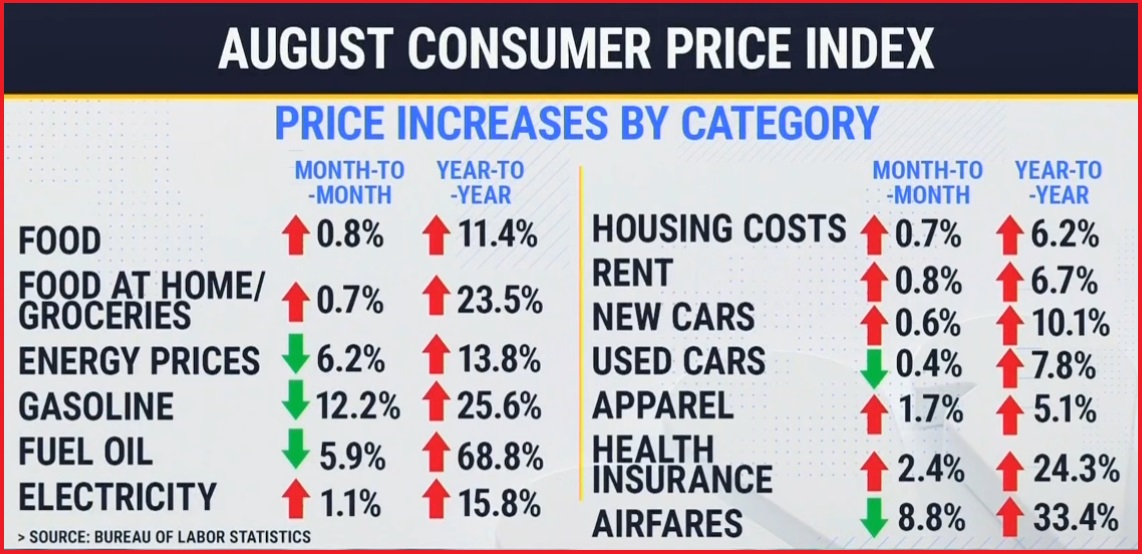
CTH has stated without reservation that August’s inflation report will show a significant –albeit temporary– drop in inflation as measured by the govt.  The drop in gasoline prices throughout July (created by a drop in demand) will allow the fiscal and monetary policy makers to falsely claim overall inflation peaked. However, after a brief respite the inflation now growing in the ground (massive increases in farm costs), will then launch into the food supply chain.  This delayed food inflation will overtake the energy inflation in the latter part of this year.  WATCH:

[Transcript] – MARGARET BRENNAN: We turn now to the state of the economy and the president of the San Francisco Federal Reserve Bank, Mary Daly. Good morning to you.

FEDERAL RESERVE BANK OF SAN FRANCISCO PRESIDENT MARY DALY: Good morning.

(more…)

Good News, Gasoline Prices Drop – Bad News, Demand for Gasoline Plummets to Pandemic Era Levels

The good news is that gasoline prices have dropped in the past several weeks to an average of $4.13/gal.  However, the bad news is that most of the drop in price is related to gasoline demand dropping to the same level as July 2020 during the pandemic lockdown phase.

Obviously, $4.13/gal is still a very high price for gasoline, and that is leading to fewer people purchasing gasoline.

(Via Fox) – […] New data from the Energy Information Administration (EIA) shows that gas demand dropped from 9.25 million barrels per day to 8.54 million per day last week. That’s 1.24 million barrels per day lower than last year and “in line with demand at the end of July 2020,” when there were widespread virus-related restrictions and fewer people were hitting the road, according to AAA. 

The latest demand figures bolster a recent AAA survey that revealed 64% of drivers had changed their driving habits or lifestyle since March to offset the high prices at the pump. (read more)

If you think about the position of the Organization of Petroleum Exporting Countries (OPEC or OPEC+), it makes sense for them to recognize the intentions of the western leaders to shrink the western industrial economies and respond accordingly.

(more…)

Labor Report, 528,000 Jobs Gained in July, Large Gains in Restaurants and Services, Unemployment Rate 3.5%

A few days ago, we were discussing the disconnect within the economy as it relates to corporate valuations.  The Bureau of Labor Statistics report today [DATA HERE] highlights another economic disconnect, this time with labor.  According to the BLS survey 528,000 jobs were added to the economy in July, the unemployment rate drops to 3.5%.

The household data [Table A] shows the number of eligible workers unemployed dropped 242,000; however, the number of eligible workers no longer in the workforce increased by 239,000.  The total labor force is shrinking as unemployment drops.

Keep in mind the previous BLS survey of job openings (JOLTS report) showed available jobs dropped 605,000 in July.  “On the last business day of June, the number and rate of job openings decreased to 10.7 million (-605,000) and 6.6 percent, respectively. The largest decreases in job openings were in retail trade (-343,000), wholesale trade (-82,000), and in state and local government education (-62,000).” [JOLTS survey]

Going back to today’s release, 303,000 part-time jobs were added in July; these are workers working part-time for economic reasons.  The Household Data shows that within the leisure and hospitality sector [Table B-1] restaurants and bars added 74,000 jobs.

If we combine both BLS surveys two days apart is: 605,000 job openings cancelled, and 528,000 new jobs gained.

Of the 528,000 new jobs gained, 303,000 were part time jobs with the largest growth in the jobs in restaurants and bars.

Again, blending data from both reports and focusing on retail.  The retail sector cancelled 343,000 job openings in July, and the retail sector added 21,600 jobs in July.  Within the retail sector (table B-1), jobs at automotive dealers, furniture stores and clothing/apparel stores dropped by a combined 7,200 jobs.

(more…)

BMW Warns Investors of Lower Production Forecast, Incoming Factory Orders Declining

Whenever we are discussing the intentionally managed decline of the western countries, it is important to remember the closely connected relationship between multinational corporations and the political leaders of those nations.  Specifically, their public-private connections as they run through the World Economic Forum assembly.

An intentionally managed decline of western economic activity should have a direct impact on the private corporations within those economies.  If the politicians are collectively going to stop energy development, raise energy prices (inflation), then use monetary policy to shrink the economy down to the level of energy available, we would normally think corporations were going to make less money.

That preceding paragraph is not controversial.  It simply explains exactly what is happening; that is the situation.  However, for some weird reason the system that evaluates corporate wealth is not responding negatively to the reality of the situation.

Traditionally, we would think destroying the economy would be against the interests of the multinational corporations who benefit from economic expansion.  However, in the era of subsidized and controlled economic management, I’m not so sure the corporations are stakeholders in economic growth.  Something is profoundly disconnected, or else the corporations would be raising hell with the politicians.

BERLIN, Aug 3 (Reuters) – BMW (BMWG.DE) lowered its output forecast and warned of a highly volatile second half on Wednesday, pinpointing supplies of energy in Europe and chips worldwide as the two crucial factors to the carmaker hitting full-year earnings targets.

New incoming orders were beginning to fall but order books remained filled for the next few months, chief executive Oliver Zipse said. (read more)

All of the basic indicators point in one direction.

(more…)

Western Nation Economic Recession, Maersk Shipping Group Forecasts Weak Shipping Demand as Warehouses Fill with Unsold Durable Goods

A few months ago, amid all of the headline warnings about inflation and prices of essential products, CTH noted that if we were to continue waiting about six months, we would see a massive backlog of unsold goods and as a consequence the prices of non-essential durable goods would begin a rapid decline.  That exact scenario is about to unfold.

Keep in mind, this is not necessarily a collapse of total global economic activity; what we are seeing is a collapse of western nation economic activity that is impacting the rest of the world.  A great economic fracturing is taking place as the western nations intentionally shrink their economy.  The supplier nations are feeling the consequences.

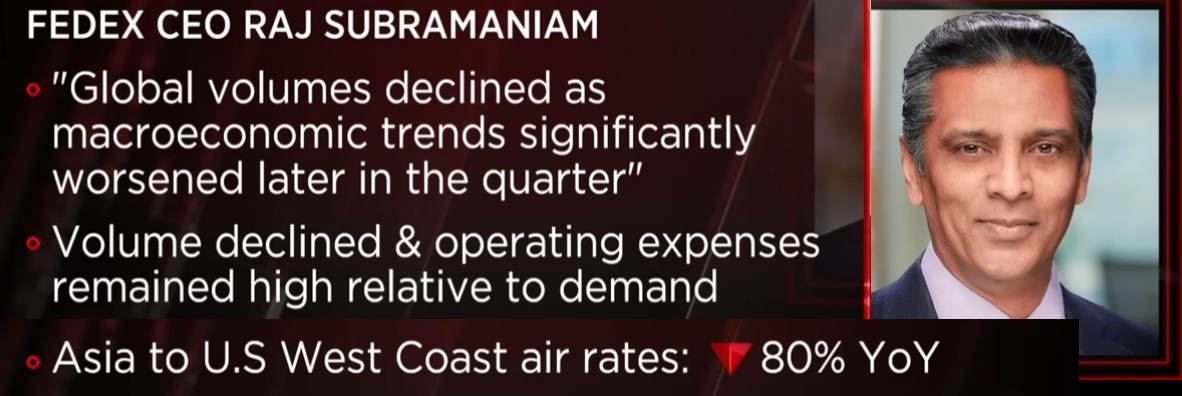
Maersk is the international shipping company that delivers millions of containers of goods all around the world, mostly by ship.  They are warning that warehouses are full of previously delivered goods, unsold consumer durable goods, as retail sales have come to a standstill.

The amount of inventory in warehousing is so extreme, major wholesale and retail groups have run out of storage space (link).

COPENHAGEN, Aug 3 (Reuters) – Shipping group Maersk (MAERSKb.CO) expects global container demand to fall this year as sales of durable goods come to a “standstill”, leaving flat-screen TVs and furniture piling up in warehouses, the company said on Wednesday.

A surge in consumer demand and pandemic-related logjams holding up containers in key ports had boosted freight rates and profits in the shipping industry in recent quarters, yet the cost-of-living crisis has reversed that trend.

(more…)

Foreboding Data, Second Quarter Credit Card Balances Jump 13 Percent, Largest Increase in Twenty Years

It’s not just the scale of the increase that is surprising; it’s the history of how long it has been since this scale of debt increase happened in a single quarter.

(CNBC) – […] Although average hourly earnings are up 5.1% from a year ago, prices have been rising much faster. The Consumer Price Index, which measures the average change in prices for consumer goods and services, jumped a higher-than-expected 9.1% in June, the fastest pace in over four decades.

To bridge the gap, more consumers are relying on credit cards to get by, which has helped propel total credit card debt to $890 billion.

Overall, credit card balances rose 13% in the second quarter of 2022, notching the largest year-over-year increase in more than 20 years, according to a report from the Federal Reserve Bank of New York. (read more)

This doesn’t sound like a good economic omen.

(more…)

Smooth Operator, Senator Joe Manchin Answers Questions About His Energy Deal with Senator Chuck Schumer

Democrat Senator Joe Manchin wears the purple tie today as he answers questions from the DC legislative narrative engineers.  There are two videos below.  The first is a general presser with multiple members of the DC media (print journos) about the Green New Deal energy bill he negotiated with Senator Chuck Schumer. The second video is an interview between Manchin and Fox News host Harris Faulkner.

Unfortunately, in both the presser and the direct interview no one pins Manchin down on where “expanded energy production” of the bill is located.  Manchin claims there is legislative language in the deal that supports the fast domestic production of oil, coal and natural gas to meet the immediate issue of skyrocketing energy prices.  However, Manchin is a smooth operator, and he states confidence that rapid and expanded development of oil, coal and gas is part of the deal.  WATCH:

(more…)

Job Openings in June Decreased 605,000, Retail Sector Dropped 343,000

The Bureau of Labor Statistics (BLS) produces a monthly report of available job openings.  The Job Openings and Labor Turnover Summary (JOLTS report) shows the number of available jobs at a captured moment in time.  This JOLTS report [DATA HERE] is a summary of the last day in June.

As you can see within modified Table-1, the number of available jobs dropped by 605,000 in this report.

Hires and separations were little changed, so too was the number of people who quit their jobs.  The big change in this JOLTS survey was the removal of available jobs.  Employers cancelling job openings.

BLS – “On the last business day of June, the number and rate of job openings decreased to 10.7 million (-605,000) and 6.6 percent, respectively. The largest decreases in job openings were in retail trade (-343,000), wholesale trade (-82,000), and in state and local government education (-62,000).”

If we monitor the JOLTS report as an indicator of employment strength reflecting the general pattern of consumers, we can see a pullback in both the goods and service sector.

Retail job openings dropping 343,000 as consumer spending tightens even more due to inflation, and now we see the service side with leisure and hospitality dropping 91,000 openings.

(more…)

Global Recession, South Korea Manufacturing Output Shrinks in July, First Time in Two Years

We are seeing the cascading impacts of the energy-driven inflation starting to ripple throughout the globe, specifically worsening economies who are dependent on the export of non-essential durable goods.  South Korea manufacturing is the latest example.

The first quarter of 2022 started with a drop in U.S. consumer spending on non-essential durable goods like electronics.  The net result of contracted consumer spending was a 1.6% negative GDP.

Inventories of goods started to build and by April/May of 2022 the Consumer Price Index (CPI) showed negative inflation in those sectors as discounts to move inventory were offered.

In June major manufacturer Samsung, headquartered in South Korea, announced they had told suppliers to stop sending component manufacturing parts for finished goods. (link)

By the end of July, the second quarter GDP in the U.S. again showed a contraction of 0.9%. Energy inflation was now creating a consumer spending recession, demand for non-essential goods dropped fast over the first half of the year.

Today, South Korea announces July manufacturing output contracted for the first time in two years, matching the prior announcement by Samsung:

(more…)

Did Joe Manchin Threaten to Switch Political Parties? Chuck Todd Seems to Know He Did

West Virginia Senator Joe Manchin was on every Sunday talk show today (CNN, NBC, ABC, CBS and Fox) responding to his reversal of position on the Build Back Better legislative package (Green New Deal spending) that is part of the senate budget reconciliation bill.  There is something very interesting in his justification. [Do not skim read this, all citations included]

Fox News Brett Bair does the best job challenging Manchin on his prior statements saying there would be no spending deal without first seeing the August inflation data. [LINK].  Manchin never answered that hypocrisy directly but says there are two components of the deal, two parts of a new future legislative bill, that brought him to the agreement on the $370 billion current spend.

The current Senate bill is a reconciliation bill, meaning it involves taxes and spending – AND ONLY taxes and spending, because the bill originated in the House.

The constitutional framework for taxes & spending requires the House to originate all spending bills.  If a desired additional measure does not involve taxes and spending (a budgetary impact) it cannot be added to a reconciliation bill.  The senate must originate a new bill and then send it to the House.

According to Manchin the deal between himself, Chuck Schumer, Nancy Pelosi and Joe Biden includes his support for the current green energy spending, in exchange for two new items in future legislation: 1) Streamlined energy permitting/regulation; and 2) Increased development of Oil, Coal, Gas.  Both of these pieces of legislation have to be handled in a separate Senate bill.

According to Manchin, his agreement to the current spending bill was contingent upon a promise that: (A) Senate Majority Leader Chuck Schumer will generate a new bill for streamlined energy permitting and increased oil, gas and coal development; (B) House Speaker Nancy Pelosi will take up the Senate bill and whip enough of her House Democrat membership to join with Republicans in support of that Senate bill; and (C) Joe Biden will sign that increased energy production bill.

Here’s the important part.  Senator Manchin claims he has leverage over Biden, Pelosi and Schumer to ensure a new bill with those priorities is created and advanced.  Manchin further claims there are “consequences” for Biden, Pelosi and Schumer if they were to renege on the deal.  He is quite emphatic about that point if you listen to the NBC interview.

(more…)