Earlier today President Trump held a nuclear energy innovation event in the White House and highlighted the next phase of U.S. energy development via small critical nuclear reactors. The media questions begin at 8:44 of the video below.
.
Earlier today President Trump held a nuclear energy innovation event in the White House and highlighted the next phase of U.S. energy development via small critical nuclear reactors. The media questions begin at 8:44 of the video below.
.
As noted in this Truth Social message, President Trump notes it is unlikely that people around Chairman Xi and people around President Putin would be providing military, logistics, targeting or weapons support for Iran for the same reason President Trump is not providing military, logistics, targeting or weapons support to Ukraine.
TRUTH SOCIAL – “President Xi, at our recent meeting in Beijing, China, told me that he would not, under any circumstances, give or sell Weapons to the Islamic Republic of Iran — And that statement included Chinese Companies. Considering our relationship, I take him at his word and, besides, l am doing him very big favors, also.
Likewise, President Putin, despite the horrible War going on in Ukraine (The relationship remains, as it does with President Zelenskyy), told me that he would not sell Weapons to Iran. He understands that I do not sell Weapons to Ukraine, but to NATO Countries. They pay full price, and how those Weapons are distributed, I have no idea.
Therefore, two major Countries that people speak of often in terms of Iran are, in my opinion, not participating. If they did, it would be very bad for them — Certainly not in their best interests. Thank you for your attention to this matter!” ~President DONALD J. TRUMP
I strongly doubt non-pretending Russian President Vladimir Putin draws a distinction between the U.S. sending drone technology and missiles to Ukraine -vs- the U.S. sending drones and military technology to NATO Germany for forwarding to Ukraine.
In his most recent outline, Promethean Action PAC’s Mike Steger puts the U.S-Canada trade conflict into an accurate context where China is really the enterprise to gain or fail. This is a very well presented segment worth watching.
CTH readers will note our long track of this dynamic. In short, as NAFTA predictably evolved, and as the U.S. manufacturing base was deconstructed, suddenly things shifted. Canada and Mexico became important as entry doors into the U.S. consumer market for the products outsourced by the destruction of the American manufacturing base.
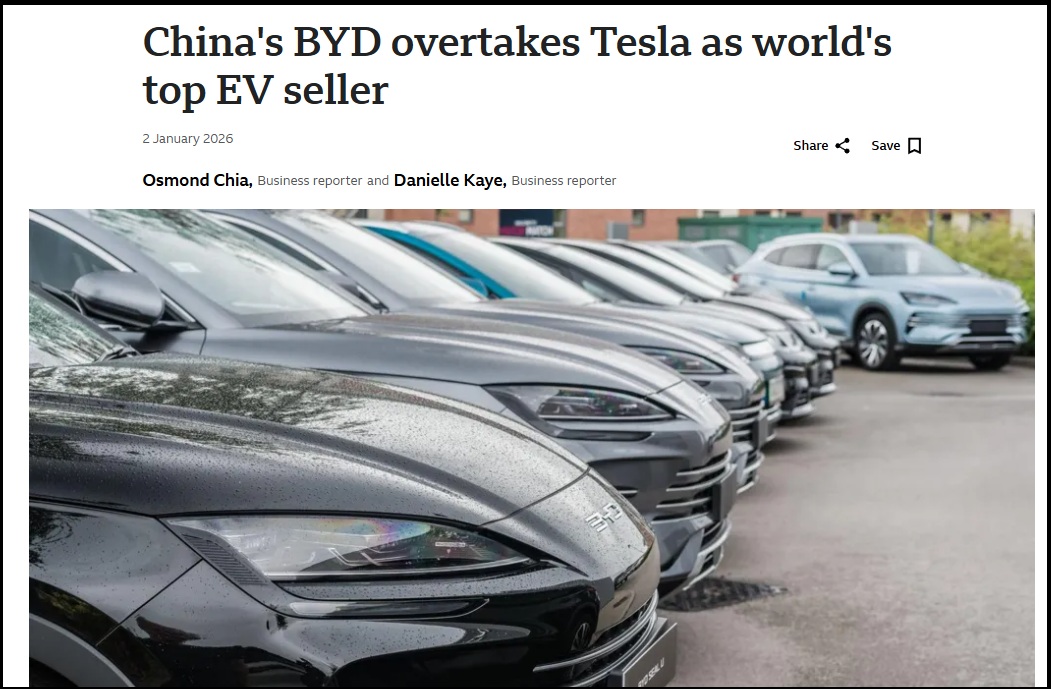
Steger appropriately uses the auto-sector as an example because it is the easiest sector to quantify damage. By playing the long game, China has thoroughly compromised the EU and U.K auto market. In 2025 China exported 1.2 million vehicles into Europe. Europe only exported 200,000 vehicles into China; a net trade deficit of 1 million vehicles in Beijing’s favor.
Chinese cars now represent over ten percent of all EU vehicles on the road, and this is only the beginning stage of the collapse of the EU industrial base that Germany and Brussels have only recently started to grasp. The pace is irreversible at this point for Europe, and now China has turned their attention toward Canada. This is why the U.S-Canada trade conflict matters!
Canada is the entryway to do in North America what China has done in Europe. WATCH:
.
In the graph below, look at how fast things move once the foothold is established by policy. This is stunning.
As expected, U.S. Trade Representative Jamieson Greer has completed the Section 301 review of “forced labor practices” in manufacturing and trade. [USTR Announcement Here]
As a result of the findings, a tariff rate of 10% to 12.5% is being added to the goods from a host of countries evaluated. These 301 duties are in addition to currently existing tariff rates. [FACT SHEET] Trading partners that have made commitments to adopt, and effectively enforce, forced labor import prohibitions will have a 10% tariff, and trading partners that have failed to adopt a forced labor import prohibition will have a 12.5% tariff rate.
• The following 54 economies have failed to impose and effectively enforce a prohibition on the importation of goods produced with forced labor:
Algeria; Angola; Argentina; Australia; the Bahamas; Bahrain; Bangladesh; Brazil; Cambodia; Chile; China, People’s Republic of; Colombia; Costa Rica; Dominican Republic; Egypt; El Salvador; Guatemala; Guyana; Honduras; Hong Kong, China; India; Iraq; Israel; Japan; Jordan; Kazakhstan; Kuwait; Libya; Malaysia; Morocco; New Zealand; Nicaragua; Nigeria; Norway; Oman; Peru; the Philippines; Qatar; Russia; Saudi Arabia; Singapore; South Africa; South Korea; Sri Lanka; Switzerland; Taiwan; Thailand; Trinidad and Tobago; Türkiye; United Arab Emirates; United Kingdom; Uruguay; Venezuela; and Vietnam.
• The following six economies have failed to effectively enforce a prohibition on the importation of goods produced with forced labor:
Canada, Ecuador, the European Union, Indonesia, Mexico, and Pakistan.
The Canadian government has cancelled their participation in a joint U.S-Canada ribbon cutting ceremony because President Trump has hurt their feelings with a new tariff announcement.
It is the official position of the Canadian government not to join in any collaborative celebration. This comes on the heels of the Premier of British Columbia, David Eby, asking his staff to revoke the Canada statement celebrating America’s 250th Independence Day. Take that Trump! {{harrumph}}
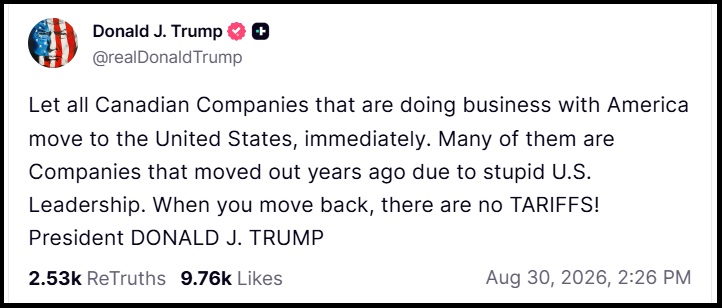
CANADA – A planned joint ceremony on Friday between the U.S. and Canada marking the opening of the Gordie Howe International Bridge has been canceled after President Trump announced a 50 percent tariff on certain Canadian imports, including alcohol and dairy.
“In light of trade action threatened by the United States earlier this week, it would be inappropriate to proceed with a celebratory event between the two countries,” Jenna Ghassabeh, a spokesperson for Canadian Infrastructure Minister Gregor Robertson, said in a statement to the Associated Press.
“We remain committed to opening the bridge on July 27th, and to celebrating this milestone among Canadians on July 24th,” she continued. (read more)
Secretary of State Marco Rubio held an extensive press availability on the sidelines of the ASEAN summit in Manilla. During the questions the meeting with Russian Foreign Minister Sergey Lavrov was one of the key areas of focus.
Rubio noted the U.S. was still willing to play a positive and constructive role toward a ceasefire in Ukraine, with the intention of bringing an end to the hostilities and bloodshed. However, Rubio was not willing to discuss details of the private conversation with Lavrov. WATCH:
[Transcript] – SECRETARY RUBIO: All right, what’s up?
QUESTION: Have you made any progress on Ukraine today? Is Russia serious about peace this time?
SECRETARY RUBIO: I mean, you think we settled the war in Ukraine in our 30 minutes here in Asia? That’s not the way it works. Look, we had a good conversation, a frank conversation. I’m not going to tell you what we talked about, because these – diplomacy doesn’t work well when you run to the microphones afterwards. Suffice it to say – I’ll tell you what I told you yesterday. The United States, the President’s been clear that we want – if we can, we are prepared to play a constructive role in bringing about an end to a senseless war. And we’re ready to do that, and we of course expressed that, and we’ve expressed it in other meetings. So we talked about other things as well.
QUESTION: Did you talk to him about Russia sharing information with Iran targeting U.S. troops?
SECRETARY RUBIO: Well, who says that they are?
QUESTION: Are they not?
SECRETARY RUBIO: Who says they are?
QUESTION: Hegseth acknowledged that Russia was enabling in some ways, both Russia and China.
SECRETARY RUBIO: Yeah, but that’s a different question from what you just asked me. Who said that they were – they’re doing that?
QUESTION: There’s been reporting that there’s – are you —
SECRETARY RUBIO: Reporting in the media?
QUESTION: Yeah.
SECRETARY RUBIO: Oh, then it must be true.
QUESTION: So is it not true?
Susan Kokinda from the Promethean Action PAC believes the USMCA tariff and trade issue is not a simple U.S–Canada dispute; rather it’s a broader conflict about U.S. sovereignty vs the British empire.
Kokinda points to how Canadian Prime Minister Mark Carney is staffing his government with figures tied to the British Crown and globalist institutions: trade minister Dominic LeBlanc also leads King Charles’s Privy Council, new Chief Operating Officer Maia Johnson is an American Democratic operative linked to Clinton and Bloomberg networks, and new the Governor General Louise Arbour comes from UN legal roles associated with the International Criminal Court.
Promethean Action believes that under Prime Minister Mark Carney, Canada is not a nation, it’s the new front for the British Empire, and President Trump’s new Canadian tariffs should be viewed through this prism. WATCH:
.
Ontario Premier Doug Ford has a message to President Trump and to all Americans. Premier Ford promises to dismantle the U.S. economy if President Trump continues to threaten tariffs and trade sanctions.
Considering the economy of the USA is ten-times larger than Canada, that’s quite a threat from Premier Doug Ford. WATCH:
.
Personally, I think all this back-and-forth banter is no longer worth the surface effort. It would be much easier, and now affirmed as constitutionally appropriate by the Supreme Court, if President Trump just executed a full trade embargo against all Canadian goods for a period of 60-days.
Perhaps that way Canada will recognize just how vulnerable they are. Perhaps not, but it’s worth the effort. Just ban all imports and exports for 60-days and let’s see what happens.
Things are going to escalate very quickly now as the midterm election looms closer and various interests start to take their lane against President Trump and the economic position of the United States. There are trillions at stake.
Canadian Prime Minister Mark Carney was asked about the latest Sec.338 tariffs levied by President Trump and USTR Jamieson Greer. Carney said he and U.S. President Donald Trump agreed to intensify trade negotiations following a phone conversation earlier this morning.
While the phone call likely did contain that sentiment, USTR Greer was clear on CNBC today that Mark Carney is simply not telling the truth. The babble from the Canadian side is nothing of substance and just repeats the same nonsensical claims about agreeing to things that are not in conflict.
Speaking to reporters in Ottawa, Prime Minister Carney said both sides would step up discussions in the coming weeks despite Trump’s latest tariff threat against Canada. He added that all options remain on the table if the United States proceeds with new tariffs. WATCH:
.
Below is how President Trump responded to questions about the motive for the new tariffs.
In the first half of this CNBC interview with U.S. Trade Representative (USTR) Jamieson Greer, the Ambassador walks through the reasoning, purpose and intent of the recently announced 50% tariff rate against Canadian imported goods.
As noted by USTR Greer the Canadians are applying two separate metrics within their trade agreement with Europe and the USA. Toward Europe there are no limits and quotas on dairy products, toward the USA there are severe limits and quotas applied by third party brokers (co-ops owned by Canadian dairy farms) leveraged by the Canadian government. This is one example of Canadian duplicity.
Additionally, by the various provincial governments of Canada banning the import and/or sale of U.S. products, and with Canada putting caps and limits on automobiles, these USA trade actions are being confronted by the 50% countervailing duties against Canadian imports. Greer also calls ‘bulls**t’ on Carney’s double speak. WATCH:
The trade discussion with Canada returns at the 10:00 minute mark. Jamieson Greer notes we have always had trade issues with Canada for decades. There was a significant percentage of the population who are against offshoring jobs, which is what NAFTA essentially did in North America.
It is also worth emphasizing that President Trump wants Canada to diversify. Both U.S. Ambassador Pete Hoekstra and President Trump have said, repeatedly, President Trump wants Canada to go make other bilateral deals with other nations.
Why? Two main reasons.