Despite the obvious instructions to the FBI, Attorney General Merrick Garland previously gave testimony before congress denying that parents who attended school board meetings were being targeted by an FBI Counterterrorism task force. However, today the House Judiciary Committee has received a ‘whistleblower complaint’ showing the FBI is indeed using the Counterterrorism Division as the tool to target parents. [Document Source]
The day before AG Merrick Garland testified to congress, the FBI instructed all national heads of the Counterterrorism Division to begin using internal tags to create a notification list containing the names of parents they considered to be domestic extremists.
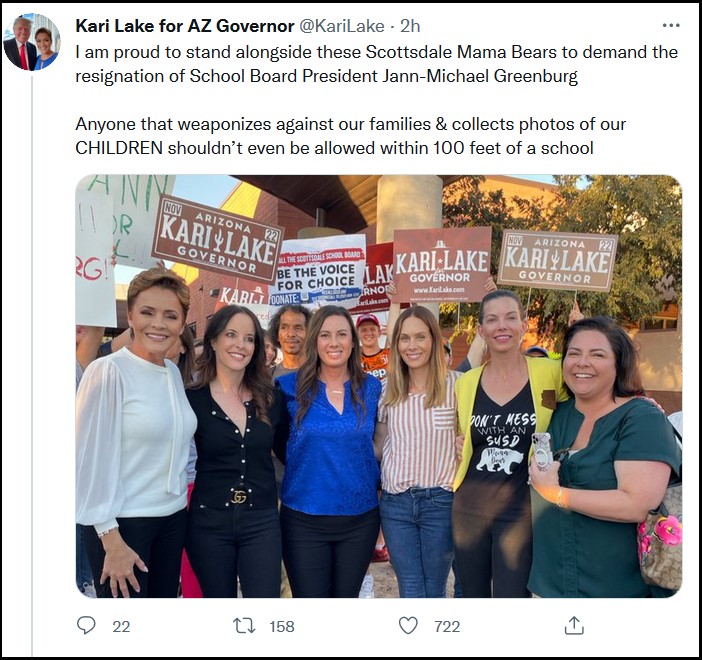
The Scottsdale Unified School District in Arizona was scrambling after a group of moms discovered that Board President Jann-Michael Greenburg was keeping secret surveillance files, a dossier of sorts, on parents and students the school board head viewed as a risk to the interests of the district.
In essence what the parents discovered was evidence their own school system was keeping creepy opposition files on the parents of students in the school district.
Parents gathered today to demand the removal of the Governing Board President Jann-Michael Greenburg, and the destruction of the Google Drive files filled with personal information, documents, and photos of about 47 people, including children.
Creepy Mr. Greenburg was removed, but not fired.
SCOTTSDALE, AZ — Jann-Michael Greenburg has been ousted as the Scottsdale Unified School Board president following controversy over a dossier of information he is accused of keeping on parents who were openly critical of the district.
The board voted 4-1 Monday evening to elect board member Patty Beckman to replace Greenburg as the president for the remainder of his term. Board members Zach Lindsay and Libby Hart-Wells called for Greenburg’s resignation, but Greenburg did not resign. Greenburg is still a member of the board, although stripped of the title of president. (read more)
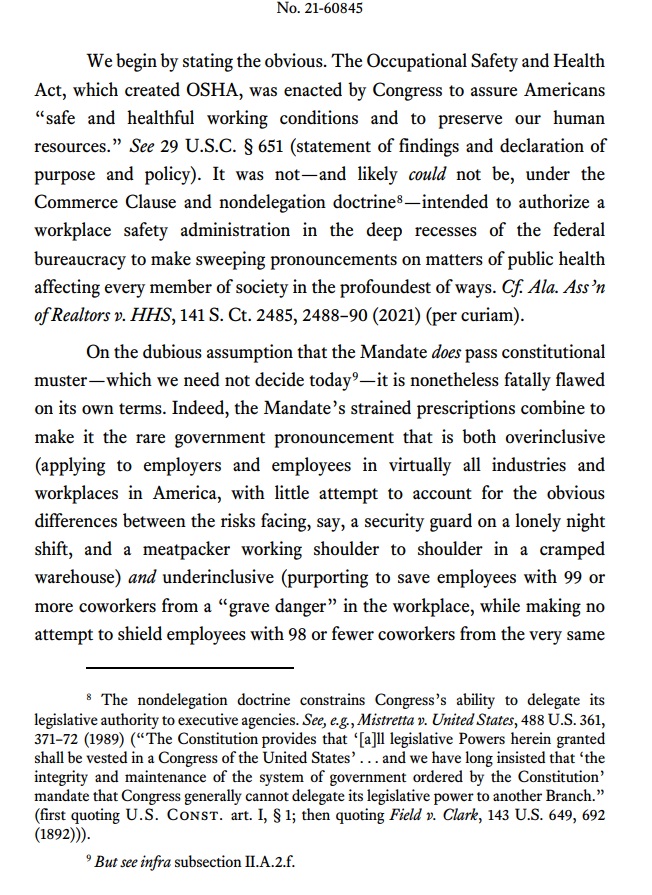
The three judge panel upheld its previous decision to put a stay on the order by Joe Biden against companies with 100 workers or more. The Biden administration had instructed the Department of Labor to require COVID-19 vaccines. The Biden administration’s effort to use an Emergency Temporary Standard OHSA rule was rejected by the court citing numerous flaws in their review and ruling:
Kyle Rittenhouse shot and killed Joseph Rosenbaum and Anthony Huber as he was being attacked by a raging mob. Rittenhouse, also fired on Gaige Grosskreutz as the attacker held a handgun toward him. Prosecutors claim that Rittenhouse was a vigilante looking for a fight. The defense, and all video of the events, show all shootings were justifiable self defense.
The trial continues today with the defense putting on its case. PBS Livestream Link
This article is written as both a representative disconnect of the current administration, and also as a direct warning to readers of a never before seen increase in U.S. food prices. As grandma always said: “charity begins at home.”
Earlier today in Paris, France, Kamala Harris waxed as philosophically as she could about the inequities around the globe. Specifically, she proclaimed that world leaders have no excuse for some unknown “we” creating enough food to “feed the entire world” while children are hungry.
The words written for Harris to recite may sound good to an audience who values their own virtue through hollow soundbites and empty phrases; however, there is a very stark and concerning disconnect specifically when it comes to U.S. leadership making these proclamations. Watch first 30 seconds (prompted):
.
“Why have we allowed so many of the world’s children to go hungry when we know that we produce enough food to feed the entire world. […] We must instead agree that these growing gaps are unacceptable,” Harris proclaims with maximum virtue-signaling emphasis in the effort to raise her approval rating.
Meanwhile, the Biden-Inflation cost of food in the United States is increasingly becoming a problem for working class Americans. Forget feeding children around the world, we are weeks away from people not being able to feed their own kids, and massive shortages in the stop-gap systems like food banks.
I’m not sure people understand yet exactly how desperate things are going to become, so let me be very specific for an audience of long-term readers who have my track record of accuracy to measure my predictions. Within the next 120 to 180 days, you are about to see butter cost $8 to 10.00/lb at your local supermarket. Bread will cost $6.00 a loaf, minimum, and other key staple item food prices, in the first two quarters of 2022, will increase 20 to 30% from where they are right now.
During a speech in Jacksonville earlier today, Florida Governor Ron DeSantis discussed some of the potential state actions that can be taken to block the distribution of illegal aliens into the state.
Joe Biden has been sending covert flights of illegal alien border crossers into Florida in the late night hours. Governor DeSantis is now looking at punitive damages, or state level punishment, against the private sector contractors who are facilitating the transport. Additionally, DeSantis noted one potential solution would be for Florida state law enforcement to put the illegal aliens onto chartered buses and sending them to Joe Biden’s home state of Delaware.
We are witnessing a very specific type of electoral frustration caused by officials within a system attempting to stop a communist style fundamental change by taking action within the same system simultaneously collapsing through the actions of the communists.
Joe Biden’s approval rating has collapsed to the lowest level in history {data here} ,which would normally cause a pause amid the political operators.
However, in this new era, where collapsing the U.S. economic and social system is the objective, the polling is irrelevant.
The Obama plan to use Biden as a disposable figure was designed for one specific four year term of maximum damage.
The polling is irrelevant.
Evidence of this purpose is found in the White House telling businesses to continue operating as if the vaccine mandate is legally authorized, despite a court ordered injunction against it {data here}. We are in a post-constitutional system now where the traditional checks and balances are ignored. This is a very Machiavellian approach being deployed against the American people.
The U.S. borders are unsecured, and illegal alien hordes are intentionally welcomed. Again, by design. Simultaneously, the U.S. military is likely to be put into a crisis position by thousands of critical servicemen rejecting the mandated vaccine {data here}. Yes, another element of the design. Saul Alinsky taught the designers how to overwhelm and collapse the system, they are doing exactly that.
Last week in an event to promote ‘environmental justice‘, Kamala Harris emphasized the priorities of the Biden administration when she held an event to highlight how trees are racist. This week Transportation Secretary Pete Buttigieg wanted to promote ‘construction and logistic equity‘ while emphasizing the priorities of the Biden administration, so Buttigieg declared that roads and bridges are racist. WATCH:
Gaige Grosskreutz was one of the attackers of Kyle Rittenhouse in Kenosha Wisconsin last year. After giving testimony earlier today attempting to paint himself as a victim of Rittenhouse, the witness/attacker admitted today in during cross examination he was shot only after he threatened Rittenhouse by pointing a gun at him inches away from his head.
While the prosecution hoped Grosskreutz’s sketchy testimony would assist their case, the actual testimony supports the defense claim of Rittenhouse acting in self defense after being attacked by a mob. The crushing admission is below (prompted to 08:10) WATCH:
.
The prosecution case just collapsed. Rittenhouse, now 18, is charged with homicide and attempted homicide for shooting three people during the Kenosha riots as the mob attacked him. Rittenhouse shot and killed 36-year-old Joseph Rosenbaum, 26-year-old Anthony Huber, and wounded Gaige Grosskreutz. All of the people shot by Rittenhouse were attacking him at the time.

 In essence what the parents discovered was evidence their own school system was keeping creepy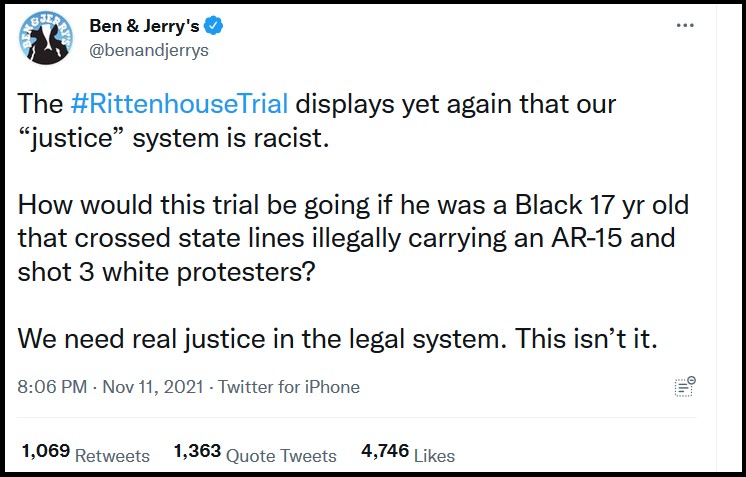
 Joe Biden’s approval rating has collapsed to the lowest level in history {