Quantcast

Rut Roh, USDA Approves First Vaccine for Honeybees

Um, I’m not saying that introducing a genetically modifying vaccine into the human population through the use of the pollinizing process in agriculture via honeybees was a plot line for an X-Files movie, except it actually was. Now this:

(New York Times) – A biotech company in Georgia has received conditional approval from the U.S. Department of Agriculture for the first vaccine for honeybees, a move scientists say could help pave the way for controlling a range of viruses and pests that have decimated the global population. It is the first vaccine approved for any insect in the United States.

The company, Dalan Animal Health, which is based in Athens, Ga., developed a prophylactic vaccine that protects honeybees from American foulbrood, an aggressive bacterium that can spread quickly from hive to hive.

[…]  The vaccine is incorporated into royal jelly, a sugar feed given to queen bees. Once they ingest it, the vaccine is then deposited in their ovaries, giving developing larvae immunity as they hatch.

[…] In 2015, she and two other researchers identified the specific protein that prompts an immune response in the offspring and realized they could cultivate immunity in a bee population with a single queen. 

[…] The introduction of a vaccine comes at a critical moment for honeybees, which are vital to the world’s food system. […]  honeybees pollinate about one-third of the food crops in the United States and help produce an estimated $15 billion worth of crops in the United States each year. Many beekeepers lease their hives across the country to assist in pollination of almonds, pears, cherries, apples and other types of produce.  (read more)
(more…)

Sunday Talks, Bank of America Economist Michael Gapen: Housing Currently in Recession, 2023 “Will Be Difficult Year”, with Continued Financial Pretending

The New Year brings a look of forward-looking economic perspectives from major financial institutions.  Unfortunately, if the perspective of Bank of America Chief Economist Michael Gapen is reflective of the larger institutional analysis, the financial pretending is anticipated to continue.

[Side Note: Notice how they will all start talking about ‘deglobalization’ in 2023. There’s a reason for that that I will touch on in the IMF interview to follow]

Appearing on Face the Nation Gapen accurately indicates the U.S. housing market is already in a steep economic recession, housing prices falling rapidly with a considerable amount of distance to go (-30% range), and the overall housing market will likely be in this situation for around two years.  On a macro level the Bank of America indicators line up with the general housing trajectory.  From a lending standpoint, Gapen would have specific insight.

Beyond the housing sector, Mr. Gapen starts to get sketchy.  He anticipates inflation taking 24 to 36 months to lower to the norm 2% range.  That is generally in line with CTH expectations; however, nowhere in the analysis does Gapen even mention energy costs and the overall impact to the economy from energy policy.  You will note this absence will be present in almost all financial punditries.  Mentioning “energy policy’ as a cause of economic pain is a third rail amid his peer group; it is simply not permitted.

Astute readers will note the great financial and economic pretending that surrounds the Build Back Better and Green New Deal climate change agenda will not be discussed by anyone, ever. The massive price impacts, the supply side inflation pressures, are baked into the western global economic outlooks.  It is strictly verboten to talk about climate change policy being stopped, modified, reversed or even, well, gasp, removed.  WATCH:

[TRANSCRIPT] – […] BANK OF AMERICA CHIEF ECONOMIST MICHAEL GAPEN: Happy New Year as well. Thank you for having me on.

MARGARET BRENNAN: You know, a majority of voters polled by The Wall Street Journal say that the economy is going to look and feel worse in 2023. What is your forecast?

GAPEN: So I think that’s probably true. I think we’re in a situation where the risk of recession is high, may not be a deep and prolonged one. But we’re in a situation where the economy has recovered very rapidly from- from COVID, and it’s come with a lot of inflation. And the Federal Reserve is trying to slow down the economy, to bring inflation down. And in the past, more often than not, that’s coincided with some sort of recession in the US economy and the U.S. labor market. It’s not baked in. It’s not for certain. We may be able to avoid it, but I would agree that the outlook by most people who sit in the position that I do think 2023 could be a difficult year for the U.S..

MARGARET BRENNAN: So we may be able to avoid recession?

GAPEN: Yes.

MARGARET BRENNAN: Or it could be mild?

(more…)

Egg Prices Surge to Record Levels as Christmas Grocery Prices Hit Consumers

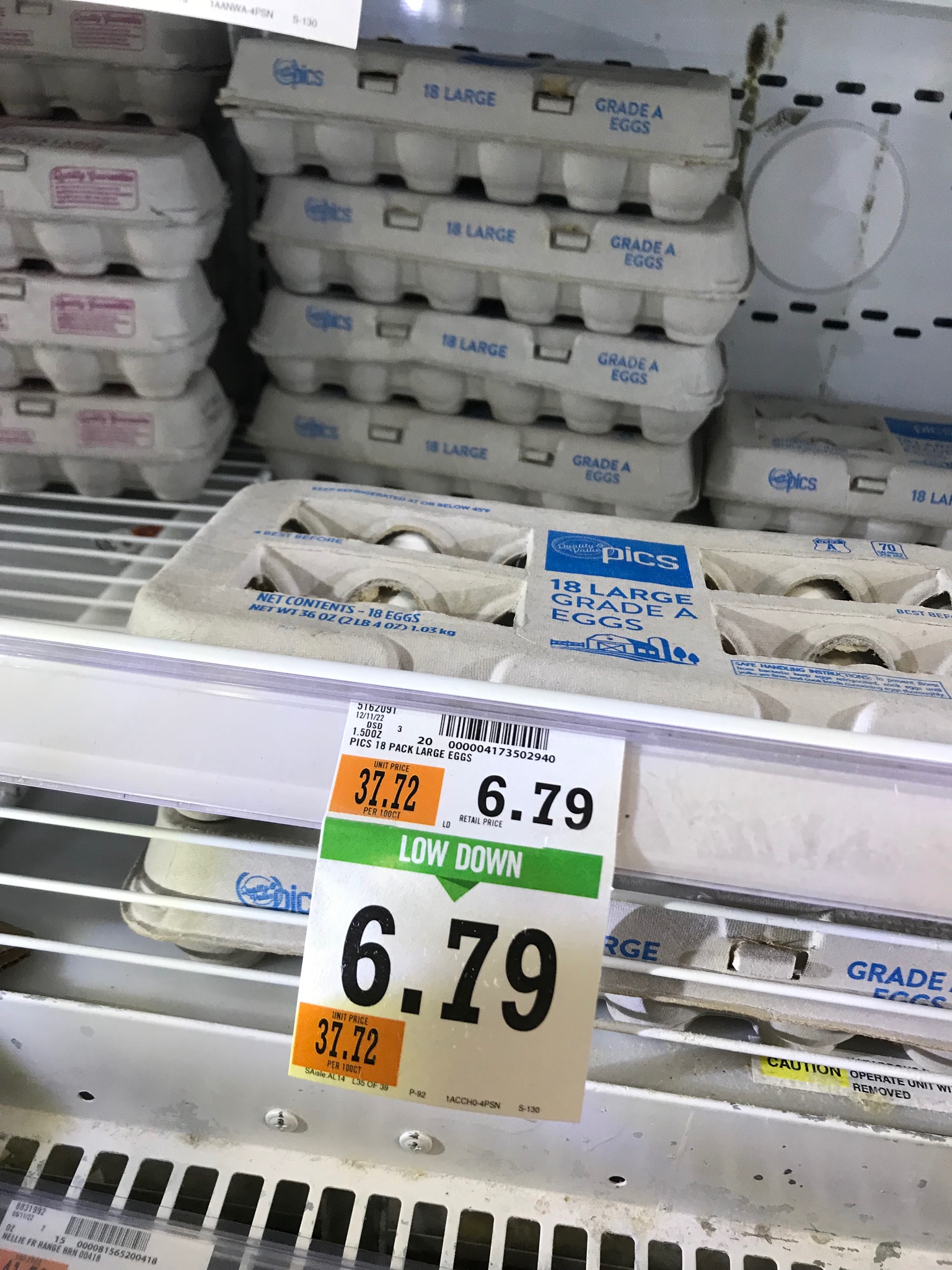
The price for a dozen eggs continues climbing as explanations turn toward blaming bird flu.  However, the avian influenza may explain a recent spike, but the longer duration of escalating food price commodities is much deeper than momentary fluctuations.  These are energy dependent products.

As CTH noted last year, watch egg prices as a general gauge for overall food inflation (eggs hit almost every process in the supply chain), and watch potato availability to gauge overall row crop stability (staple commodity on every plate, venue).

Additionally, as previously noted, as energy prices continue rising pay attention to the prices on ‘organic’ products.  Rising energy prices drive up costs for large commercially processed food supplies at a much higher rate than smaller organic production.  People are starting to notice the ‘organic’ option is almost at price parity.

Wall Street Journal – […] Wholesale prices of Midwest large eggs hit a record $5.36 a dozen in December, according to the research firm Urner Barry. Retail egg prices have increased more than any other supermarket item so far this year, climbing more than 30% from January to early December compared with the same period a year earlier, and outpacing overall food and beverage prices, according to the data firm Information Resources Inc.

For supermarkets, eggs are a staple product that most consumers pick up on trips to the grocery store, similar to milk and butter. To maintain store traffic, grocers said they have been sacrificing some profits on eggs to keep prices for consumers competitive. Some suppliers are projecting potential relief in price by February or March, but cold weather could hamper production in the near term, executives said.

(more…)

Neil Oliver Outlines the Consequences of the Western Alliance Decision to Limit Energy Development as “Winter is Coming”

Using the outline of the previous global famine to trace a modern history of desperation and the Live Aid movement rallying of the public to feed the world, Neil Oliver contrasts the current cultural Green Agenda 40 years later and the pending energy crisis.

If millions were at risk in the 1980’s, how many are likely at risk today?  Yet the same people, institutions and systems that rallied to save the hungry are right now the same people, institutions and systems willing to inflict more harm as they chase the false climate change agenda.  It is an interesting and brutally honest perspective.

Oliver then walks through the looming and predictable consequences as he follows the process to its logical conclusion. WATCH:

.

(more…)

Amish Farmer Targeted by Govt for Operating Outside Reach of USDA Regulations

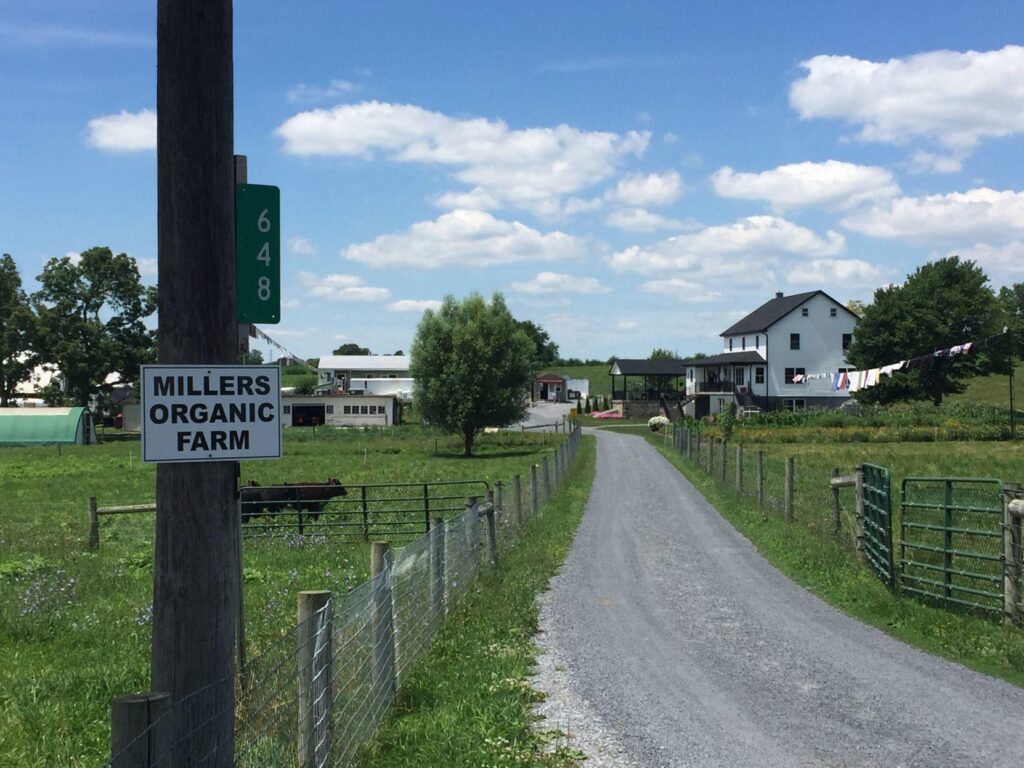
An interesting story promoted by Rebel News, highlights the plight of an Amish farmer who operates a private market club for his products.  Because his crops, dairy and beef are not sold to the ‘general public,’ and only to those who are members of the private food club, Amos Miller contends he should not be subject to USDA regulations.

Miller’s organic farm operates on century old farming practices.  His farm uses no electricity, no tractors, no diesel, no gasoline, and he produces exceptional all natural yields which people are willing to pay top dollar to purchase.

Additionally, because Mr. Miller doesn’t use chemical fertilizer or fuel, his farm has not been impacted by the increased costs that have hit industrial farms.  He and his customers are completely unaffected by outside influence.

However, a federal judge ruled that despite his closed members-only market, he must have USDA inspectors for his beef and cattle slaughter processes.  Miller does not want to use the regulated and required pharmaceutical antibiotics, and other regulatory processes required by the USDA.  He now faces jail time and a $300,000 fine. [Rebel News Article]

While CTH is completely on the side of the Miller farm, it’s not fair to share this story without providing the alternative perspective from the side of the regulatory agencies.

(more…)

McDonalds Dumps Trial of Plant Meat Because Customers Would Not Purchase – Next up, Bug Meat

McDonalds has announced they are dropping their program testing plant-based meats because people didn’t like it.

As noted by the Washington Times, “other trials at Panda Express and Yum! Brands (KFC, Taco Bell, and Pizza Hut) have also ended without a subsequent product launch. Beyond Meat products at Dunkin’, Hardee’s, and A&W have been discontinued after launching.”

Apparently, American consumers do not want to eat fake meat; at least not fake meat made from plants.

Next up….  Bug meat.

(more…)

Pretending Has Consequences – Western Media and Western Govt Continue Saying, Falsely, Global Food Crisis Caused by Russia

As oft repeated, in order for severe ideologues to retain their insufferably bad policy they must pretend not to know things.  However, in the case of food shortages, the pretending about the origin of the problem has severe consequences.

Vladimir Putin’s military action against eastern Ukraine had nothing to do with the severe food shortages and inflation in Sri Lanka {link}.  Nor does Putin have any influence over the Dutch government trying to stop food production {link}.  Additionally, Putin has no control over Justin Trudeau’s decision to limit harvest yields by blocking the use of nitrogen-based fertilizer {link}. More importantly, it was not Vladimir Putin who forced all the western politicians to sign up for a new ‘climate friendly’ energy program that is destroying the ability of western farms to generate higher yield crops.

You do not need to be a farmer to understand that nitrogen/phosphorus-based industrial fertilizer has been the reason why farm yields have generated massive amounts of food on a global basis.  The United States, Canada, the U.K. and places like the Netherlands have massively increased their ability to generate food for export, in large part due to the success of improved fertilizer and crop saving modern pesticides.  Take those farming advancements away under the guise of climate change and you get a global Sri Lanka.

Those western climate and energy policies create downstream consequences.  The decision to chase a new global energy policy under the name “Build Back Better,” in combination with short-sighted EU sanctions against Russia, and you get food shortages. And boy howdy are they trying to avoid taking responsibility for it.

It was not Vladimir Putin who told British Prime Minister Boris Johnson and German Chancellor Olaf Scholz their proactive recommendation to switch from crop-based biofuels to human food would be blocked.  That G7 decision was made by Justin Trudeau and Joe Biden. {link} Even more significantly, it was not Russia who threatened the multinational energy companies about investing in Africa for expanded natural gas supplies for their fertilizer needs. That threat came from the same western government alliance, per their instructions from the World Economic Forum group {link}.

(more…)

U.S. Public Broadcasting Promotes American Diet of Insects to Support Biden Administration Climate Change Initiatives

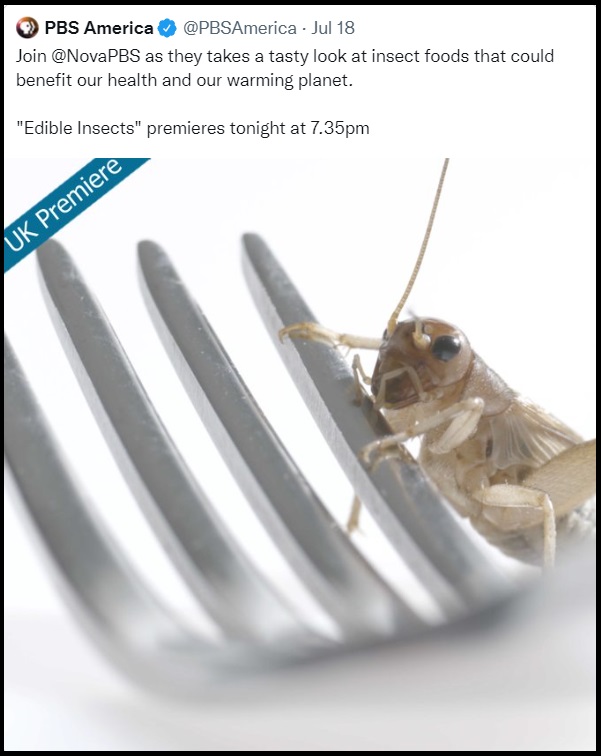
The goal of gaining public acceptance for eating insects instead of meat is now part of the Public Broadcasting Service (PBS) effort.  The larger climate change objective is to “transition” the global food supply away from cows, pigs and chickens, and toward a more sustainable lifestyle of eating insects and bugs.   Farmers in North American and Europe are facing massive regulatory changes as part of the Build Back Better or Green New Deal initiatives.

In the U.S. Joe Biden has pledged his entire administration effort toward the goal of reducing U.S. carbon emissions and protecting the planet.  Part of that initiative includes the need to change the diet of Americans away from traditional farm proteins, and toward sustainable alternatives via bugs and/or insects like cockroaches, crickets and grasshoppers.

A comprehensive marketing, branding and image campaign is underway to change the public perception toward an acceptance of sustainable algae and bugs as food sources.  Public Broadcasting (PBS) is part of that imitative:

(SOURCE)

Several U.S. food manufacturers now include insects and bugs as part of their ingredient list.  It would be worthwhile checking the labels on the latest snack foods to identify the percentages of worms and bugs that may be included in your favorite salted snack.

Additionally, a significant investment has taken place in Canada where they are now generating 9,000 metric tons of crickets to replace traditional protein sources (link).  The public/private partnership in London, Ontario, is now shipping crickets for use by North American food manufacturers.  There has been minimal public pushback against the effort and the government appears to be fast-tracking insects as food alternatives for global shortages of grain and meats.

(more…)

Eva Vlaardingerbroek Summarizes all the Merging Food, Energy and Farming Issues with Stark Advice to Americans

Eva Vlaardingerbroek is a GB News correspondent and conservative voice from Holland.  In this interview segment with NTDNews Ms. Vlaardingerbroek outlines what is happening in the Netherlands with the Dutch farm protests and how it connects to the larger Agenda 2030 goals.

In the last 20 seconds of the segment, Vlaardingerbroek has some solid advice for Americans.  WATCH (2 mins):

https://youtu.be/nQ-dIFyYXPI

To really get a strong reference point for how the global ruling elites at the World Economic Forum think about farming and climate change, which includes the brain trust at the World Health Organization, I would urge you to read THIS ARTICLE from the Irish Farmers Journal.

(more…)

Neil Oliver Analyzes the Global Uprisings that are Rejecting the Build Back Better Agenda

Appearing on GBNews with Dan Wootton, UK commentator Neil Oliver discusses and connects the Sri Lanka protests, the uprising in the Netherlands, and the aligned protests in Poland, Italy, Germany and much of the European continent.

As Oliver notes the pretorian guards for western politicians, aka the ‘western media’, are doing everything they can to ignore the global scale of the popular uprisings that are directly connected to the globalist agenda of the World Economic Forum and their Build Back Better orders to the western politicians.  The media ignore the issue until it reaches a point like Sri Lanka where it can no longer be ignored.  WATCH:

The Canadian trucker protests were targeted by Canadian Prime Minister Justin Trudeau in an effort to quickly stop the spread of any opposition to the globalist agenda. However, in the Netherlands the Dutch farmers have several distinct advantages in their ability to impact the life of ordinary Dutch people, as they refuse to become victims to the new global feudalism.

Like Sri Lanka, the Netherlands is a case study in raw people power, where the government is represented by a select few people.  The only thing keeping the Dutch from storming the politicians’ palaces and government buildings is a preference for polite society.  If that preference changes, and it might as people get more desperate, well, katy-bar the door.

(more…)