Quantcast

Memos of Conversations Between George W. Bush and President Vladimir Putin Are Released

BUMPED Due to Importance:

Following a series of FOIA lawsuits, memos from conversations between Russian Federation President Vladimir Putin and former US President George W. Bush have been released online by the National Security Archive. [Original Source Here]

I know it’s Christmas, but bookmark or review as time allows, because the content is very interesting and very important. As early as 2001 and 2008, President Putin clearly told President Bush of his opposition to Ukraine’s accession to NATO, along with other key positions.

Despite what popular media might say, these are NOT full transcripts. Rather, they are memos containing quotes from both leaders as they discuss geopolitical relations between the U.S. and Russia. [SOURCE HERE]

♦ June 16, 2001 – Memorandum of Conversation. Subject: Restricted Meeting with Russian President Vladimir Putin. [LINK HERE] In this first personal meeting at the Brno Castle in Slovenia Vladimir Putin and George W. Bush express respect for each other and desire to establish a close relationship. Putin tells Bush about his religious beliefs and the story of his cross that survived a fire at his dacha. In a short one-on-one meeting they cover all the most important issues of U.S.-Russian relations such as strategic stability, ABM treaty, nonproliferation, Iran, North Korea and NATO expansion. Bush tells his Russian counterpart that he believes Russia is part of the West and not an enemy, but raises a question about Putin’s treatment of a free press and military actions in Chechnya. Putin raises a question of Russian NATO membership and says Russia feels “left out.” [READ MEMO HERE]

(more…)

The EU Leaders Shouting About Visa Bans Are the Same EU Leaders Who Sent Political Operatives Into the U.S. to Support Kamala Harris

EU leaders from across the spectrum of their collective assembly, are furious with the administration of President Donald Trump for restricting their entry into the United States by blocking their visa permissions.  However, these same EU leaders are the people who sent operatives into the United States in order to interfere in our 2024 election.

The Vice President of the European Commission, Kaja Kallas, sums up the European position: “The decision by the U.S. to impose travel restrictions on European citizens and officials is unacceptable and an attempt to challenge our sovereignty. Europe will keep defending its values — freedom of expression, fair digital rules, and the right to regulate our own space.

The “attempt to challenge our sovereignty” statement is a particular type of hubris when we consider THIS:

GREAT BRITAIN (October 2024) – The British Labour Party is sending approximately 100 current and former staff members to the United States to work for Vice President Kamala Harris’ campaign in key swing states.

[SOURCELINKEDIN]

Not only did the U.K attempt to challenge our sovereignty, but they also actively worked to influence the outcome of our national election in 2024.

The same pearl-clutching assembly, now standing jaw-agape at the Trump administration recognizing their censorship, are the same assembly who engaged in political operations intended to influence the voting voice of the American electorate.

Methinks they doth protest too much.

(more…)

Promethean Action: Britain’s Secret Plot

Lyndon LaRouche (1922-2019) was a rather eclectic communist in the world of American politics for several generations. A few of his perspectives were sound and nationalistic. However, many of his perspectives were completely communist and slipped into the realm of geopolitical conspiracy theory finding British Imperialism under every rock and blaming Queen Elizabeth II for assassination attempts against him.

Susan Kokinda and Barbara Boyd of Promethean Action continue the LaRouche tradition while smoothing out some of the more outlandish elements and removing the overt communism the originating political movement was known for.

Barbara Boyd is the spokesperson and treasurer of the LaRouche Youth Movement. Boyd’s partner, Susan Kokinda, maintains a belief that eliminating British Imperialism is the objective of President Trump’s America-First policy agenda.  This is where I disagree.

While the outcome of President Trump’s policy does factually lead to the result LaRouche advocated, I strongly doubt “eliminating British imperialism” is the prism through which Donald Trump’s thought process flows.  That said, in the overall picture of American politics, the Kokinda and Boyd analysis of Trump’s international opposition is generally accurate, but their perspective on the domestic opposition is entirely shallow.

In their recent update, “Britains Secret Plot”, Susan Kokinda discusses how Marco Rubio is confronting the EU censorship program, and how President Trump’s national security strategy marks a significant departure from over a century of British-influenced American foreign policy.  Her review delves into the geopolitical friction between the U.S. and the UK, particularly regarding their strategies toward Russia and Ukraine.

Mrs. Kokinda underscores the broader clash of worldviews between America-First sovereignty and British-led internationalism. This episode also examines the opposition Trump faces from within the U.S. political establishment and British geopolitical strategists and emphasizes the importance of maintaining political support to ensure the success of Trump’s transformative policies.  WATCH:

The divergence between the worldview of the European Union and President Trump is accurately presented as above.  The Ukraine/Russia war serves as a case study in how the two worldviews conflict.  The core of U.K policy and national security strategy continues to view Russia as the biggest threat; the national security outlook by President Trump does not.

On the domestic side of the issue, there are several American elements in direct opposition to the geopolitical policy structure of President Trump. Understanding the domestic opposition to President Trump is where Kokinda/Boyd are shallow, while seeing British control behind every shadow.

(more…)

Zelenskyy and EU Leaders Release Official Position and Joint Statement Following Berlin Negotiations – USA Did Not Sign

Before getting to the details as released for media consumption, three facets deserve emphasis.

(1) The primary objective of Ukraine/EU has been a publicity campaign to retain influence and support. (2) U.S. Emissaries Witkoff and Kushner are silent on the announced negotiated result. (3) Ukraine’s lead negotiator Rustem Umerov notes, “There is a lot of noise and anonymous speculation in the media right now. Please don’t fall for rumors and provocations. The American team led by Steve Witkoff and Jared Kushner are working extremely constructively to help Ukraine find a way to a peace agreement that lasts.”

I would overlay that within the weeks of discussions it is easy to spot distance between Umerov and Zelenskyy, specifically as it pertains to the influence of the EU Leadership group.  Meaning, Zelenskyy is a puppet for the EU team, whereas Umerov appears more pragmatic and seemingly more focused on the interests of Ukraine.

Additionally, despite the violence and death in the war, Ukraine President Volodymyr Zelenskyy continues to say he is in no hurry to end the bloodshed.  This becomes more important to recognize when you look at the post-Berlin comments from Zelenskyy himself.

First, to the outcome of the negotiations as expressed by the EU Leadership team.

This is their official joint statement on their position within the framework.  Again, not signed or accepted by the U.S delegation. [SOURCE]

The Leaders welcomed significant progress on President Trump’s efforts to secure a just and lasting peace in Ukraine. They also welcomed the close work between President Zelenskyy’s and President Trump’s teams as well as European teams over the recent days and weeks. They agreed to work together with President Trump and President Zelenskyy to get to a lasting peace which preserves Ukrainian sovereignty and European security. Leaders appreciated the strong convergence between the United States, Ukraine and Europe.

Leaders agreed that ensuring the security, sovereignty, and prosperity of Ukraine was integral for wider Euro-Atlantic security. They were clear that Ukraine and its people deserved a prosperous, independent, and sovereign future, free from fear of future Russian aggression.

Both the US and European leaders committed to work together to provide robust security guarantees and economic recovery support measures for Ukraine in the context of an agreement on ending the war. This would include commitments to:

(more…)

British Intelligence Head Says Prepare for War Against Russia

The newly appointed head of MI6, Blaise Metreweli, formerly known by her position as “Q”, is literally the granddaughter of factual Ukraine Nazi, Constantine Dobrowolski.  Now, as head of MI6 Metreweli wants war with Russia.

In a rather remarkable speech to the British people, Blaise Metreweli proclaimed Europe is in “the space between peace and war,” with a direct military conflict with Russia looming as the biggest threat.  Metreweli declared, “Our world is being actively remade, with profound implications for national and international security.”

Seemingly targeting a shift in U.S. position toward Europe, Metreweli said, “Institutions which were designed in the ashes of the Second World War are being challenged. New blocs and identities forming and alliances reshaping. Multipolar competition in tension with multilateral cooperation.” 

She went on to imply the risk evident in Elon Musk by saying, “Power itself is becoming more diffuse, more unpredictable as control over these technologies is shifting from states to corporations, and sometimes to individuals.”

The once Great Britain is a collapsing society, completely incapable of controlling the Islamic extremist population within the nation.  Heck, they cannot even stop rubber boats filled with illegal aliens who are crossing the British channel daily, while gangs of rapists run unchecked through the streets of the U.K.

Metreweli’s remarks about preparing for war against Russia would be laughable, were it not for the top intelligence position she occupies which makes her statement alarming.  An expanded segment of her remarks is transcribed below:

(more…)

A Contrast in American vs British National Security Priorities

Lyndon LaRouche (1922-2019) was a rather eclectic fellow in the world of American politics for several generations. Some of his perspectives were sound and nationalistic, and some of his perspectives slipped into the realm of geopolitical conspiracy theory finding British Imperialism under every rock and blaming Queen Elizabeth II for assassination attempts against him.

Susan Kokinda and Barbara Boyd of Promethean Action continue the LaRouche tradition while smoothing out some of the more outlandish elements the originating political movement was known for. Barbara Boyd is the spokesperson and treasurer of the LaRouche Youth Movement. Boyd’s partner, Susan Kokinda, maintains a belief that eliminating British Imperialism is the objective of President Trump’s America-First policy agenda.  This is where I disagree.

While the outcome of President Trump’s policy does factually lead to the result LaRouche advocated, I strongly doubt “eliminating British imperialism” is the prism through which Donald Trump’s thought process flows.  That said, in the overall picture of American politics, the Kokinda and Boyd analysis of Trump’s opposition is generally accurate.

In their most recent update, Susan Kokinda discusses how President Trump’s recent national security strategy marks a significant departure from over a century of British-influenced American foreign policy.  Their review delves into the geopolitical friction between the U.S. and the UK, particularly regarding their strategies toward Russia and Ukraine.

Mrs. Kokinda underscores the broader clash of worldviews between America-First sovereignty and British-led internationalism, highlighting the latest developments including reactions from Russia and European elites. The episode also examines the opposition Trump faces from both within the U.S. political establishment and British geopolitical strategists and emphasizes the importance of maintaining political support to ensure the success of Trump’s transformative policies.  WATCH:

The divergence between the worldview of the European Union and President Trump is accurately presented as above.  The Ukraine/Russia war serves as a case study in how the two worldviews conflict.  The core of U.K policy and national security strategy continues to view Russia as the biggest threat; the national security outlook by President Trump does not.

(more…)

President Trump Gives Extensive Comments on State of Ukraine-Russia Conflict

President Trump sat down for an extensive interview with Dasha Burns of Politico.  Despite the ideological outlook of Politico, the interview itself was remarkably absent of combative antagonism. The result is a good review of the current positions of President Trump as they relate to the rest of the world.

The Ukraine-Russia conflict is the immediate issue that is discussed within the interview.  President Trump answers some direct questions about who is currently most responsible for continuing the conflict and is asked his opinion directly on Ukraine not holding elections.

President Trump notes Russian President Vladimir Putin is in the strongest position within the conflict and carries the strongest leverage into any ceasefire negotiations.  Trump also frames the need for the bloodshed to end with a much greater sense of urgency than any of the EU leaders or Zelenskyy.  Additionally sharing the opinion that Ukraine needs to have an election to showcase the will of the Ukrainian people in the leadership of Volodymyr Zelenskyy.  WATCH:

.

(more…)

Zelenskyy Met with Starmer, Merz and Macron – Now Heading to Brussels

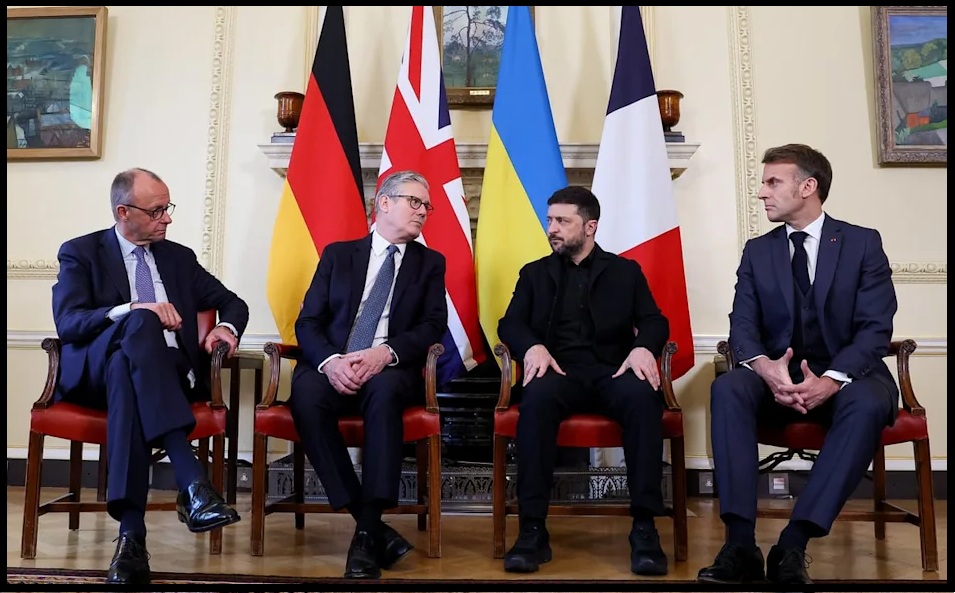
Yesterday, Ukraine President Volodymr Zelenskyy traveled to London to meet with British PM Keir Starmer, German Chancellor Friedrich Merz and French President Emmanuel Macron.

As expected, part of the Zelenskyy meeting with the “coalition of the willing” included a briefing by Ukraine negotiator Rustem Umerov, the secretary of Ukraine’s National Security and Defense Council, who held detailed consultations for three days last week in Miami with Trump’s envoys Steve Witkoff and Jared Kushner.

President Zelenskyy then departed London traveling with his media entourage to Brussels for the next round of discussions with the European Union stakeholders, financiers and politicians. During the trip Zelenskyy told his media stenographers, “Under our laws, under international law — and under moral law — we have no right to give anything away. That is what we are fighting for.

The U.K, France and Germany support Zelenskyy’s position that he is not going to concede any territory to the Russian Federation, specifically the 30% of the Donbas area in Eastern Ukraine currently at the heart of the physical conflict.

The 30% issue surrounds the Donetsk region in Ukraine, which includes the cities of Kramatorsk and Sloviansk. Russia is currently pushing deep into fortified Ukraine resistance in this region with a population of around 100,000. Zelenskyy claims losing this area would allow Putin to invade the Dnipropetrovsk, Zaporizhzhia and Kharkiv regions.

(more…)

Following Three Days of Talks with U.S, Team Zelenskyy Heads to London for Meeting With “Coalition of the Willing”

Following three days of negotiations in Florida (Thur, Fri, Sat) between President Trump emissaries Steve Witkoff and Jared Kushner, and Ukraine emissaries Rustem Umierov and Andrii Hnatov, the group then held a 2-hour phone call with Ukraine President Volodymyr Zelenskyy.

No substantial progress was reported.  However, military officials Umierov and Hnatov then flew to meet Zelenskyy in London where French President Emmanuel Macron, British Prime Minister Keir Starmer and German Chancellor Friedrich Merz are assembled to discuss alternatives to ending the conflict.

Starmer, Macron and Merz form the core of the “coalition of the willing,” an EU group who have unilaterally proclaimed they were willing to send the military of the U.K, France and Germany into Ukraine so long as President Trump would backstop their troops with promises of U.S. intervention if things went badly.  Trump would not make that commitment.

Zelenskyy Inc, Macron, Starmer and Merz do not want to end the proxy fight against Russia.  Together with the EU leadership of NATO, the coalition of the willing want to retain the conflict.  However, the problem for the four leaders is that without strong USA support, the citizens of their EU countries will rise up against them.

Even with NATO missiles and transferred technological assistance, they ultimately need the American military in order to ensure Putin doesn’t squish them.  President Trump wants the proxy war to end – loggerheads are reached.

Russian President Vladimir Putin does not seem to be paying too much attention to the bureaucratic speeches and instead is continuing forward advancement [SEE HERE] to secure the territory in Ukraine with or without a negotiated settlement.

(more…)

President Trump’s 2025 National Security Strategy – Europe Is Destroying Itself

President Trump’s 2025 National Security Strategy is outlined in a detailed 33-page report.

In addition to setting the priorities for the United States focus, the report details the Trump administration perspective on the world as broken down into specific regions.  The report is a brutally honest review of the current state of geopolitical benefits, risks and threats as they pertain to vital U.S. interests.

[Full pdf Here]

In addition to outlining a critically renewed focus on the Western Hemisphere, the Trump administration also notes the practical position of Europe, as it pertains to NATO and dependency on the U.S.A.

In a brutally honest review of the situation, the Trump administration notes Europe is increasingly losing their own identity.  The fear the Europeans express about being vulnerable to Russian strength is hypocritical, in the sense that in practical outcomes the EU is purposefully weakening itself and simultaneously demanding assistance against their own weakness.

(more…)