Quantcast

Mexico and USA Begin Bilateral Preparations to Dissolve USMCA Without Canada

One of the most curious aspects to the predictable USMCA review, ie. dissolution, has been the incapacity of the Canadian government or trade delegation to accept the United States is going to create two distinctly different bilateral trade agreements and eliminate the trilateral USMCA.
For 16 months the Canadians have refused to fathom the reality of what is going to happen this year.

The Canadians just cannot believe it is possible they will be forced to negotiate a free trade agreement without the cover of a multilateral construct. It has been remarkable to watch their dissonance.

Last week President Donald Trump and Mexican President Claudia Sheinbaum held a phone call. At the conclusion of the call, Sheinbaum publicly asserted the reality the Canadians just refuse to accept.

MEXICO – Mexico’s President Claudia Sheinbaum told reporters during her morning news briefing on Wednesday that her U.S. counterpart, Donald Trump, is open to doing away with the U.S.-Mexico-Canada trade agreement (USMCA) and replace it with individual trade deals with each country.

[…] “There might be revisions that create bilateral deals instead of involving the three countries because some things are more important between Mexico and the United Sates or between Canada and the United States,” said Sheinbaum. “Not everything has to be trilateral.”

Mexico’s president said the subject was brought up by Trump during a Tuesday phone conversation. […] According to Sheinbaum, her country is ready to consider possible changes. (read more)

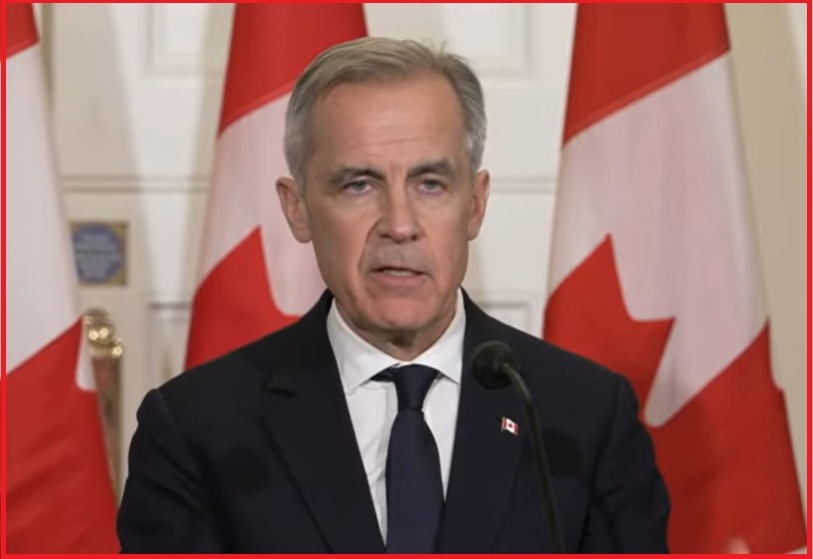
Canadian Prime Minister Mark Carney finally started to realize President Trump was likely to ignore Canada and begin direct discussions with Sheinbaum. So, Carney went to Mexico to try and get assurances from Sheinbaum that Mexico would not proceed without Canadian interests in mind.
(more…)

Part II – Europe and China Have an Energy Problem

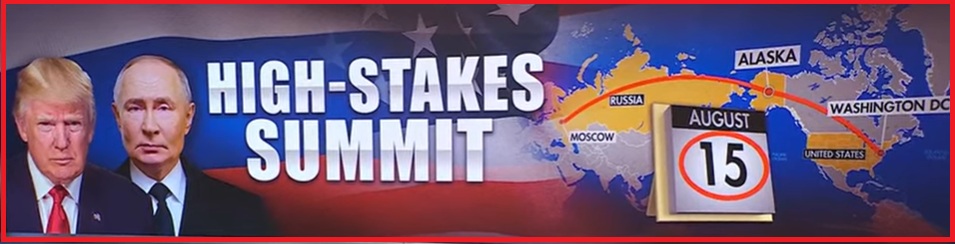
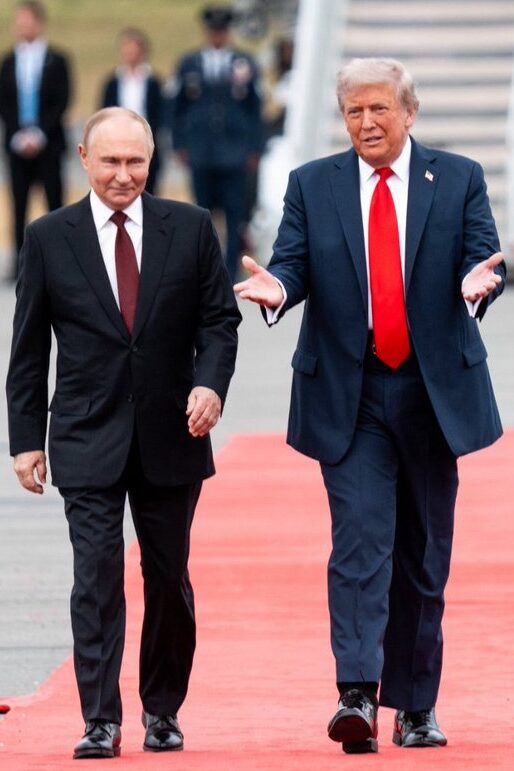
When President Donald Trump and President Vladimir Putin met in Alaska on August 15, 2025, the focus of the geopolitical world was on discussions surrounding Ukraine.  Unfortunately, it didn’t take long, merely a few hours, for both the U.S. and Russia to say that no progress was made.  However, also noted at the time was both the USA and Russia saying sideline discussions took place surrounding the possibility for a strategic relationship surrounding energy development.

What follows below is a review of the current energy dynamic, specifically surrounding LNG, against the backdrop of the Iran war with a hindsight review of that previous discussion between Putin and Trump.

What most people are missing in their current analysis was something that took place immediately following that Alaska summit six months ago.  Something that did not make any sense until now. {GO DEEP PART I HERE}

Three days after that summit meeting, on August 18, 2025, Russia announced they were restarting Russia’s Arctic-2 LNG production facility.  Russia would be more than doubling their capacity to generate and store liquified natural gas (LNG).

It absolutely did not make sense that Russia would start producing even more LNG considering the previously imposed western sanctions against them, and the fact that Russia was already overproducing LNG. As noted by analysts at the time:

AUGUST 18, 2025 – Russia’s Arctic LNG 2 export facility, which is sanctioned by the United States, is coming back to life after a year of no activity and is looking for buyers in Asia.

[…] The U.S. and EU sanctions on Russia’s Arctic LNG 2, which was billed as Russia’s flagship LNG project, have effectively frozen the start-up of the export facility in the Gydan Peninsula.

[…] Last year, Russia started shipping LNG from its flagship Arctic LNG 2 project—but not to customers. The shipments were made from the Arctic project to floating storage units either in Russia or in European waters, as potential customers were unwilling to buy the sanctioned LNG. {SOURCE}

In August of 2025, Russia was essentially producing more LNG than they could sell into the available market.  Russia was storing the overproduction from Arctic-1 on floating storage units and slowly selling to countries that did not align with the sanctions, specifically China and some Asian buyers.  Then suddenly, after the Trump summit, Russia decides to bring Arctic-2 online and produce even more LNG.  You can see how this did not make sense.

If they could not even sell all the Arctic-1 LNG output, then why would Russia bring Arctic-2 LNG production online?

That was six months ago.

(more…)

President Trump Delivers Remarks at Shield of The Americas Summit

[Full Backstory Here] – President Trump secured the border, began repatriation efforts, targeted narcotraffickers, confronted narco-terrorists, targeted Mexican drug cartel leadership, leveraged the DOJ to indict regional actors, pushed China out of control in the Panama Canal, took out Nicholas Maduro, took control of Venezuela oil production – both for the security of the U.S. and benefit of the Venezuelan people, removed the discounted oil benefit for China and reasserted stability in the Western hemisphere.

Then, with all that in place, he turned toward Iran…. but, proactively planned for a ‘Shield of the Americas Summit’ before the Iran operation began and scheduled it for today while Operation Epic Fury continues.  WATCH:

.

Additional video of the arrival ceremony below.

(more…)

Right Now, Russia is Like Amazon During COVID

We like the deep weeds, most do not.  The geopolitical ramifications of the U.S. confrontation with Iran are vast and complicated; however, to encapsulate one of the most interesting dynamics consider this ‘tldr’ statement to open the discussion with your friends: Right now, Russia is like Amazon during COVID-19.

What follows is not me saying President Trump and President Putin are holding nightly conversations, discussing steps or details, or even obliquely coordinating measures as Trump eliminates the generational threat posed by Iran.

However, I am saying that given the nature of all contact and communication between Trump and Putin, including extensive contacts by their representative emissaries, both Putin and Trump are well aware of each downstream effect from the Iranian confrontation.

Two days after the U.S./Israel began Operation Epic Fury, President Vladimir Putin said Russia should consider shutting down oil and liquified natural gas (LNG) shipments to the EU in advance of the previously scheduled April deadline date when the EU would stop purchases.

♦ First, remember ‘force majeure’ contract nullification is in place for every producer, supplier and transporter in the middle east. Second, with shipments from the Gulf of Oman greatly reduced, LNG prices along with oil prices are increasing rapidly.  The result – ships filled with oil and LNG currently on the water are diverting in real time as international bidding for the content of the ships take place.

If Putin stops selling LNG to Europe, and Europe cannot get LNG from the Gulf of Oman, and China/Asia are LNG dependent (not exporting), then where is Europe going to get the LNG to replace what Russia will no longer provide?

Answer: The United States, and to a lesser extent, Norway.

[SIDENOTE: now does President Trump continuously smacking Great Britain about shutting down their North Sea oil and gas operations take on context?  Geopolitical foresight? I digress. END SIDENOTE]

The European Commission’s decision to phase out and ultimately stop purchasing Russian oil/gas was made in 2025 prior to the Iran conflict triggering.  Europe’s replacement plan included increased LNG purchases from the U.S., Norway and middle east; the latter supply option is now void.

Europe’s decision to stop buying oil/gas from Russia puts them in a very precarious position.  The supply option for Europe is suddenly very limited, and Putin’s statement about stopping the flow early was obviously made with this understanding in mind.

(more…)

U.S. Treasury Secretary Scott Bessent Discusses U.S. Maritime Reinsurance and Global Energy Markets

The geopolitical ramifications of the oil and liquified natural gas (LNG) impact from the ongoing conflict with Iran is changing many of the world’s energy supply chains. Given the nature of the issues there are a myriad of complex dynamics to discuss. However, one key component is the U.S. policy shift to deal with the supply.

With that in mind, Treasury Secretary Scott Bessent appears with Larry Kudlow to discuss the United States’ new $20 billion maritime reinsurance plan as well as the ongoing conflict in Iran. CTH will be expanding the conversation specifically as it relates to Russian oil/gas sales. This is a good precursor interview. WATCH:

.

(more…)

President Trump: ‘No Deal with Iran Except Unconditional Surrender’

The U.S. and Israel have been targeting deep underground missile sites within Iran, with strong success.  Iranian counterstrikes, missile & drone launches are down 80 to 90 percent according to Pentagon officials.

Additionally, the Israeli military has reported they dismantled an underground bunker system in Tehran used by regime leadership.  Originally the bunker was used by slain Supreme Leader Ayatollah Ali Khamenei underneath the leadership compound in central Tehran.  The bunker was targeted by 50 Israeli fighter jets and subsequently destroyed.

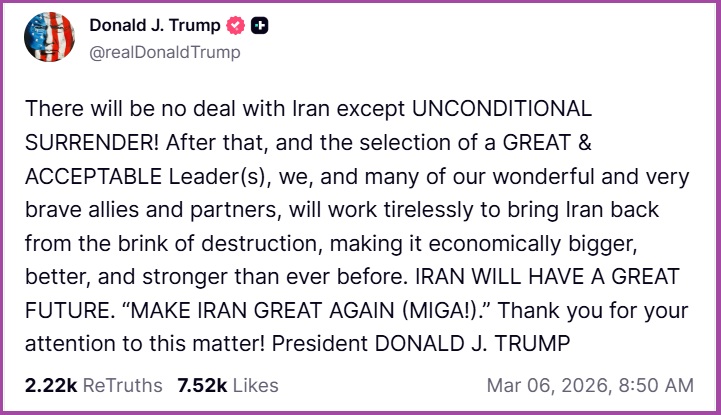
President Trump announced via Truth Social that he will not seek any terms with Iran other than unconditional surrender.

[SOURCE]

Meanwhile, in a somewhat predictable move, Treasury Secretary Scott Bessent has announced the U.S. will lift some sanctions on Russian oil exports in order to mitigate shortfalls.  India will be permitted to purchase additional Russian oil for use in their refineries.  The gasoline end products will then be sold into the market.

BESSENT: “President Trump’s energy agenda has resulted in oil and gas production reaching the highest levels ever recorded.

To enable oil to keep flowing into the global market, the Treasury Department is issuing a temporary 30-day waiver to allow Indian refiners to purchase Russian oil. This deliberately short-term measure will not provide significant financial benefit to the Russian government as it only authorizes transactions involving oil already stranded at sea.

(more…)

China Halts Refiners from Exporting Diesel and Gasoline

An interesting reaction from Beijing highlights an evaluation of risk from the lack of oil flowing from Iran.

According to most evaluated data, China was buying more than 80% of Iran’s shipped oil. That’s according to data from 2025 as analyzed by Kpler and published in January by Reuters.

Iranian oil always had limited buyers due to U.S. sanctions. However, China purchased on average 1.38 million barrels per day of Iranian oil last year, according to Kpler. That represented about 13.4% of the total 10.27 million bpd of oil it imported by sea.

With President Trump previously cutting of discounted oil from Venezuela, two things unfolded.  First, the Venezuela oil was no longer sold with non-petrodollar currencies; Venezuela oil is now being sold on the standard oil market.  Secondly, with the Venezuela oil disrupted China would become even more dependent on Iranian oil shipments if they wanted to retain the discounted rate.

How big is the financial difference?  According to Reuters, “Iranian Light crude has traded at around $8 to $10 a barrel below ICE Brent on a delivered basis to China since December.” … “That means Chinese refiners save about $8 to $10 a barrel if they buy Iranian Light rather than non-sanctioned oil.”

Additionally, as noted before Operation Epic Fury began, “Iran has a record amount of oil on the water, equivalent to around 50 days of output, as China has bought less because of sanctions and Tehran seeks to protect its supplies from the risk of U.S. strikes, Kpler said.”

Buying discounted oil from Venezuela, Iran and Russia resulted in billions of dollars saved by China.  The only production venue not currently disrupted would be purchases from Moscow.  This increases the dependency, but the purchase price may no longer carry any discounted value, at least not at the previous rate.

(more…)

Hemispheric Boss Level: Epic – Venezuela Edition

Sometimes you have to sip coffee slowly, while taking in the landscape.

About a month ago President Donald J Trump bombed Caracas, engaged the U.S. military with a direct firefight against Venezuela military & security forces, then snatched regime dictator Nicholas Maduro out of the country to face criminal charges in the United States.

Yesterday, Maduro’s replacement, President Delcy Rodriquez, stood on the steps to the Venezuela presidential office and publicly thanked Interior Secretary Doug Bergum for the kindness and support of President Donald Trump.

That reality represents a level of hemispheric ‘ultimate boss’ that boggles the mind.  But wait, it gets better. There’s video (prompted):

Before going further to current events, let us remind ourselves of a few details.

Sandwiched between the Venezuela Maduro operation and the recent Operation Epic Fury in Iran, approximately three weeks ago, Gen. Dan Caine, chairman of the Joint Chiefs of Staff, and Defense Secretary Pete Hegseth convened a gathering in Washington of all the defense chiefs and senior military officials from 34 Western Hemisphere countries.

As most of you will remember, securing the national security of the entire Western Hemisphere, was outlined in the national defense strategy document [SEE HERE] released by President Trump. In addition to setting the priorities for the United States focus, the report details the Trump administration perspective on the world as broken down into specific regions.  The report is a brutally honest review of the current state of geopolitical benefits, risks and threats as they pertain to vital U.S. interests. The report outlines a critically renewed focus on the Western Hemisphere.

Now, back to Secretary Bergum’s visit.

(more…)

Importers, Exporters and Producers Trigger Force Majeure Notifications for Gulf LNG Shipments

Force Majeure is a common clause in contracts which essentially frees both parties from liability or obligation when an extraordinary event or circumstance beyond the control of the parties, such as a war, strike, riot, crime, epidemic, or sudden legal change prevents one or both parties from fulfilling their obligations under the contract.

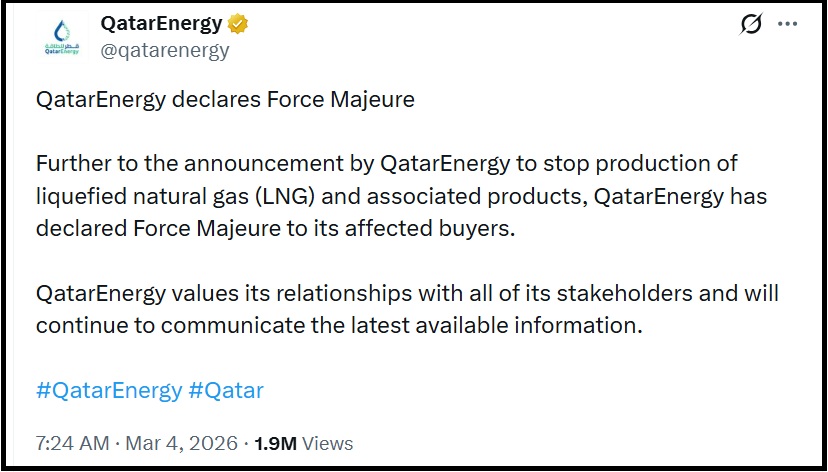
People would be well advised to wait a few days when announcements are made before jumping to immediate conclusions. The announcement by Qatar Energy of a force majeure notification did not originate from Qatar’s inability to produce contractual LNG supplies…..

[SOURCE]

…. two days prior to this announcement, India’s top gas importer Petronet LNG Ltd issued a force majeure notice to Qatar Energy and local buyers because its LNG tanker ships were unable to reach the Ras Laffan load port due to the crisis in the Middle East.  Without ships arriving to take the LNG Qatar Energy cannot keep producing.

Qatar Energy operates 14 liquefied natural gas (LNG) trains with a total annual production capacity of 77 million tonnes {SOURCE}.  If ships don’t reach the terminals, there’s no need for Qatar Energy to keep pumping and liquifying from well heads.  It’s a downstream issue.

Bahrain made the same announcement for their refined aluminum exports {SOURCE}. Indonesian company Chandra Asri made the same announcement for petrochemicals {SOURCE}. Chevron made the same announcement two days ago after Israel shut down the Leviathan natural gas field {SOURCE}.  Thus, we see the ramifications for the entire region around the Iran conflict zone and the downstream destinations (Asia and Europe) for energy products therein.

(more…)

President Trump Announces U.S. Economic Boycott of Spain During Meeting with German Chancellor Friedrich Merz

President Trump holds a bilateral meeting with German Chancellor Friedrich Merz in the Oval Office.  After brief remarks of mutual appreciation, President Trump and Chancellor Merz responded to questions from the assembled press pool.

Chancellor Merz expressed support for the objective of eliminating the regime threat from Iran.  President Trump notes at the beginning how Iran is targeting civilian targets in the region and generating even more support from the Gulf states for the USA.

When asked about the British and Spanish refusal to support U.S. military logistics and deployment, President Trump let the media be aware he is not happy with the position of Spain and the U.K.  President Trump also announced [11:00 of video] an economic embargo of trade with Spain as an outcome of their position.

.

(more…)